Unit 4 · Topic 4.7 · about 30 minutes · 7 parts · 9 scored checks, 2 of them multiple choice, plus 2 from earlier lessons
AP U.S. Government and Politics 4.7: Ideologies of Political Parties
Unit 4: 10 to 15% of the multiple-choice section
What you'll be able to do
- Explain how ideologies of the two major parties shape policy debates.
Key vocabulary
| Term | What it means | The exam trap |
|---|---|---|
| Party platform | A statement of a political party’s policy commitments and priorities. | A platform does not guarantee the vote of every officeholder. |
| Liberal ideology | A perspective generally supporting active government to address unequal access and social or market problems. | Read the policy mechanism rather than treating every intervention as identical. |
| Conservative ideology | A perspective generally favoring a more limited government role and private or traditional arrangements. | A general preference does not establish opposition to every public program. |
| Party coalition | Groups and individuals joining in support of a political party. | Coalition members can disagree on particular policies. |
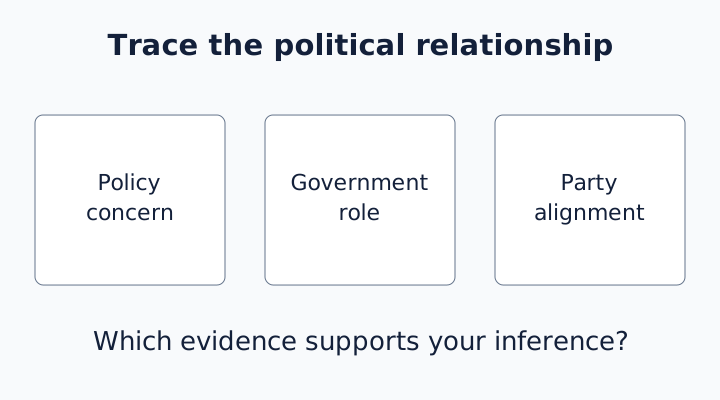 Tap to open the picture full size
Part 1 Think first Predict the institutional consequence
Explain the mechanism linking a general ideological approach to the policy in the scenario.
Predict first
Two parties both say they support opportunity but disagree about federal business rules. What is most useful for explaining the disagreement?
In short. The major parties generally connect Democratic platforms with liberal positions and Republican platforms with conservative positions, shaping competing policy arguments.
- Democratic platforms generally align with liberal positions.
- Republican platforms generally align with conservative positions.
- General alignments do not require uniform member positions.
Part 2 Learn it Platforms organize policy commitments
2a. Platforms organize policy commitments
A party platform states policy commitments and priorities. In contemporary U.S. politics, Democratic platforms generally align more closely with liberal ideological positions, while Republican platforms generally align more closely with conservative positions. These are general alignments, not claims that every member agrees on every issue.
Liberal arguments often favor a more active government role in addressing unequal access or market problems. Conservative arguments often emphasize limited government, private initiative, or traditional arrangements. Explain the particular policy argument rather than assuming a party label alone explains its mechanism. Party coalitions contain voters and officeholders with differing priorities.
For the end-of-lesson concept match, review this section together with the next two sections; the match combines their definitions.
Quick check · Fill the statement
Complete the explanation using the evidence.
Democratic platforms generally align more closely with positions; Republican platforms generally align more closely with positions.
2b. Apply the alignment to a policy debate
In an original fictional debate about consumer credit, one coalition proposes stronger federal disclosure rules to protect borrowers. Another argues that compliance costs restrict lending and favors fewer rules. The first argument is more closely aligned with a liberal case for government intervention; the second with a conservative case for limiting regulation.
The general party alignment helps explain why Democratic and Republican platforms might frame the debate differently. It does not mean a particular officeholder must support a proposal or that party names determine the correct public choice. Identify the concern, the proposed role for government, and the resulting policy difference.
Quick check · Fill the statement
Complete the explanation using the evidence.
Stronger public rules intended to correct market problems express a more government role; removing such rules to reduce compliance costs expresses a more role.
2c. Compare reasoning instead of stereotypes
Two proposals can share a goal while choosing different means. Both sides may claim to improve economic opportunity, yet disagree about whether public rules remove barriers or create them. A strong explanation connects a party’s general ideological position to a concrete policy mechanism.
Do not infer a complete ideology from a single exception. A Republican supporting one public program does not establish that the party’s entire platform is liberal; a Democrat opposing one regulation does not establish that the whole party is conservative. General tendencies describe patterns across priorities. They leave room for disagreement, coalition bargaining, and change over time.
Quick check · Fill the statement
Complete the explanation using the evidence.
One member’s exception to a party’s policy tendency demonstrates internal , rather than necessarily reversing the whole .
Part 3 Watch it done Explain the party-policy connection
Original fictional proposals: Coalition A seeks federal lending disclosures to reduce information disadvantages. Coalition B seeks fewer disclosure mandates to reduce costs for lenders and borrowers.
Step 1 · Identify the evidence
Identify the different proposed government roles.
Step 2 · Connect the mechanism
A uses public rules to address market problems; B relies more on private decisions with fewer mandates.
Why this step?
Why identify the government’s role before naming a party?
The mechanism explains the ideological alignment; a party label alone does not explain how the proposal addresses the problem.
Step 3 · Limit the inference
Connect those mechanisms to general liberal and conservative alignments without assigning every member the same vote.
Your step · Decide and justify
New condition: a coalition keeps its consumer-protection goal but replaces federal disclosure mandates with voluntary industry labels to reduce compliance burdens. How has its means shifted?
Which explanation supports this inference?
A contrasting worked example
Contrasting example: An officeholder breaks with a party’s general approach on one disclosure requirement. The vote reveals a specific disagreement, not proof that platforms have no general ideological pattern.
Part 4 Try it Classify the institutional action
Original teaching situations: distinguish what each institution can do.
Try it · Sort it
Classify each situation by the feature it directly describes.
Closer liberal alignment
Closer conservative alignment
Part 5 Explain it Explain a party’s policy reasoning
Free response is 50% of the exam score. This one is shaped like Question 1, Concept Application.
Free-response practice · Question 1 style
Original concept application: One fictional party coalition proposes federal training grants to expand access. Another proposes reducing business licensing requirements to encourage entry. Explain which proposal is closer to a liberal approach and which to a conservative approach. Connect each approach to its general major-party alignment. Explain why the alignment does not predict every member’s vote.
Model answer
Training grants use public action to expand access, making the argument closer to liberal positions and the Democratic Party’s general platform alignment. Reducing licensing requirements emphasizes fewer government barriers and private entry, making that argument closer to conservative positions and the Republican Party’s general alignment. Party coalitions contain varied priorities, so the pattern does not determine every member’s response.
Score your own answer. This is a self-check, not a grade. Tick each point your answer makes.
Part 6 Check yourself Read the evidence, then test the claim
Original fictional policy proposals. The table records arguments, not an evaluation of which proposal is preferable.
| Proposal | Mechanism |
|---|---|
| A | National disclosure rules reduce borrowers’ information disadvantages. |
| B | Fewer disclosure mandates reduce costs and preserve private choice. |
Case question 1 · Multiple choice
How does Proposal A connect ideology to policy?
Case question 2 · Multiple choice
A Republican officeholder supports A. What inference is warranted?
The rest stand on their own and do not use the case.
Check yourself · Spot the error
Select the statement that makes an institutional error.
Check yourself · Match
Match the concept to its defining feature.
Part 7 Keep it Retrieve and connect
From 1.1 Ideals of Democracy · Fill the statement
Complete the distinction between rights and the source of public power.
Rights people possess apart from government permission are . The principle that public authority comes from the people is .
From 2.1 Congress: The Senate and the House of Representatives · Fill the statement
Apply the representation rule.
The House uses representation, while the Senate gives states representation.
In three lines
- Democratic platforms generally align with liberal positions.
- Republican platforms generally align with conservative positions.
- General alignments do not require uniform member positions.
Exam strategy for this topic
- Section I, Multiple Choice: 55 questions in 80 minutes.
- Section II, Free Response: 4 questions in 100 minutes.
- This lesson's Explain it is shaped like free-response question 1, Concept Application.
Explain the mechanism linking a general ideological approach to the policy in the scenario.
Questions students ask
Is a platform a law?
No. It states party commitments and goals; legislation must pass through governing institutions.
Can party members disagree with a platform?
Yes. Coalitions include people with different priorities and issue positions.
Can both parties invoke the same value?
Yes. They can share a stated goal such as opportunity while differing about government’s role in achieving it.
Does a general alignment predict every vote?
No. A tendency across positions does not establish a deterministic rule for each person or issue.
Course alignment, for teachers
AP U.S. Government and Politics topic 4.7, Unit 4: American Political Ideologies and Beliefs.
- Skill 1.E: Explain how political principles, institutions, processes, policies, and behaviors apply to different scenarios in context.
This lesson maps the one essential knowledge statement of the topic to the part that teaches each one: 1 is checked by a scored question. The map is in the lesson file.