Unit 5 · Topic 5.13 · about 30 minutes · 7 parts · 9 scored checks, 2 of them multiple choice, plus 2 from earlier lessons
AP U.S. Government and Politics 5.13: Changing Media
Unit 5: 20 to 27% of the multiple-choice section
What you'll be able to do
- Explain how increasingly diverse choices of media and communication outlets influence political institutions and behavior.
Key vocabulary
| Term | What it means | The exam trap |
|---|---|---|
| Selective exposure | Choosing information sources consistent with existing preferences. | Available diversity differs from the diversity actually encountered. |
| Partisan outlet | A media source with a recognizable party-oriented perspective. | Perspective and factual accuracy must be evaluated separately. |
| Media ownership | The control of media organizations by owners or parent organizations. | Ownership can shape incentives without deciding every factual claim. |
| Credibility | The degree to which evidence supports trusting a source or claim. | Popularity and legal protection do not certify accuracy. |
| Prior restraint | Government suppression of expression before publication. | Evaluate the timing and government action rather than any criticism of an outlet. |
| Ideological reinforcement | Repeated exposure that strengthens existing political beliefs. | Repetition is not independent verification. |
 Tap to open the picture full size
Part 1 Think first Investigate a political mechanism
Explain a mechanism using specific evidence. A label by itself does not establish how an outcome follows.
Predict first
A reader finds a meeting through a partisan feed, then sees the same viewpoint repeatedly. What outcomes would you examine separately?
In short. Diverse media choices shape participation and political knowledge, while press freedom and credibility require distinct analysis.
- Trace content to participation and knowledge.
- Evaluate claims through evidence.
- Distinguish prior restraint from credibility.
Part 2 Learn it More choices can broaden participation
2a. More choices can broaden participation
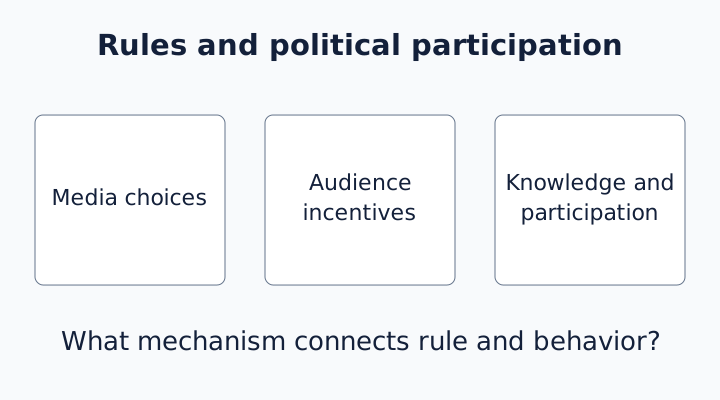
Political coverage, analysis, and commentary can inform citizens, introduce participation opportunities, or motivate people to act. Digital outlets and sharing tools make more perspectives available and can connect people around a public concern. More access does not guarantee better knowledge: a person may encounter varied evidence or repeatedly choose sources that reinforce existing views.
Consider an original fictional reader who follows only one partisan commentary feed, then finds a public meeting through it. The source has encouraged participation, while the narrow information diet may limit exposure to competing evidence. Both effects can coexist. Explain the route from content to behavior and identify what remains unknown. A count of available outlets does not measure how many perspectives a person actually reads or whether the claims are accurate.
Quick check · Fill the statement
Complete the explanation using the evidence.
A feed can encourage political while exposing a reader to a limited range of .
2b. Audience demand and ownership shape incentives
An ideologically diverse audience creates demand for different political content. Partisan news sites and ideologically oriented programming may attract people who want interpretations consistent with their beliefs. Consumer-driven outlets have incentives to retain that audience. Ownership can affect resources and editorial priorities, raising debates over concentrated control and bias.
Identify a source’s evidence and framing rather than treating an owner’s identity as conclusive proof that every report is false. Likewise, a professional appearance or popularity does not establish accuracy. Distinguish reporting from commentary, check the original evidence, compare independent accounts, and correct claims when new evidence warrants it. These practices improve evaluation without requiring students to disclose their own political affiliations or media habits. The lesson’s examples are fictional rather than surveys of students.
Selective exposure means choosing sources consistent with existing preferences. It helps explain how an ideologically diverse media supply can coexist with a narrow individual information diet.
Quick check · Fill the statement
Complete the explanation using the evidence.
A partisan outlet may respond to audience ; concentrated control raises questions about media .
2c. Freedom to publish is not certification of truth
In New York Times Co. v. United States (1971), the federal government sought to stop newspapers from publishing classified material from the Pentagon Papers. The Court’s per curiam decision held that the government had not met the heavy burden required to justify prior restraint. The relevant principle is protection against government suppression before publication, not a judicial guarantee that every newspaper claim is correct. The justices wrote separate opinions with different reasoning; do not attribute one concurrence’s broader claims to a single majority rationale.
Apply that distinction to changing media: freedom to publish allows competing coverage and criticism, while citizens still evaluate credibility. More choices, ideologically oriented programming, and technologies that reinforce existing beliefs can shape democratic debate and knowledge. A government complaint that an outlet is biased does not by itself establish the demanding basis for prior restraint. Legal freedom and evidentiary reliability answer different questions. New York Times Co. v. United States, 403 U.S. 713-714, per curiam.
Quick check · Fill the statement
Complete the explanation using the evidence.
New York Times concerns government before publication; a source’s factual reliability is a separate question.
Part 3 Watch it done Apply the case without overstating it
Original fictional scenario: a government official calls an online outlet biased and seeks an order stopping publication. Readers disagree about the outlet’s evidence.
Step 1 · Identify the required case
New York Times involved an attempted government restraint before publication of the Pentagon Papers.
Why this step?
Why does disagreement about accuracy not settle the constitutional issue?
The case addresses the government’s heavy burden for prior restraint, not a general court certification of truth.
Step 2 · Keep two questions open
Readers can investigate credibility while the court separately evaluates whether the government has justified suppression.
Your step · Decide and justify
A private reader rejects a story after checking original records. Is that the government prior restraint addressed in New York Times?
Which reason supports this new inference?
A contrasting worked example
Contrast: A reader rejects an unsupported story after comparing original records. Step 1: identify private source evaluation rather than a government publishing ban. Step 2: explain credibility. Step 3: distinguish that behavior from the prior restraint challenged in New York Times.
Part 4 Try it Classify the institutional action
Original teaching situations: distinguish what each institution can do.
Try it · Sort it
Sort each example by its defining feature.
Publication freedom
Evidence or audience behavior
Required case primary-source paraphrase: New York Times Co. v. United States, per curiam, 403 U.S. 713-714 (1971). The government sought to restrain newspaper publication of Pentagon Papers material. The Court held the government had not met its heavy burden for prior restraint. Read the per curiam decision separately from concurrences.
Part 5 Explain it Connect a required case to changing media
Free response is 50% of the exam score. This one is shaped like Question 1, Concept Application.
Free-response practice · Question 1 style
Original concept-application practice: An official seeks to stop an online news outlet from publishing because the official calls it partisan. A reader independently checks the outlet’s claims against original records. Explain how New York Times Co. v. United States relates to the official’s action. Then distinguish the reader’s conduct and explain how audience choice or recommendation technology can affect democratic debate.
Model answer
The official seeks prior restraint, connecting the situation to New York Times and the government’s heavy burden to justify suppressing publication. Calling an outlet partisan does not by itself meet that burden. The reader is evaluating credibility rather than imposing government restraint. Audience selection and recommendation systems can repeatedly expose people to aligned views, reinforcing beliefs and narrowing debate even while many outlets are available. Neither publication freedom nor popularity guarantees accurate political knowledge.
Score your own answer. This is a self-check, not a grade. Tick each point your answer makes.
Part 6 Check yourself Freedom and information quality
Original fictional media situations, used to apply a required case and analyze behavior.
| Situation | Mechanism |
|---|---|
| Official seeks prepublication injunction | Government restraint |
| Feed recommends increasingly similar commentary | Reinforcement of existing beliefs |
| Reader compares underlying records | Credibility evaluation |
Case question 1 · Multiple choice
How does New York Times relate to the first row?
Case question 2 · Multiple choice
What can the second row help explain?
The rest stand on their own and do not use the case.
Check yourself · Spot the error
Select the statement that makes an institutional error.
Check yourself · Match
Match each concept to its defining feature.
Part 7 Keep it Retrieve and connect
From 1.6 Principles of American Government · Fill the statement
Apply the distinction in the completed statement.
In an attributed paraphrase of Federalist No. 51, one branch’s institutional interest can restrain another through , limiting the concentration of power and possible abuse.
From 5.11 Campaign Finance · Fill the statement
Complete the explanation using the evidence.
Citizens United protected corporate political spending while upholding challenged requirements.
In three lines
- Trace content to participation and knowledge.
- Evaluate claims through evidence.
- Distinguish prior restraint from credibility.
Exam strategy for this topic
- Section I, Multiple Choice: 55 questions in 80 minutes.
- Section II, Free Response: 4 questions in 100 minutes.
- This lesson's Explain it is shaped like free-response question 1, Concept Application.
Explain a mechanism using specific evidence. A label by itself does not establish how an outcome follows.
Questions students ask
Does press freedom guarantee accuracy?
No. It concerns government restrictions; readers still examine evidence and corrections.
Do more outlets guarantee more varied exposure?
No. People may repeatedly select aligned perspectives, and recommendation systems may reinforce those choices.
Does partisan identity prove a claim false?
No. Evaluate the evidence for the specific claim while recognizing framing and audience incentives.
What did New York Times hold?
The government had not met the heavy burden for prior restraint in the Pentagon Papers litigation. Separate concurrences offered differing broader rationales.
Course alignment, for teachers
AP U.S. Government and Politics topic 5.13, Unit 5: Political Participation.
- Skill 2.D: Explain how a required Supreme Court case relates to a relevant political principle, institution, process, policy, or behavior.
This lesson maps all 3 essential knowledge statements of the topic to the part that teaches each one: 3 are checked by a scored question. The map is in the lesson file.