Unit 1 · Topic 1.3 · about 30 minutes · 7 parts · 12 scored checks, 2 of them multiple choice, plus 2 from earlier lessons
AP Chemistry 1.3: Elemental Composition of Pure Substances
Unit 1: 7 to 9% of the multiple-choice section
What you'll be able to do
- Explain how the masses of the elements in a pure substance relate to its empirical formula, the lowest whole-number ratio of its atoms.
Key vocabulary
| Term | What it means | The exam trap |
|---|---|---|
| Molecule | A separate particle made of a fixed group of atoms bonded together, the same in every particle of a pure molecular substance. | A formula alone does not say whether a substance is made of molecules, so picture the particles before you call one a molecule. |
| Formula unit | The fixed ratio of atoms or ions in a substance that forms one large structure instead of separate particles. | Questions can ask what kind of particles a formula describes, so look at how the particles are arranged, not only at the formula. |
| Law of definite proportions | The ratio of the masses of the elements in any pure sample of a compound is always the same. | The law is about one pure compound, so check that the samples you compare really are the same compound before you apply it. |
| Mass percent | The mass of one element in a sample divided by the mass of the whole sample, times 100. | Decide what the whole is before you divide, since dividing by the wrong mass gives a percent that looks reasonable but is wrong. |
| Empirical formula | The chemical formula that lists the lowest whole-number ratio of the atoms of the elements in a compound. | Read whether a question asks for the empirical formula or the formula of a molecule, because the two can be different. |
 Tap to open the picture full size
Part 1 Think first The sugar in a sports drink
Commit to a guess first. Being wrong now makes the right idea stick better.
Predict first
The sugar in many sports drinks is glucose, C₆H₁₂O₆. Each glucose molecule has six carbon atoms and six oxygen atoms. In a spoonful of pure glucose, how does the mass of the carbon compare with the mass of the oxygen?
In short. Every pure sample of a compound has the same ratio of its elements by mass, and turning those masses into moles gives its empirical formula, the lowest whole-number ratio of its atoms.
- Some pure substances are made of separate molecules; others are atoms or ions held together in fixed proportions, described by a formula unit.
- By the law of definite proportions, the mass ratio of the elements in a compound is the same in any pure sample, whatever its size or source.
- To find an empirical formula, convert each element's mass to moles, divide by the smallest, and scale to whole numbers.
Part 2 Learn it From masses to a formula
2a. Molecules and formula units
A pure substance has a fixed makeup. Pure substances that are compounds are built in one of two ways.
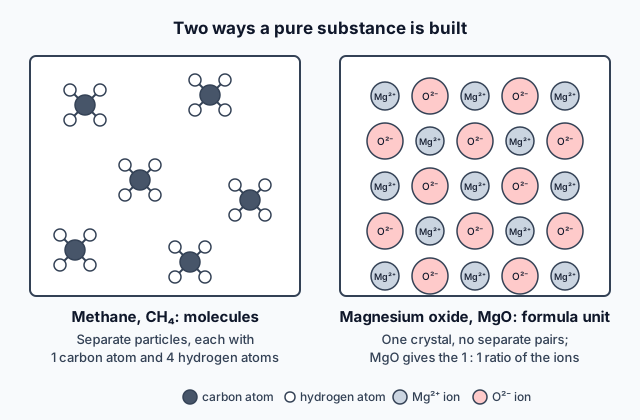
- Some are made of molecules: separate particles, each a small group of bonded atoms that is the same in every particle. Methane, CH₄, is a gas of separate molecules, each one carbon atom bonded to four hydrogen atoms. Its formula counts the atoms in one molecule.
- Others have no separate particles at all. The atoms or ions are held together in one large structure, in fixed proportions. Magnesium oxide is a crystal of Mg²⁺ and O²⁻ ions, with one O²⁻ for every Mg²⁺ and no separate MgO pairs. Its formula, MgO, describes a formula unit: the ratio of the particles in the structure, not one particle you could pick out.
The diagram above shows both. A formula looks the same either way, so ask what the particles are doing: separate groups, or one connected structure. Either kind of pure substance has the same makeup in every sample, and the rest of this lesson uses that.
Quick check · Sort it
Each card describes the particles in a pure substance. Tap a card, then the bin that describes how the substance is built.
Separate molecules
Fixed proportions in one structure (formula unit)
2b. The law of definite proportions
Because every particle or formula unit of a compound has the same makeup, every pure sample of it has the same ratio of its elements by mass. That is the law of definite proportions: the ratio of the masses of the elements in any pure sample of a compound is always the same.
One way to state the ratio is the mass percent of each element: its mass divided by the mass of the whole sample, times 100. You can find it from the formula. Water's molar mass is 2(1.008) + 16.00 = 18.016 g/mol, and 2.016 g of that is hydrogen, so water is 2.016/18.016 = 11.19% hydrogen by mass. A drop of distilled water and a whole bottle of it are both 11.19% hydrogen.
The law also works in the other direction. If a 4.00 g sample of a pure compound holds 1.00 g of one element, then any pure sample of that compound is one fourth that element by mass: a 10.0 g sample holds 2.50 g of it. Sample size changes the grams of each element, never their ratio.
Quick check · Calculate
A 5.00 g sample of pure calcium carbonate contains 2.00 g of calcium. A 12.5 g sample of pure calcium carbonate from a different supplier is analyzed. How many grams of calcium does it contain? Give your answer to three significant figures.
2c. The empirical formula
The empirical formula of a compound lists the lowest whole-number ratio of the atoms of its elements.
A formula unit, such as MgO or NaCl, is already written that way, so it is the empirical formula. A molecule's formula counts every atom in one molecule, so it can be a whole-number multiple of the empirical formula. Find the empirical formula by dividing every subscript by the largest number that divides all of them:
- Ethylene, C₂H₄: divide by 2 to get CH₂.
- Benzene, C₆H₆: divide by 6 to get CH.
- Acetylene, C₂H₂: divide by 2 to get CH as well.
Benzene and acetylene are different molecules with the same empirical formula, and so the same mass percent of carbon. That is why mass data alone give the empirical formula, not the molecule: it fixes the ratio of the atoms but not how many are in each particle. When the subscripts share no common factor, as in H₂O or CO₂, the formula is already empirical.
Quick check · Match
Match each molecular formula to its empirical formula.
2d. From masses to an empirical formula
A formula counts atoms, and atoms of different elements have different masses, so a mass ratio is not an atom ratio. To get from masses to an empirical formula:
- Find the mass of each element in the sample. If you are given mass percents, assume a 100.0 g sample, so the percents become grams.
- Convert each mass to moles with the element's molar mass.
- Divide every mole amount by the smallest one.
- If a result is not close to a whole number, multiply all of them by the smallest whole number that makes them whole.
Example: a 2.000 g sample of a compound of phosphorus and oxygen contains 0.8728 g of phosphorus, so it holds 2.000 − 0.8728 = 1.127 g of oxygen. That is 0.8728/30.97 = 0.02818 mol P and 1.127/16.00 = 0.07044 mol O. Dividing by 0.02818 gives P 1.000 and O 2.499. A ratio of about 2.5 is halfway between two whole numbers, not a rounding error, so multiply both by 2: P 2, O 5. The empirical formula is P₂O₅. Only round a result that is already within a few hundredths of a whole number.
Quick check · Decide and justify
A student finds that a compound of carbon and hydrogen has 1.000 mol of carbon for every 1.333 mol of hydrogen. What is its empirical formula?
Which reason supports your decision?
Part 3 Watch it done A brown gas from its mass percents
Predict first, then watch each step, then finish the calculation yourself.
An analysis shows that a pure brown gas is 30.45% nitrogen and 69.55% oxygen by mass. The molar masses are N 14.01 g/mol and O 16.00 g/mol. What is its empirical formula?
Predict first
Before you open the first step, predict: since the gas is about 30% nitrogen and 70% oxygen by mass, are its atoms also about 3 nitrogen for every 7 oxygen?
Step 1 · Turn the percents into grams
Assume a 100.0 g sample. It contains 30.45 g of nitrogen and 69.55 g of oxygen.
Step 2 · Convert each mass to moles
N: 30.45 g ÷ 14.01 g/mol = 2.1734 mol. O: 69.55 g ÷ 16.00 g/mol = 4.3469 mol. Keep the unrounded values for the next step.
Why this step?
Why convert to moles before comparing the elements?
A formula counts atoms, and moles count atoms. An oxygen atom and a nitrogen atom have different masses, so a ratio of grams is not a ratio of atoms.
Step 3 · Divide by the smaller amount
Nitrogen has the smaller amount, 2.1734 mol, so divide both by it. Nitrogen becomes 2.1734 ÷ 2.1734 = 1.000.
Your step · Calculate
Finish it. A pure gas contains 2.1734 mol of nitrogen and 4.3469 mol of oxygen. How many moles of oxygen are there for each mole of nitrogen? Give your answer to three significant figures.
mol O per mol N
The empirical formula is NO₂. The mass ratio was about 30 : 70, but the atom ratio is 1 : 2, because an oxygen atom is heavier than a nitrogen atom. Mass data stop at the empirical formula: dinitrogen tetroxide, N₂O₄, has exactly the same mass percents, so this analysis alone cannot tell the two apart.
Part 4 Try it An iron oxide in a crucible
A student heats 2.792 g of pure iron in a crucible until it has fully reacted with oxygen from the air. The product, a pure oxide of iron, has a mass of 3.992 g. The molar masses are Fe 55.85 g/mol and O 16.00 g/mol. These numbers are a teaching example.
Try it · Calculate
A pure oxide of iron with a mass of 3.992 g was made from 2.792 g of iron, so the rest of its mass is oxygen. How many moles of oxygen does the oxide contain for each mole of iron? Molar masses: Fe 55.85 g/mol, O 16.00 g/mol. Give your answer to three significant figures.
Try it · Multiple choice
A 2.288 g sample of a pure oxide of manganese contains 1.648 g of manganese, and the rest is oxygen. The molar masses are Mn 54.94 g/mol and O 16.00 g/mol. What is the empirical formula of the oxide?
Part 5 Explain it Burning magnesium
On the exam this is handwritten, so answer on paper first. Nothing you type here leaves this page. Then check your answer against the model and each scoring point.
Free response is 50% of the exam score. This one is shaped like a short-answer question, which is worth 4 points.
Free-response practice · Short-answer style
A student heats 0.486 g of magnesium ribbon in a crucible until it has reacted completely with oxygen. The product is pure magnesium oxide with a mass of 0.806 g. The molar masses are Mg 24.31 g/mol and O 16.00 g/mol.
(a) Calculate the mass of oxygen that combined with the magnesium.
(b) Determine the empirical formula of magnesium oxide from these data. Show how you found the mole ratio.
(c) A second student reacts 1.000 g of magnesium completely to make pure magnesium oxide. Predict the mass of magnesium oxide the second student makes, and say which law the prediction uses.
(d) Identify a testable scientific question about the law in part (c) that the students could answer with this same setup.
Model answer
(a) The oxygen's mass is 0.806 g − 0.486 g = 0.320 g.
(b) Magnesium: 0.486 g ÷ 24.31 g/mol = 0.01999 mol. Oxygen: 0.320 g ÷ 16.00 g/mol = 0.0200 mol. The ratio is 0.0200/0.01999 = 1.00 mol O per mol Mg, so the empirical formula is MgO.
(c) Magnesium is 0.486/0.806 = 0.603 of the oxide's mass. By the law of definite proportions, every pure sample of magnesium oxide has that same fraction, so 1.000 g of magnesium makes 1.000 g ÷ 0.603 = 1.66 g of magnesium oxide.
(d) Does burning different starting masses of magnesium always give an oxide with the same ratio of magnesium to oxygen by mass? The students can test it by burning several different masses of magnesium and comparing the mass ratios of their products.
Score your own answer. This is a self-check, not a grade. Tick each point your answer makes.
Part 6 Check yourself Three samples of copper and sulfur
All three case questions use the table.
A lab analyzes three pure samples, A, B and C. Each one contains only copper and sulfur. The table gives the mass of each sample and the mass of copper in it. These numbers are a teaching example.
| Sample | Mass of sample (g) | Mass of copper (g) |
|---|---|---|
| A | 2.000 | 1.329 |
| B | 5.000 | 3.323 |
| C | 3.000 | 2.396 |
Case question 1 · Calculate
Using the table: a fourth sample is the same pure compound as sample A and has a mass of 8.000 g. How many grams of copper does it contain? Give your answer to three significant figures.
Case question 2 · Multiple choice
Using the table: which of these questions can the data in the table answer?
Case question 3 · Calculate
Using the table: how many moles of copper does sample C contain for each mole of sulfur? Molar masses: Cu 63.55 g/mol, S 32.06 g/mol. Give your answer to three significant figures.
The rest stand on their own and do not use the case.
Check yourself · Spot the error
A compound is 52.14% carbon, 13.13% hydrogen and 34.73% oxygen by mass. The molar masses are C 12.01 g/mol, H 1.008 g/mol and O 16.00 g/mol. A student works out its empirical formula. Tap the line with the mistake.
Check yourself · Fill the statement
Complete the description of solid calcium chloride.
Solid calcium chloride is a crystal of Ca²⁺ and Cl⁻ ions with no separate CaCl₂ particles in it. So CaCl₂ describes a , not a , and it says the crystal holds chloride ions for every calcium ion.
Part 7 Keep it Bring back earlier ideas
This lesson leans on two earlier ideas: how a mass in grams becomes an amount in moles through the molar mass, and why each element's atomic mass is an average over its isotopes. Pulling them back up is what makes them last.
From 1.2 Mass Spectra of Elements · Calculate
Lithium, the metal in lithium-ion batteries, has two isotopes: lithium-6, of mass 6.015 amu and abundance 7.59%, and lithium-7, of mass 7.016 amu and abundance 92.41%. What is lithium's average atomic mass, in amu? Give your answer to four significant figures.
A jeweler sells a small bar of pure gold with a mass of 5.00 g. The molar mass of gold is 196.97 g/mol. These numbers are a teaching example.
From 1.1 Moles and Molar Mass · Calculate
How many gold atoms are in the 5.00 g bar? The molar mass of gold is 196.97 g/mol. Give your answer to three significant figures, typed in e-notation (6.022 × 10²³ is typed 6.022e23).
In three lines
- Some pure substances are separate molecules; others are atoms or ions in fixed proportions, described by a formula unit.
- By the law of definite proportions, any pure sample of a compound has the same ratio of its elements by mass.
- An empirical formula is the lowest whole-number ratio of atoms: convert masses to moles, divide by the smallest, and scale to whole numbers.
Exam strategy for this topic
- Section I, Multiple Choice: 60 questions in 90 minutes.
- Section II, Free Response: 7 questions in 105 minutes.
- A scientific or graphing calculator is recommended for use on both sections of the exam.
When you find an empirical formula, write every mass with its unit, convert each one to moles with the molar mass of the single atom, and show the division by the smallest amount. Keep unrounded values until the last step, and say why you multiplied if a ratio was not close to a whole number.
Questions students ask
What is the law of definite proportions?
It says that the ratio of the masses of the elements in any pure sample of a compound is always the same, whatever the size of the sample or where it came from.
What is an empirical formula?
It is the chemical formula that gives the lowest whole-number ratio of the atoms of the elements in a compound. CH₂O is the empirical formula of glucose, C₆H₁₂O₆.
How do you find an empirical formula from mass percents?
Assume a 100.0 g sample so each percent becomes grams, convert each mass to moles, divide every amount by the smallest, and multiply by a small whole number if any result is not close to a whole number.
What is the difference between a molecule and a formula unit?
A molecule is a separate particle with a fixed group of atoms. A formula unit gives the fixed ratio of atoms or ions in a substance that forms one large structure with no separate particles, such as sodium chloride.
Can two different compounds have the same empirical formula?
Yes. Benzene, C₆H₆, and acetylene, C₂H₂, both have the empirical formula CH, so they also have the same mass percent of each element.
Course alignment, for teachers
AP Chemistry topic 1.3, Unit 1: Atomic Structure and Properties.
- Skill 2.A: Identify a testable scientific question based on an observation, data, or a model.
This lesson maps all 3 essential knowledge statements of the topic to the part that teaches each one: 3 are checked by a scored question. The map is in the lesson file.