Unit 1 · Topic 1.4 · about 30 minutes · 7 parts · 11 scored checks, 1 of them multiple choice, plus 2 from earlier lessons
AP Chemistry 1.4: Composition of Mixtures
Unit 1: 7 to 9% of the multiple-choice section
What you'll be able to do
- Explain how the masses of the elements in a mixture relate to how much of each substance the mixture contains.
Key vocabulary
| Term | What it means | The exam trap |
|---|---|---|
| Pure substance | Matter that contains atoms, molecules or formula units of a single type. | Everyday labels such as "pure" or "natural" do not follow the chemistry meaning, so judge a sample by its particles, not its label. |
| Mixture | Matter that contains atoms, molecules or formula units of two or more types. | Looking the same all the way through does not make a sample pure, so judge it by its particles. |
| Elemental analysis | Measuring the mass of each element in a sample, which can show the relative numbers of atoms in it and how pure it is. | The measured masses belong to the whole sample, so keep track of what the sample contains before you calculate. |
| Percent purity | The mass of the wanted substance in a sample divided by the mass of the whole sample, times 100. | Questions give the mass of an element and ask about a compound, so be sure which of the two each number describes. |
 Tap to open the picture full size
Part 1 Think first Table salt and sea salt
Commit to a guess first. Being wrong now makes the right idea stick better.
Predict first
A lab analyzes a sample of pure sodium chloride and a sample sold as sea salt. Chlorine is 60.7% of the mass of the sodium chloride, but only 56.2% of the mass of the sea salt. These numbers are a teaching example. What best explains the difference?
In short. A mixture contains two or more types of particles in proportions that can vary, so its elemental composition by mass depends on how much of each substance it holds, and measuring an element's mass reveals that makeup.
- A pure substance has particles of a single type; a mixture has two or more types, and their proportions can change from sample to sample.
- The mass percent of an element in a mixture depends on how much of each substance is in it and on each substance's own mass percent.
- When only the wanted compound contains an element, that element's mass gives the mass of the compound, and so the sample's percent purity.
Part 2 Learn it What is in a mixture
2a. Pure substances and mixtures
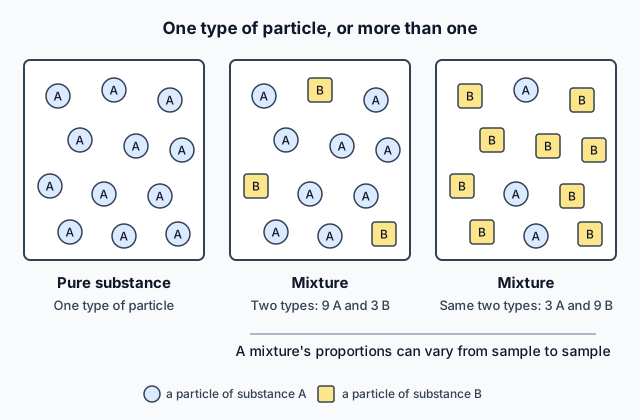
Look at the particles. A pure substance contains atoms, molecules or formula units of a single type. Pure water is only H₂O molecules; a pure sample of neon is only neon atoms. A pure substance can contain several elements, as water does, as long as every particle is the same.
A mixture contains atoms, molecules or formula units of two or more types, and their relative proportions can vary. Stir a spoonful of salt into a glass of water or a cupful: both are salt and water, in different proportions.
That difference is what matters for mass data. By the law of definite proportions, a pure compound always has the same mass percent of each element. A mixture has no fixed percent: change how much of each substance it holds and the mass percent of each element changes too. The diagram above shows two mixtures of the same two substances in different proportions.
Quick check · Sort it
Each card describes the particles in a sample. Tap a card, then its bin.
Pure substance
Mixture
2b. Elemental composition of a mixture
Each substance in a mixture brings its own mass of each element. To find an element's mass percent in a mixture, add its mass from every substance, then divide by the mass of the whole mixture.
Example: a mixture holds 6.00 g of sodium chloride, NaCl, and 4.00 g of potassium chloride, KCl. From the molar masses, NaCl is 35.45/58.44 = 60.66% chlorine and KCl is 35.45/74.55 = 47.55% chlorine.
- Chlorine from NaCl: (6.00 g)(0.6066) = 3.640 g
- Chlorine from KCl: (4.00 g)(0.4755) = 1.902 g
- Mass percent of chlorine: (3.640 g + 1.902 g)/(10.00 g) × 100 = 55.4%
The answer lies between the two pure values, nearer to the one there is more of, so a different mix gives a different answer.
Elemental analysis can count atoms too: divide each element's mass by its molar mass. Pure KCl has exactly one mole of chlorine per mole of potassium, so a measured ratio that is not 1 : 1 shows the sample holds something else. A 1 : 1 ratio does not prove purity, though: an impurity with neither element leaves it unchanged.
Quick check · Calculate
A mixture contains 3.00 g of sodium chloride, NaCl, and 1.00 g of potassium chloride, KCl. NaCl is 60.66% chlorine by mass and KCl is 47.55% chlorine by mass. What is the mass percent of chlorine in the mixture? Give your answer to three significant figures.
2c. How pure is a sample?
A sample of a compound often contains an impurity, which makes it a mixture. Elemental analysis can measure how pure it is. The percent purity is the mass of the wanted compound divided by the mass of the whole sample, times 100.
The method works when the impurity contains none of the element you measure. Then every gram of that element came from the compound, and the compound's fixed mass fraction turns the element's mass into the compound's mass.
Example: a 5.000 g piece of limestone is calcium carbonate, CaCO₃, plus rock that contains no calcium. Analysis finds 1.800 g of calcium.
- CaCO₃'s molar mass is 40.08 + 12.01 + 3(16.00) = 100.09 g/mol, so calcium is 40.08/100.09 = 0.40044 of its mass. Keep that unrounded value for the next step.
- Mass of CaCO₃ = (1.800 g)/(0.40044) = 4.495 g. Divide, because the compound is heavier than the calcium in it.
- Percent purity = (4.495 g)/(5.000 g) × 100 = 89.9%.
Notice that calcium is only 36.0% of the limestone's mass, yet the limestone is 89.9% CaCO₃. The percent of an element and the percent purity are different numbers.
Quick check · Rank it
Three samples are calcium carbonate mixed with impurities that contain no calcium. Sample A has a mass of 2.000 g and contains 0.760 g of calcium. Sample B has a mass of 1.500 g and contains 0.590 g of calcium. Sample C has a mass of 3.000 g and contains 1.080 g of calcium. Rank the samples by percent purity.
Purest first
Give each one a place, 1 for first. Give two the same place if they are equal.
Your ranking: none yet
Part 3 Watch it done How much ore is iron oxide?
Predict first, then watch each step, then finish the calculation yourself.
A 5.000 g sample of iron ore is iron(III) oxide, Fe₂O₃, mixed with rock that contains no iron. Elemental analysis finds 2.450 g of iron in the sample. The molar masses are Fe 55.85 g/mol and O 16.00 g/mol. What is the percent purity of the ore, the percent of its mass that is Fe₂O₃?
Predict first
Before you open the first step, predict: is the ore's percent purity higher than, lower than, or equal to the percent of its mass that is iron?
Step 1 · Find iron's mass fraction in Fe₂O₃
Molar mass of Fe₂O₃ = 2(55.85) + 3(16.00) = 159.70 g/mol, and 2(55.85) = 111.70 g of that is iron. So iron is 111.70/159.70 = 0.69944 of the mass of Fe₂O₃. Keep all the digits for the next step.
Why this step?
Why can the iron's mass tell us how much Fe₂O₃ there is?
The rock contains no iron, so every gram of iron came from the Fe₂O₃. By the law of definite proportions, iron is always the same fraction of Fe₂O₃'s mass, so the iron's mass fixes the compound's mass.
Step 2 · Find the mass of Fe₂O₃
Mass of Fe₂O₃ = (2.450 g)/(0.69944) = 3.503 g. Divide, because the compound weighs more than the iron inside it.
Your step · Calculate
Finish it. A 5.000 g sample of ore contains 2.450 g of iron, all of it in 3.503 g of Fe₂O₃. What is the percent purity of the ore, the percent of its mass that is Fe₂O₃? Give your answer to three significant figures.
%
The ore is 70.1% Fe₂O₃ but only 49.0% iron. When the impurity contains none of that element, the purity is always larger than the percent of the element in the sample, because the compound also includes its other elements, here the oxygen.
Part 4 Try it Is the potassium chloride pure?
A supplier sells potassium chloride, KCl, as pure. A student analyzes a 4.000 g sample and finds 1.852 g of chlorine in it. Pure KCl is 47.55% chlorine by mass. Assume the analysis is accurate. These numbers are a teaching example.
Try it · Calculate
A 4.000 g sample sold as potassium chloride contains 1.852 g of chlorine. What is the mass percent of chlorine in the sample? Give your answer to four significant figures.
Try it · Decide and justify
A 4.000 g sample sold as potassium chloride contains 1.852 g of chlorine, and the analysis is accurate. Pure KCl is 47.55% chlorine by mass. Could this sample be pure KCl?
Which piece of evidence supports your decision?
Part 5 Explain it Salt with sand in it
On the exam this is handwritten, so answer on paper first. Nothing you type here leaves this page. Then check your answer against the model and each scoring point.
Free response is 50% of the exam score. This one is shaped like a short-answer question, which is worth 4 points.
Free-response practice · Short-answer style
A student's sample of sodium chloride, NaCl, is contaminated with sand, which contains no chlorine. Analysis of a 2.000 g sample finds 1.150 g of chlorine. The molar masses are Na 22.99 g/mol and Cl 35.45 g/mol.
(a) Describe, in terms of particles, how the contaminated sample differs from pure sodium chloride.
(b) Calculate the mass of sodium chloride in the sample.
(c) Calculate the percent purity of the sample.
(d) Suppose the contaminant had been potassium chloride, KCl, instead of sand. Explain whether the method in parts (b) and (c) would then give a percent purity that is too high or too low.
Model answer
(a) Pure sodium chloride contains formula units of only one type, NaCl. The contaminated sample is a mixture: it contains NaCl and also the particles of the sand, and the proportion of sand could be different in another sample.
(b) Chlorine is 35.45/58.44 = 0.6066 of the mass of NaCl. All the chlorine came from the NaCl, so the mass of NaCl is (1.150 g)/(0.6066) = 1.896 g.
(c) Percent purity = (1.896 g)/(2.000 g) × 100 = 94.8%.
(d) Too high. KCl also contains chlorine, so some of the measured chlorine would come from the KCl. The method assigns all of the chlorine to NaCl, so it would calculate more NaCl than the sample really contains.
Score your own answer. This is a self-check, not a grade. Tick each point your answer makes.
Part 6 Check yourself Three samples sold as potassium chloride
All three case questions use the table.
A lab tests three samples, P, Q and R, each sold as potassium chloride, KCl. For each one it measures the mass of the sample and the masses of potassium and chlorine in it. Every measurement is accurate. These numbers are a teaching example.
| Sample | Mass of sample (g) | Mass of potassium (g) | Mass of chlorine (g) |
|---|---|---|---|
| P | 2.000 | 1.049 | 0.9510 |
| Q | 2.500 | 1.246 | 1.129 |
| R | 3.000 | 1.416 | 1.466 |
Case question 1 · Calculate
Using the table: sample Q's impurity contains neither potassium nor chlorine. What is the percent purity of sample Q, the percent of its mass that is KCl? Molar masses: K 39.10 g/mol, Cl 35.45 g/mol. Give your answer to three significant figures.
Case question 2 · Multiple choice
Using the table: which conclusion about sample R do the data support? Molar masses: K 39.10 g/mol, Cl 35.45 g/mol.
Case question 3 · Calculate
Using the table: how many moles of chlorine does sample R contain for each mole of potassium? Molar masses: K 39.10 g/mol, Cl 35.45 g/mol. Give your answer to three significant figures.
The rest stand on their own and do not use the case.
Check yourself · Select all
A student wants to find the percent purity of a sample of calcium carbonate, CaCO₃, whose impurities contain no calcium. Select the three quantities the student needs.
Select 3 answers, then check.
Check yourself · Spot the error
A 2.500 g piece of chalk is calcium carbonate, CaCO₃, mixed with impurities that contain no calcium. It contains 0.9500 g of calcium. A student works out the chalk's percent purity. Tap the line with the mistake.
Part 7 Keep it Bring back earlier ideas
This lesson leans on two earlier ideas: the law of definite proportions, which fixes the mass percent of each element in a pure compound, and turning a mass into moles with the molar mass. Pulling them back up is what makes them last.
From 1.3 Elemental Composition of Pure Substances · Calculate
A 5.00 g sample of pure calcium carbonate contains 2.00 g of calcium. A 12.5 g sample of pure calcium carbonate from a different supplier is analyzed. How many grams of calcium does it contain? Give your answer to three significant figures.
From 1.1 Moles and Molar Mass · Calculate
How many moles of sodium chloride, NaCl, are in 10.0 g of it? The molar mass of NaCl is 58.44 g/mol. Give your answer to three significant figures.
In three lines
- A pure substance has particles of one type; a mixture has two or more types, in proportions that can vary.
- A mixture's mass percent of an element comes from adding that element's mass from each substance and dividing by the total mass.
- When only the compound contains an element, dividing the element's mass by its mass fraction gives the compound's mass and the percent purity.
Exam strategy for this topic
- Section I, Multiple Choice: 60 questions in 90 minutes.
- Section II, Free Response: 7 questions in 105 minutes.
- A scientific or graphing calculator is recommended for use on both sections of the exam.
In a purity or mixture calculation, write which substance each mass belongs to, find the mass fraction of the measured element from molar masses, and state the assumption that the impurity contains none of that element. Check that a purity comes out at 100% or less.
Questions students ask
What is the difference between a pure substance and a mixture?
A pure substance contains atoms, molecules or formula units of a single type. A mixture contains two or more types, and their proportions can vary from one sample to another.
How do you calculate percent purity from elemental analysis?
If the impurity contains none of the measured element, divide that element's mass by its mass fraction in the compound to get the compound's mass, then divide by the sample's mass and multiply by 100.
Why does a mixture not have a fixed percent of each element?
Each substance in it has its own mass percent of the element, and the proportions of the substances can change, so the mixture's overall percent changes with them.
Is percent purity the same as the percent of an element in a sample?
No. When the impurity contains none of that element, the compound's share of the sample is larger than the element's share, because the compound also includes its other elements.
How can elemental analysis show that a sample is not pure?
A pure compound always has the same mass percent of each element and the same whole-number ratio of atoms. A measured percent or mole ratio that differs from the compound's shows another substance is present.
Course alignment, for teachers
AP Chemistry topic 1.4, Unit 1: Atomic Structure and Properties.
- Skill 5.A: Identify quantities needed to solve a problem from given information (e.g., text, mathematical expressions, graphs, or tables).
This lesson maps all 2 essential knowledge statements of the topic to the part that teaches each one: 2 are checked by a scored question. The map is in the lesson file.