Unit 1 · Topic 1.5 · about 30 minutes · 7 parts · 12 scored checks, 2 of them multiple choice, plus 2 from earlier lessons
AP Chemistry 1.5: Atomic Structure and Electron Configuration
Unit 1: 7 to 9% of the multiple-choice section
What you'll be able to do
- Write the ground-state electron configuration of an atom or an ion, filling subshells in order by the aufbau principle.
Key vocabulary
| Term | What it means | The exam trap |
|---|---|---|
| Coulomb's law | The force between two charged particles is proportional to the product of their charges divided by the square of the distance between them: F ∝ q₁q₂/r². | Check whether a question changes a charge, a distance or both before you compare two forces. |
| Shell and subshell | A shell (energy level) is a numbered layer of electrons around the nucleus; a subshell (sublevel), labeled s, p, d or f, is a part of a shell. | A subshell label has two parts: the number names the shell and the letter names the subshell, so read both. |
| Ground-state electron configuration | The list of subshells an atom's or ion's electrons occupy when it has its lowest possible energy, with the number of electrons in each as a superscript. | Add the superscripts when you finish, because they must total the electrons in the atom or ion, not its protons. |
| Aufbau principle | Electrons fill the lowest-energy subshell available first, in the order the periodic table shows. | The principle describes how an atom is built up, so check separately which electrons an ion loses. |
| Core and valence electrons | Valence electrons are the electrons in an atom's outermost shell; core electrons are all the others, closer to the nucleus. | Decide which shell each subshell belongs to before you count, since the last subshell written is not always in the outermost shell. |
| Ionization energy | The energy needed to remove an electron from an atom or ion, usually given in kJ/mol. | Name which electron is being removed, and from which particle, before you compare two ionization energies. |
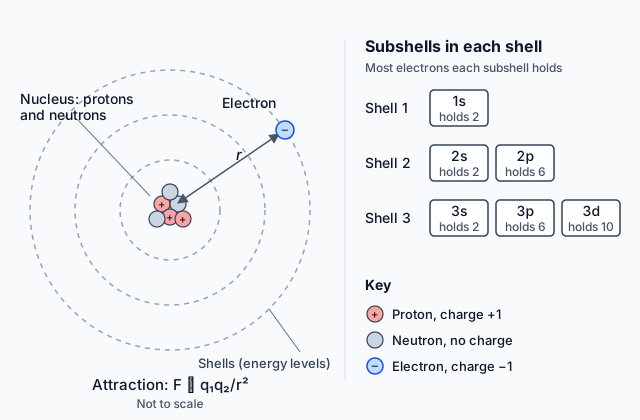 Tap to open the picture full size
Part 1 Think first Why sodium stops at one
Commit to a guess first. Being wrong now makes the right idea stick better.
Predict first
In table salt, every sodium is Na⁺, never Na²⁺. Measurements show why. Removing one electron from a gaseous sodium atom takes 496 kJ/mol, but removing a second electron, from Na⁺, takes 4562 kJ/mol, about nine times as much. Why is the second electron so much harder to remove?
In short. An electron configuration lists the subshells an atom's electrons occupy in its lowest-energy state, filled in the order the periodic table shows.
- Coulomb's law, F ∝ q₁q₂/r², says the pull between two charges grows with the size of the charges and falls with the square of the distance between them.
- Subshells fill lowest energy first (the aufbau principle): an s subshell holds 2 electrons, a p subshell 6 and a d subshell 10.
- An electron closer to the nucleus, and less shielded by inner electrons, is held more tightly and takes more energy to remove.
Part 2 Learn it Where an atom's electrons are
2a. What an atom is made of
An atom has two parts. At its center is a tiny nucleus made of protons, each with a charge of +1, and neutrons, which have no charge. Around the nucleus are electrons, each with a charge of −1. The nucleus holds nearly all of the atom's mass, while the electrons take up nearly all of its space.
The number of protons is the atomic number, and it fixes which element an atom is: every carbon atom has 6 protons. A neutral atom has as many electrons as protons, so the charges cancel. An ion is an atom that has gained or lost electrons:
- Lose electrons and the protons outnumber them: a positive ion, or cation. A sodium atom (11 protons, 11 electrons) that loses one electron becomes Na⁺.
- Gain electrons and they outnumber the protons: a negative ion, or anion. A chlorine atom (17 protons) that gains one electron has 18 electrons and becomes Cl⁻.
The charge of any atom or ion is the number of protons minus the number of electrons. Neutrons change the mass, never the charge.
Quick check · Calculate
A particle has 12 protons, 12 neutrons and 10 electrons. What is its charge? Give a whole number, with a minus sign if it is negative.
2b. Coulomb's law
Opposite charges attract and like charges repel. Coulomb's law says how strong that force is:
F ∝ q₁q₂/r²
- q₁ and q₂ are the two charges. Bigger charges mean a bigger force: double one charge and the force doubles.
- r is the distance between the charges. The distance is squared, so the force falls off fast: double the distance and the force drops to 1/2², which is 1/4 of what it was.
The ∝ sign means "is proportional to". You do not need a constant or units here, only how the force changes when a charge or the distance changes. Work it as a ratio: multiply by the factor each charge changes by, and divide by the square of the factor the distance changes by.
Example: an electron moves to half its distance from a nucleus. The force becomes 1/(1/2)², which is 4 times as strong.
This is the force that holds an atom together. The positive nucleus attracts every negative electron, and the electrons repel one another. An electron close to a highly charged nucleus is held tightly; one far away is held loosely.
Quick check · Calculate
An electron and a nucleus attract each other. The distance between them becomes three times as large, and the charges stay the same. The new force is what fraction of the original force? Give your answer as a decimal to three significant figures.
2c. Shells, subshells and the periodic table
Electrons sit in shells (energy levels), numbered 1, 2, 3 and so on outward from the nucleus. Each shell is split into subshells (sublevels), labeled s, p, d and f. An s subshell holds 2 electrons, p holds 6, d holds 10 and f holds 14. Shell 1 has only 1s; shell 2 has 2s and 2p; shell 3 has 3s, 3p and 3d.
The ground-state electron configuration lists where every electron is when the atom has its lowest energy. Each subshell is written with its electron count as a superscript: carbon, with 6 electrons, is 1s²2s²2p².
The aufbau principle says electrons fill the lowest-energy subshell available first. The periodic table shows the order: read it left to right, row by row. The two columns on the left are the s block (helium, at the far right of row 1, is s block too), the six on the right are the p block and the ten in the middle are the d block. So row 4 fills 4s (potassium, calcium), then 3d (scandium to zinc), then 4p (gallium to krypton). The d block in a row is one shell behind the row's number.
A shorthand starts from the noble gas before the element: sodium is [Ne]3s¹, where [Ne] stands for 1s²2s²2p⁶.
The electrons in the outermost shell are valence electrons; all the others are core electrons. Sodium has 1 valence electron and 10 core electrons.
Quick check · Put it in order
Put these subshells in the order electrons fill them in the ground state, from first filled to last.
2d. Removing an electron
The ionization energy is the energy needed to remove an electron from an atom or ion. Coulomb's law tells you, without any numbers, which electrons are easier to remove:
- Distance. An electron in a higher shell is farther from the nucleus, so it is attracted less and takes less energy to remove. In lithium, 1s²2s¹, the 2s electron comes off far more easily than a 1s electron.
- Shielding. Inner electrons sit between the nucleus and the outer electrons and repel them, so an outer electron feels less than the full charge of the nucleus. The charge it does feel is the effective nuclear charge. Lithium's 1s electrons feel nearly all three protons; its 2s electron is shielded by the two 1s electrons and feels much less.
So an atom holds its inner electrons much more tightly than its outer ones.
That is why a cation loses electrons from its outermost shell first. Calcium, [Ar]4s², forms Ca²⁺, [Ar], by losing both 4s electrons. A transition metal does the same: its 4s electrons go before any 3d electrons, so iron, [Ar]4s²3d⁶, forms Fe²⁺ as [Ar]3d⁶. An anion adds electrons at the next open place in the filling order: chlorine, [Ne]3s²3p⁵, gains one to become Cl⁻, [Ne]3s²3p⁶.
Quick check · Decide and justify
An aluminum atom has the configuration 1s²2s²2p⁶3s²3p¹. Which takes more energy to remove from the atom: one of its 2p electrons or its 3p electron?
Which reason supports your decision?
Part 3 Watch it done The configuration of selenium
Watch each step, then finish the last one yourself.
Selenium, atomic number 34, is a trace element the human body needs in small amounts. Write the ground-state electron configuration of a selenium atom, then find how many valence electrons it has.
Step 1 · Count the electrons
Selenium's atomic number is 34, so a neutral atom has 34 protons and 34 electrons.
Step 2 · Fill subshells in periodic table order
Walk the table row by row up to selenium. Row 1 gives 1s², row 2 gives 2s²2p⁶, row 3 gives 3s²3p⁶. Row 4 gives 4s² (potassium, calcium), then 3d¹⁰ (scandium to zinc), then 4p⁴ (gallium, germanium, arsenic, selenium). So selenium is 1s²2s²2p⁶3s²3p⁶4s²3d¹⁰4p⁴. Check the sum: 2 + 2 + 6 + 2 + 6 + 2 + 10 + 4 = 34.
Why this step?
Why does 3d come after 4s?
Electrons fill the lowest-energy subshell available first, and for these atoms that is 4s before 3d. The periodic table shows it: potassium and calcium, at the start of row 4, are in the s block, and the d block comes after them.
Step 3 · Write the shorthand
The noble gas before selenium is argon, 1s²2s²2p⁶3s²3p⁶, so selenium is [Ar]4s²3d¹⁰4p⁴.
Your step · Calculate
Finish it. A selenium atom is [Ar]4s²3d¹⁰4p⁴. How many valence electrons does it have? Give a whole number.
electrons
Selenium's 34 electrons are 6 valence electrons in shell 4 and 28 core electrons. The [Ar] in the shorthand stands for 18 of the core electrons; the 3d¹⁰ electrons are the other 10.
Part 4 Try it Atoms and ions of the transition metals
Titanium dioxide is the white pigment in most paint. Titanium is a transition metal, and in that pigment it is present as an ion, not as a neutral atom.
Try it · Multiple choice
A titanium atom, atomic number 22, has the ground-state configuration [Ar]4s²3d². What is the ground-state configuration of the Ti²⁺ ion?
Try it · Sort it
Sort each atom or ion by its ground-state electron configuration. Atomic numbers: F 9, Na 11, Mg 12, S 16, Cl 17, Ca 20. Tap a card, then a bin.
1s²2s²2p⁶
1s²2s²2p⁶3s²3p⁶
Neither of these
Part 5 Explain it The ionization energies of magnesium
On the exam this is handwritten, so answer on paper first. Nothing you type here leaves this page. Then check your answer against the model and each scoring point.
Free response is 50% of the exam score. This one is shaped like a short-answer question, which is worth 4 points.
Free-response practice · Short-answer style
The first three ionization energies of magnesium are 738 kJ/mol, 1451 kJ/mol and 7733 kJ/mol.
(a) Represent the ground-state electron configuration of a magnesium atom, atomic number 12.
(b) Identify the subshell from which an electron is removed when a magnesium atom forms Mg⁺.
(c) Explain, using Coulomb's law, why the third ionization energy is much greater than the second.
(d) Explain why the second ionization energy is greater than the first, even though both electrons are removed from the same subshell.
Model answer
(a) 1s²2s²2p⁶3s², or [Ne]3s².
(b) The 3s subshell, the outermost one.
(c) After two electrons are removed, Mg²⁺ is 1s²2s²2p⁶, so the third electron comes from the 2p subshell in shell 2. That electron is closer to the nucleus and is shielded only by the two 1s electrons, so it feels a much larger effective nuclear charge at a smaller distance. By Coulomb's law it is attracted far more strongly than a 3s electron, so removing it takes far more energy: 7733 kJ/mol against 1451 kJ/mol.
(d) The second electron is removed from Mg⁺, which still has 12 protons but only 11 electrons. With one fewer electron repelling it, the remaining 3s electron is held more strongly by the nucleus, so more energy is needed to remove it.
Score your own answer. This is a self-check, not a grade. Tick each point your answer makes.
Part 6 Check yourself Four particles
All three case questions use the table.
The table lists four particles, W to Z, by the number of protons, neutrons and electrons each one has. Each is a stable isotope of its element.
| Particle | Protons | Neutrons | Electrons |
|---|---|---|---|
| W | 16 | 16 | 18 |
| X | 19 | 20 | 18 |
| Y | 20 | 20 | 20 |
| Z | 17 | 18 | 17 |
Case question 1 · Multiple choice
Using the table: what is particle W?
Case question 2 · Select all
Using the table: which two particles have the ground-state electron configuration 1s²2s²2p⁶3s²3p⁶? Select two.
Select 2 answers, then check.
Case question 3 · Decide and justify
Using the table: which takes more energy, removing a 3p electron from particle W or removing a 3p electron from particle Z?
Which reason supports your decision?
The rest stand on their own and do not use the case.
Check yourself · Spot the error
A student compares the energy needed to remove the electron from a hydrogen atom, H, with the energy needed to remove the electron from a helium ion, He⁺. Tap the line where the reasoning first goes wrong.
Check yourself · Rank it
Four pairs of oppositely charged particles are listed, where d is a fixed distance. Rank the pairs by the strength of the attraction between the two particles.
Strongest attraction first
Give each one a place, 1 for first. Give two the same place if they are equal.
Your ranking: none yet
Part 7 Keep it Bring back earlier ideas
This lesson leans on two earlier ideas: the mass percent of an element in a mixture, worked from the composition of each substance in it, and isotopes, atoms of one element with different numbers of neutrons, read from a mass spectrum. Pulling them back up is what makes them last.
From 1.4 Composition of Mixtures · Calculate
A mixture contains 3.00 g of sodium chloride, NaCl, and 1.00 g of potassium chloride, KCl. NaCl is 60.66% chlorine by mass and KCl is 47.55% chlorine by mass. What is the mass percent of chlorine in the mixture? Give your answer to three significant figures.
From 1.2 Mass Spectra of Elements · Decide and justify
Boron has two isotopes, boron-10 (10.01 amu) and boron-11 (11.01 amu). The periodic table lists boron's average atomic mass as 10.81 amu. Which isotope is more abundant?
Which reason supports your decision?
In three lines
- An atom is a nucleus of protons and neutrons with electrons around it, and Coulomb's law, F ∝ q₁q₂/r², sets how strongly charges attract or repel.
- The ground-state configuration fills subshells lowest energy first, in periodic table order (4s before 3d); valence electrons are those in the outermost shell.
- Electrons closer to the nucleus and less shielded are held more tightly, so a cation loses electrons from its outermost shell first.
Exam strategy for this topic
- Section I, Multiple Choice: 60 questions in 90 minutes.
- Section II, Free Response: 7 questions in 105 minutes.
- A scientific or graphing calculator is recommended for use on both sections of the exam.
Write the full configuration first and add the superscripts to check the total. For an ion, start from the atom: add electrons for a negative ion, and remove them from the highest shell first for a positive ion. When you explain an ionization energy, name both parts of Coulomb's law: the electron's distance from the nucleus and the nuclear charge it feels.
Questions students ask
What is Coulomb's law in chemistry?
It says the force between two charges is proportional to the product of the charges divided by the square of the distance between them, F ∝ q₁q₂/r². It explains why the nucleus holds some electrons more tightly than others.
How do you write an electron configuration?
Count the electrons, then fill subshells in the order the periodic table shows, row by row, writing each subshell with its electron count as a superscript. Check that the superscripts add up to the number of electrons.
Why does 4s fill before 3d?
Electrons fill the lowest-energy subshell available first, and for the atoms of row 4 that is 4s before 3d. On the periodic table, the s block of row 4 comes before the d block.
What is the difference between core and valence electrons?
Valence electrons are in the outermost shell, farthest from the nucleus. Core electrons are all the electrons in the inner shells.
Why do transition metals lose 4s electrons before 3d electrons?
A cation loses electrons from its outermost shell first, and the 4s electrons are in shell 4, farther out than the 3d electrons in shell 3.
Beyond the AP Exam
College Board sets this limit on what the AP Exam asks about this topic. Anything past it is not on the exam.
The assignment of quantum numbers to electrons in subshells of an atom will not be assessed on the AP Exam.
Course alignment, for teachers
AP Chemistry topic 1.5, Unit 1: Atomic Structure and Properties.
- Skill 1.A: Describe the components of and quantitative information from models and representations that illustrate particulate-level properties only.
This lesson maps all 4 essential knowledge statements of the topic to the part that teaches each one: 4 are checked by a scored question. The map is in the lesson file.