Unit 1 · Topic 1.6 · about 30 minutes · 7 parts · 11 scored checks, 2 of them multiple choice, plus 2 from earlier lessons
AP Chemistry 1.6: Photoelectron Spectroscopy
Unit 1: 7 to 9% of the multiple-choice section
What you'll be able to do
- Explain how the photoelectron spectrum of an atom or ion shows its ground-state electron configuration and the interactions between its electrons and its nucleus.
Key vocabulary
| Term | What it means | The exam trap |
|---|---|---|
| Photoelectron spectroscopy (PES) | A method that knocks electrons out of atoms with high-energy light and measures the energy needed to remove them. | Read the axis labels before anything else, because many spectra draw binding energy increasing to the left. |
| Photoelectron spectrum | The graph a PES instrument produces: the number of electrons detected at each binding energy. | Peak height and peak position answer different questions, so decide which one a question is asking about. |
| Binding energy | The energy needed to remove an electron from an atom or ion, its ionization energy, given in PES in MJ/mol. | 1 MJ/mol is 1000 kJ/mol, so convert before you compare a PES value with an ionization energy given in kJ/mol. |
| Subshell | A part of a shell, labeled s, p, d or f, holding up to 2, 6, 10 or 14 electrons. | A subshell can hold fewer electrons than its limit, so check whether the last one in a configuration is full. |
 Tap to open the picture full size
Part 1 Think first Only three energies
Commit to a guess first. Being wrong now makes the right idea stick better.
Predict first
A scientist shines X-rays, all of one energy, on a sample of neon gas. Electrons are knocked out of the neon atoms, but they do not fly out with every possible energy. They come out with only three different energies. Why only three?
In short. Photoelectron spectroscopy (PES) measures the energy needed to remove electrons from each occupied subshell of an atom, so its spectrum is a direct test of the electron configuration.
- Each peak stands for one subshell, and its position is the energy needed to remove an electron from that subshell.
- A peak's height is proportional to the number of electrons in that subshell, so a 2p⁶ peak stands three times as tall as a 2s² peak.
- Electrons closer to the nucleus and less shielded are held more tightly, so their peaks sit at higher binding energy.
Part 2 Learn it Reading a photoelectron spectrum
2a. How PES works
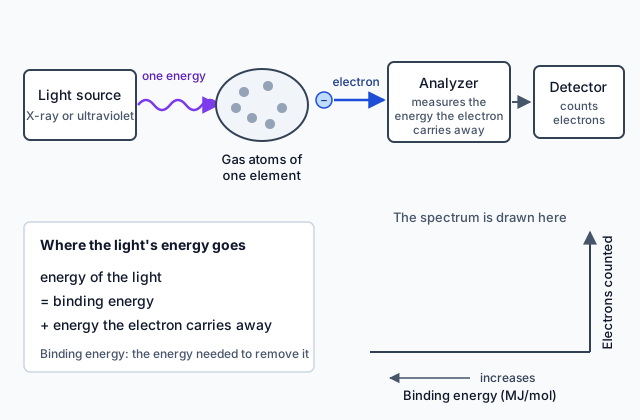
Photoelectron spectroscopy (PES) measures how much energy it takes to remove electrons from an atom. A gas sample of an element is hit with high-energy light (X-ray or ultraviolet), all of one known energy. Each hit can knock one electron out of an atom, and the instrument measures the energy that electron carries away. The rest of the light's energy was spent pulling the electron free, so the instrument works out the binding energy: the energy needed to remove that electron, its ionization energy. PES values are usually given in MJ/mol (1 MJ/mol = 1000 kJ/mol).
The result is a photoelectron spectrum: the number of electrons detected at each binding energy. Two features carry the information.
- Position. Electrons in one subshell all need the same energy to remove, so they pile up in one peak. A peak's position is the energy needed to remove an electron from that subshell.
- Height. A peak's relative height is (ideally) proportional to the number of electrons in that subshell. A peak twice as tall stands for twice as many electrons.
Read the axis first: many spectra draw binding energy increasing to the left, so the electrons hardest to remove appear on the left.
Quick check · Match
Match each feature of a photoelectron spectrum to what it tells you about the atom.
2b. From a spectrum to a configuration
A spectrum is an electron configuration drawn as data. To read one:
- Assign the peaks to subshells, starting from the highest binding energy. For the elements up to calcium, that order is 1s, 2s, 2p, 3s, 3p and then 4s. (Past calcium, 3d electrons are held more tightly than 4s electrons, so the 3d peak comes before the 4s peak.)
- Turn heights into electron counts. An atom with more than one peak has a full 1s subshell, so the 1s peak stands for 2 electrons. Scale every other peak from it.
- Add up the electrons. For a neutral atom the total is the atomic number, which names the element.
Example: an atom's spectrum has three peaks, at 52.6, 3.04 and 1.31 MJ/mol, with relative heights 1 : 1 : 2. These are 1s, 2s and 2p. The 1s peak stands for 2 electrons, so the heights stand for 2, 2 and 4: the configuration is 1s²2s²2p⁴, 8 electrons in all, which is oxygen. These numbers are a teaching example.
Within one shell, the s peak sits at a higher binding energy than the p peak, so 2s comes before 2p.
Quick check · Calculate
The photoelectron spectrum of a neutral atom has four peaks. Their relative heights, from the highest binding energy to the lowest, are 1.0, 1.0, 3.0 and 0.5. How many electrons does the atom have? Give a whole number.
2c. Peak position and the nucleus
Why is the 1s peak so far from the others? Coulomb's law. The 1s electrons are closest to the nucleus, and no inner electrons shield them, so they feel nearly the whole charge of the nucleus. Electrons in higher shells are farther away and shielded by the electrons inside them, so they are held less tightly and their peaks sit at lower binding energy. In the oxygen example, a 1s electron needs 52.6 MJ/mol, about 40 times the 1.31 MJ/mol a 2p electron needs.
The same reasoning compares one subshell in two different atoms. Carbon has 6 protons and nitrogen has 7. Their 1s electrons are in the same subshell, unshielded in both, but nitrogen's nucleus pulls harder, so its 1s peak sits at a higher binding energy: 39.6 MJ/mol against carbon's 28.6 MJ/mol. These numbers are a teaching example.
So a spectrum shows two things at once: the configuration, in which peaks there are and how tall they stand, and the attraction between the electrons and the nucleus, in where the peaks sit.
Quick check · Decide and justify
In the photoelectron spectrum of fluorine (9 protons), the 1s peak is at 67.2 MJ/mol. Is the 1s peak in the spectrum of neon (10 protons) at a higher or a lower binding energy?
Which reason supports your decision?
Part 3 Watch it done Which element made this spectrum?
Watch each step, then finish the last one yourself.
A photoelectron spectrum of a neutral atom has five peaks, at 239, 22.7, 16.5, 2.05 and 1.00 MJ/mol. Their relative heights, in the same order, are 1 : 1 : 3 : 1 : 2. These numbers are a teaching example. What is the atom's electron configuration, and which element is it?
Step 1 · Assign each peak to a subshell
Start at the highest binding energy and go 1s, 2s, 2p, 3s, 3p: 239 MJ/mol is 1s, 22.7 is 2s, 16.5 is 2p, 2.05 is 3s and 1.00 is 3p.
Step 2 · Turn heights into electrons
The 1s peak stands for 2 electrons, so each unit of height is 2 electrons. The heights 1 : 1 : 3 : 1 : 2 become 2, 2, 6, 2 and 4 electrons.
Why this step?
Why is the 1s peak known to stand for 2 electrons?
Electrons fill 1s first, and this atom has electrons in four more subshells, so its 1s subshell must be full, with 2 electrons. That fixes the scale for every other peak.
Step 3 · Write the configuration
1s²2s²2p⁶3s²3p⁴. The 3p peak is two-thirds as tall as the 2p peak, so 3p holds 4 of its 6 places.
Your step · Calculate
Finish it. The atom is 1s²2s²2p⁶3s²3p⁴. How many electrons does it have, which tells you the element? Give a whole number.
electrons
Sixteen electrons in a neutral atom means 16 protons: sulfur. The spectrum agrees with the configuration rules from the last lesson, peak for subshell and height for electron count.
Part 4 Try it Spectra that change
A spectrum changes when the atom changes. Use what each feature means to predict how.
Try it · Multiple choice
The photoelectron spectrum of a sodium atom, 1s²2s²2p⁶3s¹, has four peaks. How is the spectrum of a sodium ion, Na⁺, different?
Try it · Sort it
Compare the photoelectron spectra of a sodium atom (11 protons, 1s²2s²2p⁶3s¹) and a magnesium atom (12 protons, 1s²2s²2p⁶3s²). Sort each feature. Tap a card, then a bin.
Same in both spectra
Different
Part 5 Explain it Read a spectrum and explain it
On the exam this is handwritten, so answer on paper first. Nothing you type here leaves this page. Then check your answer against the model and each scoring point.
Free response is 50% of the exam score. This one is shaped like a short-answer question, which is worth 4 points.
Free-response practice · Short-answer style
The photoelectron spectrum of a neutral atom has six peaks, at 390, 42.7, 34.0, 4.65, 2.90 and 0.59 MJ/mol. Their relative heights, in the same order, are 1 : 1 : 3 : 1 : 3 : 1. These numbers are a teaching example.
(a) Represent the ground-state electron configuration that the spectrum shows.
(b) Identify the element.
(c) Explain, using Coulomb's law, why the peak at 390 MJ/mol is at a much higher binding energy than the peak at 0.59 MJ/mol.
(d) Potassium has 19 protons. Predict whether the 1s peak of potassium is at a higher or a lower binding energy than 390 MJ/mol, and justify your prediction.
Model answer
(a) The peaks are 1s, 2s, 2p, 3s, 3p and 4s, and with the 1s peak as 2 electrons the heights stand for 2, 2, 6, 2, 6 and 2: 1s²2s²2p⁶3s²3p⁶4s².
(b) The atom has 20 electrons, so as a neutral atom it has 20 protons: calcium.
(c) The 390 MJ/mol peak is the 1s subshell. Its electrons are closest to the nucleus and no inner electrons shield them, so they feel nearly the full +20 charge at a small distance and are attracted very strongly. The 0.59 MJ/mol peak is 4s: those electrons are farthest from the nucleus and shielded by 18 inner electrons, so they are attracted weakly and need far less energy to remove.
(d) Lower. Potassium's nucleus has 19 protons, one fewer than calcium's 20, and in both atoms nothing shields the 1s electrons, so potassium's smaller nuclear charge attracts its 1s electrons less strongly.
Score your own answer. This is a self-check, not a grade. Tick each point your answer makes.
Part 6 Check yourself An unknown spectrum
All three case questions use the table.
A student records the photoelectron spectrum of a neutral atom of an unknown element. The table lists its peaks from the highest binding energy to the lowest. These numbers are a teaching example.
| Peak | Binding energy (MJ/mol) | Relative height |
|---|---|---|
| 1 | 208 | 2 |
| 2 | 18.7 | 2 |
| 3 | 13.5 | 6 |
| 4 | 1.95 | 2 |
| 5 | 1.01 | 3 |
Case question 1 · Multiple choice
Using the table: which element produced this spectrum?
Case question 2 · Calculate
Using the table: removing a 2s electron from this atom takes how many times as much energy as removing a 3s electron? Give your answer to three significant figures.
Case question 3 · Decide and justify
Using the table: a student proposes that this atom's ground-state electron configuration is 1s²2s²2p⁶3s¹3p⁴. Is that model consistent with the spectrum?
Which reason supports your decision?
The rest stand on their own and do not use the case.
Check yourself · Spot the error
A student reads the photoelectron spectrum of argon, 1s²2s²2p⁶3s²3p⁶, which has peaks at 309, 31.5, 24.1, 2.82 and 1.52 MJ/mol. These numbers are a teaching example. Tap the line with the mistake.
Check yourself · Rank it
Sodium has 11 protons and magnesium has 12. Rank these electrons by the binding energy of their peaks in a photoelectron spectrum.
Highest binding energy first
Give each one a place, 1 for first. Give two the same place if they are equal.
Your ranking: none yet
Part 7 Keep it Bring back earlier ideas
This lesson leans on two earlier ideas: the ground-state electron configuration and Coulomb's law from the last lesson, and reading the peaks of a spectrum, as with the mass spectrum of an element. Pulling them back up is what makes them last.
From 1.5 Atomic Structure and Electron Configuration · Put it in order
Put these subshells in the order electrons fill them in the ground state, from first filled to last.
From 1.2 Mass Spectra of Elements · Multiple choice
The mass spectrum of a sample of pure rubidium has two peaks: one at 84.91 amu with a height of 100, and one at 86.91 amu with a height of 38.6. The tallest peak is set to 100. About what percent of rubidium atoms are rubidium-85?
In three lines
- Photoelectron spectroscopy measures the energy needed to remove electrons from each occupied subshell, and gives one peak per subshell.
- A peak's position is the energy needed to remove an electron from that subshell; its height is proportional to the number of electrons there.
- Peaks for electrons closer to the nucleus, less shielded or pulled by more protons sit at higher binding energy.
Exam strategy for this topic
- Section I, Multiple Choice: 60 questions in 90 minutes.
- Section II, Free Response: 7 questions in 105 minutes.
- A scientific or graphing calculator is recommended for use on both sections of the exam.
When a question gives a spectrum, assign every peak to a subshell from the highest binding energy to the lowest (for elements up to calcium: 1s, 2s, 2p, 3s, 3p, 4s), then turn heights into electron counts using the 1s peak as 2 electrons. Explain a peak's position with Coulomb's law: the electrons' distance from the nucleus and the nuclear charge they feel.
Questions students ask
What does photoelectron spectroscopy measure?
The energy needed to remove electrons from an atom, subshell by subshell. High-energy light knocks electrons out, and the energy each one carries away tells how tightly it was held.
What does the height of a PES peak mean?
It is proportional to the number of electrons in that subshell. A 2p⁶ peak is three times as tall as a 2s² peak.
Why is the 1s peak at such a high binding energy?
The 1s electrons are closest to the nucleus and no inner electrons shield them, so they feel nearly the full nuclear charge and are held most tightly.
Why does binding energy increase to the left on many PES graphs?
It is a drawing convention many spectra follow. Always read the axis labels before you assign peaks to subshells.
How do you identify an element from its photoelectron spectrum?
Assign each peak to a subshell from the highest binding energy down (up to calcium, in the order 1s, 2s, 2p, 3s, 3p, 4s), turn heights into electron counts using the 1s peak as 2, and add them. For a neutral atom the total is the atomic number.
Course alignment, for teachers
AP Chemistry topic 1.6, Unit 1: Atomic Structure and Properties.
- Skill 4.B: Explain whether a model is consistent with chemical theories.
This lesson maps the one essential knowledge statement of the topic to the part that teaches each one: 1 is checked by a scored question. The map is in the lesson file.