Unit 1 · Topic 1.7 · about 30 minutes · 7 parts · 11 scored checks, 1 of them multiple choice, plus 2 from earlier lessons
AP Chemistry 1.7: Periodic Trends
Unit 1: 7 to 9% of the multiple-choice section
What you'll be able to do
- Explain how trends in the properties of atoms across the periodic table follow from their electron structure and from periodicity.
Key vocabulary
| Term | What it means | The exam trap |
|---|---|---|
| Effective nuclear charge | The net positive charge a valence electron feels once the inner electrons' repulsion is taken into account; the core charge, protons minus inner electrons, estimates it. | It is smaller than the atomic number, so do not use the full count of protons as the pull on a valence electron. |
| Shielding | The reduction in the nucleus's pull on a valence electron caused by repulsion from the electrons between them. | Shielding is a model for repulsion between electrons, not a wall, so treat it as reducing the pull rather than blocking it. |
| First ionization energy | The energy needed to remove the most loosely held electron from a gaseous atom. | A larger value means the electron is harder to remove, so read the direction of a comparison carefully. |
| Electron affinity | The energy change when a gaseous atom gains an electron; more energy is released when the added electron is strongly attracted. | It is the energy of gaining an electron, the reverse direction from ionization energy, so do not swap the two. |
| Electronegativity | How strongly an atom in a bond attracts the electrons it shares. | It describes an atom in a bond, not an isolated atom, so it is a different property from electron affinity even though the trends look alike. |
 Tap to open the picture full size
Part 1 Think first An element no one had seen
Commit to a guess first. Being wrong now makes the right idea stick better.
Predict first
In 1871 Dmitri Mendeleev left a gap in his periodic table directly below silicon and described the element that should fill it: its atomic mass, its density and the formula of its oxide. No one had ever seen that element. In 1886 Clemens Winkler discovered germanium, and it matched Mendeleev's description closely. How could Mendeleev describe an element nobody had found?
In short. Periodic trends are the regular changes in atomic properties across a period and down a group, and they come from how strongly the nucleus attracts the outermost electrons.
- Across a period, protons are added while the valence electrons stay in the same shell, so the core charge rises and atoms get smaller and hold their electrons more tightly.
- Down a group, each element adds a shell farther from the nucleus, so atoms get larger and hold their valence electrons less tightly.
- Because properties repeat in a pattern, an element's neighbors in its column give a good estimate of a value that has not been measured.
Part 2 Learn it Where the trends come from
2a. Why the table repeats
The periodic table lists the elements in order of atomic number, and every so often the same properties come round again. Lithium, sodium and potassium are all soft, shiny metals that react with water; neon and argon react with almost nothing. The table is laid out so that elements with recurring properties sit in the same column.
The reason is the electrons. Elements in a column have the same pattern of valence electrons, the electrons in the outermost shell:
- Lithium is 1s²2s¹ and sodium is 1s²2s²2p⁶3s¹: one valence electron each, in an s subshell.
- Nitrogen is 1s²2s²2p³ and phosphorus is 1s²2s²2p⁶3s²3p³: five valence electrons each.
- Neon is 1s²2s²2p⁶: its outer shell is completely filled, which is why it, and the noble gases below it, so rarely react.
So the column tells you the valence configuration, and the row tells you which shell it is in. Period 3 elements have their valence electrons in the third shell, and period 4 elements in the fourth. To place an element from its configuration, count the electrons in the highest-numbered shell.
Quick check · Match
Match each ground-state electron configuration to the element whose column it belongs in.
2b. How tightly the nucleus holds the outer electrons
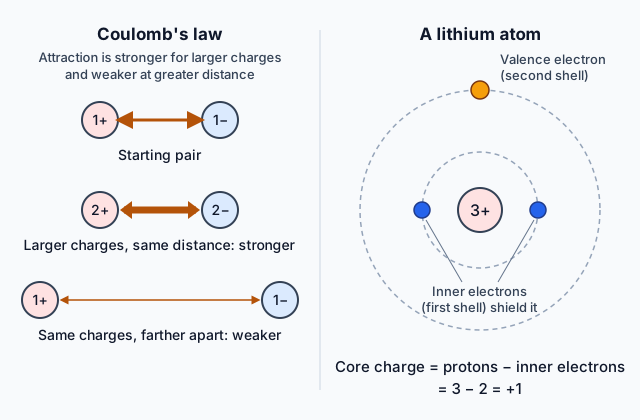
The trends in this lesson come from one idea, Coulomb's law: the attraction between two opposite charges is stronger when the charges are larger and when they are closer together. In an atom, the charges are the positive nucleus and a negative valence electron.
A valence electron does not feel the full charge of the nucleus. The inner (core) electrons sit between it and the nucleus and repel it, which cancels part of the pull. This is shielding. What is left is the effective nuclear charge. In the shell model, a quick measure of it is the core charge: the number of protons minus the number of inner electrons. Electrons in the same shell shield one another very little, so they are not subtracted.
- Across a period, each element adds one proton and one valence electron to the same shell, while the inner electrons stay the same. The core charge rises, from +1 for sodium to +7 for chlorine, so the valence electrons are pulled closer and the atomic radius decreases.
- Down a group, each element adds a shell. The valence electrons are farther from the nucleus, and the added inner electrons shield the added protons, so the core charge stays the same (+1 for lithium, sodium and potassium). The atomic radius increases.
Quick check · Rank it
Sodium, magnesium and chlorine are in period 3, and potassium is directly below sodium in period 4. Rank the four atoms by atomic radius.
Largest atom first
Give each one a place, 1 for first. Give two the same place if they are equal.
Your ranking: none yet
2c. Ionization energy, electron affinity and electronegativity
Three more properties measure how strongly an atom attracts electrons, so they follow the same pull:
- First ionization energy is the energy needed to remove the most loosely held electron from a gaseous atom. A stronger pull on that electron means more energy is needed.
- Electron affinity is the energy change when a gaseous atom gains an electron. An atom whose nucleus strongly attracts an added electron releases more energy as it gains one.
- Electronegativity is how strongly an atom in a bond attracts the shared electrons.
Across a period, as the core charge grows and the atom shrinks, ionization energy and electronegativity rise, and in general more energy is released when an atom gains an electron. Down a group, as the valence electrons sit farther from the nucleus, ionization energy and electronegativity fall. Fluorine has the highest electronegativity of all.
The rise in ionization energy across a period is not perfectly smooth. Boron's first ionization energy is slightly lower than beryllium's, because boron's outermost electron is in a 2p subshell, which is higher in energy than 2s (a photoelectron spectrum shows this). Electron affinity follows the pattern least tidily of the four properties: down a group it changes only a little and not always in one direction, so compare it only across a period.
Quick check · Decide and justify
Sulfur is in period 3, and selenium is directly below it in period 4. Which atom has the higher first ionization energy?
Which reason supports your decision?
2d. Ions are not the size of their atoms
Atomic radius is measured on neutral atoms. Ionic radius is the size of an ion, and it differs from the size of the atom for two reasons.
- A cation (a positive ion) has lost electrons. When a sodium atom loses its one 3s electron, the third shell is left empty, so the outermost electrons of Na⁺ are in the second shell, much closer to the nucleus. A cation is smaller than its atom.
- An anion (a negative ion) has gained electrons. The nuclear charge is unchanged, but the added electron increases the repulsion among the valence electrons, so the electron cloud spreads out. An anion is larger than its atom.
Ions with the same number of electrons can be compared by their protons. O²⁻, F⁻, Na⁺ and Mg²⁺ all have 10 electrons; Mg²⁺, with 12 protons, pulls them in the most and is the smallest, and O²⁻, with 8, is the largest.
Quick check · Sort it
Each card names an ion. Tap a card, then the bin that compares the ion's radius with the radius of its neutral atom.
Larger than its neutral atom
Smaller than its neutral atom
Part 3 Watch it done A value nobody gave you
Predict first, then watch each step, then finish the estimate yourself.
A data table lists the first ionization energy of chlorine as 1251.2 kJ/mol and of iodine as 1008.4 kJ/mol, but bromine's value is missing. Bromine lies between them in group 17: chlorine in period 3, bromine in period 4, iodine in period 5. Estimate bromine's first ionization energy.
Predict first
Before you open the first step, predict: where does bromine's first ionization energy fall?
Step 1 · Place bromine in its column
Chlorine, bromine and iodine are three neighbors in group 17, one row apart. All three have seven valence electrons, in an ns²np⁵ pattern, and the same core charge, +7.
Step 2 · Use the trend for direction
Down a group the valence electrons are in shells farther from the nucleus, with the same core charge, so first ionization energy falls. Bromine's value must be below chlorine's 1251.2 kJ/mol and above iodine's 1008.4 kJ/mol.
Why this step?
Why not simply use chlorine's value for bromine?
Being in the same column gives the same valence configuration, not the same values. Bromine's valence electrons are in the fourth shell, farther out than chlorine's third, so they are held less tightly and take less energy to remove.
Step 3 · Choose a simple estimate
Bromine sits one row below chlorine and one row above iodine, so the midpoint of their two values is a reasonable estimate.
Your step · Calculate
Finish it. The first ionization energy of chlorine is 1251.2 kJ/mol and that of iodine is 1008.4 kJ/mol. Bromine lies between them in group 17. Estimate bromine's first ionization energy as the midpoint of the two values, in kJ/mol. Give your estimate to the nearest 10 kJ/mol.
kJ/mol
The measured value is 1139.9 kJ/mol, so the estimate is within 1 percent. Periodicity does not give exact values, but it puts a missing one in the right place and close to the right size, which is just what Mendeleev did for germanium.
Part 4 Try it Strontium, from its neighbors
Strontium lies between calcium and barium in group 2: calcium in period 4, strontium in period 5, barium in period 6. The first ionization energy of calcium is 589.8 kJ/mol and that of barium is 502.9 kJ/mol (values from standard reference tables).
Try it · Calculate
Estimate strontium's first ionization energy from calcium's (589.8 kJ/mol) and barium's (502.9 kJ/mol), as the midpoint of the two values, in kJ/mol. Give your estimate to three significant figures.
Try it · Decide and justify
Is a strontium atom larger or smaller than a calcium atom?
Which reason supports your decision?
Part 5 Explain it Explain a trend with the shell model
On the exam this is handwritten, so answer on paper first. Nothing you type here leaves this page. Then check your answer against the model and each scoring point.
Free response is 50% of the exam score. This one is shaped like a short-answer question, which is worth 4 points.
Free-response practice · Short-answer style
Magnesium and chlorine are both in period 3 of the periodic table. Calcium is directly below magnesium, in period 4.
(a) Identify the element, magnesium or chlorine, whose atoms have the larger atomic radius.
(b) Explain your answer to part (a) in terms of the shell model and effective nuclear charge.
(c) Predict whether the first ionization energy of calcium is greater than or less than that of magnesium.
(d) Justify your prediction in part (c) using Coulomb's law.
Model answer
(a) Magnesium.
(b) The valence electrons of both atoms are in the third shell, and both atoms have 10 inner electrons. Magnesium's core charge is 12 − 10 = +2, while chlorine's is 17 − 10 = +7. Chlorine's valence electrons feel a much larger effective nuclear charge in the same shell, so they are pulled closer to the nucleus, and the magnesium atom is larger.
(c) Less than magnesium's.
(d) Calcium's valence electrons are in the fourth shell, farther from the nucleus than magnesium's in the third, and they feel the same core charge, +2. By Coulomb's law the attraction between the nucleus and an electron is weaker at a greater distance, so less energy is needed to remove calcium's outermost electron.
Score your own answer. This is a self-check, not a grade. Tick each point your answer makes.
Part 6 Check yourself Down the alkali metals
Both case questions use the table.
The table gives the atomic radius and the first ionization energy of five elements of group 1, from standard reference tables. Cesium's ionization energy has been left out.
| Element | Period | Atomic radius (pm) | First ionization energy (kJ/mol) |
|---|---|---|---|
| Lithium | 2 | 152 | 520.2 |
| Sodium | 3 | 186 | 495.8 |
| Potassium | 4 | 227 | 418.8 |
| Rubidium | 5 | 248 | 403.0 |
| Cesium | 6 | 265 | ? |
Case question 1 · Multiple choice
Using the table: which is the most reasonable estimate of the first ionization energy of cesium?
Case question 2 · Decide and justify
Using the table: a student claims that, in this column, the larger an atom is, the less energy it takes to remove its outermost electron. Does the table support the claim?
Which reason supports your decision?
The rest stand on their own and do not use the case.
Check yourself · Spot the error
A student explains why a sulfur atom is smaller than a magnesium atom. Tap the line with the mistake.
Check yourself · Fill the statement
Complete the explanation of the trend in electronegativity down group 17, from fluorine to iodine.
Moving down the group, the valence electrons are in a shell the nucleus, and more inner electrons them from it. The attraction is weaker, so the electronegativity .
Part 7 Keep it Bring back earlier ideas
This lesson leans on two earlier ideas: which electron an atom loses first, as the photoelectron spectrum of an ion shows, and Coulomb's law, which sets the strength of an attraction by the sizes of the charges and the distance between them. Pulling them back up is what makes them last.
A spectrum changes when the atom changes. Use what each feature means to predict how.
From 1.6 Photoelectron Spectroscopy · Multiple choice
The photoelectron spectrum of a sodium atom, 1s²2s²2p⁶3s¹, has four peaks. How is the spectrum of a sodium ion, Na⁺, different?
From 1.5 Atomic Structure and Electron Configuration · Rank it
Four pairs of oppositely charged particles are listed, where d is a fixed distance. Rank the pairs by the strength of the attraction between the two particles.
Strongest attraction first
Give each one a place, 1 for first. Give two the same place if they are equal.
Your ranking: none yet
In three lines
- Elements in a column share a valence configuration, which is why their properties recur; the row gives the shell the valence electrons are in.
- Across a period the core charge rises in the same shell, so atoms shrink, ionization energy and electronegativity rise, and gaining an electron generally releases more energy; down a group atoms grow and ionization energy and electronegativity fall.
- Cations are smaller than their atoms and anions larger, and a missing value can be estimated from its neighbors in the same column.
Exam strategy for this topic
- Section I, Multiple Choice: 60 questions in 90 minutes.
- Section II, Free Response: 7 questions in 105 minutes.
- A scientific or graphing calculator is recommended for use on both sections of the exam.
When you explain a trend, name the particles: which shell the valence electrons are in, the core charge they feel, and what Coulomb's law says about that distance and charge. A trend stated only by position, such as "because it is farther to the right," describes the pattern without explaining it.
Questions students ask
Why do atoms get smaller across a period?
Each element adds a proton and a valence electron to the same shell, while the inner electrons stay the same. The core charge rises, so the valence electrons are pulled closer to the nucleus.
Why do atoms get larger down a group?
Each row adds a shell, so the valence electrons are farther from the nucleus. The added protons are shielded by added inner electrons, so the core charge stays about the same.
What is effective nuclear charge?
The pull of the nucleus that a valence electron actually feels, after the inner electrons' repulsion is taken into account. The core charge, protons minus inner electrons, is a simple estimate of it.
Why is a cation smaller than its atom?
A main-group cation loses its valence electrons, which often empties the outer shell, so the electrons that remain are in a lower shell closer to the nucleus.
How can I estimate a property that is not in the table?
Find the element's neighbors in its column and use the trend: its value lies between theirs, and the midpoint of the values above and below it is a reasonable first estimate.
Beyond the AP Exam
College Board sets this limit on what the AP Exam asks about this topic. Anything past it is not on the exam.
Writing the electron configuration of elements that are exceptions to the aufbau principle will not be assessed on the AP Exam.
Course alignment, for teachers
AP Chemistry topic 1.7, Unit 1: Atomic Structure and Properties.
- Skill 4.A: Predict and/or explain chemical properties or phenomena (e.g., of atoms or molecules) using given chemical theories, models, and representations.
This lesson maps all 3 essential knowledge statements of the topic to the part that teaches each one: 3 are checked by a scored question. The map is in the lesson file.