Unit 1 · Topic 1.8 · about 30 minutes · 7 parts · 10 scored checks, 2 of them multiple choice, plus 2 from earlier lessons
AP Chemistry 1.8: Valence Electrons and Ionic Compounds
Unit 1: 7 to 9% of the multiple-choice section
What you'll be able to do
- Explain how trends in the reactivity of elements follow from periodicity and the elements' places on the periodic table.
Key vocabulary
| Term | What it means | The exam trap |
|---|---|---|
| Valence electrons | The electrons in an atom's outermost shell, the ones involved when the atom reacts. | Count only the highest-numbered shell; a filled inner subshell does not add to the count for a main-group element. |
| Cation | A positively charged ion, formed when an atom loses electrons. | A positive charge means electrons were lost, not protons gained; the nucleus does not change. |
| Anion | A negatively charged ion, formed when an atom gains electrons. | The size of the negative charge is the number of electrons gained, which is not the same as the number of valence electrons the atom started with. |
| Ionic compound | A compound made of positive and negative ions held together by their attraction, written with the cation first. | Its formula gives the simplest ratio of the ions, not a count of separate molecules. |
| Analogous compounds | Compounds of elements from the same columns, which have the same kind of formula, such as NaCl and KCl. | Copy a formula pattern only between elements in the same columns, and check that the charges still balance before you write it. |
 Tap to open the picture full size
Part 1 Think first Three metals, three dishes of water
Commit to a guess first. Being wrong now makes the right idea stick better.
Predict first
In a classic demonstration, a teacher drops a small piece of lithium, of sodium and of potassium into three dishes of water. All three are metals from the first column of the periodic table, with potassium lowest in the column and lithium highest. Which one reacts most vigorously?
In short. An element's valence electrons, and how strongly its nucleus holds them, decide how it reacts, and its column on the periodic table predicts the charge of its ion in an ionic compound.
- Atoms that hold their valence electrons loosely give them up, atoms one to three electrons short of a filled shell take them, and atoms with a filled shell rarely react at all.
- The number of valence electrons, read from an element's column, predicts the charge of its ion in an ionic compound.
- Elements in the same column form analogous compounds: sodium chloride is NaCl and potassium chloride is KCl.
Part 2 Learn it From valence electrons to ions
2a. What makes two elements react
Whether two elements react to form a compound depends on their valence electrons and on how strongly each nucleus attracts them.
- An atom that holds its valence electrons loosely, with a low ionization energy, gives them up easily. The metals on the left of the table, with one to three valence electrons, are like this.
- An atom one to three electrons short of a filled valence shell, with a large core charge, attracts extra electrons strongly. Nonmetals on the right, such as oxygen and chlorine, are like this.
- A noble gas has a filled valence shell. Removing one of its electrons takes a great deal of energy, and an added electron would have to start a new shell farther out, where it is barely attracted. The noble gases form almost no compounds.
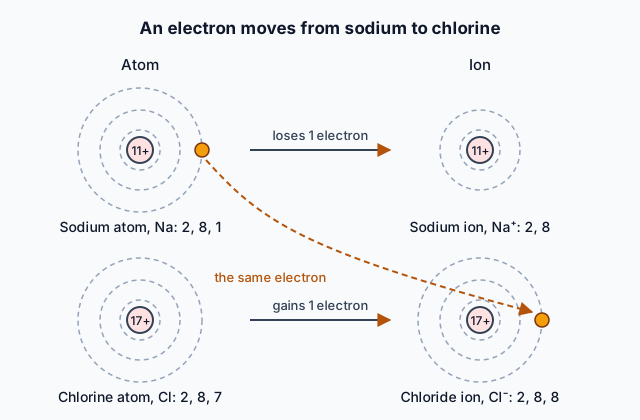
When an atom that gives up electrons easily meets one that attracts them strongly, electrons transfer from one to the other and ions form.
Reactivity follows the same pull. Down group 1, the valence electron is farther from the nucleus and easier to remove, so the metals react more vigorously. For a nonmetal, which reacts by gaining electrons, ask instead how strongly it pulls on electrons: a smaller atom, whose valence shell is closer to the nucleus, has a higher electronegativity and pulls harder.
Quick check · Rank it
Iodine, chlorine, fluorine and bromine are the first four elements of group 17, and each reacts with sodium by gaining one electron per atom. Rank them by how vigorously they react with sodium.
Most vigorous first
Give each one a place, 1 for first. Give two the same place if they are equal.
Your ranking: none yet
2b. Charges from the column
In an ionic compound, a main-group atom typically gains or loses electrons until it has the same number of electrons as the nearest noble gas. How many it gains or loses comes from its number of valence electrons, which you can read from its column:
- Group 1 (1 valence electron) loses 1: Li⁺, Na⁺.
- Group 2 (2 valence electrons) loses 2: Mg²⁺, Ca²⁺.
- Group 13 (3 valence electrons): aluminum loses 3, Al³⁺.
- Group 15 (5 valence electrons): nitrogen gains 3, N³⁻.
- Group 16 (6 valence electrons) gains 2: O²⁻, S²⁻.
- Group 17 (7 valence electrons) gains 1: F⁻, Cl⁻.
An atom stops there because the next electron would be far harder to move. A magnesium atom's first two electrons come from its third shell, but a third would come from the second shell, much closer to the nucleus. Magnesium's third ionization energy, 7732.7 kJ/mol, is more than five times its second, 1450.7 kJ/mol, so magnesium forms Mg²⁺ and not Mg³⁺.
Quick check · Match
Match each element to the typical charge of its ion in an ionic compound.
2c. Same column, same kind of formula
Elements in the same column have the same number of valence electrons, so they form ions of the same charge, and so they form analogous compounds: compounds with the same kind of formula. Sodium chloride is NaCl, so potassium chloride is KCl. Magnesium oxide is MgO, so calcium oxide is CaO and magnesium sulfide is MgS.
To write the formula of an ionic compound from the charges, make the total positive charge equal the total negative charge, using the smallest whole numbers, and write the metal first. Aluminum oxide is made of Al³⁺ and O²⁻ ions. Two Al³⁺ give +6 and three O²⁻ give −6, so the formula is Al₂O₃.
A known formula is therefore a template for its whole column. If you know aluminum oxide is Al₂O₃, the compound of aluminum and sulfur, just below oxygen, is Al₂S₃.
Quick check · Fill the statement
Complete the predictions.
Lithium and oxygen form Li₂O. Sodium, below lithium in group 1, and sulfur, below oxygen in group 16, form . Calcium and chlorine form CaCl₂, so strontium, below calcium in group 2, and bromine, below chlorine in group 17, form .
Part 3 Watch it done A formula from a known one
Watch each step, then finish the last one yourself.
Calcium and nitrogen form calcium nitride, Ca₃N₂. Predict the formula of the compound formed by strontium and phosphorus.
Step 1 · Find each element's column
Strontium is directly below calcium, in group 2. Phosphorus is directly below nitrogen, in group 15.
Step 2 · Read the charges from the valence electrons
Strontium has 2 valence electrons and loses both: Sr²⁺. Phosphorus has 5 and gains 3 to reach 8: P³⁻. These are the same charges as Ca²⁺ and N³⁻.
Why this step?
Why can calcium nitride's formula be used for strontium and phosphorus?
Elements in the same column have the same number of valence electrons, so they form ions of the same charge, and ions of the same charges combine in the same ratio.
Step 3 · Balance the charges
Three Sr²⁺ give +6 and two P³⁻ give −6, so the formula is Sr₃P₂, the same pattern as Ca₃N₂.
Your step · Multiple choice
Finish it. Aluminum and oxygen form Al₂O₃. Gallium is directly below aluminum in group 13, and sulfur is directly below oxygen in group 16. What is the formula of the compound formed by gallium and sulfur?
The column did the work twice: it gave each element's charge, and it let you copy a formula you already knew.
Part 4 Try it Down group 2
Radium sits at the bottom of group 2, below barium. Marie and Pierre Curie discovered it in 1898, and Marie Curie first isolated radium as a salt, radium chloride. Barium's chloride is BaCl₂.
Try it · Decide and justify
What is the formula of radium chloride?
Which reason supports your decision?
Try it · Decide and justify
Calcium and barium are both in group 2, with calcium in period 4 and barium in period 6. Which metal reacts more vigorously with water?
Which reason supports your decision?
Part 5 Explain it Potassium and sulfur
On the exam this is handwritten, so answer on paper first. Nothing you type here leaves this page. Then check your answer against the model and each scoring point.
Free response is 50% of the exam score. This one is shaped like a short-answer question, which is worth 4 points.
Free-response practice · Short-answer style
Potassium and sulfur react to form an ionic compound.
(a) Identify the typical charge of a potassium ion and of a sulfide ion in the compound.
(b) Explain, in terms of valence electrons and the attraction of the nucleus, why a potassium atom loses one electron but not a second.
(c) Determine the formula of the compound.
(d) Predict the formula of the compound formed by rubidium and selenium, and justify your prediction using the periodic table.
Model answer
(a) Potassium ion: 1+ (K⁺). Sulfide ion: 2− (S²⁻).
(b) Potassium has one valence electron, in the fourth shell, far from the nucleus and shielded by 18 inner electrons, so it is held weakly and is removed easily. A second electron would have to come from the third shell, closer to the nucleus and much less shielded, so it is held far more strongly and removing it takes much more energy.
(c) K₂S. Two K⁺ ions (+2) balance one S²⁻ ion (−2).
(d) Rb₂Se. Rubidium is below potassium in group 1 and selenium is below sulfur in group 16, so they have the same numbers of valence electrons, form Rb⁺ and Se²⁻ ions, and combine in the same 2 : 1 ratio.
Score your own answer. This is a self-check, not a grade. Tick each point your answer makes.
Part 6 Check yourself Three unknown metals
Both case questions use the table.
The table gives the first four ionization energies of three main-group metals, X, Y and Z, each in period 3 or period 4. The values are from standard reference tables.
| Metal | First | Second | Third | Fourth |
|---|---|---|---|---|
| X | 577.5 | 1816.7 | 2744.8 | 11577 |
| Y | 418.8 | 3052 | 4420 | 5877 |
| Z | 589.8 | 1145.4 | 4912.4 | 6491 |
Case question 1 · Match
Using the table: match each metal to the formula of the compound it forms with chlorine.
Case question 2 · Multiple choice
Using the table: which statement explains the charge that metal Z takes in its ionic compounds?
The rest stand on their own and do not use the case.
Check yourself · Spot the error
A student works out the formula of magnesium nitride. Tap the line with the mistake.
Check yourself · Sort it
Each card names a pair of elements. Tap a card, then the bin that says how likely the pair is to form a compound.
Readily forms an ionic compound
Forms almost no compounds
Part 7 Keep it Bring back earlier ideas
This lesson leans on two earlier ideas: how ionization energy changes down a group, and the electron configurations of atoms and ions, which show the valence electrons an atom loses or gains. Pulling them back up is what makes them last.
Strontium lies between calcium and barium in group 2: calcium in period 4, strontium in period 5, barium in period 6. The first ionization energy of calcium is 589.8 kJ/mol and that of barium is 502.9 kJ/mol (values from standard reference tables).
From 1.7 Periodic Trends · Calculate
Estimate strontium's first ionization energy from calcium's (589.8 kJ/mol) and barium's (502.9 kJ/mol), as the midpoint of the two values, in kJ/mol. Give your estimate to three significant figures.
Titanium dioxide is the white pigment in most paint. Titanium is a transition metal, and in that pigment it is present as an ion, not as a neutral atom.
From 1.5 Atomic Structure and Electron Configuration · Sort it
Sort each atom or ion by its ground-state electron configuration. Atomic numbers: F 9, Na 11, Mg 12, S 16, Cl 17, Ca 20. Tap a card, then a bin.
1s²2s²2p⁶
1s²2s²2p⁶3s²3p⁶
Neither of these
In three lines
- Elements react when one atom gives up its valence electrons easily and another attracts them strongly; noble gases, with filled shells, form almost no compounds.
- The column gives the number of valence electrons and so the typical charge: 1+ in group 1, 2+ in group 2, 3+ for aluminum, 3− in group 15, 2− in group 16 and 1− in group 17.
- Elements in the same column form analogous compounds, so a known formula such as Ca₃N₂ predicts another, such as Sr₃P₂, once the charges are balanced.
Exam strategy for this topic
- Section I, Multiple Choice: 60 questions in 90 minutes.
- Section II, Free Response: 7 questions in 105 minutes.
- A scientific or graphing calculator is recommended for use on both sections of the exam.
When a question asks for the charge of an ion or the formula of a compound, say where the element is on the periodic table and how many valence electrons that gives it, then balance the charges. Saying why the next electron is not lost (it would come from an inner shell, closer to the nucleus) is what turns a stated charge into an explanation.
Questions students ask
How do I predict the charge of an ion from the periodic table?
Count the valence electrons from the element's column. Metals in groups 1 and 2, and aluminum, lose all of theirs (1+, 2+, 3+); nonmetals in groups 15 to 17 gain enough to reach eight (3−, 2−, 1−).
Why don't noble gases form ionic compounds?
Their valence shell is filled. Removing an electron takes a great deal of energy, and an added electron would have to go into a new shell farther out, where it is barely attracted.
What are analogous compounds?
Compounds formed by elements in the same columns, which have the same kind of formula because their ions have the same charges: NaCl and KCl, or MgO and CaO.
Why are the alkali metals more reactive lower in the group?
Their one valence electron is in a shell farther from the nucleus, with the same core charge, so it is held more weakly and given up more easily.
How do I write the formula of an ionic compound?
Find the charge of each ion, then choose the smallest whole numbers of each so the total positive charge equals the total negative charge, and write the metal first: Al³⁺ and O²⁻ give Al₂O₃.
Course alignment, for teachers
AP Chemistry topic 1.8, Unit 1: Atomic Structure and Properties.
- Skill 4.C: Explain the connection between particulate-level and macroscopic properties of a substance using models and representations.
This lesson maps all 3 essential knowledge statements of the topic to the part that teaches each one: 3 are checked by a scored question. The map is in the lesson file.