Unit 2 · Topic 2.1 · about 30 minutes · 7 parts · 10 scored checks, 3 of them multiple choice, plus 2 from earlier lessons
AP Chemistry 2.1: Types of Chemical Bonds
Unit 2: 7 to 9% of the multiple-choice section
What you'll be able to do
- Explain how the type of bond between two atoms depends on the properties of the elements in it: their electronegativities, and whether they are metals or nonmetals.
Key vocabulary
| Term | What it means | The exam trap |
|---|---|---|
| Electronegativity | How strongly an atom in a bond attracts the electrons it shares with another atom. | It describes an atom in a bond, so the useful comparison is between the two atoms of the bond, not one atom against a fixed standard. |
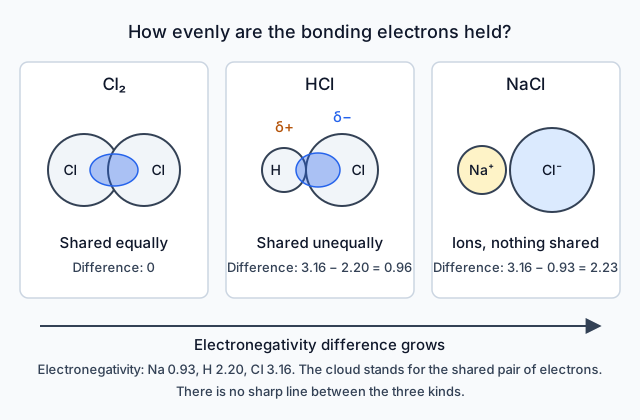
| Nonpolar covalent bond | A bond in which two atoms of the same or similar electronegativity share valence electrons evenly. | Nonpolar does not mean no electrons are shared: the electrons are shared, just evenly. |
| Polar covalent bond | A covalent bond between atoms of unequal electronegativity, in which the shared electrons spend more time near one atom. | The electrons are still shared and no full ion forms, so write δ+ and δ−, never a charge of 1+ or 1−, on its atoms. |
| Bond dipole | The separation of partial positive and partial negative charge along a polar bond. | A bond dipole belongs to one bond; whether a whole molecule is polar is a separate question that also depends on its shape. |
| Ionic bond | The attraction between oppositely charged ions, cations and anions, that holds an ionic compound together. | An ionic compound has no separate molecules, so its formula gives the ratio of its ions, not a count of atoms in one particle. |
 Tap to open the picture full size
Part 1 Think first A wire and its coating
Commit to a guess first. Being wrong now makes the right idea stick better.
Predict first
The copper wire inside a phone charger cable carries an electric current, while the coating around it, a plastic such as polyethylene made of carbon and hydrogen atoms, carries none. What best explains the difference?
In short. The type of bond between two atoms depends on how strongly each attracts valence electrons: shared evenly in a nonpolar covalent bond, unevenly in a polar covalent bond, transferred to form ions in an ionic bond, and spread through the whole solid in a metal.
- Electronegativity increases across a period and decreases down a group, as Coulomb's law and the shell model predict.
- In a polar bond the more electronegative atom is partially negative, and in single bonds a larger difference gives a larger bond dipole.
- Ionic and covalent bonding form a continuum: the elements are a guide, and a compound's properties are the best evidence.
Part 2 Learn it How atoms hold their valence electrons
2a. Electronegativity across and down the table
Electronegativity is how strongly an atom in a bond attracts the electrons it shares with another atom. On the scale chemists use most, values run from below 1 for the alkali metals up to 3.98 for fluorine, the most electronegative element.
The trend comes from Coulomb's law: the attraction between the nucleus and a bonding electron is stronger when the charge pulling on the electron is larger and when the electron is closer to it.
- Across a period, electronegativity increases. The core charge (protons minus inner electrons) grows by one with each element, while the valence electrons stay in the same shell, so the bonding electrons are pulled harder. In period 2 it rises from lithium, 0.98, to fluorine, 3.98.
- Down a group, electronegativity decreases. Each element adds a shell, so the valence shell sits farther from the nucleus, while the core charge stays the same. In group 17 it falls from fluorine, 3.98, to chlorine, 3.16, and bromine, 2.96.
In the shell model, then, two numbers predict an atom's pull on bonding electrons: its core charge and the shell its valence electrons are in.
Quick check · Rank it
Carbon, oxygen and nitrogen are in period 2, and silicon is directly below carbon in period 3. Rank carbon, oxygen, silicon and nitrogen by electronegativity.
Highest electronegativity first
Give each one a place, 1 for first. Give two the same place if they are equal.
Your ranking: none yet
2b. Sharing electrons: nonpolar and polar bonds
When two nonmetal atoms bond, they share valence electrons in a covalent bond. How evenly they share depends on the difference between their electronegativities.
- In a nonpolar covalent bond the two atoms have the same or similar electronegativity, so the shared electrons are held evenly between them. H-H and Cl-Cl are nonpolar. Bonds between carbon and hydrogen count as effectively nonpolar too, even though carbon (2.55) is slightly more electronegative than hydrogen (2.20).
- In a polar covalent bond the electronegativities are unequal, so the shared electrons spend more time near the more electronegative atom. That atom develops a partial negative charge, written δ−, and the other atom a partial positive charge, δ+. This separation of charge along the bond is a bond dipole.
In single bonds, a greater difference in electronegativity gives a greater bond dipole. H-F, with a difference of 3.98 − 2.20 = 1.78, has a larger bond dipole than H-Cl, with 3.16 − 2.20 = 0.96.
Quick check · Fill the statement
Complete the description of two bonds to hydrogen. The electronegativities are N 3.04, H 2.20 and P 2.19.
An N-H bond is , and the atom in it carries a partial negative charge. A P-H bond is .
2c. Ionic or covalent: a continuum
Every polar bond has some ionic character. As the difference in electronegativity grows, the shared electrons are pulled further toward one atom, and at the far end of the range that atom has in effect taken them: the two become a cation and an anion, held together by the attraction of opposite charges, an ionic bond. There is no sharp line where polar covalent stops and ionic begins. The kinds of bonding form a continuum.
So how do you decide which a compound has? Two guides:
- The elements. Generally, bonds between a metal and a nonmetal are ionic (NaCl, MgO), and bonds between two nonmetals are covalent (CO₂, H₂O). The difference in electronegativity is not the only factor, so do not classify a bond by a cutoff number alone.
- The properties. Examining how the compound behaves is the best way to characterize its bonding. Typically, an ionic compound is a solid that melts only at a high temperature, and its melt conducts electricity. A substance made of separate covalent molecules, such as water or carbon dioxide, melts at a far lower temperature, and its liquid conducts electricity very poorly or not at all. Unit 3 explains why these properties follow from the bonding.
Quick check · Decide and justify
Calcium fluoride, CaF₂, is a hard solid that melts at 1418 °C, and the melted compound conducts electricity. Is the bonding in calcium fluoride ionic or covalent?
Which reason best supports your claim?
2d. Electrons in a metal
A sample of a pure metal, such as sodium or copper, has no more electronegative partner to share electrons with or to hand them to. Every atom is the same, and each holds its valence electrons only weakly.
In a metallic solid, the valence electrons are delocalized: they are not associated with any individual atom, but belong to the whole piece of metal. In solid sodium, each atom contributes its one 3s electron, and what stays in place is the rest of each atom, its nucleus and inner electrons.
That makes a metal different from both kinds of bond above. In a covalent bond, the shared electrons belong to the two atoms they join. In an ionic bond, electrons have moved from the metal atoms to the nonmetal atoms, which become anions. In a metal, the valence electrons belong to the sample as a whole.
Quick check · Multiple choice
Which statement best describes the valence electrons in a piece of solid magnesium?
Part 3 Watch it done Three bonds in one molecule
Predict first, then watch each step, then finish the comparison yourself.
Methanol, CH₃OH, the fuel in some camping stoves, contains three kinds of bond: C-H, C-O and O-H. The electronegativities are H 2.20, C 2.55 and O 3.44. Which bond is the most polar, and which of its atoms carries the partial negative charge?
Predict first
Before you open the first step, predict: which of the three bonds is the most polar?
Step 1 · Find the difference in the C-H bond
2.55 − 2.20 = 0.35. The difference is small, so the C-H bond is treated as effectively nonpolar.
Step 2 · Find the difference in the C-O bond
3.44 − 2.55 = 0.89. Oxygen has the higher value, so the C-O bond is polar, with δ− on oxygen and δ+ on carbon.
Why this step?
Why subtract the smaller value from the larger one?
The size of the difference measures how unevenly the electrons are shared, so it is never negative. Which atom has the higher value is a separate question, and it tells you where the partial negative charge goes.
Your step · Multiple choice
Finish it. In methanol, CH₃OH, the C-H bond has an electronegativity difference of 0.35 and the C-O bond 0.89. With H 2.20 and O 3.44, which bond in methanol is the most polar, and which atom of that bond carries the partial negative charge?
Two bonds that share an atom can differ a lot in polarity. Oxygen is the δ− end of both of its bonds in methanol, but its bond to hydrogen, with a difference of 1.24, is more polar than its bond to carbon, with 0.89.
Part 4 Try it A larger difference, yet not ionic
Here are two compounds, with the electronegativities of their elements and some measured properties.
- Hydrogen fluoride, HF: H 2.20 and F 3.98, a difference of 1.78. At room temperature HF is a gas (it boils at about 20 °C) made of separate HF molecules, and the pure liquid conducts electricity very poorly.
- Lithium iodide, LiI: Li 0.98 and I 2.66, a difference of 1.68. LiI is a white solid that melts at 469 °C, and the melt conducts electricity well.
Try it · Decide and justify
Hydrogen fluoride, HF, has a larger electronegativity difference (1.78) than lithium iodide, LiI (1.68). HF boils at about 20 °C, is made of separate molecules, and its pure liquid conducts electricity very poorly. Is the bonding in hydrogen fluoride ionic or covalent?
Which reason best supports your claim?
Part 5 Explain it Chlorine and its bonds
On the exam this is handwritten, so answer on paper first. Nothing you type here leaves this page. Then check your answer against the model and each scoring point.
Free response is 50% of the exam score. This one is shaped like a short-answer question, which is worth 4 points.
Free-response practice · Short-answer style
Use these electronegativity values: H 2.20, C 2.55, Br 2.96, Cl 3.16.
(a) Identify the atom in a C-Cl bond that develops a partial negative charge.
(b) Explain, using Coulomb's law and the shell model, why chlorine is more electronegative than bromine, which is directly below it in group 17.
(c) Make a claim about which bond has the greater bond dipole, H-Cl or H-Br, and justify it with the values given.
(d) Potassium chloride, KCl, is a white solid that melts at 770 °C and conducts electricity when melted. Make a claim about whether the bonding in KCl is ionic or covalent, and justify it with two pieces of evidence.
Model answer
(a) Chlorine. Its electronegativity, 3.16, is higher than carbon's, 2.55, so the shared electrons are pulled toward chlorine.
(b) Chlorine and bromine both have a core charge of +7, but chlorine's valence electrons are in the third shell and bromine's are in the fourth, farther from the nucleus. By Coulomb's law the same charge attracts a closer electron more strongly, so chlorine attracts bonding electrons more strongly.
(c) H-Cl. Its difference is 3.16 − 2.20 = 0.96, larger than H-Br's 2.96 − 2.20 = 0.76, and in single bonds a larger difference in electronegativity gives a larger bond dipole.
(d) Ionic. Potassium is a metal and chlorine a nonmetal, and the compound's properties, a high melting point and a melt that conducts electricity, match an ionic compound.
Score your own answer. This is a self-check, not a grade. Tick each point your answer makes.
Part 6 Check yourself Bonds to hydrogen and to fluorine
Both case questions use the table.
The table gives the electronegativity of hydrogen and of five elements in period 2, on the scale chemists use most. These are measured values.
| Element | Electronegativity |
|---|---|
| Hydrogen (H) | 2.20 |
| Beryllium (Be) | 1.57 |
| Carbon (C) | 2.55 |
| Nitrogen (N) | 3.04 |
| Oxygen (O) | 3.44 |
| Fluorine (F) | 3.98 |
Case question 1 · Multiple choice
Using the table: in which of these single bonds does the hydrogen atom carry a partial negative charge?
Case question 2 · Rank it
Using the table: rank the single bonds C-F, F-F, Be-F and O-F by the size of their bond dipoles.
Largest bond dipole first
Give each one a place, 1 for first. Give two the same place if they are equal.
Your ranking: none yet
The rest stand on their own and do not use the case.
Check yourself · Sort it
Each card names a substance. Tap a card, then the bin for the kind of bonding that holds it together.
Ionic
Covalent
Metallic
Check yourself · Spot the error
A student explains why chlorine is more electronegative than iodine, which is two rows below it in group 17. Tap the line with the mistake.
Part 7 Keep it Bring back earlier ideas
This lesson leans on two earlier ideas: how electronegativity changes across a period and down a group, from Periodic Trends, and how a metal and a nonmetal form ions with typical charges, from Valence Electrons and Ionic Compounds. Pulling them back up is what makes them last.
From 1.8 Valence Electrons and Ionic Compounds · Match
Match each element to the typical charge of its ion in an ionic compound.
From 1.7 Periodic Trends · Fill the statement
Complete the explanation of the trend in electronegativity down group 17, from fluorine to iodine.
Moving down the group, the valence electrons are in a shell the nucleus, and more inner electrons them from it. The attraction is weaker, so the electronegativity .
In three lines
- Electronegativity increases across a period and decreases down a group, because the core charge and the distance of the valence shell set an atom's pull on bonding electrons.
- Similar electronegativities share electrons evenly (nonpolar covalent); unequal ones give a polar bond with δ− on the more electronegative atom, and a larger difference gives a larger bond dipole.
- Bonding is a continuum: a metal with a nonmetal is generally ionic and two nonmetals covalent, properties are the best evidence, and a metal's valence electrons are delocalized.
Exam strategy for this topic
- Section I, Multiple Choice: 60 questions in 90 minutes.
- Section II, Free Response: 7 questions in 105 minutes.
- A scientific or graphing calculator is recommended for use on both sections of the exam.
When a question asks you to compare bonds or to justify a type of bonding, write the electronegativity values or the difference you used and name the atom that is δ−. For ionic or covalent, give evidence from both the elements and the properties, and for a trend, name both the core charge and the shell.
Questions students ask
What is electronegativity?
It is how strongly an atom in a bond attracts the electrons it shares. It increases across a period and decreases down a group, and fluorine has the highest value, 3.98.
How do you tell a polar bond from a nonpolar one?
Compare the electronegativities of the two atoms. The same or similar values give a nonpolar bond with evenly shared electrons; unequal values give a polar bond.
Which atom in a polar bond gets the partial negative charge?
The atom with the higher electronegativity. It pulls the shared electrons toward itself, so it is δ− and its partner is δ+.
Is there an electronegativity difference that makes a bond ionic?
No single number works, because ionic and covalent bonding form a continuum. A metal with a nonmetal generally forms an ionic bond and two nonmetals a covalent one, and the compound's properties are the best test.
What holds the atoms of a metal together?
In a metallic solid the valence electrons are delocalized: they are not associated with any individual atom, but belong to the whole piece of metal.
Course alignment, for teachers
AP Chemistry topic 2.1, Unit 2: Compound Structure and Properties.
- Skill 6.A: Make a scientific claim.
This lesson maps all 5 essential knowledge statements of the topic to the part that teaches each one: 5 are checked by a scored question. The map is in the lesson file.