Unit 2 · Topic 2.2 · about 30 minutes · 7 parts · 9 scored checks, 0 of them multiple choice, plus 2 from earlier lessons
AP Chemistry 2.2: Intramolecular Force and Potential Energy
Unit 2: 7 to 9% of the multiple-choice section
What you'll be able to do
- Represent how the potential energy of two atoms changes with the distance between them, and explain how bond order, the size of the atoms and the charges of ions affect the strength of the interaction.
Key vocabulary
| Term | What it means | The exam trap |
|---|---|---|
| Internuclear distance | The distance between the nuclei of two atoms, usually given in picometers (pm). | It is measured from nucleus to nucleus, not from the edge of one electron cloud to the edge of the other. |
| Bond length | The internuclear distance at which the potential energy of two bonded atoms is lowest. | Bond lengths are tiny, so check the unit: 1 pm is 10⁻¹² m. |
| Bond energy | The energy required to separate two bonded atoms; on a potential energy graph, the depth of the lowest point below zero. | It is quoted per mole of bonds, in kJ/mol, so compare it with other molar values, not with the energy of a single molecule. |
| Bond order | The number of electron pairs two bonded atoms share: 1 for a single bond, 2 for a double bond and 3 for a triple bond. | A molecular formula alone does not show it, so use the bond order a question gives you; working it out from a structure comes later in the unit. |
 Tap to open the picture full size
Part 1 Think first Why the nitrogen in air is so hard to use
Commit to a guess first. Being wrong now makes the right idea stick better.
Predict first
Nitrogen gas, N₂, makes up about 78% of the air, yet crops cannot use it directly, and fertilizer plants that turn it into ammonia run at roughly 400 to 500 °C with a catalyst. In N₂ the two nitrogen atoms share three pairs of electrons, a triple bond. In hydrazine, N₂H₄, the two nitrogen atoms share one pair, a single bond. How do the two nitrogen-nitrogen bonds compare?
In short. A graph of potential energy against the distance between two atoms shows the bond length at its lowest point and the bond energy as the depth of that point below zero.
- Bonds with a higher bond order are shorter and have larger bond energies.
- Atoms with larger cores form longer bonds.
- Between a cation and an anion, larger charges and smaller ions give a stronger attraction, as Coulomb's law predicts.
Part 2 Learn it Energy, distance and bond strength
2a. Potential energy against distance
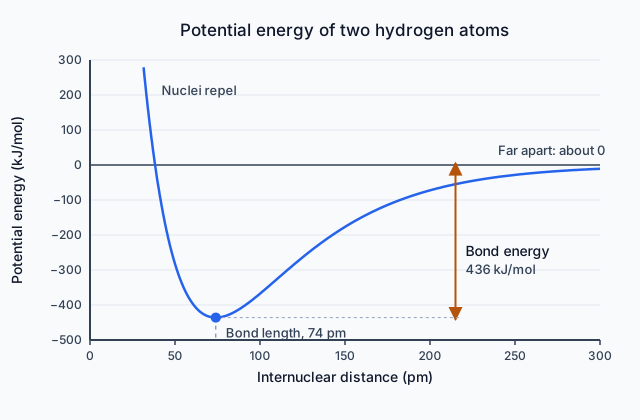
Picture two hydrogen atoms far apart. They do not interact, and their potential energy is taken as zero. As they move closer, each nucleus attracts the other atom's electron. The attractions win, and the potential energy falls below zero.
The atoms cannot keep getting closer. At short distances the two positive nuclei repel each other, and so do the electrons. These repulsions grow faster than the attractions, so if the atoms are pushed closer still, the potential energy rises steeply.
A graph of potential energy against internuclear distance, the distance between the two nuclei, shows the whole story, as the diagram at the top of this lesson does for H₂:
- The atoms settle at the lowest point. Its distance is the bond length: 74 pm for H₂.
- Its depth below zero is the bond energy, the energy required to separate the atoms: 436 kJ/mol for H₂. Energy must be added to break a bond, so the bond energy is a positive number even though the potential energy at the bottom is negative.
- Beyond the bond length the curve climbs back toward zero, and it levels off once the atoms are too far apart to interact.
Quick check · Spot the error
A student describes the potential energy of two atoms as they approach each other from far apart. Tap the line with the mistake.
2b. What makes a bond shorter and stronger
Two things set the length of a covalent bond.
The size of the atoms' cores. An atom with more shells has a larger core, so the bonding electrons, and the other nucleus, sit farther from its own nucleus. The C-C bond in ethane is 154 pm long, and the Si-Si bond in solid silicon, between two larger atoms from period 3, is 235 pm.
The bond order. The bond order is the number of electron pairs the two atoms share: 1 in a single bond, 2 in a double bond, 3 in a triple bond. More shared pairs pull the two nuclei closer and hold them more strongly, so bonds with a higher order are shorter and have larger bond energies. For bonds between two carbon atoms:
- C-C, a single bond (ethane): 154 pm and 347 kJ/mol
- C=C, a double bond (ethene): 134 pm and 614 kJ/mol
- C≡C, a triple bond (ethyne): 120 pm and 839 kJ/mol
On a potential energy graph, a bond of higher order has its lowest point farther to the left, because it is shorter, and deeper, because it takes more energy to separate.
Quick check · Rank it
Carbon and oxygen are joined by a single bond in methanol, CH₃OH, by a triple bond in carbon monoxide, CO, and by double bonds in carbon dioxide, CO₂. Rank these carbon-oxygen bonds by bond energy.
Largest bond energy first
Give each one a place, 1 for first. Give two the same place if they are equal.
Your ranking: none yet
2c. Attraction between ions
In an ionic compound the interaction is between a cation and an anion, and Coulomb's law describes its strength. The attraction between them:
- is proportional to the charge on each ion, so larger charges lead to stronger interactions;
- gets stronger as the distance between the centers of the ions (their nuclei) decreases, so smaller ions, whose centers can come closer, lead to stronger interactions. The distance between the centers of two touching ions is about the sum of their radii.
Compare potassium fluoride with potassium chloride. Both pair a 1+ cation with a 1− anion, but F⁻ (radius 133 pm) is smaller than Cl⁻ (181 pm), so K⁺ and F⁻ come closer together and attract more strongly.
Now compare calcium oxide with potassium chloride. Ca²⁺ and O²⁻ each carry twice the charge of K⁺ and Cl⁻, and they are smaller too (Ca²⁺ 100 pm and O²⁻ 140 pm, against K⁺ 138 pm and Cl⁻ 181 pm), so the attraction between the ions in calcium oxide is far stronger.
Quick check · Decide and justify
Which compound has the stronger attraction between its cation and its anion: sodium fluoride, made of Na⁺ and F⁻, or magnesium oxide, made of Mg²⁺ and O²⁻? The ionic radii are Na⁺ 102 pm, F⁻ 133 pm, Mg²⁺ 72 pm and O²⁻ 140 pm.
Which reason supports your decision?
Part 3 Watch it done Reading bond data from a table
Predict first, then watch each step, then finish the reading yourself.
A model gives the potential energy of a hydrogen atom and a chlorine atom at several internuclear distances. These numbers are a teaching example, built from the measured bond length and bond energy of HCl.
- 80 pm: +424 kJ/mol
- 100 pm: −245 kJ/mol
- 127 pm: −431 kJ/mol
- 150 pm: −378 kJ/mol
- 200 pm: −192 kJ/mol
- 300 pm: −33 kJ/mol
- far apart: 0 kJ/mol
What is the bond length of HCl, and what is its bond energy?
Predict first
Before you open the first step, predict: at which of the listed distances do the atoms settle?
Step 1 · Find the lowest potential energy
Read down the list: the potential energy falls from +424 kJ/mol at 80 pm to −431 kJ/mol at 127 pm, then rises again. The lowest value, −431 kJ/mol, is at 127 pm.
Step 2 · Read the bond length
The atoms settle where the potential energy is lowest, so the bond length of HCl is 127 pm.
Why this step?
Why is the bond length not 80 pm, the shortest distance listed?
At 80 pm the nuclei are so close that their repulsion makes the potential energy positive, +424 kJ/mol. From there the atoms would move apart until they reached the lowest point, at 127 pm.
Step 3 · Set up the bond energy
The bond energy is the energy required to take the atoms from the lowest point to far apart, where the potential energy is 0. That is the change from −431 kJ/mol up to 0.
Your step · Calculate
Finish it. In a model of HCl, the potential energy is lowest, −431 kJ/mol, at 127 pm, rises to −33 kJ/mol at 300 pm, and is 0 when the atoms are far apart. What is the bond energy of HCl, in kJ/mol? Give your answer to three significant figures.
kJ/mol
Every potential energy graph or table is read the same way: the distance of the lowest point is the bond length, and its depth below zero is the bond energy. For HCl, that is 127 pm and 431 kJ/mol.
Part 4 Try it Pulling a molecule apart
A hydrogen bromide molecule, HBr, has a bond length of 141 pm. Suppose its two atoms are pulled apart, one small step at a time, until they are well past that distance.
Try it · Sketch the graph
In HBr the bond length is 141 pm. Sketch the shape of the graph of potential energy against internuclear distance as the atoms are pulled apart from 200 pm to 325 pm. The first point, at 200 pm, is placed for you; drag the others so the curve rises or falls the way the potential energy does, and bends the same way along its whole length, as the potential energy does.
One shape that fits
Drag a point up or down, or tap it and use the arrow keys. Only the shape is checked.
Part 5 Explain it Nitrogen and oxygen on one graph
On the exam this is handwritten and the graph is drawn on paper, so answer and sketch on paper first. Nothing you type here leaves this page. Then compare your work with the model graph and each scoring point.
Free response is 50% of the exam score. This one is shaped like a short-answer question, which is worth 4 points.
Free-response practice · Short-answer style
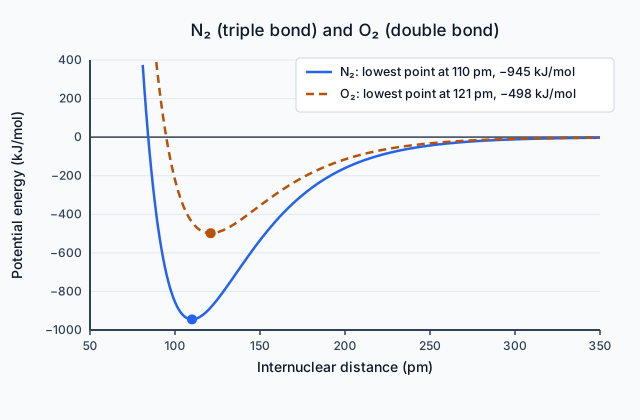
A potential energy curve for two nitrogen atoms has its lowest point at an internuclear distance of 110 pm and a potential energy of −945 kJ/mol. The atoms in N₂ share a triple bond; the atoms in O₂ share a double bond.
(a) Identify the bond length and the bond energy of N₂.
(b) On paper, draw axes of potential energy (kJ/mol) against internuclear distance (pm), and represent the potential energy curve of N₂, from very short distances to atoms far apart.
(c) On the same axes, represent the potential energy curve of O₂.
(d) Justify where you placed the lowest point of the O₂ curve relative to that of N₂, in terms of the sizes of the atoms and bond order.
Model answer
(a) The bond length is 110 pm, and the bond energy is 945 kJ/mol, the energy needed to separate the atoms.
(b) The curve is near zero far apart, falls to its lowest point at 110 pm and −945 kJ/mol, and rises steeply at distances shorter than 110 pm, where the nuclei repel.
(c) The O₂ curve has the same shape, with its lowest point to the right of N₂'s (a longer bond) and higher, closer to zero (a smaller bond energy). It also levels off at zero far apart.
(d) O₂ has a bond order of 2 and N₂ a bond order of 3. Nitrogen and oxygen are neighbors in period 2 with cores of similar size, so bond order decides the difference. A bond of lower order is longer and has a smaller bond energy, so the lowest point of the O₂ curve is at a longer distance and is less deep. The measured values for O₂ are 121 pm and 498 kJ/mol.
 Tap to open the picture full size
Score your own answer. This is a self-check, not a grade. Tick each point your answer makes.
Part 6 Check yourself Two halogen molecules
Both case questions use the graph.
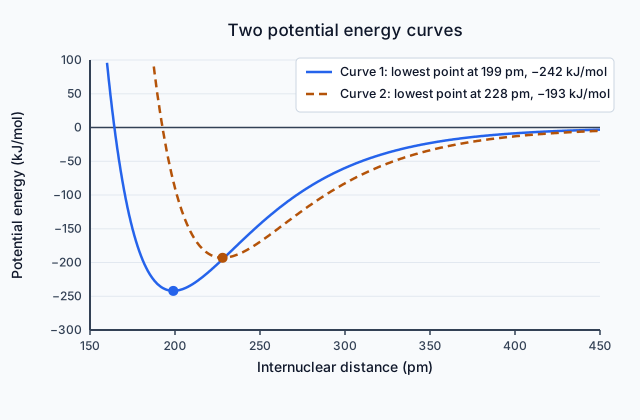
The graph shows potential energy curves for two diatomic molecules. One is Cl₂ and the other is Br₂. The curves are drawn from a model matched to the measured bond length and bond energy of each molecule.
 Tap to open the picture full size
Case question 1 · Decide and justify
Using the graph: which curve belongs to Br₂?
Which reason supports your decision?
Case question 2 · Calculate
Using the graph: how much energy, in kJ/mol, is needed to separate the atoms of the molecule shown by curve 1? Give your answer to three significant figures.
The rest stand on their own and do not use the case.
Check yourself · Select all
A cation and an anion attract each other. Which two changes would each make the attraction between them stronger? Pick two.
Select 2 answers, then check.
Check yourself · Rank it
Hydrogen forms a single bond with each element of group 17. Rank the bonds H-Br, H-F, H-I and H-Cl by bond length.
Shortest bond first
Give each one a place, 1 for first. Give two the same place if they are equal.
Your ranking: none yet
Part 7 Keep it Bring back earlier ideas
This lesson leans on two earlier ideas: how the elements and the measured properties of a compound show whether its bonding is ionic, from Types of Chemical Bonds, and how the size of an ion compares with the size of its atom, from Periodic Trends. Pulling them back up is what makes them last.
From 2.1 Types of Chemical Bonds · Decide and justify
Calcium fluoride, CaF₂, is a hard solid that melts at 1418 °C, and the melted compound conducts electricity. Is the bonding in calcium fluoride ionic or covalent?
Which reason best supports your claim?
From 1.7 Periodic Trends · Sort it
Each card names an ion. Tap a card, then the bin that compares the ion's radius with the radius of its neutral atom.
Larger than its neutral atom
Smaller than its neutral atom
In three lines
- On a graph of potential energy against internuclear distance, the lowest point gives the bond length, and its depth below zero gives the bond energy.
- Bonds of higher order are shorter and have larger bond energies, and bonds between atoms with larger cores are longer.
- By Coulomb's law, a cation and an anion attract more strongly when their charges are larger and their centers are closer.
Exam strategy for this topic
- Section I, Multiple Choice: 60 questions in 90 minutes.
- Section II, Free Response: 7 questions in 105 minutes.
- A scientific or graphing calculator is recommended for use on both sections of the exam.
When you draw a potential energy curve, label both axes with units, start near zero at large distances, mark the distance and energy of the lowest point, and make the curve rise steeply at short distances. When you compare two curves, say which lowest point is farther left and which is deeper, and give the reason: bond order, atom size or ion charge.
Questions students ask
What does a graph of potential energy against internuclear distance show?
How the energy of two atoms changes as they come together. The distance of the lowest point is the bond length, and the depth of that point below zero is the bond energy.
Why does the curve rise so steeply at short distances?
When the atoms are pushed closer than the bond length, the repulsions between the two nuclei, and between the electrons, grow faster than the attractions, so the potential energy climbs.
Is bond energy positive or negative?
Positive. The potential energy at the bottom of the curve is negative, but energy must be added to separate the atoms, and the bond energy is the size of that energy.
Why is a triple bond shorter and stronger than a single bond?
A triple bond shares three pairs of electrons instead of one, which pulls the two nuclei closer and holds them more strongly. Bonds of higher order are shorter and have larger bond energies.
How does Coulomb's law compare the attraction between different ions?
The attraction is proportional to the charge on each ion and grows as the distance between their centers shrinks, so ions with larger charges and smaller radii attract more strongly.
Course alignment, for teachers
AP Chemistry topic 2.2, Unit 2: Compound Structure and Properties.
- Skill 3.A: Represent chemical phenomena using appropriate graphing techniques, including correct scale and units.
This lesson maps all 3 essential knowledge statements of the topic to the part that teaches each one: 3 are checked by a scored question. The map is in the lesson file.