Unit 2 · Topic 2.3 · about 30 minutes · 7 parts · 10 scored checks, 1 of them multiple choice, plus 2 from earlier lessons
AP Chemistry 2.3: Structure of Ionic Solids
Unit 2: 7 to 9% of the multiple-choice section
What you'll be able to do
- Represent an ionic solid with a particulate model that is consistent with Coulomb's law and with the charges and sizes of its ions.
Key vocabulary
| Term | What it means | The exam trap |
|---|---|---|
| Ionic solid | A solid made of cations and anions held together by the attraction between opposite charges. | A question may give only the name of the solid, so work out each ion's charge from the periodic table before you count or draw anything. |
| Cation | A positively charged ion, formed when an atom loses one or more electrons. | Write the charge on every cation you draw, because a model is judged on the charges as well as the elements. |
| Anion | A negatively charged ion, formed when an atom gains one or more electrons. | An anion's name changes its ending (chloride, oxide, fluoride), so read the ending to tell the ion from its element. |
| Coulomb's law | The force between two charged particles is proportional to the product of their charges and inversely proportional to the square of the distance between their centers. | The force depends on the product of the charges, so doubling one charge doubles the force rather than adding to it. |
 Tap to open the picture full size
Part 1 Think first Salt from seawater
Commit to a guess first. Being wrong now makes the right idea stick better.
Predict first
At a salt works, seawater sits in shallow ponds in the sun. As the water evaporates, sodium ions and chloride ions that were moving freely through the water come out of it as solid salt crystals. How are the ions arranged in a crystal of salt?
In short. An ionic solid is a repeating 3-D array of cations and anions, arranged so that the attractions between opposite charges are as large as possible and the repulsions between like charges as small as possible.
- Each ion's closest neighbors have the opposite charge, and the array has no separate molecules.
- The array has no net charge, so the ratio of cations to anions follows their charges.
- A model draws each ion to scale from its radius, with neighbors of opposite charge touching.
Part 2 Learn it Modeling an ionic solid
2a. Opposite charges side by side
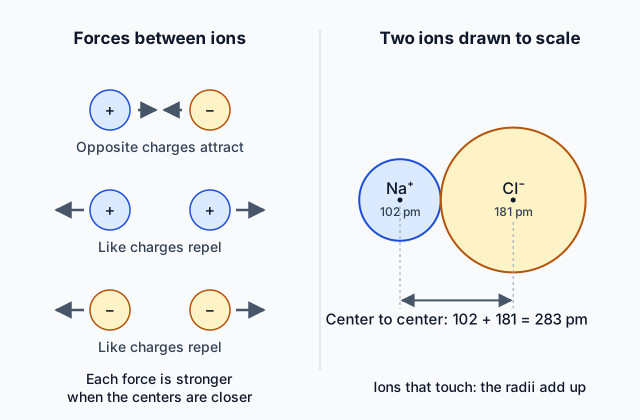
An ionic solid is made of cations and anions. Coulomb's law describes how they interact: opposite charges attract, like charges repel, and both forces grow stronger as the distance between the centers of the ions shrinks.
So the ions do not sit just anywhere. In an ionic crystal they are arranged in a systematic, periodic 3-D array: a pattern that repeats in every direction, in which the attractions among cations and anions are as large as possible and the repulsions as small as possible. In practice:
- each ion's closest neighbors are ions of the opposite charge;
- ions of the same charge are kept farther apart, with ions of the opposite charge between them;
- the pattern does not stop at a pair. Each ion is attracted to all of its neighbors at once, so the crystal has no separate molecules in it.
A particulate model of an ionic solid is a drawing of this array. On paper it is usually one flat layer of the 3-D pattern, with each ion drawn as a circle labeled with its charge.
Quick check · Sort it
Each card describes a feature of a student's model of one layer of solid sodium chloride. Tap a card, then the bin it belongs in.
Fits a real ionic crystal
Does not fit a real ionic crystal
2b. Charges set the ratio
A sample of an ionic solid that you can hold has no net charge, so neither does the array. The total positive charge of the cations equals the total negative charge of the anions, and that fixes the ratio of ions in a model.
The typical charges come from the periodic table: 1+ for group 1, 2+ for group 2, 3+ for aluminum, 3− for group 15, 2− for group 16 and 1− for group 17.
Example: magnesium chloride. Magnesium forms Mg²⁺ and chlorine forms Cl⁻. One Mg²⁺ carries a charge of +2, which takes two Cl⁻ ions to balance, so a model of magnesium chloride shows two chloride ions for every magnesium ion. A model with equal numbers of each would carry a net positive charge, so it cannot be right.
The formula of an ionic compound is this ratio in lowest terms. MgCl₂ is a formula unit, not a molecule: it says the whole crystal holds one Mg²⁺ for every two Cl⁻.
Quick check · Calculate
A student's model of solid aluminum oxide shows 18 oxide ions, O²⁻. How many aluminum ions, Al³⁺, must the model show so that it has no net charge? Give a whole number.
2c. Sizes set the spacing
A model should also fit the sizes of the ions, so draw each one to scale from its ionic radius.
Recall how ion sizes compare: a cation is smaller than the atom it came from, an anion is larger than its atom, and among ions with the same number of electrons, the one with more protons is smaller. Those rules compare an ion with its own atom, or with an ion that has the same number of electrons. To compare a cation with an anion of a different element, read their radii from the data rather than guessing from the charges.
In the array, each ion touches its neighbors of the opposite charge. The distance between the centers of a cation and a neighboring anion is therefore about the sum of their radii. Example: sodium chloride. Na⁺ has a radius of 102 pm and Cl⁻ a radius of 181 pm, so the centers of neighboring ions are about 102 + 181 = 283 pm apart; the measured distance is 282 pm. By Coulomb's law, smaller ions sit closer together and attract each other more strongly.
Quick check · Rank it
Ionic radii, in picometers: Li⁺ 76, Na⁺ 102, K⁺ 138, Rb⁺ 152, F⁻ 133, Cl⁻ 181, Br⁻ 196. In a model of each solid, each cation touches its neighboring anions. Rank the four solids by the distance between the centers of a cation and a neighboring anion.
Shortest distance first
Give each one a place, 1 for first. Give two the same place if they are equal.
Your ranking: none yet
Part 3 Watch it done A model of potassium fluoride
Predict first, then watch each step, then finish the model yourself.
A student is drawing one layer of solid potassium fluoride, KF. The radius of K⁺ is 138 pm and the radius of F⁻ is 133 pm. How should the ions be drawn, and how far apart are the centers of a K⁺ ion and a neighboring F⁻ ion?
Predict first
Before you open the first step, predict: which ion should the student draw larger?
Step 1 · Find the charges and the ratio
Potassium is in group 1 and forms K⁺; fluorine is in group 17 and forms F⁻. One +1 charge balances one −1 charge, so the layer shows one K⁺ for every F⁻.
Step 2 · Compare the sizes
The radii are 138 pm for K⁺ and 133 pm for F⁻, so the two ions are drawn almost the same size, with K⁺ very slightly larger. A K⁺ ion has 18 electrons in three shells, while an F⁻ ion has 10 electrons in two shells. Here the cation is the larger ion, which is why a model is drawn from the radii and not from the charges.
Why this step?
Why does the student put ions of opposite charge next to each other in every direction?
By Coulomb's law, opposite charges attract and like charges repel. Giving each ion closest neighbors of the opposite charge gives it the most attraction, and keeping ions of the same charge apart keeps the repulsion small.
Step 3 · Place the ions
Draw a layer in which every K⁺ has F⁻ ions as its closest neighbors and every F⁻ has K⁺ ions, with no two ions of the same charge touching, and each ion touching its neighbors of the opposite charge.
Your step · Calculate
Finish it. In a model of solid potassium fluoride, each K⁺ ion touches its neighboring F⁻ ions. The radius of K⁺ is 138 pm and the radius of F⁻ is 133 pm. What is the distance between the centers of a K⁺ ion and a neighboring F⁻ ion, in picometers? Give your answer to three significant figures.
pm
Potassium fluoride is a reminder that the larger ion is not always the anion. A model fits its ions only when it uses their own radii, places opposite charges side by side, and balances the charges.
Part 4 Try it Two student models
Two more ionic solids to model. These are the ionic radii you need: Li⁺ 76 pm, Ca²⁺ 100 pm and O²⁻ 140 pm.
Try it · Fill the statement
Complete the description of a correct model of one layer of solid lithium oxide. The radius of Li⁺ is 76 pm and the radius of O²⁻ is 140 pm.
The model shows lithium ions for every oxide ion. The oxide ions are drawn than the lithium ions. The closest neighbors of each oxide ion are .
Try it · Decide and justify
A student's model of solid calcium oxide gives every ion closest neighbors of the opposite charge, shows equal numbers of each ion, and draws each Ca²⁺ ion larger than each O²⁻ ion. The radius of Ca²⁺ is 100 pm and the radius of O²⁻ is 140 pm. Is the model consistent with the properties of the ions?
Which reason supports your decision?
Part 5 Explain it Model magnesium oxide
On the exam this is handwritten, so answer on paper first, and draw the model on paper too. Nothing you type here leaves this page. Then check your answer against the model and each scoring point.
Free response is 50% of the exam score. This one is shaped like a short-answer question, which is worth 4 points.
Free-response practice · Short-answer style
Magnesium oxide, MgO, is an ionic solid. The radius of Mg²⁺ is 72 pm and the radius of O²⁻ is 140 pm.
(a) Identify the ratio of Mg²⁺ ions to O²⁻ ions in the solid, and justify it using the charges of the ions.
(b) Represent one layer of solid magnesium oxide, with at least eight ions, on paper. Draw each ion as a circle labeled with its charge, with the sizes in the right proportion.
(c) Explain, using Coulomb's law, why your model places each ion next to ions of the opposite charge.
(d) The formula is written MgO. Explain why your model shows no separate MgO molecules.
Model answer
(a) One Mg²⁺ for every O²⁻. Magnesium is in group 2 and forms Mg²⁺; oxygen is in group 16 and forms O²⁻. One +2 charge balances one −2 charge, so the solid has no net charge at a 1 : 1 ratio.
(b) A layer of at least eight ions in which every Mg²⁺ has O²⁻ ions as its closest neighbors and every O²⁻ has Mg²⁺ ions, with no two ions of the same charge touching. Each O²⁻ circle is drawn about twice the radius of each Mg²⁺ circle (140 pm against 72 pm), and each ion touches its neighbors of the opposite charge.
(c) Opposite charges attract and like charges repel, and both interactions are stronger at shorter distances. Giving each ion closest neighbors of the opposite charge makes the attractions as large as possible, and keeping ions of the same charge farther apart, with an ion of the opposite charge between them, makes the repulsions as small as possible.
(d) Each ion is attracted to all of its neighbors of the opposite charge, not to one partner, so the array continues in every direction. MgO gives the ratio of ions in the whole crystal, not a molecule.
Score your own answer. This is a self-check, not a grade. Tick each point your answer makes.
Part 6 Check yourself Four models of lithium fluoride
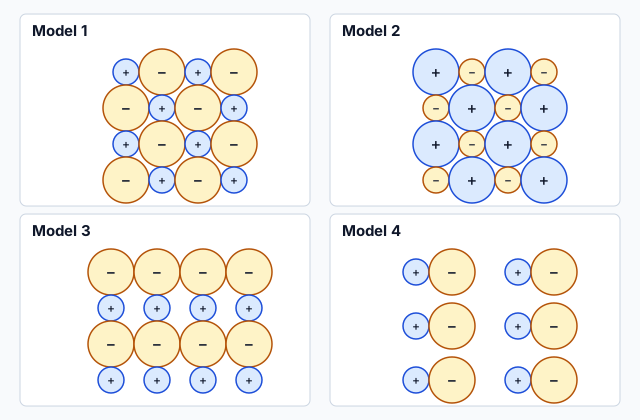
Both case questions use the figure.
Four students each drew one layer of solid lithium fluoride, LiF. The radius of Li⁺ is 76 pm and the radius of F⁻ is 133 pm. In the figure, a circle marked + is a Li⁺ ion and a circle marked − is an F⁻ ion.
 Tap to open the picture full size
Case question 1 · Multiple choice
Using the figure: which model is consistent with both Coulomb's law and the radii of the ions?
Case question 2 · Decide and justify
Using the figure: models 1 and 3 show the same ions at the same sizes. Which model's arrangement keeps the repulsions among the ions smaller?
Which reason supports your decision?
The rest stand on their own and do not use the case.
Check yourself · Spot the error
A student explains how many ions of each kind a model of solid calcium chloride should show. Tap the line with the mistake.
Check yourself · Select all
Which two statements are true of the arrangement of the ions in an ionic crystal? Select two.
Select 2 answers, then check.
Part 7 Keep it Bring back earlier ideas
This lesson leans on two earlier ideas: the attraction between a cation and an anion grows with their charges and with how close their centers are, and the charges of the ions decide the formula of an ionic compound. Pulling them back up is what makes them last.
From 2.2 Intramolecular Force and Potential Energy · Select all
A cation and an anion attract each other. Which two changes would each make the attraction between them stronger? Pick two.
Select 2 answers, then check.
From 1.8 Valence Electrons and Ionic Compounds · Fill the statement
Complete the predictions.
Lithium and oxygen form Li₂O. Sodium, below lithium in group 1, and sulfur, below oxygen in group 16, form . Calcium and chlorine form CaCl₂, so strontium, below calcium in group 2, and bromine, below chlorine in group 17, form .
In three lines
- In an ionic crystal, cations and anions form a repeating 3-D array in which each ion's closest neighbors have the opposite charge, which makes attraction largest and repulsion smallest.
- The array has no net charge, so the ratio of ions follows their charges, and a formula such as MgCl₂ is that ratio, not a molecule.
- A model draws each ion to scale from its radius, with neighbors of opposite charge touching and their centers about the sum of the two radii apart.
Exam strategy for this topic
- Section I, Multiple Choice: 60 questions in 90 minutes.
- Section II, Free Response: 7 questions in 105 minutes.
- A scientific or graphing calculator is recommended for use on both sections of the exam.
When a question asks for a particulate model of an ionic solid, show three things a reader can check: the ions alternate so that opposite charges are neighbors, the numbers of each ion balance the charges, and the circles are drawn to relative size from the radii given. Label every circle with its charge.
Questions students ask
What is the structure of an ionic solid?
A repeating 3-D array of cations and anions in which each ion's closest neighbors have the opposite charge. That arrangement makes the attractions as large as possible and the repulsions as small as possible.
Why are there no molecules in an ionic solid?
Each ion attracts all of its neighbors of opposite charge, not one partner, so the array continues in every direction. A formula such as NaCl gives the ratio of ions in the crystal.
How do you find the ratio of ions in an ionic solid?
Balance the charges. The total positive charge of the cations equals the total negative charge of the anions, so Mg²⁺ and Cl⁻ give two chloride ions for every magnesium ion.
Is the cation always smaller than the anion?
No. A cation is smaller than its own atom, but it can be larger than another element's anion: K⁺, at 138 pm, is larger than F⁻, at 133 pm. Draw ions from their radii.
How far apart are neighboring ions in an ionic solid?
Neighbors of opposite charge touch, so the distance between their centers is about the sum of their radii: about 283 pm in sodium chloride.
Beyond the AP Exam
College Board sets this limit on what the AP Exam asks about this topic. Anything past it is not on the exam.
Knowledge of specific crystal structures is not essential to an understanding of the learning objective and will not be assessed on the AP Exam.
Course alignment, for teachers
AP Chemistry topic 2.3, Unit 2: Compound Structure and Properties.
- Skill 4.C: Explain the connection between particulate-level and macroscopic properties of a substance using models and representations.
This lesson maps the one essential knowledge statement of the topic to the part that teaches each one: 1 is checked by a scored question. The map is in the lesson file.