Unit 2 · Topic 2.4 · about 30 minutes · 7 parts · 11 scored checks, 1 of them multiple choice, plus 2 from earlier lessons
AP Chemistry 2.4: Structure of Metals and Alloys
Unit 2: 7 to 9% of the multiple-choice section
What you'll be able to do
- Represent a metallic solid or an alloy with a model that shows its structure and the interactions that hold it together.
Key vocabulary
| Term | What it means | The exam trap |
|---|---|---|
| Metallic bonding | The bonding that holds the atoms of a solid metal, or of an alloy, together. | Name the particles in your model when you describe metallic bonding, since a description with no particles explains nothing. |
| Lattice | The regular, repeating pattern of positions that the particles of a crystalline solid occupy. | A drawing shows one flat layer of a lattice, but the real pattern repeats in three dimensions. |
| Alloy | A metal that contains atoms of one or more other elements mixed into its array. | An alloy is a mixture, so its composition can vary from one sample to another; use the amounts each question gives. |
| Interstitial alloy | An alloy in which atoms of the added element sit in the spaces between the atoms of the main metal, which keep their own positions. | Both kinds of alloy keep the main metal's lattice, so the main metal's pattern alone does not tell them apart. |
| Substitutional alloy | An alloy in which atoms of the added element take the places of some atoms of the main metal in its array. | Decide which element is the main metal first, since the added element is the one that fits into its array. |
 Tap to open the picture full size
Part 1 Think first Inside aluminum foil
Commit to a guess first. Being wrong now makes the right idea stick better.
Predict first
Kitchen foil is solid aluminum, and an aluminum atom has three valence electrons. Which picture best describes the particles in the foil?
In short. A metal is an array of positive metal ions surrounded by a sea of delocalized valence electrons, and an alloy adds atoms of a second element to that array, either in the spaces between the metal atoms or in place of some of them.
- The attraction between the positive ions and the delocalized electrons around them holds a metal together.
- Atoms much smaller than the metal's atoms fill the spaces between them: an interstitial alloy, such as carbon in steel.
- Atoms of comparable size take the places of some metal atoms: a substitutional alloy, such as zinc in brass.
Part 2 Learn it Modeling metals and alloys
2a. A sea of electrons
In a metal, each atom gives its valence electrons to the whole solid. What stays at each position is a positive ion, often called a core: the nucleus with its inner electrons. The cores sit in a regular array, and the valence electrons are delocalized: they move through the whole solid and belong to no single atom. This picture is called a sea of electrons.
Metallic bonding is the attraction between the positive cores and the sea around them. The cores repel one another, but each one is attracted to the electrons all around it, and that attraction holds the solid together. It is not a bond between two particular atoms.
The charges balance. Each core's charge equals the number of valence electrons its atom gave up, and the sea holds all of those electrons. Example: sodium has one valence electron, so a model of solid sodium shows Na⁺ cores with one delocalized electron for each core. A model with fewer electrons than that would carry a net positive charge.
Quick check · Calculate
A particulate model of a small piece of solid magnesium shows 15 magnesium cores. A magnesium atom has two valence electrons. How many delocalized electrons must the model show so that the piece has no net charge? Give a whole number.
2b. Interstitial alloys
An alloy is a metal with atoms of another element mixed into its array. Which kind of alloy forms depends on how the sizes of the two kinds of atoms compare.
When the added atoms have a significantly different radius, much smaller than the metal's atoms, they do not take over a metal atom's position. They fit into the interstices, the small spaces between the larger atoms, and the larger atoms keep their array. This is an interstitial alloy.
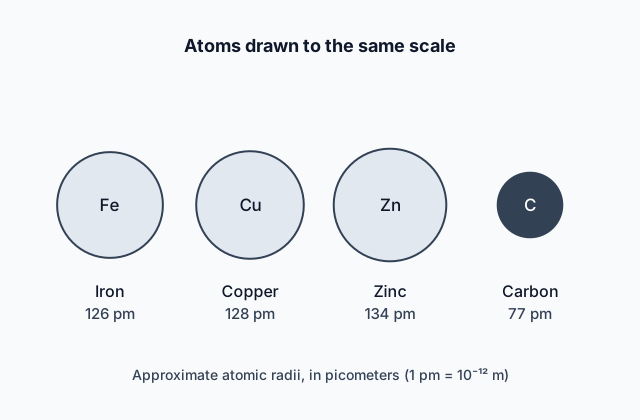
Steel is the classic example. Carbon atoms, with a radius of about 77 pm, are far smaller than iron atoms, about 126 pm, so in steel the carbon atoms occupy some of the spaces between the iron atoms. The iron array and its sea of electrons are still there, with carbon atoms tucked into some of the gaps.
Quick check · Decide and justify
Solid palladium metal can take up hydrogen gas, and the hydrogen atoms end up inside the palladium. A hydrogen atom has a radius of about 37 pm and a palladium atom a radius of about 137 pm. Where do the hydrogen atoms sit in the palladium?
Which reason supports your decision?
2c. Substitutional alloys
When the two kinds of atoms have comparable radii, an added atom fits where a metal atom would be. It takes that atom's place in the lattice, and the array keeps its pattern with two kinds of atoms at its sites. This is a substitutional alloy.
Brass is the classic example. Zinc atoms, about 134 pm, are close in size to copper atoms, about 128 pm, so in brass some zinc atoms substitute for copper atoms at their sites. The cores still sit in a regular array, and their valence electrons still form a sea around them.
So to decide which kind of alloy two elements form, compare their radii. Comparable radii point to a substitutional alloy; a much smaller added atom points to an interstitial one.
Quick check · Sort it
Each card names an element added to a metal, with approximate atomic radii. Tap a card, then the kind of alloy it forms.
Interstitial
Substitutional
Part 3 Watch it done Where does copper go in rose gold?
Predict first, then watch each step, then judge a drawing yourself.
Rose gold is gold with copper added. Gold atoms have a radius of about 144 pm and copper atoms a radius of about 128 pm. How should a model of rose gold be drawn?
Predict first
Before you open the first step, predict: where do the copper atoms go?
Step 1 · Compare the radii
Copper's radius divided by gold's is 128/144 = 0.89, so a copper atom is only about 11% smaller than a gold atom. That is comparable. Compare carbon in iron, 77/126 = 0.61, which is significantly smaller.
Step 2 · Recall where an added atom can go
An added atom either takes the place of a host atom at a site of the array, or sits in a gap between host atoms. Which one it does depends on how its size compares with the host atom's.
Why this step?
Why does the size of the gaps matter?
The gaps between atoms that touch are much smaller than the atoms themselves, so only an atom much smaller than the host atoms can fit in one.
Your step · Decide and justify
Finish it. Gold atoms have a radius of about 144 pm and copper atoms about 128 pm. A student's drawing of rose gold keeps a gold circle at every site of the array and puts copper circles, about 0.9 times the size of the gold circles, in the gaps between gold circles. Is the drawing consistent with the radii?
Which reason supports your decision?
Rose gold and steel are the two cases side by side: copper, about 0.89 times gold's radius, takes sites, while carbon, about 0.61 times iron's radius, fits between the iron atoms. A model of an alloy shows the added atoms at the size and in the place the radii call for.
Part 4 Try it Drawing brass
Yellow brass is an alloy of copper and zinc. Two students are getting ready to draw it.
Try it · Select all
Copper atoms have a radius of about 128 pm and zinc atoms a radius of about 134 pm. Select the two features a particulate model of yellow brass should show.
Select 2 answers, then check.
Try it · Calculate
A sample of brass holds one zinc atom for every three copper atoms. Copper atoms have a radius of about 128 pm and zinc atoms a radius of about 134 pm. A student draws one layer of this brass whose array has 24 sites. How many of the 24 sites should hold zinc atoms? Give a whole number. These numbers are a teaching example.
Part 5 Explain it Model stainless steel
On the exam this is handwritten, so answer on paper first, and draw the model on paper too. Nothing you type here leaves this page. Then check your answer against the model and each scoring point.
Free response is 50% of the exam score. This one is shaped like a short-answer question, which is worth 4 points.
Free-response practice · Short-answer style
Stainless steel is mostly iron, with chromium and a small amount of carbon added. The approximate atomic radii are iron 126 pm, chromium 128 pm and carbon 77 pm.
(a) Identify which added element takes the places of iron atoms in the array, and which fills the spaces between iron atoms.
(b) Justify your answer to part (a) using the radii.
(c) Represent one layer of stainless steel on paper, with at least twelve metal atoms, showing where the chromium and carbon atoms sit. Draw each kind of atom to relative size.
(d) Describe what holds the atoms in your model together, and how your drawing shows it.
Model answer
(a) Chromium takes the places of iron atoms; carbon fills the spaces between them.
(b) Chromium's radius, 128 pm, is comparable to iron's, 126 pm, so a chromium atom fits at an iron atom's site, as in a substitutional alloy. Carbon's radius, 77 pm, is much smaller than iron's, so carbon atoms fit into the interstices between the iron atoms, as in an interstitial alloy.
(c) A regular grid of equal-sized circles, mostly marked Fe, with a few marked Cr at grid positions, and a few much smaller circles marked C in the gaps between the grid circles, each about 0.6 times the radius of an iron circle.
(d) Metallic bonding. The metal atoms' valence electrons are delocalized as a sea of electrons around positive cores, and the attraction between the cores and the sea holds the solid together. The drawing marks each metal circle as a positive core and shades the space among all of them to show the electrons spread through the whole layer.
Score your own answer. This is a self-check, not a grade. Tick each point your answer makes.
Part 6 Check yourself Four models of metals
All three case questions use the figure.
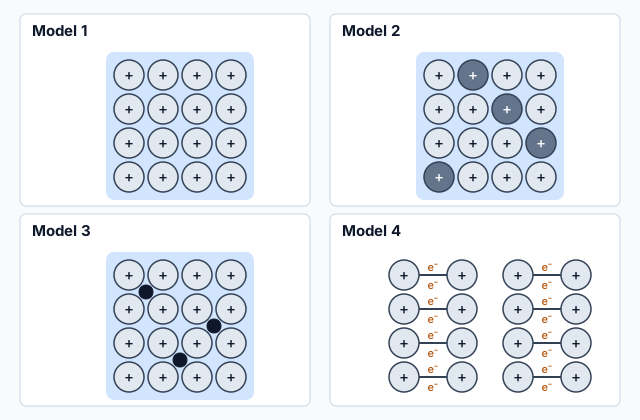
Four students drew models of solid metals and alloys. In the figure, each circle is an atom, and light and dark circles are atoms of different elements. A + marks a positive core, blue shading stands for delocalized electrons, and each e⁻ is an electron.
 Tap to open the picture full size
Case question 1 · Multiple choice
Using the figure: brass is copper with some zinc atoms added. Copper atoms have a radius of about 128 pm and zinc atoms a radius of about 134 pm. Which model can represent brass?
Case question 2 · Decide and justify
Using the figure: is model 4 a correct model of the bonding in a metal?
Which reason supports your decision?
Case question 3 · Calculate
Using the figure: exactly one of the models shows a substitutional alloy. In that model, what percent of the sites of the array hold atoms of the added element? Give a whole-number percent.
The rest stand on their own and do not use the case.
Check yourself · Spot the error
A student explains a model of steel. Tap the line with the mistake.
Check yourself · Rank it
Four models each show 10 cores of a pure metal: sodium, magnesium, aluminum and potassium. Rank the models by the number of delocalized electrons each must show so that it has no net charge.
Most electrons first
Give each one a place, 1 for first. Give two the same place if they are equal.
Your ranking: none yet
Part 7 Keep it Bring back earlier ideas
This lesson leans on two earlier ideas: the charges in a model of a solid must balance, as the ions in an ionic solid do, and an amount of a substance is counted in particles, the way an alloy's makeup is given as a ratio of atoms. Pulling them back up is what makes them last.
From 2.3 Structure of Ionic Solids · Calculate
A student's model of solid aluminum oxide shows 18 oxide ions, O²⁻. How many aluminum ions, Al³⁺, must the model show so that it has no net charge? Give a whole number.
From 1.1 Moles and Molar Mass · Calculate
How many moles of sodium chloride, NaCl, are in 10.0 g of it? The molar mass of NaCl is 58.44 g/mol. Give your answer to three significant figures.
In three lines
- A metal is an array of positive cores in a sea of delocalized valence electrons; the attraction between them is metallic bonding, and the charges balance.
- Atoms much smaller than the metal's atoms fill the spaces between them, making an interstitial alloy such as carbon in steel.
- Atoms of comparable size take the places of metal atoms in the lattice, making a substitutional alloy such as zinc in brass.
Exam strategy for this topic
- Section I, Multiple Choice: 60 questions in 90 minutes.
- Section II, Free Response: 7 questions in 105 minutes.
- A scientific or graphing calculator is recommended for use on both sections of the exam.
When you draw a metal or an alloy, make the structure easy to read: positive cores in a regular array, with the electrons shown spread among them rather than between pairs of atoms. For an alloy, draw the added atoms to relative size, put them where they belong, at lattice sites or in the spaces between atoms, and say which radii decided it.
Questions students ask
What is the sea of electrons model?
A metal is pictured as positive metal ions in a regular array, surrounded by valence electrons that are delocalized over the whole solid. The attraction between the ions and the electrons is metallic bonding.
What is the difference between an interstitial and a substitutional alloy?
In an interstitial alloy, much smaller atoms fill the spaces between the metal's atoms. In a substitutional alloy, atoms of comparable size take the places of some metal atoms in the lattice.
Is steel an interstitial or a substitutional alloy?
Steel is interstitial: carbon atoms, much smaller than iron atoms, sit in the spaces between them.
Is brass an interstitial or a substitutional alloy?
Brass is substitutional: zinc atoms, close in size to copper atoms, take the places of some copper atoms.
How many delocalized electrons does each metal atom give?
All of its valence electrons: one for sodium, two for magnesium and three for aluminum, which leaves Na⁺, Mg²⁺ and Al³⁺ cores.
Course alignment, for teachers
AP Chemistry topic 2.4, Unit 2: Compound Structure and Properties.
- Skill 4.C: Explain the connection between particulate-level and macroscopic properties of a substance using models and representations.
This lesson maps all 3 essential knowledge statements of the topic to the part that teaches each one: 3 are checked by a scored question. The map is in the lesson file.