Unit 2 · Topic 2.5 · about 30 minutes · 7 parts · 11 scored checks, 1 of them multiple choice, plus 2 from earlier lessons
AP Chemistry 2.5: Lewis Diagrams
Unit 2: 7 to 9% of the multiple-choice section
What you'll be able to do
- Represent a molecule with a Lewis diagram.
Key vocabulary
| Term | What it means | The exam trap |
|---|---|---|
| Lewis diagram | A diagram of a molecule or ion that shows its valence electrons: a line for each shared pair and two dots for each unshared pair. | A Lewis diagram shows which atoms are joined, not the shape of the molecule, so do not read angles from the way it is drawn. |
| Valence electrons | The electrons in an atom's outermost shell, the ones that take part in bonding; for a main-group element, the ones digit of its group number. | Use the periodic table group of each element, and count each atom in the formula separately. |
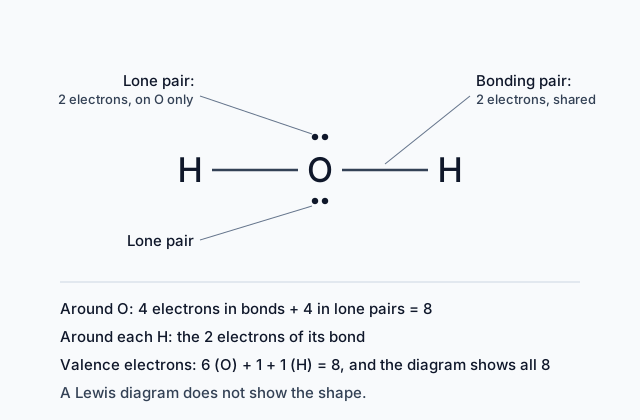
| Bonding pair | Two electrons shared between two atoms, drawn as a line. A single bond is one bonding pair. | A shared pair counts toward the electrons around both of the atoms it joins. |
| Lone pair | Two valence electrons that belong to one atom and are not shared, drawn as two dots. | Lone pairs on the outer atoms are easy to leave out of a drawing, and they count in the total. |
| Octet rule | In a Lewis diagram, atoms of carbon, nitrogen, oxygen and fluorine end with 8 electrons around them, from their bonds and their lone pairs. | Check the target for each atom before adding dots, because not every atom aims for 8. |
| Double and triple bonds | Two or three bonding pairs shared between the same two atoms, written = and ≡. | Draw each bond with its full number of lines so that the electrons in it are easy to count. |
 Tap to open the picture full size
Part 1 Think first The gas you breathe out
Commit to a guess first. Being wrong now makes the right idea stick better.
Predict first
In carbon dioxide, CO₂, the carbon atom sits between the two oxygen atoms. Carbon has 4 valence electrons and each oxygen has 6, for 16 in all. Suppose the carbon shares just one pair of electrons with each oxygen. Could every atom then have 8 electrons around it?
In short. A Lewis diagram shows every valence electron in a molecule or ion, as pairs shared between atoms and lone pairs that belong to one atom.
- Count the valence electrons first, adjusting for any charge; the finished diagram shows exactly that many.
- Hydrogen is always on the outside, and the central atom is usually the least electronegative of the other atoms.
- If the central atom is short of 8, move lone pairs from outer atoms into double or triple bonds instead of adding electrons.
Part 2 Learn it Drawing a Lewis diagram
2a. Count the valence electrons
A Lewis diagram shows the valence electrons of every atom in a molecule or ion: a line for each bonding pair shared between two atoms, and two dots for each lone pair that belongs to one atom. Drawing one always starts with a count.
- For a main-group element, the number of valence electrons is the ones digit of its group number: C (group 14) has 4, N (15) has 5, O (16) has 6, and F and Cl (17) have 7. H has 1.
- Add the valence electrons of every atom in the formula. Count each atom, not each element.
- For an ion, add one electron for each negative charge and take one away for each positive charge.
Examples: water, H₂O, has 6 + 2(1) = 8 valence electrons. The ammonium ion, NH₄⁺, has 5 + 4(1) − 1 = 8.
Every bond holds 2 electrons and every lone pair holds 2. The finished diagram shows exactly the number you counted, no more and no fewer.
Quick check · Calculate
How many valence electrons does the Lewis diagram of the phosphate ion, PO₄³⁻, show? Phosphorus is in group 15 and oxygen is in group 16. Give a whole number.
2b. Choose the skeleton
Next, decide which atoms are bonded to which. That arrangement is the skeleton.
- Hydrogen has room for only 2 electrons, so it forms exactly one bond and always sits at an end. Fluorine also forms one bond in nearly every molecule.
- The central atom is usually the least electronegative of the atoms that can form more than one bond. Carbon, when there is one, is almost always central.
- The order of a formula is not a rule. In H₂S the central atom is sulfur, even though hydrogen is written first.
Formulas are often written to show the skeleton. Methanol, CH₃OH, has its carbon bonded to three hydrogen atoms and to the oxygen, and the oxygen bonded to the last hydrogen: H₃C-O-H.
Remember that electronegativity increases from left to right across a period and decreases down a group.
Quick check · Fill the statement
Complete the reasoning for the skeleton of hydrogen cyanide, HCN.
Hydrogen sits at one end of the molecule. Carbon is electronegative than nitrogen, so is the central atom, and the skeleton has single bonds before any multiple bond is added.
2c. Place the electrons
With the count and the skeleton, place the electrons in this order:
- Draw a single bond, 2 electrons, between each pair of bonded atoms.
- Give each outer atom lone pairs until it has 8 electrons around it. Hydrogen needs only its 2.
- Put any electrons still left over on the central atom, as lone pairs.
To count the electrons around an atom, add every electron in its bonds to the electrons in its own lone pairs. A shared pair counts for both atoms it joins. Ending with 8 is the octet rule: carbon, nitrogen, oxygen and fluorine reach 8 and do not go past it in the molecules of this lesson. (Boron is often drawn with only 6, and atoms from period 3 down can sometimes hold more than 8.)
Example: ammonia, NH₃, has 5 + 3(1) = 8 valence electrons. Three N-H bonds use 6. Each H is full with its 2, so the last 2 go on the nitrogen as a lone pair. The nitrogen then has 6 + 2 = 8.
Quick check · Calculate
In the Lewis diagram of phosphorus trichloride, PCl₃, the phosphorus atom is central and joined to each chlorine atom by a single bond. Phosphorus is in group 15 and chlorine is in group 17. How many lone pairs does the whole diagram have? Give a whole number.
2d. Multiple bonds and ions
Sometimes step 3 leaves the central atom short of 8 with nothing left over. Then move a lone pair from an outer atom into the space between that atom and the central one. A single bond becomes a double bond: two shared pairs, 4 electrons, written =. Move a second pair to the same atom for a triple bond (three pairs, 6 electrons, ≡), or to another outer atom for a second double bond. Moving a pair never changes the total; it only changes which atoms count it.
Example: hydrogen cyanide, HCN, has 1 + 4 + 5 = 10 valence electrons. The skeleton H-C-N uses 4. The nitrogen takes three lone pairs (6), which uses the rest, and the carbon has only the 4 in its two bonds. Move two of nitrogen's lone pairs into the C-N bond: H-C≡N, with one lone pair on N. Now C has 2 + 6 = 8 and N has 6 + 2 = 8.
An ion is drawn inside square brackets with its charge outside them. Hydroxide, OH⁻, has 6 + 1 + 1 = 8 electrons and is drawn [O-H]⁻, with three lone pairs on the oxygen.
Quick check · Spot the error
A student draws the Lewis diagram of acetylene, C₂H₂, the fuel in welding torches, whose atoms are connected H-C-C-H. Tap the line with the mistake.
Part 3 Watch it done Formaldehyde, one step at a time
Watch each step, then finish the diagram yourself.
Formaldehyde, CH₂O, is used to preserve biology specimens. Its carbon atom is bonded to both hydrogen atoms and to the oxygen atom. Draw its Lewis diagram.
Step 1 · Count the valence electrons
Carbon has 4, each hydrogen has 1 and oxygen has 6: 4 + 2(1) + 6 = 12 valence electrons.
Step 2 · Draw the skeleton with single bonds
Carbon is central, with single bonds to H, H and O. Three bonds use 6 electrons, leaving 6.
Step 3 · Complete the outer atoms
Each hydrogen already has its 2. The oxygen takes three lone pairs, 6 electrons, for 8 around it. That uses the last 6, so none are left for the carbon.
Why this step?
Why can the carbon not simply get a lone pair of its own?
All 12 electrons are already placed. A new pair on carbon would make 14, which is a diagram of a different species, not of CH₂O.
Step 4 · Check the central atom
Carbon has only its three bonds, 6 electrons. It needs one more pair, and that pair has to come from a lone pair on the oxygen.
Your step · Calculate
Finish it. Move one of the oxygen atom's lone pairs into the C-O bond to make a double bond. In the finished Lewis diagram of formaldehyde, CH₂O, how many lone pairs are on the oxygen atom? Give a whole number.
lone pairs
Formaldehyde is H₂C=O, with a C=O double bond and two lone pairs on the oxygen. Both C and O have 8 electrons around them. Count the whole diagram: two C-H bonds (4), the double bond (4) and two lone pairs (4) make 12, the same 12 you started with.
Part 4 Try it Air, halogens and bleach
Air is mostly nitrogen, N₂, and oxygen, O₂. The halogens fluorine and chlorine are also made of two-atom molecules, F₂ and Cl₂.
Try it · Rank it
Draw the Lewis diagram of each molecule, with every atom reaching 8 electrons. Rank the molecules by the number of electron pairs shared between their two atoms.
Most shared pairs first
Give each one a place, 1 for first. Give two the same place if they are equal.
Your ranking: none yet
Household bleach is a solution of sodium hypochlorite, NaOCl, which contains the hypochlorite ion, ClO⁻.
Try it · Multiple choice
A student draws the hypochlorite ion, ClO⁻, this way: the chlorine and oxygen atoms joined by one single bond, three lone pairs on the chlorine, three lone pairs on the oxygen, and no brackets or charge. What does the diagram leave out?
Part 5 Explain it Draw a rocket fuel
On the exam this is handwritten, so answer on paper first, and draw the diagram on paper too. Nothing you type here leaves this page. Then check your answer against the model and each scoring point.
Free response is 50% of the exam score. This one is shaped like a short-answer question, which is worth 4 points.
Free-response practice · Short-answer style
Hydrazine, N₂H₄, is a rocket fuel. In a hydrazine molecule the two nitrogen atoms are bonded to each other, and each nitrogen atom is also bonded to two hydrogen atoms. A related molecule, diazene, N₂H₂, has its atoms connected H-N-N-H.
(a) Determine the total number of valence electrons in one molecule of hydrazine.
(b) Represent hydrazine with a complete Lewis diagram, showing every bonding pair and every lone pair.
(c) Explain why the bond between the two nitrogen atoms in the Lewis diagram of diazene must be a double bond.
(d) Identify the number of lone pairs on each nitrogen atom in the Lewis diagram of diazene.
Model answer
(a) Each nitrogen has 5 valence electrons and each hydrogen has 1: 2(5) + 4(1) = 14.
(b) H₂N-NH₂: a single bond between the two nitrogen atoms, two N-H single bonds on each nitrogen, and one lone pair on each nitrogen. The five bonds hold 10 electrons and the two lone pairs hold 4, for 14. Each N has 8 electrons around it and each H has 2.
(c) Diazene has 2(5) + 2(1) = 12 valence electrons. Its three single bonds use 6, leaving 6. With only single bonds, each nitrogen would need two lone pairs to reach 8, which is 8 electrons, but only 6 are left. So one lone pair has to become a second shared pair between the nitrogen atoms, making N=N, and then each nitrogen has 2 + 4 + 2 = 8.
(d) One lone pair on each nitrogen atom.
Score your own answer. This is a self-check, not a grade. Tick each point your answer makes.
Part 6 Check yourself Four students, four diagrams
Both case questions use the table.
Four students each drew the Lewis diagram of a different molecule, starting from the skeleton they were given. The table describes each diagram: the bonds it shows, and the lone pairs it shows on each atom.
| Diagram | Molecule | Bonds shown | Lone pairs shown |
|---|---|---|---|
| W | HOCl | H-O and O-Cl single bonds | none on H, 2 on O, 3 on Cl |
| X | CS₂ | two C=S double bonds | 1 on C, 2 on each S |
| Y | COF₂ | one C=O double bond and two C-F single bonds | none on C, 2 on O, 3 on each F |
| Z | NF₃ | three N-F single bonds | none on N, 3 on each F |
Case question 1 · Calculate
Using the table: how many electrons does diagram X show in all, counting both its bonds and its lone pairs? Give a whole number.
Case question 2 · Select all
Using the table: which two diagrams are correct Lewis diagrams of their molecules? Select two.
Select 2 answers, then check.
The rest stand on their own and do not use the case.
Check yourself · Put it in order
Put the steps for drawing a Lewis diagram in order.
Check yourself · Sort it
Draw the Lewis diagram of each molecule from the skeleton given, with every atom other than hydrogen reaching 8. Tap a card, then the bin for the bonds its diagram needs.
Single bonds only
One double bond
One triple bond
Part 7 Keep it Bring back earlier ideas
This lesson leans on two earlier ideas: an element's column in the periodic table, which matches its electron configuration and gives its valence electrons, and electronegativity, which decides the central atom. Pulling them back up is what makes them last.
From 2.1 Types of Chemical Bonds · Fill the statement
Complete the description of two bonds to hydrogen. The electronegativities are N 3.04, H 2.20 and P 2.19.
An N-H bond is , and the atom in it carries a partial negative charge. A P-H bond is .
From 1.7 Periodic Trends · Match
Match each ground-state electron configuration to the element whose column it belongs in.
In three lines
- A Lewis diagram shows every valence electron: count them first, adding one per negative charge and taking one away per positive charge.
- Put hydrogen at the ends and the least electronegative other atom in the middle, then fill the outer atoms before the central one.
- If the central atom is still short of 8, move outer lone pairs into double or triple bonds; draw an ion in brackets with its charge.
Exam strategy for this topic
- Section I, Multiple Choice: 60 questions in 90 minutes.
- Section II, Free Response: 7 questions in 105 minutes.
- A scientific or graphing calculator is recommended for use on both sections of the exam.
When a question asks for a Lewis diagram, show every lone pair, including those on the outer atoms, and draw an ion in brackets with its charge. Before you move on, count the electrons in your finished diagram and compare them with your valence electron count.
Questions students ask
How do you draw a Lewis diagram?
Count the valence electrons, join the atoms of the skeleton with single bonds, give the outer atoms lone pairs until each has 8 (2 for hydrogen), put any left over on the central atom, and make double or triple bonds if the central atom is still short.
How do you choose the central atom?
Hydrogen is never central because it forms only one bond. The central atom is usually the least electronegative of the other atoms, and carbon is almost always central when there is one.
When does a Lewis diagram need a double or triple bond?
When all the valence electrons have been placed and the central atom still has fewer than 8 around it. Then lone pairs from outer atoms are moved into shared pairs.
How do you draw the Lewis diagram of an ion?
Add one electron to the count for each negative charge, or take one away for each positive charge, draw the diagram as usual, and put it in square brackets with the charge outside.
Does a Lewis diagram show the shape of a molecule?
No. It shows which atoms are bonded and where the valence electrons are. Predicting shape uses a separate model in a later topic, VSEPR and Hybridization.
Course alignment, for teachers
AP Chemistry topic 2.5, Unit 2: Compound Structure and Properties.
- Skill 3.B: Represent chemical substances or phenomena with appropriate diagrams or models (e.g., electron configuration).
This lesson maps the one essential knowledge statement of the topic to the part that teaches each one: 1 is checked by a scored question. The map is in the lesson file.