Unit 2 · Topic 2.6 · about 30 minutes · 7 parts · 11 scored checks, 1 of them multiple choice, plus 2 from earlier lessons
AP Chemistry 2.6: Resonance and Formal Charge
Unit 2: 7 to 9% of the multiple-choice section
What you'll be able to do
- Represent a molecule with a Lewis diagram that shows resonance when equivalent structures exist, or that uses formal charge to choose between structures that are not equivalent.
Key vocabulary
| Term | What it means | The exam trap |
|---|---|---|
| Formal charge | A bookkeeping charge for one atom in one Lewis diagram: its valence electrons, minus its lone-pair electrons, minus half its bonding electrons. | It is a tool for comparing diagrams, not a measured charge, so it does not say where the real charge in a molecule sits. |
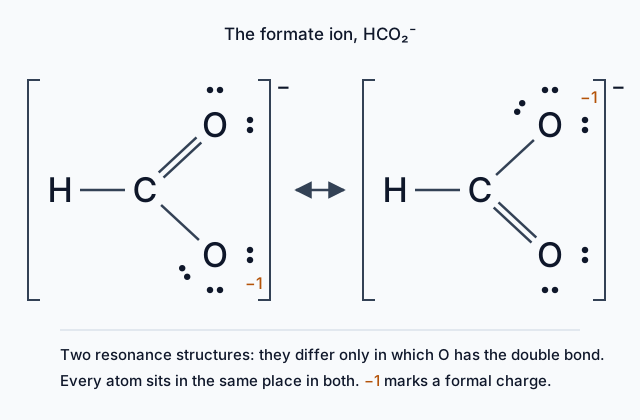
| Resonance structures | Two or more equivalent Lewis diagrams of the same species that differ only in where a multiple bond and lone pairs are placed. | The atoms stay in the same places in every resonance structure, so a diagram with the atoms in a different order describes a different molecule. |
| Octet rule | In a good Lewis diagram, atoms of carbon, nitrogen, oxygen and fluorine end with 8 electrons around them, from their bonds and their lone pairs. | Count the electrons around each atom, in both bonds and lone pairs, before you call an octet complete. |
| Free radical | A molecule, atom or ion with an unpaired electron. | Free radicals include neutral molecules and ions alike. |
 Tap to open the picture full size
Part 1 Think first Same atoms, very different behavior
Commit to a guess first. Being wrong now makes the right idea stick better.
Predict first
The cyanate ion, OCN⁻, is stable enough to keep in a jar as one of its salts. The fulminate ion, CNO⁻, has the same three atoms and the same 16 valence electrons joined in a different order, and its mercury salt is so unstable that it was once used to set off explosives in blasting caps. What could make one order of the same atoms so much less stable?
In short. Formal charge and resonance refine a Lewis diagram: formal charge picks the best of several diagrams, and resonance describes a species that no single diagram fits.
- Formal charge = valence electrons − lone-pair electrons − half the bonding electrons, and the formal charges in a diagram add up to the species' charge.
- The best diagram gives every C, N, O and F an octet, keeps formal charges as close to zero as possible, and puts any negative one on the most electronegative atom.
- When equivalent diagrams exist, the real species is one blend of them; a species with an odd number of valence electrons cannot give every atom an octet.
Part 2 Learn it Choosing and refining Lewis diagrams
2a. Formal charge
Formal charge is a bookkeeping charge given to each atom in one Lewis diagram. It pretends that every bonding pair is split evenly between its two atoms:
formal charge = (valence electrons) − (electrons in lone pairs) − ½(electrons in bonds)
A quicker form: valence electrons, minus lone-pair electrons, minus the number of bonds to the atom, where a double bond counts as 2 and a triple bond as 3.
Example: the hydronium ion, H₃O⁺, has three O-H single bonds and one lone pair on the oxygen. Oxygen: 6 − 2 − 3 = +1. Each hydrogen: 1 − 0 − 1 = 0.
The formal charges in a diagram always add up to the overall charge of the species: here +1 + 0 + 0 + 0 = +1, the charge of H₃O⁺. That is a quick check on your arithmetic. Formal charge is not a measured charge on the atom; it is a tool for comparing diagrams, which is what the next chunk uses it for.
Quick check · Calculate
Carbon monoxide's Lewis diagram is C≡O, with one lone pair on the carbon atom and one lone pair on the oxygen atom. What is the formal charge on the carbon atom? Give a whole number with its sign, or 0.
2b. Choosing the best diagram
Often more than one valid Lewis diagram can be drawn for a formula, with the electrons arranged differently or even the atoms in a different order. When the diagrams are not equivalent, choose the one that best models the real molecule with these criteria, in order:
- Every atom of C, N, O and F has 8 electrons around it (the octet rule).
- The formal charges are as close to zero as possible. A diagram with a formal charge of +2 or −2 is worse than one whose formal charges are all 0, +1 or −1.
- Any negative formal charge sits on the most electronegative atom.
Example: carbon dioxide can be drawn O=C=O or O≡C-O, and both give every atom 8. In O=C=O every formal charge is 0. In O≡C-O the triple-bonded oxygen is 6 − 2 − 3 = +1 and the single-bonded oxygen is 6 − 6 − 1 = −1. O=C=O is the better model, and it matches the real molecule, whose two carbon-oxygen bonds are identical.
Quick check · Decide and justify
Nitrous oxide, N₂O, the laughing gas used by dentists, has 16 valence electrons. Two possible Lewis diagrams are N=N=O and N=O=N, each with two lone pairs on each end atom and none on the central atom. Which diagram is the better model of N₂O?
Which reason supports your decision?
2c. Resonance
Sometimes two or more diagrams are equivalent: the same atoms in the same places and the same kinds of bonds, with only the position of a multiple bond and its lone pairs different. Then no single diagram is right. The species is described by all of them together, its resonance structures, joined by a double-headed arrow, ↔.
Example: the nitrite ion, NO₂⁻, has 5 + 2(6) + 1 = 18 valence electrons. It can be drawn [O=N-O]⁻ or [O-N=O]⁻, each with one lone pair on nitrogen, two on the double-bonded oxygen and three on the single-bonded oxygen. The two differ only in which oxygen has the double bond.
The real ion is not one of these structures, and it does not switch between them. It is a single blend, the resonance hybrid, in which both nitrogen-oxygen bonds are the same, partway between a single and a double bond. Measurements agree: the two bonds in nitrite have the same length. One Lewis diagram alone would predict one short bond and one long one, which is why resonance is needed for an accurate picture.
Quick check · Sort it
Draw the best Lewis diagram of each species from the skeleton given. Tap a card, then the bin for how the species is best represented.
Needs resonance structures
One Lewis diagram is enough
2d. Where Lewis diagrams fall short
Lewis diagrams are a model, and like any model they have limits. The clearest one is a species with an odd number of valence electrons. Electrons in a Lewis diagram are drawn in pairs, so with an odd total at least one electron is left unpaired, and at least one atom cannot have 8.
Example: chlorine dioxide, ClO₂, used to bleach paper and to treat drinking water, has 7 + 2(6) = 19 valence electrons. However they are arranged, one atom ends up with an odd number of electrons around it. A species with an unpaired electron is called a free radical, and many free radicals are very reactive.
There are other limits too. Boron in BF₃ is usually drawn with only 6 electrons, and atoms from period 3 down, such as phosphorus and sulfur, can show more than 8. For any of these, one Lewis diagram is a starting point, not the full story.
Quick check · Select all
For which two species can no Lewis diagram give every atom 8 electrons? Select two.
Select 2 answers, then check.
Part 3 Watch it done The nitrate ion
Watch each step, then finish the last one yourself.
The nitrate ion, NO₃⁻, is in most fertilizers. Its nitrogen atom is bonded to all three oxygen atoms. Find its Lewis diagram, the formal charge on each atom, and how many resonance structures it has.
Step 1 · Count and connect
5 + 3(6) + 1 = 24 valence electrons. Three N-O single bonds use 6, leaving 18, and each oxygen takes three lone pairs. That uses all 18, and nitrogen has only the 6 in its bonds.
Step 2 · Make a double bond
Move one lone pair from an oxygen into its bond with nitrogen. Now nitrogen has 8, the double-bonded oxygen has two lone pairs, and the other two oxygen atoms still have three each.
Why this step?
Why does nitrate have more than one diagram?
Any of the three oxygen atoms could have given up the lone pair. The three diagrams differ only in which oxygen has the double bond, so they are equivalent: nitrate has three resonance structures, and in the real ion all three N-O bonds are the same.
Step 3 · Formal charges on the oxygen atoms
Double-bonded oxygen: 6 − 4 − 2 = 0. Each single-bonded oxygen: 6 − 6 − 1 = −1.
Your step · Calculate
Finish it. In any one resonance structure of the nitrate ion, NO₃⁻, the nitrogen atom has one double bond, two single bonds and no lone pairs. What is the formal charge on the nitrogen atom? Give a whole number with its sign, or 0.
Check the sum: +1 + 0 + (−1) + (−1) = −1, the charge of the ion. All three resonance structures have the same set of formal charges, which is what being equivalent means.
Part 4 Try it What fills an airbag
Some car airbags inflate when sodium azide, a solid made of Na⁺ and N₃⁻ ions, breaks down and releases nitrogen gas. The azide ion, N₃⁻, is three nitrogen atoms in a row with 16 valence electrons. Three Lewis diagrams give every atom 8:
- Diagram A: [N=N=N]⁻, with two lone pairs on each end nitrogen and none on the middle one.
- Diagram B: [N≡N-N]⁻, with one lone pair on the triple-bonded end nitrogen, none on the middle one, and three on the single-bonded end nitrogen.
- Diagram C: [N-N≡N]⁻, the mirror image of B.
Try it · Calculate
In diagram B of the azide ion, what is the formal charge on the triple-bonded end nitrogen atom? Give a whole number with its sign, or 0.
Try it · Rank it
Rank diagrams A, B and C of the azide ion as models of the real ion.
Best model first
Give each one a place, 1 for first. Give two the same place if they are equal.
Your ranking: none yet
Part 5 Explain it Ozone's two bonds
On the exam this is handwritten, so answer on paper first, and draw the diagrams on paper too. Nothing you type here leaves this page. Then check your answer against the model and each scoring point.
Free response is 50% of the exam score. This one is shaped like a short-answer question, which is worth 4 points.
Free-response practice · Short-answer style
Ozone, O₃, high in the atmosphere absorbs ultraviolet light from the Sun. In an ozone molecule, one oxygen atom is bonded to each of the other two.
(a) Determine the total number of valence electrons in a molecule of O₃.
(b) Represent ozone with Lewis diagrams that account for resonance, showing every bonding pair and lone pair.
(c) Calculate the formal charge on the central oxygen atom in one of your diagrams.
(d) Both oxygen-oxygen bonds in ozone are measured to have the same length. Explain how your diagrams account for this.
Model answer
(a) 3(6) = 18 valence electrons.
(b) Two equivalent resonance structures, O=O-O ↔ O-O=O. In each, the central oxygen has one lone pair, the double-bonded end oxygen has two lone pairs, and the single-bonded end oxygen has three. Every atom has 8 electrons.
(c) The central oxygen has one lone pair (2 electrons) and three bonds (one single and one double): 6 − 2 − 3 = +1.
(d) The real molecule is a blend of the two resonance structures, not either one. The double bond is shared equally between the two sides, so the two oxygen-oxygen bonds are the same, each partway between a single and a double bond, and they have the same length.
Score your own answer. This is a self-check, not a grade. Tick each point your answer makes.
Part 6 Check yourself Three ways to draw cyanate
Both case questions use the table.
A student draws three Lewis diagrams for the cyanate ion, OCN⁻, which has 16 valence electrons. In all three, the carbon atom is in the middle and every atom has 8 electrons around it.
| Diagram | Bonds | Lone pairs |
|---|---|---|
| P | O=C double bond and C=N double bond | 2 on O, none on C, 2 on N |
| Q | O-C single bond and C≡N triple bond | 3 on O, none on C, 1 on N |
| R | O≡C triple bond and C-N single bond | 1 on O, none on C, 3 on N |
Case question 1 · Calculate
Using the table: what is the formal charge on the nitrogen atom in diagram R? Give a whole number with its sign, or 0.
Case question 2 · Multiple choice
Using the table: which diagram is the best model of the cyanate ion?
The rest stand on their own and do not use the case.
Check yourself · Spot the error
A student describes the carbonate ion, CO₃²⁻, in which the carbon atom is bonded to all three oxygen atoms. Tap the line where the reasoning first goes wrong.
Check yourself · Fill the statement
Hydrogen isocyanide, HNC, found in clouds of gas between the stars, has the same atoms as hydrogen cyanide, HCN, in a different order. Complete the comparison.
In H-N≡C, with one lone pair on carbon, the formal charge on nitrogen is and the formal charge on carbon is . Comparing these with the formal charges in H-C≡N, which has one lone pair on nitrogen, is the better model of a molecule made of these atoms.
Part 7 Keep it Bring back earlier ideas
This lesson leans on two earlier ideas: drawing a Lewis diagram and counting its lone pairs, and the trend in electronegativity, which decides where a negative formal charge belongs. Pulling them back up is what makes them last.
From 2.5 Lewis Diagrams · Calculate
In the Lewis diagram of phosphorus trichloride, PCl₃, the phosphorus atom is central and joined to each chlorine atom by a single bond. Phosphorus is in group 15 and chlorine is in group 17. How many lone pairs does the whole diagram have? Give a whole number.
From 1.7 Periodic Trends · Fill the statement
Complete the explanation of the trend in electronegativity down group 17, from fluorine to iodine.
Moving down the group, the valence electrons are in a shell the nucleus, and more inner electrons them from it. The attraction is weaker, so the electronegativity .
In three lines
- Formal charge = valence electrons − lone-pair electrons − one per bond, and the formal charges add up to the species' charge.
- The best diagram has octets, formal charges closest to zero, and any negative formal charge on the most electronegative atom.
- Equivalent diagrams are resonance structures of one blended species, and an odd number of valence electrons leaves some atom short of 8.
Exam strategy for this topic
- Section I, Multiple Choice: 60 questions in 90 minutes.
- Section II, Free Response: 7 questions in 105 minutes.
- A scientific or graphing calculator is recommended for use on both sections of the exam.
When a question asks you to choose between Lewis diagrams, write the formal charge on every atom of each diagram and then name the criterion that decides. For resonance, draw every equivalent structure with ↔ and describe the real species as one blend of them.
Questions students ask
How do you calculate formal charge?
Take the atom's valence electrons, subtract the electrons in its lone pairs, and subtract one for each bond to it (two for a double bond, three for a triple). The formal charges in a diagram add up to the charge of the species.
How do you choose the best Lewis diagram?
First keep the diagrams that give every C, N, O and F an octet. Then choose the one whose formal charges are closest to zero, and if two are tied, the one with any negative formal charge on the most electronegative atom.
What is resonance?
When two or more equivalent Lewis diagrams can be drawn for a species, differing only in where a multiple bond sits, the species is shown by all of them. The real species is one blend of them, not one that switches.
Why do resonance structures matter?
A single diagram can predict bonds of different lengths that are really identical, as in nitrite or carbonate. Showing resonance gives the correct picture of the structure.
What are the limits of Lewis diagrams?
A species with an odd number of valence electrons, such as NO or ClO₂, cannot give every atom an octet. Some atoms, such as boron, are drawn with fewer than 8, and atoms from period 3 down can show more than 8.
Course alignment, for teachers
AP Chemistry topic 2.6, Unit 2: Compound Structure and Properties.
- Skill 6.C: Support a claim with evidence from representations or models at the particulate level, such as the structure of atoms and/or molecules.
This lesson maps all 3 essential knowledge statements of the topic to the part that teaches each one: 3 are checked by a scored question. The map is in the lesson file.