Unit 2 · Topic 2.7 · about 30 minutes · 7 parts · 12 scored checks, 2 of them multiple choice, plus 2 from earlier lessons
AP Chemistry 2.7: VSEPR and Hybridization
Unit 2: 7 to 9% of the multiple-choice section
What you'll be able to do
- Explain the structural and electron properties of a molecule, such as its shape, bond angles, hybridization, bond strengths and lengths, and polarity, from its Lewis diagram, VSEPR theory, bond orders and bond polarities.
Key vocabulary
| Term | What it means | The exam trap |
|---|---|---|
| VSEPR theory | Valence shell electron pair repulsion theory: a model that predicts the arrangement of electron domains around a central atom from the Coulombic repulsion between them. | The theory works around one central atom at a time, so in a larger molecule apply it to each central atom separately. |
| Molecular geometry | The three-dimensional arrangement of the atoms in a molecule, named by where the atoms sit around the central atom. | Read whether a question asks for the arrangement of electron domains or for the molecular geometry, because they have separate names. |
| Hybridization | A description of the arrangement of electrons around a central atom by the names sp, sp² and sp³. | The name describes one atom, not the whole molecule, so two atoms in the same molecule can have different hybridizations. |
| Sigma bond | A covalent bond whose orbital overlap lies directly between the two bonded nuclei. | The name says where the orbital overlap lies, not how strong the bond is, so read each bond in a Lewis diagram carefully before you classify it. |
| Pi bond | A covalent bond whose orbital overlap lies above and below the line between the two bonded nuclei. | Questions often ask you to compare pi and sigma bonds, so be ready to say which kind of overlap is which. |
| Dipole moment | A measure of how unevenly electric charge is spread across a whole molecule; a molecule with a dipole moment is polar. | Polar bonds alone do not settle it, so work out the shape before you decide on polarity. |
 Tap to open the picture full size
Part 1 Think first Two three-atom molecules
Commit to a guess first. Being wrong now makes the right idea stick better.
Predict first
Carbon dioxide, CO₂, and water, H₂O, are both made of three atoms: one central atom bonded to two others. Experiments show that a CO₂ molecule is straight, with its three atoms in a line. What shape do you predict for a water molecule?
In short. VSEPR theory predicts the shape of a molecule from its Lewis diagram: the electron domains around a central atom repel one another and spread as far apart as they can, and the positions of the atoms give the molecular geometry.
- Each bond (single, double or triple) and each lone pair on the central atom is one domain; 2, 3 and 4 domains mean sp, sp² and sp³ hybridization, with ideal angles of 180°, 120° and 109.5°.
- Lone pairs repel more strongly than bonding pairs, so they squeeze bond angles, and the shape's name counts only the atoms.
- A double bond is one sigma bond and one pi bond; the sigma bond is the stronger, the pi bond stops rotation, and a molecule is polar only when its bond dipoles do not cancel.
Part 2 Learn it From a Lewis diagram to a shape
2a. Electron domains push apart
Every electron around a central atom is negative, so by Coulomb's law the groups of electrons around it repel one another. VSEPR theory (valence shell electron pair repulsion) predicts that these groups spread out around the central atom as far apart as they can, which keeps the repulsion as small as possible.
To use it, find the central atom in the Lewis diagram and count its electron domains:
- each bond to another atom is one domain, whether it is single, double or triple, because all of a multiple bond's electrons lie between the same two atoms;
- each lone pair on the central atom is one domain.
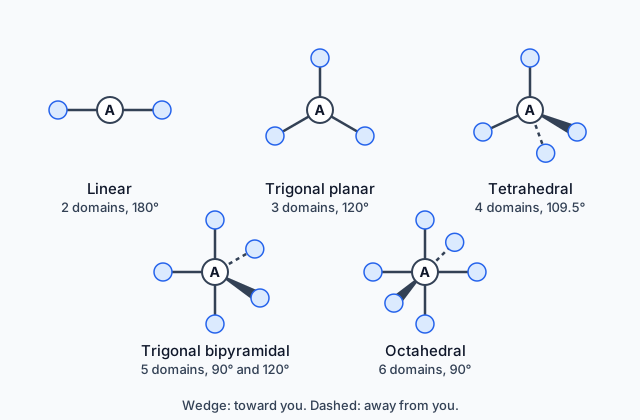
The number of domains sets the arrangement: 2 domains are linear (180°), 3 trigonal planar (120°), 4 tetrahedral (109.5°), 5 trigonal bipyramidal (90° and 120°) and 6 octahedral (90°).
The same arrangement is also described by the central atom's hybridization. An atom with 2 domains is sp hybridized, with ideal bond angles of 180°; with 3 domains it is sp², 120°; with 4 domains it is sp³, 109.5°. For 5 or 6 domains, the course asks only for the shape, not a hybridization.
Example: in CO₂, O=C=O, carbon has two double bonds and no lone pairs. That is two domains, so CO₂ is linear and its carbon is sp hybridized.
Quick check · Sort it
Each card describes the central atom in a Lewis diagram. Tap a card, then the arrangement of electron domains around that central atom.
Linear
Trigonal planar
Tetrahedral
2b. Lone pairs and the shape of a molecule
The molecular geometry names the positions of the atoms only. A lone pair still fills a domain and pushes on the bonds, but it is not part of the name. So place all the domains first, then look only at where the atoms are.
| Domains | Lone pairs | Molecular geometry |
|---|---|---|
| 2 | 0 | Linear |
| 3 | 0 | Trigonal planar |
| 3 | 1 | Bent |
| 4 | 0 | Tetrahedral |
| 4 | 1 | Trigonal pyramidal |
| 4 | 2 | Bent |
| 5 | 0 | Trigonal bipyramidal |
| 5 | 1 | Seesaw |
| 5 | 2 | T-shaped |
| 5 | 3 | Linear |
| 6 | 0 | Octahedral |
| 6 | 1 | Square pyramidal |
| 6 | 2 | Square planar |
With 5 domains, lone pairs take positions in the ring around the middle. There a domain has only two other domains 90° away, instead of three at the top or bottom, so the lone pairs have the most room.
Lone pairs also change bond angles. A lone pair is held by only one nucleus, so its electrons spread out more widely near the central atom and repel more strongly than a bonding pair. Each lone pair pushes the bonds closer together: the H-C-H angle in CH₄ (no lone pairs) is 109.5°, the H-N-H angle in NH₃ (one lone pair) is about 107°, and the H-O-H angle in H₂O (two lone pairs) is about 104.5°.
Quick check · Rank it
Four molecules each have one central atom. In BCl₃, boron has single bonds to three Cl atoms and no lone pairs. In SO₃, sulfur is bonded to three O atoms and has no lone pairs. In CCl₄, carbon has single bonds to four Cl atoms and no lone pairs. In NCl₃, nitrogen has single bonds to three Cl atoms and one lone pair. Rank the bond angles.
Largest angle first
Give each one a place, 1 for first. Give two the same place if they are equal.
Your ranking: none yet
2c. Sigma bonds, pi bonds and bond order
A covalent bond forms where orbitals on two atoms overlap. A single bond is one sigma bond, with its overlap directly between the two nuclei. A double bond is one sigma bond plus one pi bond, whose overlap lies above and below that line; a triple bond is one sigma bond plus two pi bonds.
Sigma overlap is stronger, so a sigma bond has a greater bond energy than a pi bond. Average values from a standard table show it: C-C is 347 kJ/mol and C=C is 614 kJ/mol, so the added pi bond brings only about 267 kJ/mol.
More bonds between the same two atoms (a higher bond order) hold them closer and more strongly. Carbon-carbon bonds are 154 pm long (single), 134 pm (double) and 120 pm (triple), and their bond energies rise from 347 to 614 to 839 kJ/mol. Bond length also grows with atomic radius: a C-Cl bond is longer than a C-F bond.
A pi bond also stops the two atoms from twisting around their bond, because twisting would pull its overlap apart. So 1,2-dichloroethene, ClHC=CHCl, comes as two different compounds: cis, with both Cl atoms on the same side of the double bond, and trans, with them on opposite sides. These are geometric isomers. They exist only when each carbon of the double bond carries two different groups.
Quick check · Calculate
Acrylonitrile, CH₂=CH-C≡N, is used to make acrylic fibers. Its Lewis diagram has three C-H single bonds, one C=C double bond, one C-C single bond and one C≡N triple bond. How many sigma bonds does one molecule contain? Give a whole number.
2d. Polar or nonpolar molecules
Each polar bond has a bond dipole, with its negative end at the more electronegative atom. A molecule has a dipole moment, and is polar, when its bond dipoles do not cancel. The shape decides whether they cancel.
- CO₂ has two polar C=O bonds, but it is linear, so the two bond dipoles point in opposite directions and cancel. CO₂ has no dipole moment.
- H₂O has two polar O-H bonds, but it is bent, so both bond dipoles point partly toward the oxygen side. Water has a dipole moment.
A useful test: when the central atom has no lone pairs and all its outer atoms are the same, the shape is symmetric and the bond dipoles cancel, as in CCl₄ and SF₆. Two things can break that balance. Lone pairs on the central atom usually leave the outer atoms bunched on one side, as in NH₃; only when the lone pairs sit evenly around the central atom do the bond dipoles stay balanced. And outer atoms that differ give bond dipoles of different sizes, which do not cancel even on a symmetric frame.
Quick check · Decide and justify
Dichloromethane, CH₂Cl₂, is a solvent used in some paint strippers. Its carbon atom has single bonds to two H atoms and two Cl atoms and no lone pairs. Is a CH₂Cl₂ molecule polar or nonpolar?
Which reason supports your decision?
Part 3 Watch it done The shape of xenon tetrafluoride
Predict first, then watch each step, then finish the reasoning yourself.
Xenon is a noble gas, but it does form a few compounds. Xenon tetrafluoride, XeF₄, is a colorless solid made from xenon and fluorine, with xenon as the central atom. Xenon has 8 valence electrons and fluorine has 7. Use the Lewis diagram and VSEPR theory to find the shape of XeF₄ and decide whether it is polar.
Predict first
Before you open the first step, predict: when two of a central atom's six domains are lone pairs, where do the two lone pairs go?
Step 1 · Count the valence electrons and place them
Xenon brings 8 and each F brings 7: 8 + 4(7) = 36 electrons. Four Xe-F single bonds use 8, and three lone pairs on each F use 24 more. That leaves 36 − 8 − 24 = 4 electrons, which go on xenon as two lone pairs.
Step 2 · Count the domains on xenon
Four bonds and two lone pairs make six electron domains, so the domains take an octahedral arrangement, each 90° from its neighbors.
Step 3 · Place the lone pairs and name the shape
The two lone pairs go opposite each other, one above and one below the xenon. The four F atoms take the four positions left, all in one plane with the xenon and 90° apart, so XeF₄ is square planar.
Why this step?
Why do the two lone pairs go opposite each other?
Lone pairs repel more strongly than bonding pairs. Placed 180° apart, the two lone pairs are as far from each other as six positions allow, which keeps the total repulsion as small as possible.
Your step · Multiple choice
Finish it. Does an XeF₄ molecule have a dipole moment?
XeF₄ has lone pairs on its central atom and still has no dipole moment, because the lone pairs sit evenly around the xenon. Lone pairs usually make a molecule polar, so always check where they are before you decide.
Part 4 Try it Inside vinegar
Vinegar gets its sour taste from acetic acid, CH₃COOH. In its Lewis diagram, one carbon (the CH₃ carbon) is bonded to three H atoms and to a second carbon. The second carbon is bonded to one O atom by a double bond and to another O atom by a single bond, and that O atom is bonded to an H atom. Each O atom completes its octet with lone pairs.
Try it · Fill the statement
Complete the description of acetic acid.
The CH₃ carbon is hybridized, and its H-C-H bond angles are about . The second carbon is hybridized, and its O=C-O bond angle is about .
Try it · Decide and justify
In acetic acid, which of the two carbon-oxygen bonds on the second carbon is shorter?
Which reason supports your decision?
Part 5 Explain it The shape of nitrogen trifluoride
On the exam this is handwritten, so answer on paper first. Nothing you type here leaves this page. Then check your answer against the model and each scoring point.
Free response is 50% of the exam score. This one is shaped like a short-answer question, which is worth 4 points.
Free-response practice · Short-answer style
Nitrogen trifluoride, NF₃, is a gas used to clean the chambers in which computer chips are made. In its Lewis diagram, nitrogen is the central atom, with a single bond to each of the three F atoms and one lone pair.
(a) Identify the number of electron domains around the nitrogen atom and the hybridization of nitrogen.
(b) Identify the molecular geometry of NF₃.
(c) Predict whether the F-N-F bond angle is greater than, less than or equal to 109.5°. Explain your prediction using the repulsion between electron domains.
(d) Justify the claim that an NF₃ molecule has a dipole moment.
Model answer
(a) Four electron domains: three N-F bonds and one lone pair. Nitrogen is sp³ hybridized.
(b) Trigonal pyramidal: the three F atoms form the base of a pyramid with the nitrogen at the top.
(c) Less than 109.5°. The four domains point toward the corners of a tetrahedron, but the lone pair repels the bonding pairs more strongly than they repel each other, so it pushes the three N-F bonds closer together. (The measured angle is about 102°.)
(d) Each N-F bond is polar, with its negative end at the more electronegative F atom. In a trigonal pyramid all three F atoms are on the same side of the nitrogen, so the three bond dipoles do not cancel, and the molecule has a dipole moment.
Score your own answer. This is a self-check, not a grade. Tick each point your answer makes.
Part 6 Check yourself Five fluorides
All three case questions use the table.
The table summarizes the Lewis diagrams of five molecules. In each one, the central atom is bonded to every F atom by a single bond.
| Molecule | F atoms bonded to the central atom | Lone pairs on the central atom |
|---|---|---|
| BF₃ | 3 | 0 |
| PF₃ | 3 | 1 |
| ClF₃ | 3 | 2 |
| XeF₂ | 2 | 3 |
| BrF₅ | 5 | 1 |
Case question 1 · Fill the statement
Using the table: complete the description.
PF₃ has a molecular geometry, ClF₃ is , and XeF₂ is . The boron atom in BF₃ is hybridized.
Case question 2 · Select all
Using the table: which two molecules have no dipole moment? Select two.
Select 2 answers, then check.
Case question 3 · Multiple choice
Using the table: which two molecules have the same arrangement of electron domains around the central atom but different molecular geometries?
The rest stand on their own and do not use the case.
Check yourself · Sort it
Tap each compound, then the bin that says whether it exists as two geometric isomers, cis and trans.
Has cis and trans isomers
Has no cis and trans isomers
Check yourself · Spot the error
A student compares the carbon-carbon bond in ethane, H₃C-CH₃, with the one in ethene, H₂C=CH₂. Tap the line with the mistake.
Part 7 Keep it Bring back earlier ideas
This lesson leans on two earlier ideas: when a species needs resonance structures to be drawn well (as NO₂⁻ does here), and how bond order sets bond energy. Pulling them back up is what makes them last.
From 2.6 Resonance and Formal Charge · Sort it
Draw the best Lewis diagram of each species from the skeleton given. Tap a card, then the bin for how the species is best represented.
Needs resonance structures
One Lewis diagram is enough
From 2.2 Intramolecular Force and Potential Energy · Rank it
Carbon and oxygen are joined by a single bond in methanol, CH₃OH, by a triple bond in carbon monoxide, CO, and by double bonds in carbon dioxide, CO₂. Rank these carbon-oxygen bonds by bond energy.
Largest bond energy first
Give each one a place, 1 for first. Give two the same place if they are equal.
Your ranking: none yet
In three lines
- Count the electron domains on a central atom (each bond, single, double or triple, and each lone pair is one); 2 to 6 domains are linear, trigonal planar, tetrahedral, trigonal bipyramidal and octahedral.
- The molecular geometry names only the atoms; lone pairs repel more than bonds and squeeze bond angles, and 2, 3 and 4 domains mean sp, sp² and sp³ (180°, 120°, 109.5°).
- A double bond is one sigma and one pi bond; sigma is stronger, pi stops rotation, a higher bond order is shorter and stronger, and a molecule is polar when its bond dipoles do not cancel.
Exam strategy for this topic
- Section I, Multiple Choice: 60 questions in 90 minutes.
- Section II, Free Response: 7 questions in 105 minutes.
- A scientific or graphing calculator is recommended for use on both sections of the exam.
When a question asks for a shape, write the count first: atoms bonded to the central atom, lone pairs on it, and total domains. Then name the arrangement, then the molecular geometry. For polarity, name the shape and say whether the bond dipoles cancel, since a written answer may ask for the reasoning as well as the claim.
Questions students ask
What does VSEPR stand for?
Valence shell electron pair repulsion. The electron domains around a central atom repel one another, so they spread out as far apart as they can, and that arrangement sets the shape of the molecule.
How do you find the hybridization of an atom?
Count its electron domains: every bonded atom and every lone pair is one. Two domains is sp (180°), three is sp² (120°) and four is sp³ (109.5°).
Why is water bent but carbon dioxide linear?
The carbon in CO₂ has two domains, its two double bonds, which point in opposite directions. The oxygen in water has four domains, two bonds and two lone pairs, so its atoms form a bent shape with an angle of about 104.5°.
What is the difference between a sigma bond and a pi bond?
A sigma bond's overlap lies directly between the two nuclei, and every single bond is one. A pi bond's overlap lies above and below that line; a double bond has one and a triple bond two. Sigma bonds are stronger, and a pi bond stops rotation.
Can a molecule with polar bonds be nonpolar?
Yes. If the shape is symmetric and the outer atoms are the same, the bond dipoles cancel, as in CO₂ and CCl₄, and the molecule has no dipole moment.
Beyond the AP Exam
College Board sets these limits on what the AP Exam asks about this topic. Anything past them is not on the exam.
An understanding of the derivation and depiction of hybrid orbitals will not be assessed on the AP Exam. The course includes the distinction between sigma and pi bonding, the use of VSEPR to explain the shapes of molecules, and the sp, sp^2, and sp^3 nomenclature.
Hybridization involving d orbitals will not be assessed on the AP Exam. When an atom has more than four pairs of electrons surrounding the central atom, students are only responsible for the shape of the resulting molecule.
Course alignment, for teachers
AP Chemistry topic 2.7, Unit 2: Compound Structure and Properties.
- Skill 6.C: Support a claim with evidence from representations or models at the particulate level, such as the structure of atoms and/or molecules.
This lesson maps all 4 essential knowledge statements of the topic to the part that teaches each one: 4 are checked by a scored question. The map is in the lesson file.