Unit 3 · Topic 3.1 · about 30 minutes · 7 parts · 10 scored checks, 1 of them multiple choice, plus 2 from earlier lessons
AP Chemistry 3.1: Intermolecular and Interparticle Forces
Unit 3: 18 to 22% of the multiple-choice section
What you'll be able to do
- Explain how the chemical structures of molecules set the relative strength of the intermolecular forces between them, for molecules of one substance and for molecules of two different substances.
Key vocabulary
| Term | What it means | The exam trap |
|---|---|---|
| Van der Waals forces | A broad family name for several kinds of intermolecular force, of which London dispersion forces are one. | Name the specific force, such as dispersion or dipole-dipole, rather than the family name. |
| London dispersion force | An attraction between temporary dipoles that form as electrons move, present between all atoms and molecules. | Dispersion forces come from temporary dipoles, so a molecule needs no polar bond to have them. |
| Polarizability | How easily the electron cloud of an atom or molecule is pushed out of shape to form a dipole. | Polarizability is not polarity: a nonpolar molecule can be highly polarizable. |
| Dipole | A separation of charge in a molecule, with a partial positive end (δ+) and a partial negative end (δ−). | A temporary dipole and a permanent dipole are different: every molecule forms the first, and only a polar molecule has the second. |
 Tap to open the picture full size
Part 1 Think first A gecko on a window
Commit to a guess first. Being wrong now makes the right idea stick better.
Predict first
A gecko can run up a clean glass window and hang from it by a single toe. Its feet make no glue. Each foot carries about half a million tiny hairs, and each hair splits into hundreds of even finer tips. What holds the gecko to the glass?
In short. Intermolecular forces are the attractions between separate particles, and how strong they are follows from the structure of those particles.
- Every molecule has London dispersion forces, which grow with the number of electrons and with the contact area between molecules.
- A polar molecule adds dipole-dipole, dipole-induced dipole or ion-dipole attractions, depending on its partner.
- A hydrogen bond forms when an H atom bonded to N, O or F is attracted to an N, O or F atom of another molecule, or of another part of the same one.
Part 2 Learn it The forces between molecules
2a. Dispersion forces act between all molecules
An intermolecular force is an attraction between separate particles, such as two molecules or an ion and a molecule, and is much weaker than a covalent bond.
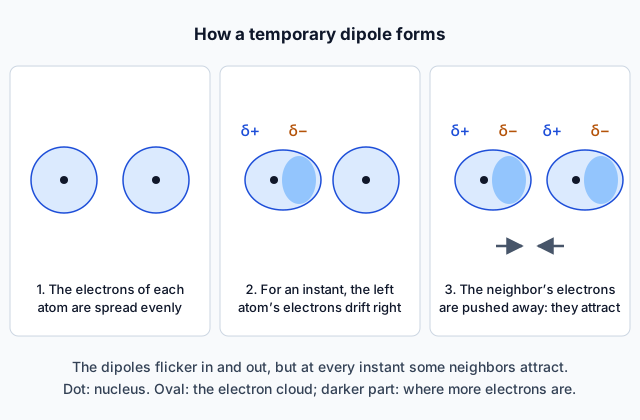
The electrons of any atom or molecule are always moving. At one instant more of them may be on one side, making a temporary dipole, one end slightly negative and the other slightly positive. That dipole pushes on a neighbor's electrons and gives the neighbor a dipole too, lined up so the two attract. These Coulombic attractions between flickering dipoles are London dispersion forces, and they act between all molecules, polar or not.
Two things make them stronger:
- Polarizability, how easily the electron cloud is pushed out of shape. It grows with the number of electrons and the size of the cloud, and pi bonds add to it. Cl₂, with 34 electrons, is more polarizable than F₂, with 18.
- Contact area. Long molecules lying side by side touch along their length; compact, ball-shaped ones touch at only a few points.
Between large molecules, dispersion is often the strongest net force. Nonpolar CCl₄, with 74 electrons, attracts its neighbors more strongly than polar CH₂Cl₂, with 42. Dispersion forces are one kind of van der Waals force; the two names do not mean the same thing.
Quick check · Rank it
All three are nonpolar hydrocarbons. Propane, CH₃CH₂CH₃, has 26 electrons. Pentane, CH₃CH₂CH₂CH₂CH₃, has 42 electrons in a chain of five carbon atoms. 2,2-Dimethylpropane, C(CH₃)₄, also has 42 electrons, with four carbon atoms bonded around a central one, which makes the molecule compact. Rank the three by the strength of the dispersion forces between their own molecules.
Strongest first
Give each one a place, 1 for first. Give two the same place if they are equal.
Your ranking: none yet
2b. Dipoles add more attractions
A polar molecule has a permanent dipole, with a partial positive end (δ+) and a partial negative end (δ−); its shape and bond polarities decide whether it has one. A permanent dipole adds attractions on top of dispersion forces, and which one depends on the partner.
- Dipole-dipole, between two polar molecules. The δ+ end of one attracts the δ− end of the other, while like ends repel, so the strength depends on how large the dipoles are and on how the molecules are turned. Between molecules of comparable size, polar ones attract each other more than nonpolar ones, because the dipole-dipole forces act in addition to dispersion.
- Dipole-induced dipole, between a polar and a nonpolar molecule. The dipole distorts the nonpolar molecule's electrons, inducing a dipole that always points the attracting way, so this force is always attractive. It is stronger when the polar molecule's dipole is larger and when the nonpolar molecule is more polarizable.
- Ion-dipole, between an ion and a polar molecule. A cation attracts the δ− end of the molecule, and an anion attracts the δ+ end. An ion carries a full charge, not a partial one, so ion-dipole forces tend to be stronger than dipole-dipole forces.
Quick check · Sort it
Every pair below attracts by dispersion forces. Sort each pair by the other kind of attraction it also has, if any. Tap a card, then its bin.
Ion-dipole
Dipole-dipole
Dipole-induced dipole
No other kind
2c. Hydrogen bonds
A hydrogen bond is a strong kind of intermolecular attraction. It forms when a hydrogen atom covalently bonded to N, O or F is attracted to the negative end of a dipole formed by an N, O or F atom, in a different molecule or in a different part of the same molecule. That negative end is a lone pair on the N, O or F.
Why those three elements? N, O and F are so electronegative that they pull the shared electrons far from the hydrogen, leaving it with a large partial positive charge, and a hydrogen atom is so small that it can come very close to the lone pair it is attracted to.
The hydrogen atom must be bonded to the N, O or F itself. Acetaldehyde, CH₃CHO, contains an oxygen atom, but all four of its hydrogen atoms are bonded to carbon, so pure acetaldehyde has no hydrogen bonds; its molecules attract by dipole-dipole and dispersion forces.
In large biomolecules such as proteins and DNA, hydrogen bonds, dipole-dipole forces and dispersion forces act between two molecules, as between the two strands of DNA, and also between different regions of the same molecule.
Quick check · Select all
Which two of these substances form hydrogen bonds between their own molecules? Select two.
Select 2 answers, then check.
Part 3 Watch it done Bromine or iodine monochloride?
Predict first, then watch each step, then finish the comparison yourself.
Bromine, Br₂, and iodine monochloride, ICl, are each made of two halogen atoms joined by one bond. Which substance has the stronger attractions between its molecules, and why?
Predict first
Before you open the first step, predict: which substance has the stronger attractions between its molecules?
Step 1 · List the forces in bromine
A Br₂ molecule is two identical atoms, so its bond is nonpolar and the molecule has no dipole. Between Br₂ molecules there are only dispersion forces.
Step 2 · Compare the dispersion forces
Count the electrons. Br₂ has 2 × 35 = 70, and ICl has 53 + 17 = 70. Both molecules are two atoms in a line, so they are also similar in size and shape. Their dispersion forces are about equally strong.
Why this step?
Why compare the dispersion forces before anything else?
Every molecule has dispersion forces, and they are often the largest part of the attraction. Only when they are about equal can another kind of attraction decide which substance attracts more strongly.
Your step · Decide and justify
Finish it. Br₂ and ICl each have 70 electrons and similar shapes. Which substance has the stronger attractions between its molecules?
Which reason supports your decision?
Matching the dispersion forces first is what let the dipole decide. A comparison that names every force in each substance, then says which one differs, is a complete explanation.
Part 4 Try it A protein chain and three substances
Two new situations: one region of a long protein molecule meeting another, and three substances whose molecules are about the same size.
Try it · Decide and justify
A protein is one long chain molecule. As it folds, an N-H group in one part of the chain comes to lie next to a C=O group in a distant part of the same chain. Can a hydrogen bond form between these two groups?
Which reason supports your decision?
Try it · Rank it
Butane, CH₃CH₂CH₂CH₃, has 34 electrons and is nonpolar. Propanal, CH₃CH₂CHO, has 32 electrons and is polar. 1-Propanol, CH₃CH₂CH₂OH, has 34 electrons and is polar. The three molecules are similar in size and shape. Rank them by the strength of the attractions between their own molecules.
Strongest first
Give each one a place, 1 for first. Give two the same place if they are equal.
Your ranking: none yet
Part 5 Explain it Water around two ions
On the exam this is handwritten, so answer on paper first, and draw the model on paper too. Nothing you type here leaves this page. Then check your answer against the model and each scoring point.
Free response is 50% of the exam score. This one is shaped like a short-answer question, which is worth 4 points.
Free-response practice · Short-answer style
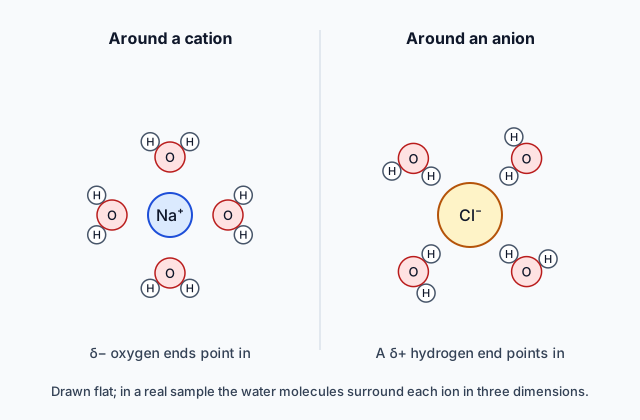
When sodium chloride is in water, each sodium ion, Na⁺, and each chloride ion, Cl⁻, is surrounded by water molecules.
(a) Identify the type of attraction between a Na⁺ ion and a water molecule.
(b) Represent on paper a Na⁺ ion with four water molecules around it and a Cl⁻ ion with four water molecules around it. Show which end of each water molecule points toward the ion.
(c) Explain, in terms of partial charges, why the water molecules point toward the two ions in different ways.
(d) Explain why a water molecule is attracted more strongly to a Na⁺ ion than to a neighboring water molecule.
Model answer
(a) Ion-dipole attraction: Na⁺ is an ion and water is a polar molecule.
(b) Four water molecules around Na⁺, each with its oxygen atom pointed toward the ion and its two hydrogen atoms pointed away. Four water molecules around Cl⁻, each with one hydrogen atom pointed toward the ion.
(c) Oxygen is more electronegative than hydrogen, so in water the O end carries a partial negative charge and the H ends carry partial positive charges. The positive Na⁺ attracts the δ− oxygen end, and the negative Cl⁻ attracts a δ+ hydrogen end, so the molecules turn opposite ends toward the two ions.
(d) Na⁺ carries a full positive charge, while the end of a neighboring water molecule carries only a partial charge. By Coulomb's law, a larger charge at a similar distance gives a stronger attraction, so the ion-dipole attraction is stronger than the attraction between two water molecules.
 Tap to open the picture full size
Score your own answer. This is a self-check, not a grade. Tick each point your answer makes.
Part 6 Check yourself Four particles compared
Both case questions use the table.
A class compares the attractions between pairs of particles using the reference data below. A dipole moment measures how large a molecule's dipole is, in debye (D); a value of 0 means the particle is nonpolar.
| Substance | Electrons per particle | Dipole moment (D) |
|---|---|---|
| Hydrogen chloride, HCl | 18 | 1.11 |
| Hydrogen bromide, HBr | 36 | 0.83 |
| Argon, Ar | 18 | 0 |
| Krypton, Kr | 36 | 0 |
Case question 1 · Multiple choice
Using the table: for which pair is the dipole-induced dipole attraction strongest?
Case question 2 · Decide and justify
Using the table: a student predicts, from the dipole moments alone, that HCl molecules attract one another more strongly than HBr molecules do. Is the prediction right?
Which reason supports your decision?
The rest stand on their own and do not use the case.
Check yourself · Fill the statement
In HCl, chlorine is more electronegative than hydrogen. Complete the description of how two HCl molecules attract.
The H end of one HCl molecule is attracted most strongly when it points at the end of the other, which carries a partial charge. If instead the Cl end of one molecule points at the Cl end of the other, the two ends each other.
Check yourself · Spot the error
A student explains hydrogen bonding in water and in hydrogen sulfide, H₂S. Tap the line with the mistake.
Part 7 Keep it Bring back earlier ideas
This lesson leans on two earlier ideas: a difference in electronegativity makes a bond polar, and the electron domains around a central atom set the shape of a molecule. Pulling them back up is what makes them last.
From 2.1 Types of Chemical Bonds · Fill the statement
Complete the description of two bonds to hydrogen. The electronegativities are N 3.04, H 2.20 and P 2.19.
An N-H bond is , and the atom in it carries a partial negative charge. A P-H bond is .
From 2.7 VSEPR and Hybridization · Rank it
Four molecules each have one central atom. In BCl₃, boron has single bonds to three Cl atoms and no lone pairs. In SO₃, sulfur is bonded to three O atoms and has no lone pairs. In CCl₄, carbon has single bonds to four Cl atoms and no lone pairs. In NCl₃, nitrogen has single bonds to three Cl atoms and one lone pair. Rank the bond angles.
Largest angle first
Give each one a place, 1 for first. Give two the same place if they are equal.
Your ranking: none yet
In three lines
- Every molecule has London dispersion forces, from temporary dipoles, and they grow with the number of electrons, the size of the electron cloud and the contact area.
- A polar molecule adds dipole-dipole attractions with another polar molecule, dipole-induced dipole with a nonpolar one and ion-dipole with an ion, all set by its partial charges.
- A hydrogen bond forms when H bonded to N, O or F is attracted to a lone pair on N, O or F in another molecule or another part of the same one.
Exam strategy for this topic
- Section I, Multiple Choice: 60 questions in 90 minutes.
- Section II, Free Response: 7 questions in 105 minutes.
- A scientific or graphing calculator is recommended for use on both sections of the exam.
When you compare the attractions in two substances, name every force present in each one, then say which one differs and why. A justification needs the structural reason, such as the number of electrons, the shape, or an H atom bonded to O, and not only the name of a force.
Questions students ask
What are the types of intermolecular forces?
London dispersion forces, present between all particles; dipole-dipole forces between polar molecules; dipole-induced dipole forces between a polar and a nonpolar molecule; ion-dipole forces between an ion and a polar molecule; and hydrogen bonds, a strong attraction involving H bonded to N, O or F.
Do nonpolar molecules have intermolecular forces?
Yes. Every atom and molecule forms temporary dipoles as its electrons move, so nonpolar molecules attract one another by London dispersion forces. Between large molecules these can be the strongest attractions present.
What does a molecule need to form hydrogen bonds?
A hydrogen atom covalently bonded to N, O or F, and a lone pair on an N, O or F atom for that hydrogen to be attracted to, in another molecule or another part of the same molecule.
Are London dispersion forces the same as van der Waals forces?
No. Van der Waals forces is a broader name that also covers other attractions between neutral molecules. Use "London dispersion forces" for the attraction between temporary dipoles.
Why are ion-dipole forces stronger than dipole-dipole forces?
An ion carries a full charge, while the end of a polar molecule carries only a partial charge. By Coulomb's law, the larger charge gives a stronger attraction at a similar distance.
Course alignment, for teachers
AP Chemistry topic 3.1, Unit 3: Properties of Substances and Mixtures.
- Skill 4.D: Explain the degree to which a model or representation describes the connection between particulate-level properties and macroscopic properties.
This lesson maps all 5 essential knowledge statements of the topic to the part that teaches each one: 5 are checked by a scored question. The map is in the lesson file.