Unit 3 · Topic 3.2 · about 30 minutes · 7 parts · 10 scored checks, 1 of them multiple choice, plus 2 from earlier lessons
AP Chemistry 3.2: Properties of Solids
Unit 3: 18 to 22% of the multiple-choice section
What you'll be able to do
- Explain how the properties of a substance that you can see and measure follow from the particles it is made of and the interactions between those particles.
Key vocabulary
| Term | What it means | The exam trap |
|---|---|---|
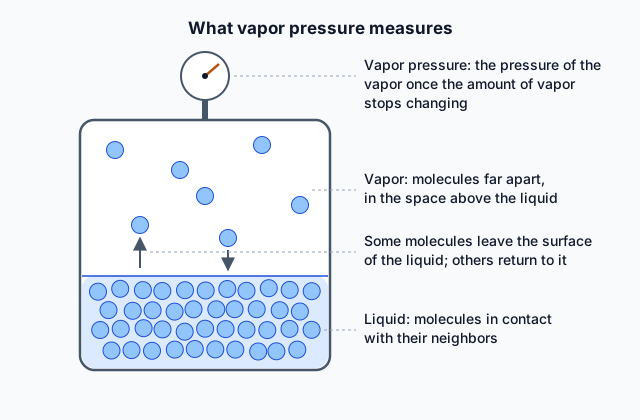
| Vapor pressure | The pressure of a substance's vapor above its liquid or solid in a closed container, once the amount of vapor stops changing. | Vapor pressure changes with temperature, so compare two substances only at the same temperature. |
| Molecular solid | A solid made of separate molecules held to one another by intermolecular forces. | Some molecular solids are made of very large molecules, so the size of a molecule alone does not tell you the type of solid. |
| Covalent network solid | A solid in which covalent bonds link every atom to its neighbors in one continuous network, in three dimensions or in flat layers. | Network solids and molecular solids can be made of the same kinds of elements, so decide from the structure or the properties, not from the elements alone. |
| Malleable | Able to be hammered or pressed into thin sheets without breaking. | Malleable describes bending into a new shape without breaking, so do not use it as another word for soft. |
 Tap to open the picture full size
Part 1 Think first Nail polish remover and water
Commit to a guess first. Being wrong now makes the right idea stick better.
Predict first
Nail polish remover is mostly acetone, (CH₃)₂CO. A drop of it on the back of your hand is gone in seconds, while a drop of water the same size takes many minutes to disappear. An acetone molecule is more than three times as heavy as a water molecule. Why does the acetone leave the drop so much faster?
In short. The properties of a solid come from its particles and the forces that hold them: ions, a network of covalent bonds, separate molecules, or metal cores in a sea of electrons.
- Vaporizing overcomes the attractions completely, so stronger attractions mean a higher boiling point and a lower vapor pressure.
- Ionic and covalent network solids melt at high temperatures; molecular solids melt at low ones and do not conduct.
- Metals conduct and bend without breaking because their valence electrons are free to move and their cores can rearrange.
Part 2 Learn it From particles to properties
2a. Boiling, vapor pressure and melting
When a substance vaporizes, its particles move far apart, so the attractions between them are overcome completely. Two properties track the strength of those attractions directly:
- Boiling point. Stronger attractions mean a higher boiling point.
- Vapor pressure, the pressure of the vapor above a liquid or solid in a closed container once the amount of vapor stops changing. Stronger attractions hold more particles back, so the vapor pressure is lower.
Water, with hydrogen bonds, boils at 100 °C. Methane, CH₄, with the same number of electrons (10) but only dispersion forces, boils at −162 °C.
When a substance melts, its particles stay in contact, and the attractions are only rearranged. Melting points also tend to rise with the strength of the attractions, but how well the particles pack matters too, so the link is less direct. Pentane boils at 36 °C and its compact isomer 2,2-dimethylpropane at 9.5 °C, as their dispersion forces predict, yet the compact molecules pack so neatly that they melt at −17 °C, far above pentane's −130 °C.
A particulate drawing of several particles and their attractions is a good way to explain properties like these.
Quick check · Rank it
Four liquids are each made of nonpolar molecules with a straight chain of carbon atoms: hexane, C₆H₁₄; octane, C₈H₁₈; pentane, C₅H₁₂; and heptane, C₇H₁₆. Rank them by vapor pressure at 25 °C.
Highest vapor pressure first
Give each one a place, 1 for first. Give two the same place if they are equal.
Your ranking: none yet
2b. Ionic solids
In an ionic solid, each ion is held by strong Coulombic attractions to all of its neighbors of opposite charge. Those strong interactions explain three properties.
- High melting and boiling points, low vapor pressure. Melting and boiling must work against the attractions between ions. Sodium chloride melts at 801 °C.
- Brittle. A sharp blow can push one layer of ions along by one position, so ions of the same charge end up side by side. Their repulsion forces the layers apart, and the crystal cracks.
- Conducts only when the ions can move. An electric current in an ionic substance is carried by moving ions. In the solid, the ions are held in fixed places, so the solid does not conduct. When the solid is melted (molten), or dissolved in water or another solvent, the ions are free to move and carry charge, so the liquid conducts.
Quick check · Sort it
Potassium chloride, KCl, is an ionic solid that melts at 770 °C. Sort each sample by whether it conducts electricity. Tap a card, then its bin.
Conducts
Does not conduct
2c. Covalent network and molecular solids
In a covalent network solid, covalent bonds link every atom to its neighbors in one continuous network. They form only from nonmetals and metalloids: elements such as diamond and graphite (both carbon), and binary compounds such as SiO₂ and SiC.
- Melting must break covalent bonds, so the melting points are high.
- In a three-dimensional network such as diamond, the bond angles are fixed, so the solid is rigid and hard.
- Graphite is made of flat two-dimensional sheets. The sheets are held to one another only weakly and slide past each other easily, so graphite is soft.
In a molecular solid, separate molecules are held together by intermolecular forces, which are much weaker than covalent bonds. Molecular solids have low melting points: ice melts at 0 °C and iodine, I₂, at 114 °C. They do not conduct electricity, because every valence electron is held in a covalent bond or a lone pair within its molecule.
Some molecular solids are made of very large molecules, such as polymers. In a polymer or large biomolecule, noncovalent interactions between molecules, and between different regions of the same molecule, largely set its shape, and its properties and how it works depend strongly on that shape.
Quick check · Decide and justify
In solid boron nitride, BN, each boron atom is covalently bonded to three nitrogen atoms and each nitrogen atom to three boron atoms, in sheets that run through the whole crystal. Solid boron trichloride is made of separate BCl₃ molecules. Which solid has the higher melting point?
Which reason supports your decision?
2d. Metallic solids and alloys
In a metallic solid, metal cores sit in a sea of valence electrons that are free to move through the whole solid.
- Good conductors of electricity and heat. The free valence electrons carry charge and energy through the metal.
- Malleable and ductile. A metal can be hammered into sheets and drawn into wires because its cores can rearrange. When one layer of cores slides past another, the sea of electrons still surrounds every core, so the metal bends instead of breaking.
- Alloys. In an interstitial alloy, small atoms of a second element sit in the gaps between the metal cores. They make the lattice more rigid, so the alloy is less malleable and less ductile than the pure metal. Alloys typically keep a sea of mobile electrons, so they still conduct.
Quick check · Decide and justify
Steel is iron with a small amount of carbon added. The carbon atoms are much smaller than the iron atoms and sit in the gaps between the iron cores. Compared with pure iron, is steel more malleable or less malleable?
Which reason supports your decision?
Part 3 Watch it done Three ionic solids, three melting points
Watch each step, then finish the explanation yourself.
Sodium chloride, NaCl, magnesium oxide, MgO, and calcium oxide, CaO, are all ionic solids. The ionic radii are Na⁺ 102 pm, Cl⁻ 181 pm, Mg²⁺ 72 pm, Ca²⁺ 100 pm and O²⁻ 140 pm. Which of the three melts at the highest temperature, and which at the lowest?
Step 1 · Name what melting works against
In both solids, melting frees the ions from their fixed places. That works against the Coulombic attraction between each ion and its neighbors of opposite charge, so the stronger those attractions are, the higher the melting point.
Step 2 · Recall what sets the attraction
By Coulomb's law, the attraction between two ions grows with the product of their charges and falls as the distance between their centers grows. For ions that touch, that distance is about the sum of their radii.
Why this step?
Why compare the attractions between ions, and not between molecules?
An ionic solid has no separate molecules. Each ion is attracted to all of its neighbors of opposite charge, so melting has to overcome attractions between ions.
Your step · Rank it
Finish it. The ionic radii are Na⁺ 102 pm, Cl⁻ 181 pm, Mg²⁺ 72 pm, Ca²⁺ 100 pm and O²⁻ 140 pm. Rank the three ionic solids by melting point.
Highest melting point first
Give each one a place, 1 for first. Give two the same place if they are equal.
Your ranking: none yet
The measured melting points agree: MgO above 2800 °C, CaO at about 2600 °C and NaCl at 801 °C. What changes from one ionic solid to the next is how strongly each ion holds its neighbors.
Part 4 Try it Cooking an egg
A new situation: what happens to the proteins in egg white as an egg cooks.
Try it · Fill the statement
Egg white is mostly water and proteins. Each protein is a long chain molecule folded into a particular shape. When the egg cooks, the proteins unfold and tangle together, and the egg white turns solid and white. Complete the explanation.
Heating disrupts the interactions, such as hydrogen bonds, between different regions of each protein chain, while the bonds along the chain stay intact. A protein's function depends on its , so the cooked proteins no longer work as they did.
Part 5 Explain it Diamond, graphite and iodine
On the exam this is handwritten, so answer on paper first. Nothing you type here leaves this page. Then check your answer against the model and each scoring point.
Free response is 50% of the exam score. This one is shaped like a short-answer question, which is worth 4 points.
Free-response practice · Short-answer style
Diamond and graphite are both made only of carbon atoms. Iodine, I₂, is another nonmetal element that is a solid at room temperature.
(a) Identify the type of solid that diamond and graphite both are.
(b) Explain why diamond and graphite both have very high melting points.
(c) Explain why diamond is hard but graphite is soft.
(d) Iodine melts at 114 °C. Explain why iodine melts at a far lower temperature than diamond, in terms of what must be overcome when each one melts.
Model answer
(a) Both are covalent network solids: covalent bonds link each carbon atom to its neighbors throughout the solid.
(b) To melt either solid, covalent bonds between carbon atoms must be broken. Covalent bonds are strong, so it takes a great deal of energy, and the melting points are very high.
(c) In diamond, each carbon atom is bonded to its neighbors in a three-dimensional network with fixed bond angles, so the atoms cannot shift and the solid is rigid and hard. Graphite is made of flat sheets of bonded carbon atoms, and the sheets are held to one another only weakly, so they slide past each other easily and graphite is soft.
(d) Solid iodine is a molecular solid of separate I₂ molecules. Melting it only overcomes the dispersion forces between the molecules, which are much weaker than covalent bonds, while melting diamond requires breaking covalent bonds.
Score your own answer. This is a self-check, not a grade. Tick each point your answer makes.
Part 6 Check yourself Four unknown solids
Both case questions use the table, and the first uses the figure too.
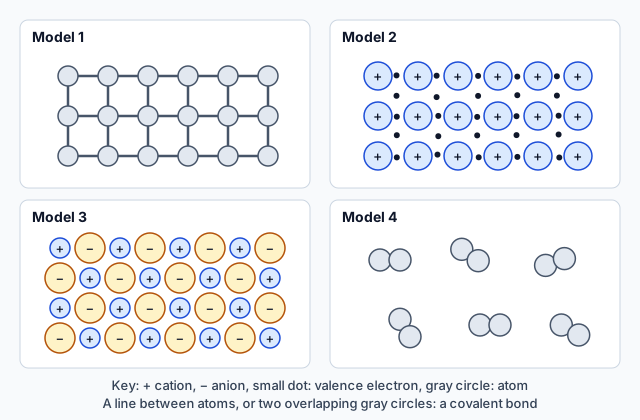
A student tested four unknown solids, labeled W to Z, and recorded the results in the table. The figure shows four particulate models, one for each type of solid.
| Solid | Melting point (°C) | Conducts as a solid? | Conducts when melted? | Struck with a hammer |
|---|---|---|---|---|
| W | 801 | No | Yes | Shatters |
| X | 1085 | Yes | Yes | Flattens |
| Y | 1713 | No | No | Too hard to dent |
| Z | 80 | No | No | Crumbles |
 Tap to open the picture full size
Case question 1 · Multiple choice
Using the table and the figure: which model is consistent with every property of solid W?
Case question 2 · Decide and justify
Using the table: when solid Z melts at 80 °C, are covalent bonds broken?
Which reason supports your decision?
The rest stand on their own and do not use the case.
Check yourself · Spot the error
A student explains why a copper sheet bends when struck but a sodium chloride crystal shatters. Tap the line with the mistake.
Check yourself · Match
Match each property to the particle-level reason for it.
Part 7 Keep it Bring back earlier ideas
This lesson leans on two earlier ideas: the kinds of intermolecular forces and what makes them stronger, and Coulomb's law for the attraction between ions of different charges and sizes. Pulling them back up is what makes them last.
Two new situations: one region of a long protein molecule meeting another, and three substances whose molecules are about the same size.
From 3.1 Intermolecular and Interparticle Forces · Rank it
Butane, CH₃CH₂CH₂CH₃, has 34 electrons and is nonpolar. Propanal, CH₃CH₂CHO, has 32 electrons and is polar. 1-Propanol, CH₃CH₂CH₂OH, has 34 electrons and is polar. The three molecules are similar in size and shape. Rank them by the strength of the attractions between their own molecules.
Strongest first
Give each one a place, 1 for first. Give two the same place if they are equal.
Your ranking: none yet
From 2.2 Intramolecular Force and Potential Energy · Select all
A cation and an anion attract each other. Which two changes would each make the attraction between them stronger? Pick two.
Select 2 answers, then check.
In three lines
- Vaporizing overcomes the attractions between particles completely, so stronger attractions give a higher boiling point and a lower vapor pressure; melting only rearranges them.
- Ionic solids melt high, are brittle and conduct only when melted or dissolved; covalent network solids melt high and, in 3-D, are hard.
- Molecular solids melt low and do not conduct; metals conduct and are malleable, and an interstitial alloy is more rigid but still conducts.
Exam strategy for this topic
- Section I, Multiple Choice: 60 questions in 90 minutes.
- Section II, Free Response: 7 questions in 105 minutes.
- A scientific or graphing calculator is recommended for use on both sections of the exam.
To explain a property, link three things in order: the particles the solid is made of, the force that must be overcome or rearranged, and the property itself. "NaCl has a high melting point because it is ionic" names a type; "melting must overcome strong Coulombic attractions between each ion and its neighbors" explains it.
Questions students ask
What are the four types of solids?
Ionic solids (cations and anions), covalent network solids (atoms in a continuous network of covalent bonds), molecular solids (separate molecules held by intermolecular forces) and metallic solids (metal cores in a sea of mobile valence electrons).
Why are ionic solids brittle?
A blow can shift one layer of ions by one position, which puts ions of the same charge side by side. Their repulsion forces the layers apart, so the crystal cracks.
Why does an ionic compound conduct only when melted or dissolved?
A current needs moving charges. In the solid the ions are held in fixed places; melted or dissolved, they are free to move and carry charge.
How is vapor pressure related to intermolecular forces?
Stronger intermolecular forces hold more particles in the liquid or solid, so fewer are in the vapor and the vapor pressure is lower. The same forces make the boiling point higher.
Why is graphite soft when diamond is so hard?
Diamond is a three-dimensional network with fixed bond angles, so its atoms cannot shift. Graphite is made of flat layers held to one another only weakly, so the layers slide past each other.
Course alignment, for teachers
AP Chemistry topic 3.2, Unit 3: Properties of Substances and Mixtures.
- Skill 4.C: Explain the connection between particulate-level and macroscopic properties of a substance using models and representations.
This lesson maps all 7 essential knowledge statements of the topic to the part that teaches each one: 7 are checked by a scored question. The map is in the lesson file.