Unit 3 · Topic 3.10 · about 30 minutes · 7 parts · 10 scored checks, 1 of them multiple choice, plus 2 from earlier lessons
AP Chemistry 3.10: Solubility
Unit 3: 18 to 22% of the multiple-choice section
What you'll be able to do
- Explain how the solubility of ionic and molecular compounds in water and in nonpolar solvents follows from the intermolecular interactions between their particles.
Key vocabulary
| Term | What it means | The exam trap |
|---|---|---|
| Solute | The substance that is dissolved in a solution, usually the one present in the smaller amount. | With two liquids, the names solute and solvent follow the amounts, so they can swap when the amounts change. |
| Solvent | The substance in which a solute is dissolved, usually the one present in the larger amount. | A question may name the solvent only by its formula, so work out its intermolecular forces before you judge what it dissolves. |
| Solubility | The greatest amount of a solute that dissolves in a given amount of a solvent at a given temperature. | A solubility belongs to a solute in one solvent, so always say which solvent a value is for. |
| Miscible | Describes two liquids that mix in all proportions to form one solution. | Two layers in a test tube do not mean that none of either liquid dissolved; a little of each can still be in the other layer. |
 Tap to open the picture full size
Part 1 Think first Cleaning a paintbrush
Commit to a guess first. Being wrong now makes the right idea stick better.
Predict first
A painter finishes a door with oil-based paint, whose binder is made of long molecules that are mostly carbon and hydrogen. Rinsed under the tap, the brush sheds water in beads and stays full of paint. Swished in mineral spirits, a liquid made of hydrocarbon molecules, the brush comes clean in seconds. Why does the mineral spirits remove the paint when water does not?
In short. Substances with similar intermolecular interactions tend to dissolve in one another, so a solute dissolves best in a solvent whose particles attract it about as strongly as they attract their own kind.
- Water, which hydrogen bonds, mixes with molecules that can hydrogen bond to it, and holds ions by ion-dipole attractions.
- Nonpolar solvents such as hexane dissolve nonpolar solutes, which they attract by dispersion forces.
- In a molecule with a polar group and a nonpolar part, the larger the nonpolar part, the less it dissolves in water.
Part 2 Learn it What dissolves in what
2a. Similar attractions mix
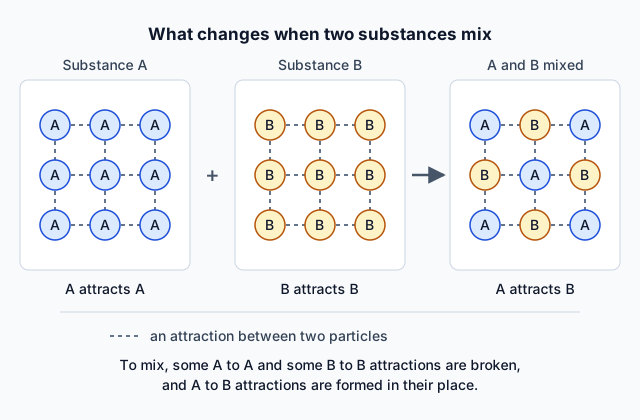
When a solute dissolves in a solvent, its particles spread out evenly among the solvent's particles. That takes three changes in attractions:
- solute particles are pulled away from one another;
- solvent particles move apart to make room;
- new attractions form between solute and solvent particles.
Particles spread out on their own unless something holds them back. What holds them back is a mismatch: when the particles of one substance attract one another much more strongly than they attract the other substance, they stay together. So substances with similar intermolecular interactions tend to be soluble in one another. Two liquids that mix in any proportion are miscible.
Example: ethanol, CH₃CH₂OH, and water. Both form hydrogen bonds, and an ethanol molecule can hydrogen bond to a water molecule, so the new attractions replace the ones that were broken. The two liquids are miscible.
Hexane, C₆H₁₄, is nonpolar. To mix with water it would have to break water's hydrogen bonds, and it would offer back only weak attractions to water molecules. So the water molecules stay together, and hexane and water form two layers. Hexane and octane, C₈H₁₈, both attract by dispersion forces, so they mix.
Quick check · Sort it
Each card names two liquids poured into one test tube and shaken. Tap a card, then the bin that says what you would see.
They mix into one layer
They form two layers
2b. Ionic solids and water
An ionic solid dissolves only if something pulls its ions out of the array. A polar solvent can do that. A water molecule has a partial negative charge on its oxygen end and partial positive charges on its hydrogen ends. Around a cation, water molecules turn their oxygen ends inward; around an anion, they turn their hydrogen ends inward. These ion-dipole attractions are strong enough to compete with the attractions holding the ions in the solid.
A nonpolar solvent has no dipole to offer. An ion pulled into hexane would meet only weak attractions to its molecules, so ionic solids barely dissolve in nonpolar solvents.
Example: table salt, NaCl, dissolves readily in water, but a spoonful stirred into cooking oil sits on the bottom unchanged.
Not every ionic solid dissolves well in water: in some, the ions attract one another more strongly than water can pull them away, and which ones do is a later topic. What this topic gives you is the comparison. An ionic solid is far more soluble in a polar solvent such as water than in a nonpolar one such as hexane.
Quick check · Fill the statement
Complete the explanation of why potassium bromide, KBr, dissolves in water but barely dissolves in hexane.
In water, the molecules around each K⁺ ion point their ends toward it, and the molecules around each Br⁻ ion point their ends toward it. These attractions pull the ions out of the solid. Hexane is .
2c. Molecules with two parts
Many molecules are partly polar and partly nonpolar. An alcohol has an O-H group, which hydrogen bonds to water, joined to a hydrocarbon chain, which attracts other molecules mainly by dispersion forces.
Methanol, CH₃OH, is mostly its O-H group, and it is miscible with water. Each carbon added to the chain makes the nonpolar part bigger: more of water's hydrogen bonds must break to make room for it, and it gives back only weak attractions. So the solubility of these alcohols in water falls as the chain grows, and their solubility in hexane rises. 1-Octanol, CH₃(CH₂)₇OH, with eight carbons and one O-H group, barely dissolves in water.
This is why the rule says "tend to". "Like dissolves like" is a model. It predicts which of two solvents a substance prefers, or which of two substances is more soluble in a solvent, but it does not say how much dissolves. To use it, look at the whole molecule: how much of it can hydrogen bond or carry a dipole, and how much of it is nonpolar.
Quick check · Sketch the graph
1-Butanol, an alcohol with a chain of four carbon atoms and one O-H group, dissolves in water to about 70 g per liter of water at room temperature. In the alcohols with five, six, seven and eight carbons, the solubility in water changes by about the same factor, a factor of about 3, with each carbon atom added. Sketch solubility in water against the number of carbon atoms. The first point, for 1-butanol, is placed for you; drag the others so the graph rises or falls the way the solubility does, and so each step reflects a change by the same factor.
One shape that fits
Drag a point up or down, or tap it and use the arrow keys. Only the shape is checked.
Part 3 Watch it done Why vitamin C dissolves in water
Predict first, then watch each step, then finish the last one yourself.
Vitamin C, C₆H₈O₆, is a small molecule with four O-H groups and two more oxygen atoms on a frame of six carbon atoms. It dissolves readily in water but hardly at all in cooking oil, whose molecules are long chains of carbon and hydrogen. Explain why, in terms of intermolecular interactions.
Predict first
Before you open the first step, predict: which attraction will matter most between vitamin C and water?
Step 1 · Name the attractions in each pure substance
Water molecules attract one another by hydrogen bonds. Vitamin C molecules hydrogen bond to one another through their O-H groups, and also attract by dipole-dipole and dispersion forces. Cooking oil molecules attract one another mainly by dispersion forces along their long chains.
Step 2 · Compare the attractions with water
Each O-H group of vitamin C can hydrogen bond to water molecules, and its other oxygen atoms can accept hydrogen bonds from water's O-H groups. So when vitamin C dissolves in water, the hydrogen bonds it forms with water replace the ones that broke.
Why this step?
Why does it matter that the molecule is small, with oxygen atoms spread across it?
Almost every part of the molecule sits near a group that can hydrogen bond. It has no long nonpolar stretch that would break water's hydrogen bonds and give back only weak attractions.
Step 3 · Compare the attractions with oil
To dissolve in oil, vitamin C would have to give up its hydrogen bonds and would get back only dispersion forces from the oil's chains. The interactions are not alike, so it hardly dissolves. Vitamin C is like water in its interactions, and dissolves in water.
Your step · Decide and justify
Finish it. Vitamin A, C₂₀H₃₀O, is a molecule of twenty carbon atoms, in a ring and a long chain, with a single O-H group at one end. Does vitamin A dissolve better in water or in cooking oil?
Which reason supports your decision?
The two vitamins have the same kinds of atoms. What differs is how much of each molecule can hydrogen bond: nearly all of vitamin C, and only one end of vitamin A.
Part 4 Try it Iodine and four solutes in water
A few iodine crystals, I₂, shaken with water give a pale brown liquid. Shaken with hexane, the same crystals give a deep purple solution. Then four more solutes, each dissolving in water.
Try it · Spot the error
A student explains why only a little iodine dissolves in water. Tap the line with the mistake.
Try it · Decide and justify
Chloromethane, CH₃Cl, is a polar molecule. Methane, CH₄, is nonpolar. Which one dissolves to a greater extent in water?
Which reason supports your decision?
Part 5 Explain it Antifreeze and motor oil
On the exam this is handwritten, so answer on paper first. Nothing you type here leaves this page. Then check your answer against the model and each scoring point.
Free response is 50% of the exam score. This one is shaped like a short-answer question, which is worth 4 points.
Free-response practice · Short-answer style
Ethylene glycol, HOCH₂CH₂OH, the main ingredient of antifreeze, mixes with water in all proportions. Motor oil, a mixture of hydrocarbons with long chains, forms a separate layer on water.
(a) Identify the strongest type of attraction between an ethylene glycol molecule and a water molecule.
(b) Explain, in terms of intermolecular interactions, why ethylene glycol and water are miscible.
(c) Explain why motor oil and water form two layers.
(d) Sodium chloride dissolves in water but not in motor oil. Explain why, in terms of the attractions each liquid can form with the ions.
Model answer
(a) Hydrogen bonding.
(b) Ethylene glycol and water both form hydrogen bonds through O-H groups, and an ethylene glycol molecule can hydrogen bond to water molecules. When they mix, the hydrogen bonds formed between the two replace the ones broken in each liquid, so their interactions are similar and they mix in any proportion.
(c) Motor oil molecules are nonpolar and attract one another by dispersion forces. To mix with water they would have to break water's hydrogen bonds and could form only weak attractions with water molecules in return, so the water molecules stay attracted to one another and the oil stays in its own layer.
(d) Water is polar, so its partially negative oxygen ends attract Na⁺ and its partially positive hydrogen ends attract Cl⁻. These ion-dipole attractions are strong enough to pull ions out of the solid. Oil molecules are nonpolar and have no dipole to attract the ions, so the ions stay in the solid.
Score your own answer. This is a self-check, not a grade. Tick each point your answer makes.
Part 6 Check yourself Four test tubes
Both case questions use the table.
A student pours equal volumes of two liquids into each of four test tubes, shakes each tube and lets it stand. 1-Butanol, CH₃CH₂CH₂CH₂OH, is an alcohol with a chain of four carbon atoms and one O-H group. It is only partly soluble in water: far less of it dissolves than the student pours in.
| Tube | Liquids | Result |
|---|---|---|
| 1 | Water and ethanol, CH₃CH₂OH | One layer |
| 2 | Water and hexane, C₆H₁₄ | Two layers |
| 3 | Water and 1-butanol | Two layers |
| 4 | Hexane and 1-butanol | One layer |
Case question 1 · Multiple choice
Using the table: which statement best explains the result in tube 4?
Case question 2 · Decide and justify
Using the table: a student's model says that any molecule with an O-H group mixes with water. Do the results support the model for every liquid in the table?
Which reason supports your decision?
The rest stand on their own and do not use the case.
Check yourself · Rank it
Each molecule below has six carbon atoms. Glucose, C₆H₁₂O₆, carries five O-H groups. 1-Hexanol, C₆H₁₃OH, is a chain of six carbons with one O-H group. Hexane, C₆H₁₄, has no O-H group. Rank the three by their solubility in water.
Most soluble first
Give each one a place, 1 for first. Give two the same place if they are equal.
Your ranking: none yet
Check yourself · Select all
Which two of these substances dissolve better in hexane than in water? Select two.
Select 2 answers, then check.
Part 7 Keep it Bring back earlier ideas
This lesson leans on two earlier ideas: how water molecules line up around a dissolved ion, and when molecules can form hydrogen bonds with one another. Pulling them back up is what makes them last.
From 3.8 Representations of Solutions · Decide and justify
A student draws a bromide ion, Br⁻, dissolved in water, with four water molecules around it. Each water molecule points its O atom at the Br⁻ ion. Is the drawing correct?
Which reason supports your decision?
From 3.1 Intermolecular and Interparticle Forces · Spot the error
A student explains hydrogen bonding in water and in hydrogen sulfide, H₂S. Tap the line with the mistake.
In three lines
- Substances with similar intermolecular interactions tend to dissolve in one another, because the attractions formed on mixing replace the ones broken.
- Water hydrogen bonds to molecules with O-H or N-H groups and holds ions by ion-dipole attractions; nonpolar solvents dissolve nonpolar solutes by dispersion forces.
- In a molecule with a polar group and a nonpolar part, the larger the nonpolar part, the less soluble it is in water and the more soluble in hexane.
Exam strategy for this topic
- Section I, Multiple Choice: 60 questions in 90 minutes.
- Section II, Free Response: 7 questions in 105 minutes.
- A scientific or graphing calculator is recommended for use on both sections of the exam.
When a question asks why one substance dissolves in another, name the strongest attractions in the solute, in the solvent and between the two, then compare them. A sentence that only says "like dissolves like" names the rule without explaining it.
Questions students ask
What does "like dissolves like" mean?
Substances with similar intermolecular interactions tend to be soluble in one another. Polar and hydrogen-bonding solvents such as water dissolve polar molecules and many ionic solids; nonpolar solvents such as hexane dissolve nonpolar solutes.
Why do oil and water not mix?
Water molecules attract one another by hydrogen bonds, and nonpolar oil molecules offer water only weak attractions in return. The water molecules stay together, so the oil forms its own layer.
Why do ionic compounds dissolve in water but not in hexane?
Water's polar molecules attract cations with their oxygen ends and anions with their hydrogen ends. These ion-dipole attractions can pull ions out of the solid. Hexane is nonpolar and has no dipole to attract them.
Why are short alcohols soluble in water and long ones not?
The O-H group hydrogen bonds to water, but the hydrocarbon chain does not. As the chain grows, more of the molecule is nonpolar, so solubility in water falls and solubility in hexane rises.
What does miscible mean?
Two liquids are miscible when they mix in all proportions to form one solution, as ethanol and water do.
Course alignment, for teachers
AP Chemistry topic 3.10, Unit 3: Properties of Substances and Mixtures.
- Skill 4.D: Explain the degree to which a model or representation describes the connection between particulate-level properties and macroscopic properties.
This lesson maps the one essential knowledge statement of the topic to the part that teaches each one: 1 is checked by a scored question. The map is in the lesson file.