Unit 3 · Topic 3.9 · about 30 minutes · 7 parts · 10 scored checks, 1 of them multiple choice, plus 2 from earlier lessons
AP Chemistry 3.9: Separation of Solutions and Mixtures
Unit 3: 18 to 22% of the multiple-choice section
What you'll be able to do
- Explain the results of a chromatography or distillation experiment from the intermolecular interactions of the components being separated.
Key vocabulary
| Term | What it means | The exam trap |
|---|---|---|
| Stationary phase | The part of a chromatography setup that stays in place, such as the paper, the silica coating of a plate, or the packing of a column. | Which components it holds back depends on what it is made of, so check its polarity before you read a chromatogram. |
| Mobile phase | The solvent that moves through or across the stationary phase, carrying the components of the mixture with it. | A component is pulled by both phases, so the solvent's own polarity matters as well as the stationary phase's. |
| Retention factor | Rf, the distance a spot moved divided by the distance the solvent front moved, both measured from the starting line. | An Rf has no unit and cannot be larger than 1, so a value above 1 means the division is upside down. |
| Distillate | The liquid collected when the vapor from a heated mixture is cooled and condensed. | The first distillate is often richer in one component rather than pure, so say "richer in" unless the question says otherwise. |
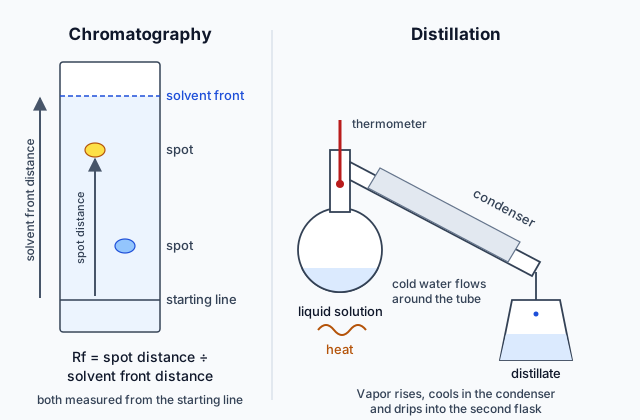 Tap to open the picture full size
Part 1 Think first Fresh water at sea
Commit to a guess first. Being wrong now makes the right idea stick better.
Predict first
On a long sailing trip, a crew runs low on drinking water. One sailor suggests pouring seawater through a stack of coffee filters to take the salt out. How will the water that drips through the filters taste?
In short. The components of a liquid solution pass through a filter together, so they are separated by differences in their intermolecular attractions instead.
- Chromatography: a component more attracted to the stationary phase moves more slowly, so the spots show relative polarity.
- Rf, the distance a spot moved divided by the distance the solvent front moved, compares spots on one chromatogram.
- Distillation: a component with weaker attractions has a higher vapor pressure, so the first distillate is richer in it.
Part 2 Learn it Separating solutions
2a. Why a filter cannot do it
Filtration pours a mixture through paper or another filter with tiny holes. It separates by size: solid particles too large for the holes, such as grains of sand, stay on the paper, and the liquid runs through.
In a solution, though, the solute is spread out as single molecules or ions, about as small as the solvent's own molecules. They pass through any filter the solvent passes through, so filtration cannot separate the components of a liquid solution.
To pull a solution apart, use a difference the components do have: how strongly each one is attracted to the particles around it. Two processes do this, and both come down to the intermolecular forces of Topic 3.1:
- chromatography uses differences in how strongly each component is attracted to a surface and to a moving solvent;
- distillation uses differences in how easily each component escapes from the liquid into the vapor.
Neither process cares about particle size. A solution of two dyes, or of two liquids, can be separated by either one when its components attract their surroundings differently.
Quick check · Sort it
Each card names a mixture. Tap a card, then the bin it belongs in.
Filtration can separate it
Filtration cannot separate it
2b. Chromatography
In chromatography, a mobile phase, a solvent, moves through or across a stationary phase, which stays put: paper (paper chromatography), a thin coating of silica on a plate (thin-layer chromatography), or a packed tube (column chromatography). The mixture starts as a small spot or band, and the mobile phase carries its components along.
Each component is pulled two ways: attractions to the stationary phase hold it back, and attractions to the mobile phase carry it along. A component more strongly attracted to the stationary phase moves more slowly. The components spread apart into separate spots, a chromatogram, or leave a column one after another so each can be collected.
Silica and paper are polar. With a polar stationary phase and a less polar solvent, a more polar component is held back more strongly and travels a shorter distance, and a less polar one travels farther. So the chromatogram shows the order of the components' polarities.
To compare spots in numbers, use the retention factor:
Rf = distance moved by the spot ÷ distance moved by the solvent front
with both distances measured from the starting line. Rf has no unit and lies between 0 and 1; a smaller Rf means a component held back more.
Quick check · Rank it
A mixture of three dyes is separated on a polar silica plate with a solvent much less polar than silica. From the starting line, dye A moved 1.2 cm, dye B moved 4.8 cm and dye C moved 3.0 cm. Rank the dyes by polarity.
Most polar first
Give each one a place, 1 for first. Give two the same place if they are equal.
Your ranking: none yet
2c. Distillation
In distillation, a liquid solution is heated in a flask. How easily each component's molecules escape into the vapor depends on their intermolecular attractions: a component with weaker attractions has a higher vapor pressure (Topic 3.2), so it makes up a larger share of the vapor than of the liquid. The vapor rises into a condenser, a tube cooled by flowing water, where it turns back into liquid and drips into a second flask as the distillate.
Example: acetone and water. Water molecules attract one another by hydrogen bonds. Acetone has no H bonded to O, so its molecules attract one another by dipole-dipole and dispersion forces, which here are weaker. Acetone has the higher vapor pressure, so the first distillate is richer in acetone, and the liquid left in the flask grows richer in water.
A dissolved ionic solid, such as salt in water, has almost no vapor pressure, because its ions are held by strong attractions. Distilling salt water collects nearly pure water and leaves the salt behind in the flask.
Quick check · Decide and justify
A solution of pentane, C₅H₁₂, and octane, C₈H₁₈, both nonpolar, is heated in a distillation setup. The first distillate is richer in which liquid?
Which reason supports your decision?
Part 3 Watch it done Reading a chromatogram
Watch each step, then finish the problem yourself.
A student spots a green food coloring on a polar silica plate and develops it with a solvent much less polar than silica. The coloring separates into a yellow spot and a blue spot. From the starting line, the yellow spot moved 4.5 cm, the blue spot moved 1.8 cm and the solvent front moved 6.0 cm. What is the Rf of each dye? The distances are a teaching example.
Step 1 · Measure from the starting line
Every distance runs from the starting line, where the coloring was spotted, to the center of a spot or to the solvent front. Here the distances are given that way: 4.5 cm, 1.8 cm and 6.0 cm.
Step 2 · Find the yellow dye's Rf
Rf = 4.5 cm ÷ 6.0 cm = 0.75. The centimeters cancel, so Rf has no unit, and two significant figures, as in the distances.
Why this step?
Why are both distances measured from the starting line and not from the bottom edge of the plate?
The dyes started moving at the starting line, so the distance from the line is how far each one traveled. Measuring the solvent front from the same line compares the two over the same stretch of plate.
Your step · Calculate
Finish it. The blue spot moved 1.8 cm from the starting line, and the solvent front moved 6.0 cm. What is the Rf of the blue dye? Give your answer to two significant figures.
The blue dye has the smaller Rf: it is held back more by the polar silica, so it is the more polar of the two dyes. An Rf compares spots run on the same plate with the same solvent; change either one and the values change.
Part 4 Try it Plan a separation
Two planning tasks: the steps of a paper chromatography experiment, and the right process for each of four jobs.
Try it · Put it in order
A student wants to find out whether a black marker ink is a mixture of dyes. Put the steps of the paper chromatography experiment in order.
Try it · Match
Match each job to the process that does it.
Part 5 Explain it The pigments in spinach
On the exam this is handwritten, so answer on paper first. Nothing you type here leaves this page. Then check your answer against the model and each scoring point.
Free response is 50% of the exam score. This one is shaped like a short-answer question, which is worth 4 points.
Free-response practice · Short-answer style
A student grinds spinach leaves in acetone and filters the mixture through paper to remove the pieces of leaf. The green liquid that passes through holds several pigments. The student spots it on a polar silica plate and develops the plate with a solvent that is mostly hexane, which is nonpolar. From the starting line, the orange spot of β-carotene, a hydrocarbon, moved 7.2 cm, a green spot of chlorophyll moved 2.8 cm, and the solvent front moved 8.0 cm. The distances are a teaching example.
(a) Calculate the Rf of the chlorophyll.
(b) Identify which pigment, β-carotene or chlorophyll, is more polar, and justify your answer using the attractions of each pigment to the stationary phase and the mobile phase.
(c) Explain why the green liquid that passed through the filter paper still held every pigment.
(d) The student runs a second plate with a solvent that is more polar than hexane. Predict whether the chlorophyll spot will move farther or less far than 2.8 cm, and justify your prediction.
Model answer
(a) Rf = 2.8 cm ÷ 8.0 cm = 0.35.
(b) Chlorophyll is more polar. It is more strongly attracted to the polar silica than to the nonpolar hexane, so it is held back and moved only 2.8 cm. β-carotene, a nonpolar hydrocarbon, is attracted only weakly to the silica and is carried along by the hexane, so it moved 7.2 cm, an Rf of 0.90.
(c) The pigments are dissolved in the acetone, spread out as single molecules about as small as the solvent's own. They pass through the filter paper with the acetone; the paper holds back only undissolved solids such as the pieces of leaf.
(d) Farther. A more polar solvent attracts the polar chlorophyll more strongly, so the mobile phase pulls it along more, against the pull of the silica, and the spot moves farther from the line.
Score your own answer. This is a self-check, not a grade. Tick each point your answer makes.
Part 6 Check yourself Four liquids and their vapor pressures
Both case questions use the table.
The table gives the vapor pressure of four liquids at 20 °C, rounded from standard reference values.
| Liquid | Formula | Vapor pressure at 20 °C (kPa) |
|---|---|---|
| Acetone | C₃H₆O | 25 |
| Water | H₂O | 2.3 |
| Diethyl ether | C₄H₁₀O | 59 |
| Ethanol | C₂H₅OH | 5.9 |
Case question 1 · Rank it
Using the table: rank the four liquids by the strength of the attractions among their molecules.
Strongest attractions first
Give each one a place, 1 for first. Give two the same place if they are equal.
Your ranking: none yet
Case question 2 · Decide and justify
Using the table: a solution of acetone and ethanol is heated gently in a distillation setup. The first few milliliters of distillate are richer in which liquid?
Which reason supports your decision?
The rest stand on their own and do not use the case.
Check yourself · Spot the error
A student explains how distilling salt water gives drinking water. Tap the line with the mistake.
Check yourself · Multiple choice
A student pours sugar water through filter paper, and the liquid that comes through tastes just as sweet as before. Which explanation is correct?
Part 7 Keep it Bring back earlier ideas
This lesson leans on two earlier ideas: stronger attractions between particles mean a lower vapor pressure, and which molecules can form hydrogen bonds with one another. Pulling them back up is what makes them last.
From 3.2 Properties of Solids · Rank it
Four liquids are each made of nonpolar molecules with a straight chain of carbon atoms: hexane, C₆H₁₄; octane, C₈H₁₈; pentane, C₅H₁₂; and heptane, C₇H₁₆. Rank them by vapor pressure at 25 °C.
Highest vapor pressure first
Give each one a place, 1 for first. Give two the same place if they are equal.
Your ranking: none yet
From 3.1 Intermolecular and Interparticle Forces · Select all
Which two of these substances form hydrogen bonds between their own molecules? Select two.
Select 2 answers, then check.
In three lines
- Filtration separates by size, so it cannot separate the components of a liquid solution; chromatography and distillation use differences in attractions instead.
- In chromatography, a component more attracted to the stationary phase moves less; on a polar plate with a less polar solvent, the most polar spot has the smallest Rf.
- In distillation, the component with weaker attractions has the higher vapor pressure, so the first distillate is richer in it.
Exam strategy for this topic
- Section I, Multiple Choice: 60 questions in 90 minutes.
- Section II, Free Response: 7 questions in 105 minutes.
- A scientific or graphing calculator is recommended for use on both sections of the exam.
To explain a separation, name the intermolecular forces of each component and say what they do. For chromatography, compare each component's attraction to the stationary phase and to the mobile phase. For distillation, connect weaker attractions to a higher vapor pressure. A claim with no forces named may not earn the point.
Questions students ask
Why can't you separate a solution by filtration?
A filter separates by size. In a solution the solute is spread out as single molecules or ions, about as small as the solvent's molecules, so they pass through the filter with the solvent.
How does chromatography separate a mixture?
A solvent, the mobile phase, carries the mixture across a stationary phase such as paper or silica. Each component is attracted to both, and one more strongly attracted to the stationary phase moves more slowly, so the components spread apart.
How do you calculate Rf?
Divide the distance the spot moved by the distance the solvent front moved, both measured from the starting line. A spot that moved 4.5 cm when the front moved 6.0 cm has an Rf of 0.75.
What does a chromatogram say about polarity?
It depends on the phases. On a polar plate such as silica with a less polar solvent, a more polar component is held back more, so it has a smaller Rf.
Which component comes off first in distillation?
The one with weaker intermolecular attractions. Weaker attractions give it a higher vapor pressure, so it makes up more of the vapor and of the first distillate.
Course alignment, for teachers
AP Chemistry topic 3.9, Unit 3: Properties of Substances and Mixtures.
- Skill 2.C: Identify experimental procedures that are aligned to a scientific question (which may include a sketch of a lab setup).
This lesson maps the one essential knowledge statement of the topic to the part that teaches each one: 1 is checked by a scored question. The map is in the lesson file.