Unit 3 · Topic 3.11 · about 30 minutes · 7 parts · 10 scored checks, 1 of them multiple choice, plus 2 from earlier lessons
AP Chemistry 3.11: Spectroscopy and the Electromagnetic Spectrum
Unit 3: 18 to 22% of the multiple-choice section
What you'll be able to do
- Explain how microwave, infrared, and ultraviolet or visible radiation are each linked to a different kind of change in a molecule's energy levels.
Key vocabulary
| Term | What it means | The exam trap |
|---|---|---|
| Electromagnetic spectrum | The full range of electromagnetic radiation, sorted by wavelength into regions with names such as infrared and ultraviolet. | The edges of the regions are not sharp, so place a wavelength by the range it falls well inside, not by a single cutoff. |
| Photon | A single packet of light energy, absorbed or given off whole. | A photon is absorbed whole or not at all, so a molecule never takes in part of one. |
| Wavelength | The distance from one crest of a wave to the next, given in units such as nm, μm, mm or cm. | Wavelengths in one question may come in different units, so convert them to one unit before you compare them. |
| Spectroscopy | The study of which wavelengths of radiation a substance absorbs or gives off, and what they show about its particles. | A spectrum shows where a sample absorbs or emits; you supply the link from that region to the kind of change. |
 Tap to open the picture full size
Part 1 Think first Inside a microwave oven
Commit to a guess first. Being wrong now makes the right idea stick better.
Predict first
A microwave oven warms a bowl of soup because the water molecules in the soup absorb the microwave radiation. What does the radiation do to the water molecules?
In short. Molecules absorb and give off light in different regions of the electromagnetic spectrum because each region goes with a different kind of change in the molecule.
- Microwave radiation goes with changes in rotational levels, the energy of a molecule turning.
- Infrared radiation goes with changes in vibrational levels, the energy of bonds stretching and bending.
- Ultraviolet and visible radiation go with changes in electronic levels, the energy of the electrons.
Part 2 Learn it Light and the changes it causes
2a. Regions of the spectrum
Light is electromagnetic radiation, and a molecule takes it in or gives it off one photon, one packet of energy, at a time. The electromagnetic spectrum sorts radiation by wavelength into regions. The table lists them from the longest wavelengths to the shortest. The boundaries are not sharp, so the ranges are rough.
The shorter the wavelength, the more energy each photon carries. A microwave photon carries less energy than an infrared photon, which carries less than a photon of visible or ultraviolet light. The next topic gives the equations that link wavelength and energy; for now, the order is what matters.
Wavelengths come in many units, so convert before you compare: 1 mm = 1000 μm, and 1 μm = 1000 nm. Example: radiation of wavelength 5.0 μm is 5000 nm, longer than red light at 700 nm and shorter than 1 mm, so it is infrared.
| Region | Rough range of wavelengths |
|---|---|
| Radio | Longer than about 1 m |
| Microwave | About 1 mm to 1 m |
| Infrared | About 700 nm to 1 mm |
| Visible | About 400 nm (violet) to 700 nm (red) |
| Ultraviolet | About 10 nm to 400 nm |
| X-ray | Shorter than about 10 nm |
Quick check · Put it in order
Put these five sources in order of the energy of one photon of their radiation, lowest energy first.
2b. Each region, its own kind of change
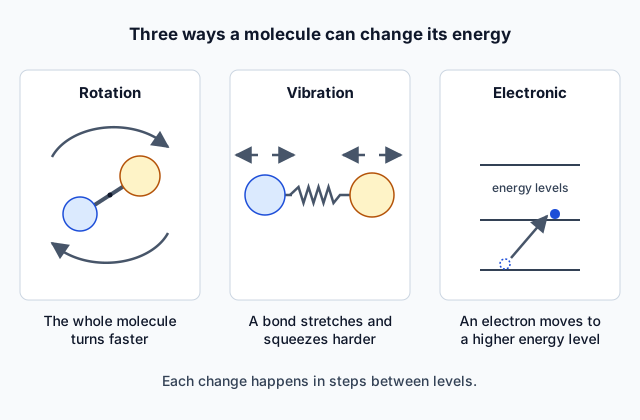
A molecule's energy can change in three ways, and each comes in levels: the molecule can have only certain amounts of that energy, so it changes in steps.
- Rotational levels: the energy of the molecule turning as a whole. These levels are the closest together, so a step between them is small.
- Vibrational levels: the energy of its bonds stretching and bending. These are farther apart.
- Electronic levels: the energy of its electrons. These are the farthest apart of the three.
A molecule absorbs light in the region whose photons carry the energy of one of these steps. So each region goes with one kind of change:
- microwave radiation goes with transitions between rotational levels;
- infrared radiation goes with transitions between vibrational levels;
- ultraviolet and visible radiation go with transitions between electronic levels.
Example: ozone, O₃, high in the atmosphere absorbs ultraviolet light from the Sun. Each ultraviolet photon it absorbs moves an electron in an ozone molecule to a higher energy level. That is how the ozone layer screens the ground from much of the Sun's ultraviolet light.
Quick check · Fill the statement
Complete the explanation of which region of the spectrum goes with a change in a molecule's rotational level.
Of the three kinds of levels, rotational levels are the , so a step between them needs a photon with the energy. Those photons are photons.
2c. Absorbing and giving off
A molecule absorbs a photon when it moves up to a higher level, and it emits, or gives off, a photon when it drops to a lower one. The region is the same either way. A molecule that drops to a lower vibrational level gives off infrared radiation, and an electron that drops to a lower level gives off ultraviolet or visible light, which is the glow of a neon sign.
A molecule has all three kinds of levels, which is why a spectrum of one gas can show absorptions in the microwave, the infrared and the ultraviolet, each from its own kind of change.
A gas of single atoms, such as neon, has no bonds to vibrate and no molecules to turn, so its spectrum comes from changes in electronic levels only.
That is what makes spectroscopy, the study of which light a substance absorbs or emits, so useful. The region where a sample absorbs tells a chemist what kind of change happened: a turning molecule, a vibrating bond or an electron moving between levels.
Quick check · Decide and justify
In a cold cloud of gas between the stars, carbon monoxide molecules drop from a higher rotational level to a lower one. What does the cloud do with radiation as this happens?
Which reason supports your decision?
Part 3 Watch it done Water vapor in the microwave region
Predict first, then watch each step, then finish the last one yourself.
Water vapor absorbs radiation of wavelength 1.35 cm. What kind of change in a water molecule goes with this absorption?
Predict first
Before you open the first step, predict: which kind of change goes with the 1.35 cm absorption?
Step 1 · Put the wavelength in a region
1.35 cm is 13.5 mm, or 0.0135 m. That lies between 1 mm and 1 m, so the radiation is in the microwave region.
Step 2 · Match the region to a kind of level
Microwave photons carry the least energy of the three regions that go with changes in a molecule. That matches the smallest steps, the ones between rotational levels.
Why this step?
Why can a microwave photon not raise a water molecule to a higher vibrational level?
Vibrational levels are farther apart than rotational levels. A microwave photon carries too little energy for that step, which takes an infrared photon.
Step 3 · State the change
Each photon absorbed at 1.35 cm raises a water molecule to a higher rotational level: the molecule turns faster.
Your step · Decide and justify
Finish it. Water vapor also absorbs radiation of wavelength 6.27 μm. Which kind of level changes when a water molecule absorbs a photon of this wavelength?
Which reason supports your decision?
One molecule, two absorptions, two kinds of change. The region decides the change, so every question of this kind starts by putting the wavelength in a region.
Part 4 Try it Spectra at work
Spectroscopy turns up far from the lab: in the air, in a breath tester, in sunscreen and in food coloring.
Try it · Spot the error
A student explains how carbon dioxide in the air takes in energy given off by Earth's surface. Tap the line with the mistake.
Try it · Sort it
Each card describes light a substance absorbs. Tap a card, then the kind of level that changes.
Rotational levels
Vibrational levels
Electronic levels
Part 5 Explain it Three absorptions of sulfur dioxide
On the exam this is handwritten, so answer on paper first. Nothing you type here leaves this page. Then check your answer against the model and each scoring point.
Free response is 50% of the exam score. This one is shaped like a short-answer question, which is worth 4 points.
Free-response practice · Short-answer style
A chemist shines radiation through a sample of gaseous sulfur dioxide, SO₂, and finds that it absorbs in the microwave, infrared and ultraviolet regions.
(a) Identify the kind of transition in SO₂ that goes with the absorption of microwave radiation.
(b) Identify the kind of transition in SO₂ that goes with the absorption of infrared radiation.
(c) Explain why one sample of SO₂ can absorb radiation in three different regions.
(d) A student claims that because SO₂ absorbs microwave radiation, the microwaves must be moving its electrons to higher energy levels. Explain what is wrong with the claim.
Model answer
(a) A transition between rotational levels: the molecules turn faster.
(b) A transition between vibrational levels: the bonds stretch or bend harder.
(c) An SO₂ molecule has rotational, vibrational and electronic levels, and the steps between each kind of level are a different size. Each kind of step matches photons from a different region, so the sample absorbs in one region for each kind of change.
(d) Electronic levels are the farthest apart of the three, and a microwave photon carries far too little energy for that step. Microwave photons match the small steps between rotational levels, so the absorption shows the molecules turning faster. Electronic transitions go with ultraviolet and visible light.
Score your own answer. This is a self-check, not a grade. Tick each point your answer makes.
Part 6 Check yourself Three absorptions of carbon monoxide
Both case questions use the table.
Carbon monoxide, CO, is studied in the lab and in space by the radiation it absorbs. The table gives three of its absorptions.
| Absorption | Wavelength |
|---|---|
| A | 2.60 mm |
| B | 4.67 μm |
| C | 155 nm |
Case question 1 · Match
Using the table: match each absorption to the change in a CO molecule that goes with it.
Case question 2 · Decide and justify
Using the table: carbon monoxide also absorbs weakly at a wavelength of 2.35 μm. Call this absorption D. Which absorption in the table goes with the same kind of change in the molecule as absorption D?
Which reason supports your decision?
The rest stand on their own and do not use the case.
Check yourself · Multiple choice
A chemist wants to measure how the bonds in a sample of methane, CH₄, stretch and bend. Which region of radiation should the spectrometer use?
Check yourself · Select all
Which two statements about molecules and light are true? Select two.
Select 2 answers, then check.
Part 7 Keep it Bring back earlier ideas
This lesson leans on two earlier ideas: photoelectron spectroscopy measures the energy needed to remove electrons, and the bonds between atoms in a molecule have a lowest-energy length they stretch and squeeze about. Pulling them back up is what makes them last.
From 1.6 Photoelectron Spectroscopy · Match
Match each feature of a photoelectron spectrum to what it tells you about the atom.
From 2.2 Intramolecular Force and Potential Energy · Spot the error
A student describes the potential energy of two atoms as they approach each other from far apart. Tap the line with the mistake.
In three lines
- Light comes in photons, and the shorter the wavelength, the more energy each photon carries.
- Microwave radiation goes with rotational levels, infrared with vibrational levels, and ultraviolet and visible with electronic levels.
- Moving up a level absorbs a photon and dropping down emits one, in the same region, so the region of a spectrum tells what kind of change happened.
Exam strategy for this topic
- Section I, Multiple Choice: 60 questions in 90 minutes.
- Section II, Free Response: 7 questions in 105 minutes.
- A scientific or graphing calculator is recommended for use on both sections of the exam.
When a question gives a wavelength and asks what happens in the molecule, do it in two written steps: name the region, with the wavelength converted to one unit, then name the kind of transition that region goes with. Writing "it absorbs energy" alone names no transition.
Questions students ask
What does microwave radiation do to molecules?
It goes with changes in rotational levels. A molecule that absorbs a microwave photon turns faster.
What does infrared radiation do to molecules?
It goes with changes in vibrational levels. A molecule that absorbs an infrared photon has bonds that stretch or bend harder.
What does ultraviolet or visible light do to molecules?
It goes with changes in electronic levels. A molecule that absorbs an ultraviolet or visible photon has an electron move to a higher energy level.
Why does each region go with a different change?
Rotational levels are closest together, vibrational levels farther apart and electronic levels farthest apart. Photons carry more energy as the wavelength gets shorter, so each kind of step matches photons from a different region.
Which region has the most energy per photon?
Of the regions linked to changes in molecules, ultraviolet. Energy per photon rises from microwave to infrared to visible to ultraviolet as the wavelength gets shorter.
Course alignment, for teachers
AP Chemistry topic 3.11, Unit 3: Properties of Substances and Mixtures.
- Skill 4.A: Predict and/or explain chemical properties or phenomena (e.g., of atoms or molecules) using given chemical theories, models, and representations.
This lesson maps the one essential knowledge statement of the topic to the part that teaches each one: 1 is checked by a scored question. The map is in the lesson file.