Unit 3 · Topic 3.12 · about 30 minutes · 7 parts · 11 scored checks, 1 of them multiple choice, plus 2 from earlier lessons
AP Chemistry 3.12: Properties of Photons
Unit 3: 18 to 22% of the multiple-choice section
What you'll be able to do
- Explain the properties of a photon that an atom or molecule absorbs or emits, in terms of the change in the energy of that atom or molecule.
Key vocabulary
| Term | What it means | The exam trap |
|---|---|---|
| Photon | A single packet of electromagnetic energy; a beam of light is a stream of photons. | A question about one photon wants the energy of a single packet, so multiply by a number of photons only when the question gives one. |
| Wavelength | The distance from one crest of a wave to the next, written λ. | A wavelength is a length, so write its unit beside every value you substitute and check that the units cancel. |
| Frequency | The number of wave crests that pass a point each second, written ν, in s⁻¹ (hertz). | The symbol ν is the Greek letter nu, not the letter v used for speed, so do not read it as a velocity. |
| Planck's constant | The constant h = 6.626 × 10⁻³⁴ J·s that links the energy of a photon to the frequency of its light. | Its unit is J·s, so it multiplies a frequency in s⁻¹ to give joules; if the units do not come out in joules, recheck the setup. |
 Tap to open the picture full size
Part 1 Think first Two laser pointers
Commit to a guess first. Being wrong now makes the right idea stick better.
Predict first
A red laser pointer makes light with a wavelength of 650 nm, and a violet one makes light with a wavelength of 405 nm. Light comes in tiny packets of energy called photons. Which pointer makes photons that each carry more energy?
In short. A photon is one packet of light energy, E = hν, and when an atom or molecule absorbs or emits one, its energy rises or falls by exactly the energy of that photon.
- Wavelength and frequency are tied by c = λν, so a shorter wavelength means a higher frequency.
- The energy of one photon is E = hν, which is also hc/λ: the higher the frequency, the more energy.
- Absorbing a photon raises a species' energy by the photon's energy, and emitting one lowers it by the same amount.
Part 2 Learn it Photons and their energy
2a. Wavelength and frequency
Light is an electromagnetic wave. Its wavelength, λ (lambda), is the distance from one crest of the wave to the next. Its frequency, ν (nu), is the number of crests that pass a point each second, in s⁻¹ (also called hertz, Hz).
In a vacuum, light of every wavelength travels at the same speed, c = 2.998 × 10⁸ m/s, and the three quantities are tied together:
c = λν
Because c is fixed, wavelength and frequency move in opposite directions: halve the wavelength and the frequency doubles.
Watch the units. c is in meters per second, so the wavelength must be in meters. Visible light is usually given in nanometers, and 1 nm = 10⁻⁹ m.
Example: a helium-neon laser makes red light with a wavelength of 633 nm, which is 6.33 × 10⁻⁷ m. Its frequency is ν = c/λ = (2.998 × 10⁸ m/s) ÷ (6.33 × 10⁻⁷ m) = 4.74 × 10¹⁴ s⁻¹.
Quick check · Rank it
Four beams of light have these frequencies: light A, 5.66 × 10¹⁴ s⁻¹; light B, 4.62 × 10¹⁴ s⁻¹; light C, 7.41 × 10¹⁴ s⁻¹; light D, 6.38 × 10¹⁴ s⁻¹. Rank the four beams by wavelength.
Longest wavelength first
Give each one a place, 1 for first. Give two the same place if they are equal.
Your ranking: none yet
2b. The energy of one photon
Light also comes in packets of energy called photons. Planck's equation gives the energy of one photon from the frequency of its light:
E = hν
Here h is Planck's constant, 6.626 × 10⁻³⁴ J·s. The higher the frequency, the more energy each photon carries. Putting ν = c/λ into Planck's equation gives the energy straight from the wavelength, E = hc/λ, so a shorter wavelength means more energy in each photon.
Example: the helium-neon laser's 633 nm light. E = hν = (6.626 × 10⁻³⁴ J·s)(4.736 × 10¹⁴ s⁻¹) = 3.14 × 10⁻¹⁹ J for each photon. E = hc/λ = (6.626 × 10⁻³⁴ J·s)(2.998 × 10⁸ m/s) ÷ (6.33 × 10⁻⁷ m) gives the same answer.
That is the energy of one photon, not of the beam. A brighter beam of the same light sends out more photons each second, and each one still carries 3.14 × 10⁻¹⁹ J.
Quick check · Calculate
Sodium streetlamps glow with yellow light of wavelength 589 nm. Using h = 6.626 × 10⁻³⁴ J·s and c = 2.998 × 10⁸ m/s, calculate the energy of one photon of this light. Give your answer to three significant figures.
2c. Absorbing and emitting change a species' energy
An atom or molecule can hold only certain amounts of energy, called its energy levels, like the shells that an atom's electrons sit in. Light changes that energy one photon at a time, and energy is conserved:
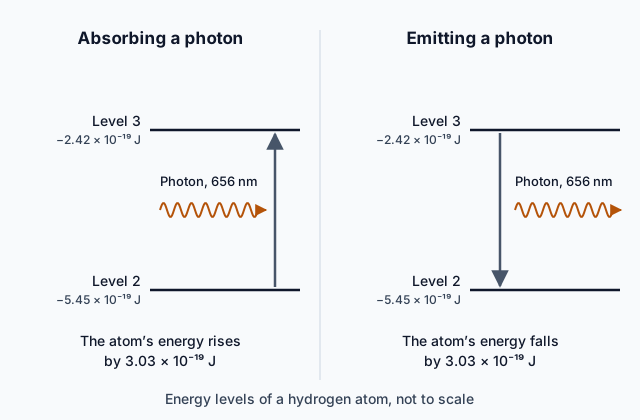
- When an atom or molecule absorbs a photon, its energy increases by exactly the energy of the photon.
- When an atom or molecule emits a photon, its energy decreases by exactly the energy of the photon.
So for a jump between two levels, the energy of the photon equals the gap between them, and a photon whose energy matches no gap from the species' present level cannot move it to another level. Breaking a bond or removing an electron is different: it takes a photon with at least that much energy. A photon's energy is always a positive amount; the sign belongs to the change in the species' energy, + for a gain and − for a loss.
Example: a hydrogen atom's second level is at −5.45 × 10⁻¹⁹ J and its third level at −2.42 × 10⁻¹⁹ J. Moving up from the second to the third, the atom absorbs a photon of 3.03 × 10⁻¹⁹ J, red light of 656 nm. Dropping back down, it emits a photon of the same energy and wavelength.
Quick check · Calculate
A mercury atom in a germicidal lamp emits a photon of ultraviolet light with a wavelength of 254 nm. Using h = 6.626 × 10⁻³⁴ J·s and c = 2.998 × 10⁸ m/s, what is the change in the energy of the mercury atom? Give your answer with its sign, to three significant figures.
Part 3 Watch it done Lithium's red light
Predict first, then watch each step, then finish the calculation yourself.
Lithium salts color a flame deep red. In a lithium atom, the lowest energy level is at −8.64 × 10⁻¹⁹ J and the next level up is at −5.68 × 10⁻¹⁹ J. In the flame, an atom drops from the higher of these levels to the lower one and emits a photon. What is the wavelength of the photon? Use h = 6.626 × 10⁻³⁴ J·s and c = 2.998 × 10⁸ m/s.
Predict first
Before you open the first step, predict: as it emits the photon, does the lithium atom's energy go up or down?
Step 1 · Find the change in the atom's energy
Final level minus starting level: ΔE = (−8.64 × 10⁻¹⁹ J) − (−5.68 × 10⁻¹⁹ J) = −2.96 × 10⁻¹⁹ J. The sign is negative: the atom ends with less energy than it started with.
Why this step?
Why is the photon's energy +2.96 × 10⁻¹⁹ J when the atom's change is −2.96 × 10⁻¹⁹ J?
Energy is conserved. The energy the atom loses leaves as the photon, so the photon carries exactly 2.96 × 10⁻¹⁹ J. A photon's energy is a positive amount; the minus sign only says that the atom lost energy.
Step 2 · Find the frequency from Planck's equation
ν = E/h = (2.96 × 10⁻¹⁹ J) ÷ (6.626 × 10⁻³⁴ J·s) = 4.467 × 10¹⁴ s⁻¹. Keep this unrounded value for the last step.
Your step · Calculate
Finish it. A photon emitted by a lithium atom has a frequency of 4.467 × 10¹⁴ s⁻¹. Using c = 2.998 × 10⁸ m/s, what is the wavelength of the photon, in nanometers? Give your answer to three significant figures.
nm
Lithium's red line is measured at 670.8 nm, which matches this answer. A lithium atom that absorbs a 671 nm photon makes the same jump the other way, and its energy rises by 2.96 × 10⁻¹⁹ J.
Part 4 Try it A bond and two beams
Two new situations: a molecule that light can split apart, and two lasers compared photon by photon.
Try it · Calculate
Light can split a Cl₂ molecule into two chlorine atoms when one photon carries at least the energy of one Cl-Cl bond. Breaking one mole of Cl-Cl bonds takes 242 kJ. Using h = 6.626 × 10⁻³⁴ J·s, c = 2.998 × 10⁸ m/s and 6.022 × 10²³ mol⁻¹, what is the longest wavelength of light, in nanometers, whose photons can each break one Cl-Cl bond? Give your answer to three significant figures.
Try it · Decide and justify
A green laser makes light of 532 nm and a red laser makes light of 650 nm. Each laser delivers the same total energy of light each second. Does the red laser emit more photons each second than the green laser?
Which reason supports your decision?
Part 5 Explain it A blue-green line of hydrogen
On the exam this is handwritten, so answer on paper first. Nothing you type here leaves this page. Then check your answer against the model and each scoring point.
Free response is 50% of the exam score. This one is shaped like a short-answer question, which is worth 4 points.
Free-response practice · Short-answer style
A hydrogen atom emits a photon of blue-green light with a wavelength of 486 nm. Use h = 6.626 × 10⁻³⁴ J·s and c = 2.998 × 10⁸ m/s.
(a) Calculate the frequency of the light.
(b) Calculate the energy of one photon of the light.
(c) Describe the change in the energy of the hydrogen atom as it emits this photon, giving its sign and its size.
(d) Hydrogen also emits violet light at 434 nm. Without calculating, justify whether the energy of a hydrogen atom changes by more or by less when it emits one 434 nm photon than when it emits one 486 nm photon.
Model answer
(a) 486 nm is 4.86 × 10⁻⁷ m. ν = c/λ = (2.998 × 10⁸ m/s) ÷ (4.86 × 10⁻⁷ m) = 6.17 × 10¹⁴ s⁻¹.
(b) E = hν = (6.626 × 10⁻³⁴ J·s)(6.169 × 10¹⁴ s⁻¹) = 4.09 × 10⁻¹⁹ J.
(c) The atom's energy decreases by exactly the energy of the photon it emits, so ΔE = −4.09 × 10⁻¹⁹ J.
(d) By more. Light of 434 nm has a shorter wavelength, so by c = λν it has a higher frequency, and by E = hν each of its photons carries more energy. The atom's energy falls by the energy of the photon it emits, so it falls by more when it emits a 434 nm photon.
Score your own answer. This is a self-check, not a grade. Tick each point your answer makes.
Part 6 Check yourself The energy levels of atom Z
All three case questions use the table.
The table lists the four lowest energy levels of an atom, called atom Z here. The values are a teaching example, not a real element. Use h = 6.626 × 10⁻³⁴ J·s and c = 2.998 × 10⁸ m/s.
| Level | Energy (× 10⁻¹⁹ J) |
|---|---|
| 4 | −1.80 |
| 3 | −3.10 |
| 2 | −5.40 |
| 1 | −9.50 |
Case question 1 · Calculate
Using the table: an atom Z in level 1 absorbs a photon and ends in level 3. What is the wavelength of the photon, in nanometers? Give your answer to three significant figures.
Case question 2 · Multiple choice
Using the table: light containing photons of three energies, 3.60 × 10⁻¹⁹ J, 4.10 × 10⁻¹⁹ J and 5.00 × 10⁻¹⁹ J, shines on a sample of atom Z in which every atom is in level 1. Which photons can an atom in level 1 absorb?
Case question 3 · Rank it
Using the table: an atom Z can drop from a higher level to a lower one and emit a photon. Rank these three drops by the wavelength of the photon emitted.
Longest wavelength first
Give each one a place, 1 for first. Give two the same place if they are equal.
Your ranking: none yet
The rest stand on their own and do not use the case.
Check yourself · Spot the error
A student calculates the energy of one photon of violet light with a wavelength of 410 nm. Tap the line with the mistake.
Check yourself · Select all
Light X has twice the frequency of light Y. Which two statements are true? Select two.
Select 2 answers, then check.
Part 7 Keep it Bring back earlier ideas
This lesson leans on two earlier ideas: the electrons of an atom sit in levels of fixed energy, and radiation from different regions of the spectrum carries photons of different energy. Pulling them back up is what makes them last.
From 3.11 Spectroscopy and the Electromagnetic Spectrum · Put it in order
Put these five sources in order of the energy of one photon of their radiation, lowest energy first.
From 1.5 Atomic Structure and Electron Configuration · Decide and justify
An aluminum atom has the configuration 1s²2s²2p⁶3s²3p¹. Which takes more energy to remove from the atom: one of its 2p electrons or its 3p electron?
Which reason supports your decision?
In three lines
- Wavelength and frequency are tied by c = λν, so with c fixed a shorter wavelength means a higher frequency.
- One photon carries E = hν = hc/λ, so higher frequency and shorter wavelength both mean more energy in each photon.
- An atom or molecule that absorbs a photon gains exactly its energy, and one that emits a photon loses exactly its energy.
Exam strategy for this topic
- Section I, Multiple Choice: 60 questions in 90 minutes.
- Section II, Free Response: 7 questions in 105 minutes.
- A scientific or graphing calculator is recommended for use on both sections of the exam.
Write each equation before you substitute, carry the units through, and change nanometers to meters before you use c. When a question asks how an atom's or molecule's energy changes, give the sign as well as the size.
Questions students ask
How do you find the energy of a photon from its wavelength?
Change the wavelength to meters, then use E = hc/λ, or find ν = c/λ first and use E = hν. For 589 nm light the two routes give the same energy per photon.
Does a longer wavelength mean more energy?
No. A longer wavelength means a lower frequency, and E = hν, so each photon carries less energy. Red photons carry less energy than violet ones.
What happens to an atom's energy when it absorbs a photon?
It increases by exactly the energy of the photon. When the atom emits a photon, its energy decreases by exactly the energy of that photon.
Does a brighter light have more energetic photons?
No. A brighter beam of the same light has more photons each second. The energy of each photon depends only on its frequency.
What is the value of Planck's constant?
h = 6.626 × 10⁻³⁴ J·s. It links the energy of one photon to the frequency of its light through E = hν.
Course alignment, for teachers
AP Chemistry topic 3.12, Unit 3: Properties of Substances and Mixtures.
- Skill 5.F: Calculate, estimate, or predict an unknown quantity from known quantities by selecting and following a logical computational pathway and attending to precision (e.g., performing dimensional analysis and attending to significant figures).
This lesson maps all 2 essential knowledge statements of the topic to the part that teaches each one: 2 are checked by a scored question. The map is in the lesson file.