Unit 3 · Topic 3.13 · about 30 minutes · 7 parts · 10 scored checks, 1 of them multiple choice, plus 2 from earlier lessons
AP Chemistry 3.13: Beer-Lambert Law
Unit 3: 18 to 22% of the multiple-choice section
What you'll be able to do
- Explain how much light a solution of molecules or ions absorbs in terms of its concentration, the path length of the light and the molar absorptivity of the absorbing species.
Key vocabulary
| Term | What it means | The exam trap |
|---|---|---|
| Absorbance | A measure of how much light of one wavelength a sample absorbs, read by a spectrophotometer; it has no unit. | A spectrophotometer reads absorbance at one wavelength at a time, so always say which wavelength a reading was taken at. |
| Molar absorptivity | The constant ε in the Beer-Lambert law, which describes how intensely one species absorbs light of one wavelength, in M⁻¹ cm⁻¹. | A value of ε belongs to a species at a stated wavelength, so a value quoted without its wavelength is incomplete. |
| Path length | The distance the light travels through the solution, written b, set by the width of the cuvette and usually 1.00 cm. | The path length is measured along the light beam, not as the height of the liquid in the cuvette. |
| Calibration curve | A graph of absorbance against concentration for standard solutions of known concentration, used to find the concentration of an unknown. | A calibration curve covers only the range of its standards, so dilute an unknown that reads above the highest standard and read it again. |
 Tap to open the picture full size
Part 1 Think first A flashlight through blue dye
Commit to a guess first. Being wrong now makes the right idea stick better.
Predict first
A teacher fills a narrow test tube and a wide beaker with the same blue dye solution. She shines a flashlight sideways through each one, onto a sheet of white paper on the far side. Through which container does more of the light get to the paper?
In short. The Beer-Lambert law, A = εbc, says a solution's absorbance grows in proportion to the path length of the light and the concentration of the absorbing species, scaled by how intensely that species absorbs.
- Path length and concentration together set how many absorbing particles are in the light's path.
- Molar absorptivity belongs to one species at one wavelength, and it is largest at the wavelength of maximum absorbance.
- With the cuvette and wavelength held fixed, absorbance is proportional to concentration, so a calibration line gives an unknown's concentration.
Part 2 Learn it Absorbance and concentration
2a. Particles in the light's path
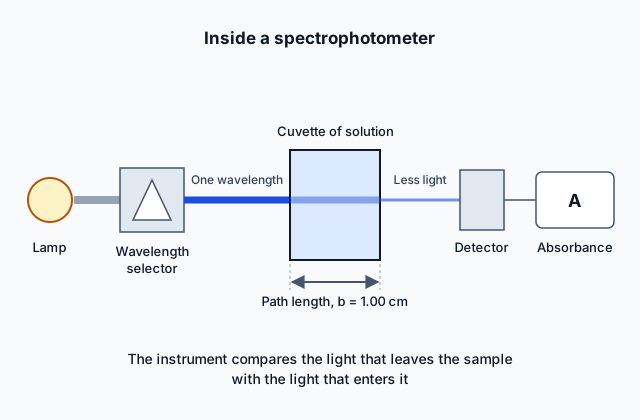
A spectrophotometer shines light of one wavelength through a sample in a clear container called a cuvette, and measures how much of it the sample absorbs. The result is the absorbance, A, a number with no unit: 0 means no light is absorbed, and a larger absorbance means more light is absorbed.
The Beer-Lambert law relates the absorbance to three quantities:
A = εbc
- b is the path length, the distance the light travels through the solution, in cm (usually 1.00 cm, the width of the cuvette);
- c is the concentration of the absorbing species, in mol/L (M);
- ε (epsilon) is the molar absorptivity, in M⁻¹ cm⁻¹ (next chunk).
The path length and the concentration both set how many absorbing particles are in the light's path. Double the concentration and the light meets twice as many particles over the same distance; double the path length and it meets twice as many at the same concentration. Either way, the absorbance doubles.
Example: a dye solution with A = 0.300 in a 1.00 cm cuvette reads A = 0.600 in a 2.00 cm cuvette, and diluted to half its concentration, it reads A = 0.150 in the 1.00 cm cuvette.
Quick check · Rank it
Four solutions of the same dye are read at the same wavelength. Solution P is 2.00 × 10⁻⁵ M in a 1.00 cm cuvette; Q is 1.00 × 10⁻⁵ M in a 2.00 cm cuvette; R is 3.00 × 10⁻⁵ M in a 0.500 cm cuvette; S is 4.00 × 10⁻⁵ M in a 1.00 cm cuvette. Rank the four solutions by absorbance.
Largest absorbance first
Give each one a place, 1 for first. Give two the same place if they are equal.
Your ranking: none yet
2b. Molar absorptivity and the best wavelength
The molar absorptivity, ε, describes how intensely one species absorbs light of one particular wavelength. It belongs to the species and the wavelength, not to the sample: a species with a large ε absorbs strongly even in a dilute solution.
ε changes with wavelength. A graph of a solution's absorbance against wavelength, its absorption spectrum, rises to a peak where ε is largest. That peak is the wavelength of maximum absorbance, also called the optimum wavelength.
A spectrophotometer is usually set to that wavelength. There, each change in concentration makes the largest change in absorbance, so the measurement is as sensitive as it can be. Read the peak from the spectrum rather than guessing it from the color you see: the color of a solution is the light it lets through, not the light it absorbs.
Example: a blue dye whose spectrum peaks at 630 nm is measured at 630 nm. At 450 nm, where it absorbs blue light only weakly, even a large change in its concentration would barely move the reading.
Quick check · Decide and justify
A student records the absorption spectrum of a red food dye solution: absorbance 0.12 at 410 nm, 0.35 at 460 nm, 0.78 at 500 nm, 0.41 at 560 nm and 0.03 at 630 nm. The student will then measure several solutions of the dye at one wavelength to find their concentrations. Which wavelength should the student use?
Which reason supports your decision?
2c. Absorbance tracks concentration
In most experiments every solution is read in the same cuvette at the same wavelength, so b and ε stay fixed. Then A = εbc says that the absorbance is proportional to the concentration of the absorbing species alone.
That is how a spectrophotometer measures a concentration:
- Fill the cuvette with the solvent alone, the blank, and set the instrument to read A = 0, so the cuvette and the solvent are not counted.
- Read several standard solutions of known concentration, and plot absorbance against concentration. This is the calibration curve, and its slope is εb.
- Read the unknown under the same conditions, and find its concentration from the line.
The proportion holds only while nothing else changes. A different cuvette, a different wavelength, or anything else in the light path that blocks light changes the reading with no change in concentration.
Quick check · Sketch the graph
A student reads five solutions of one dye in the same 1.00 cm cuvette at the dye's wavelength of maximum absorbance: a blank with no dye, and four standards of 2.00, 4.00, 6.00 and 8.00 × 10⁻⁵ M. Sketch the absorbance against the concentration. The blank, at zero concentration and zero absorbance, is placed for you; drag the other four points so that each step in concentration changes the absorbance the way the Beer-Lambert law says it does.
One shape that fits
Drag a point up or down, or tap it and use the arrow keys. Only the shape is checked.
Part 3 Watch it done The blue dye in a sports drink
Predict first, then watch each step, then finish the calculation yourself.
A blue sports drink gets its color from the dye Brilliant Blue FCF, whose absorption spectrum peaks at 630 nm. A student reads four standard solutions of the dye and then the drink itself, all in the same 1.00 cm cuvette. The standards of 2.00, 4.00, 6.00 and 8.00 × 10⁻⁶ M read absorbances of 0.262, 0.519, 0.783 and 1.038, and the drink reads 0.585. What is the concentration of the dye in the drink? The readings are a teaching example.
Predict first
Before you open the first step, predict: between which two standards does the drink's concentration fall?
Step 1 · Set the wavelength and zero the instrument
The dye absorbs most at 630 nm, so every reading is taken at 630 nm. The cuvette is filled with water, the blank, and the instrument is set to read A = 0.
Why this step?
Why must the standards and the drink all be read in the same cuvette at the same wavelength?
Only then are b and ε the same for every reading, so the absorbance changes with the concentration of dye and nothing else, and the line through the standards fits the drink too.
Step 2 · Find the calibration line
The absorbances rise by about the same amount for each 2.00 × 10⁻⁶ M step, so the standards lie close to a straight line through the origin. The best-fit line through the origin gives A = 0.130 for each 1.00 × 10⁻⁶ M of dye. With a 1.00 cm cuvette, that slope means ε = 1.30 × 10⁵ M⁻¹ cm⁻¹.
Your step · Calculate
Finish it. A blue sports drink, read at 630 nm in a 1.00 cm cuvette, has an absorbance of 0.585. The calibration line for its dye gives A = 0.130 for each 1.00 × 10⁻⁶ M of dye. What is the concentration of the dye in the drink? Give your answer to three significant figures.
× 10⁻⁶ M
Real readings scatter a little about the line, which is why the slope comes from all four standards rather than from one. The drink's absorbance falls inside the range of the standards, where the line is known to hold.
Part 4 Try it When a reading goes wrong
Two new situations: things that can go wrong in a real measurement, and a cuvette narrower than the usual one.
Try it · Sort it
A student made a calibration line with clean, dry 1.00 cm cuvettes at a dye's wavelength of maximum absorbance. Each card is something that went wrong with the reading of the unknown only. Sort each card by its effect on the unknown's measured absorbance.
Higher than it should be
Lower than it should be
Try it · Calculate
A dye has a molar absorptivity of 1.30 × 10⁵ M⁻¹ cm⁻¹ at the wavelength used. A solution of the dye in a 0.500 cm cuvette has an absorbance of 0.468. What is the concentration of the dye? Give your answer to three significant figures.
Part 5 Explain it Permanganate by spectrophotometer
On the exam this is handwritten, so answer on paper first. Nothing you type here leaves this page. Then check your answer against the model and each scoring point.
Free response is 50% of the exam score. This one is shaped like a short-answer question, which is worth 4 points.
Free-response practice · Short-answer style
A student finds the concentration of permanganate ion, MnO₄⁻, in a purple solution, using a spectrophotometer and 1.00 cm cuvettes. The absorption spectrum of MnO₄⁻ peaks at 525 nm. Standard solutions read at 525 nm give a calibration line through the origin with a slope of 2.40 × 10³ M⁻¹, and the unknown reads an absorbance of 0.552 at 525 nm.
(a) Identify the wavelength the student should use, and justify the choice.
(b) Calculate the concentration of MnO₄⁻ in the unknown.
(c) Explain why the student must read the standards and the unknown in cuvettes with the same path length.
(d) Later the student learns that the stock solution used to make the standards was more concentrated than its label said. Predict whether the calculated concentration of the unknown is too high or too low, and justify the prediction.
Model answer
(a) 525 nm, the peak of the absorption spectrum. There MnO₄⁻ absorbs most strongly, so each change in concentration makes the largest change in absorbance and the measurement is most sensitive.
(b) The absorbance is proportional to the concentration, so c = A ÷ slope = 0.552 ÷ (2.40 × 10³ M⁻¹) = 2.30 × 10⁻⁴ M.
(c) By A = εbc, the absorbance depends on the path length as well as the concentration. Only with the same path length is the absorbance proportional to the concentration alone, so that the calibration line fits the unknown.
(d) Too low. Each standard held more MnO₄⁻ than the student thought, so each read a higher absorbance than its labeled concentration would give, and the slope came out too large. Dividing the unknown's absorbance by too large a slope gives too small a concentration.
Score your own answer. This is a self-check, not a grade. Tick each point your answer makes.
Part 6 Check yourself A red dye in four standards
Both case questions use the class's measurements.
A class measures a red food dye at 504 nm, the peak of its absorption spectrum, in 1.00 cm cuvettes. The table shows the absorbance of four standard solutions. The readings are a teaching example.
| Concentration (× 10⁻⁵ M) | Absorbance |
|---|---|
| 1.00 | 0.251 |
| 2.00 | 0.499 |
| 3.00 | 0.752 |
| 4.00 | 1.004 |
Case question 1 · Calculate
Using the table: what absorbance would a 2.50 × 10⁻⁵ M solution of the dye have at 504 nm in a 0.500 cm cuvette? Give your answer to three significant figures.
Case question 2 · Decide and justify
The class read its standards at 504 nm, the peak of the dye's spectrum. A student then reads an unknown solution of the dye but sets the spectrophotometer to 460 nm by mistake, where the dye's spectrum is lower. The student finds the unknown's concentration from the line through the class's standards. Compared with the true concentration, is the student's value too high or too low?
Which reason supports your decision?
The rest stand on their own and do not use the case.
Check yourself · Spot the error
A student predicts the absorbance of a diluted dye solution. Tap the line with the mistake.
Check yourself · Multiple choice
Solutions of two different dyes, X and Y, are read in the same 1.00 cm cuvette, each at its own wavelength of maximum absorbance. The solution of X is 2.00 × 10⁻⁵ M and the solution of Y is 5.00 × 10⁻⁵ M, and both read an absorbance of 0.500. Which statement is supported by these data?
Part 7 Keep it Bring back earlier ideas
This lesson leans on two earlier ideas: a photon's energy is set by its frequency and wavelength, and the concentration of a solution counts the moles of solute in each liter. Pulling them back up is what makes them last.
From 3.12 Properties of Photons · Select all
Light X has twice the frequency of light Y. Which two statements are true? Select two.
Select 2 answers, then check.
From 3.7 Solutions and Mixtures · Spot the error
A student finds the molarity of a solution made by dissolving 5.85 g of sodium chloride, NaCl, and adding water to make 250.0 mL of solution. Tap the line with the mistake.
In three lines
- The Beer-Lambert law, A = εbc, ties absorbance to the path length, the concentration and the molar absorptivity of the absorbing species.
- Molar absorptivity belongs to one species at one wavelength, and readings are taken at the wavelength of maximum absorbance for the greatest sensitivity.
- With the cuvette and wavelength held fixed, absorbance is proportional to concentration, so standards give a line from which an unknown is read.
Exam strategy for this topic
- Section I, Multiple Choice: 60 questions in 90 minutes.
- Section II, Free Response: 7 questions in 105 minutes.
- A scientific or graphing calculator is recommended for use on both sections of the exam.
When a question asks how an error changes a calculated concentration, follow it in two steps: first say what the error does to the measured absorbance, then what that absorbance does to the concentration found from A = εbc or the calibration line.
Questions students ask
What does the Beer-Lambert law say?
A = εbc: a solution's absorbance equals the molar absorptivity of the absorbing species, times the path length of the light, times the concentration of the species.
Why is absorbance proportional to concentration?
When the cuvette and the wavelength are the same for every reading, b and ε are fixed, so A changes only with c. Twice the concentration puts twice as many absorbing particles in the light's path.
Which wavelength should a spectrophotometer be set to?
The wavelength of maximum absorbance, the peak of the species' absorption spectrum. There the molar absorptivity is largest, so the reading changes most with concentration.
What is molar absorptivity?
The constant ε that describes how intensely one species absorbs light of one wavelength. It has units of M⁻¹ cm⁻¹ and does not depend on the sample or the cuvette.
How do you find a concentration from a calibration curve?
Read standard solutions of known concentration, draw the line of absorbance against concentration, then divide the unknown's absorbance by the slope, or read it from the line.
Course alignment, for teachers
AP Chemistry topic 3.13, Unit 3: Properties of Substances and Mixtures.
- Skill 2.E: Identify or describe potential sources of experimental error.
This lesson maps all 2 essential knowledge statements of the topic to the part that teaches each one: 2 are checked by a scored question. The map is in the lesson file.