Unit 4 · Topic 4.1 · about 30 minutes · 7 parts · 10 scored checks, 2 of them multiple choice, plus 2 from earlier lessons
AP Chemistry 4.1: Introduction for Reactions
Unit 4: 7 to 9% of the multiple-choice section
What you'll be able to do
- Identify evidence of chemical and physical changes in matter.
Key vocabulary
| Term | What it means | The exam trap |
|---|---|---|
| Composition | The elements a substance contains and the proportions they are in. | Composition belongs to the substance, not the sample: a crumb of sugar has the same composition as a bowl of it. |
| Physical change | A change in some properties of a substance that leaves its composition the same. | Do not write "nothing changed": some property does change, so name it, then say what stays the same. |
| Chemical change | A change in which substances are turned into new substances, typically with different compositions. | An observation such as "it bubbled" is evidence, not a claim; a written answer names the kind of change and ties the evidence to it. |
| Precipitate | A solid that forms when solutions are mixed. | A precipitate can be so fine that the mixture only turns cloudy at first, so cloudiness counts as a solid forming. |
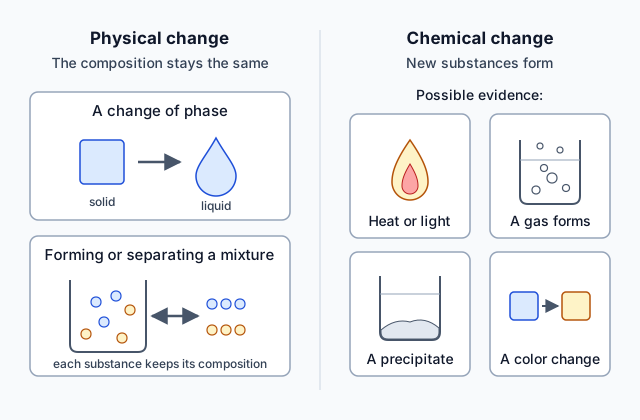 Tap to open the picture full size
Part 1 Think first Bubbles in a pot
Commit to a guess first. Being wrong now makes the right idea stick better.
Predict first
A pot of water sits on a hot stove. Soon large bubbles form all through the water and rise to the top in a rolling boil. What is inside the bubbles?
In short. A physical change alters some properties of a substance but not its composition, while a chemical change turns substances into new substances.
- Changes of phase and forming or separating a mixture are the common physical changes.
- Heat or light produced, a gas forming, a precipitate forming or a color change is possible evidence of a chemical change.
- Each of those signs can also come from a physical change, so the deciding question is whether a new substance formed.
Part 2 Learn it Telling physical and chemical changes apart
2a. Same substance, new properties
Every substance has a composition: the elements it contains and the proportions they are in. A physical change alters some properties of a substance, such as its state, its shape or what it is mixed with, but not its composition. Two kinds of physical change are common.
- Changes of phase. Ice melting, water boiling and frost forming on a window are all changes of phase. Water is H₂O as a solid, as a liquid and as a gas.
- Forming or separating a mixture. Stirring sugar into tea makes a mixture in which the sugar and the water each keep their composition. Pouring sand and water through a filter, or letting the water evaporate slowly from sugar water, separates a mixture, and each part comes out as the substance it was before.
So the question to ask is whether the same substances are there after the change. If the sugar you get back from sugar water looks and behaves like the sugar you put in, nothing new was made, and the change was physical.
Quick check · Sort it
Each card describes a physical change. Tap a card, then the kind of physical change it is.
A change of phase
Forming a mixture
Separating a mixture
2b. Signs of a new substance
In a chemical change, substances are turned into new substances, typically with different compositions. When iron rusts, iron and oxygen become iron oxide, a red-brown solid with properties that neither iron nor oxygen has.
You cannot see composition directly, so you look for evidence. Four kinds of observation can show that a chemical change has occurred:
- Heat or light is produced. A burning candle gives off both.
- A gas forms. Zinc dropped into hydrochloric acid gives off bubbles of hydrogen.
- A precipitate forms. Pouring together two clear solutions gives a solid, often seen first as cloudiness.
- The color changes. A copper roof slowly turns from shiny orange-brown to green.
Each of these is a clue that a new substance with new properties is being made.
Quick check · Match
Match each observation to the kind of evidence of a chemical change it shows.
2c. Evidence is not proof
These four observations are possible evidence of a chemical change, and the word matters. Each of them can also come from a physical change.
- Boiling water is full of bubbles, but the gas in them is water vapor, still H₂O.
- The coil of an electric stove glows orange and gives off heat, but when it cools it is the same metal it was.
- A drop of purple ink turns a glass of water purple, but the ink and the water are only mixed.
So one sign suggests a chemical change; it does not settle the question. To decide, go back to composition: did something with new properties form? The case is strongest when what is left at the end is not the starting substance in a new state or a new mixture, so cooling it, drying it or filtering it does not bring back what you started with.
Quick check · Decide and justify
A student warms a bottle of carbonated water, and bubbles of carbon dioxide gas rise out of it. The gas was dissolved in the water when the bottle was filled. Are the bubbles evidence that a chemical change has occurred?
Which reason supports your decision?
Part 3 Watch it done Is the purple gas a new substance?
Watch each step, then make the prediction yourself.
A student gently heats a few iodine crystals in a sealed flask. The crystals are gray-black and melt at 114 °C. As the flask warms, a purple gas fills it. The student hypothesizes that no new substance has formed: the purple gas is iodine. She plans to let the flask cool and look at what comes back. What result should she predict if her hypothesis is right?
Step 1 · List the observations
Two things happened as the flask warmed: a gas formed, and the color changed from gray-black to purple. Both are on the list of possible evidence of a chemical change.
Why this step?
Why can those two observations not settle the question on their own?
Each can also come from a physical change. A solid turning into a gas is a change of phase, and the same substance can look different in a different state.
Step 2 · Turn the hypothesis into a test
A chemical change would make a substance with a different composition, and so with different properties. A physical change would not. So the test is to compare properties after the change with properties before it.
Your step · Multiple choice
Finish it. Which result, once the flask has cooled, would support her hypothesis that no new substance formed?
The prediction came from the hypothesis: an unchanged composition means unchanged properties. A result that only shows something happened, such as heat or a steady mass, cannot tell a physical change from a chemical one.
Part 4 Try it Plan the test
Two more hypotheses to test. For each one, think about what result would count as support before you answer.
Try it · Put it in order
A student hypothesizes that dissolving sugar in water is a physical change. Put the steps of her test in order.
Try it · Multiple choice
A green powder, copper(II) carbonate, is heated in an open test tube. As it is heated, it turns black. A student hypothesizes that the black solid is a new substance, not the green powder with a different look while it is hot. She turns off the burner and lets the tube cool. Which result would support her hypothesis?
Part 5 Explain it Two trials, two kinds of change
On the exam this is handwritten, so answer on paper first. Nothing you type here leaves this page. Then check your answer against the model and each scoring point.
Free response is 50% of the exam score. This one is shaped like a short-answer question, which is worth 4 points.
Free-response practice · Short-answer style
A student runs two trials.
Trial 1: a clear, colorless solution is poured into a second clear, colorless solution. The mixture turns cloudy, and a yellow solid settles to the bottom.
Trial 2: an open beaker of liquid ethanol is left in a warm room. The level of the liquid drops, and the smell of ethanol spreads through the room.
(a) Identify the evidence in trial 1 that a chemical change has occurred.
(b) A classmate claims that trial 2 is a chemical change because a gas formed. Explain why a gas forming does not, on its own, support that claim.
(c) Make a claim about whether trial 2 is a physical change or a chemical change, and justify it in terms of composition.
(d) The student hypothesizes that the yellow solid in trial 1 is a new substance, not a solid form of either substance that was dissolved. Predict one result of a test that would support this hypothesis.
Model answer
(a) A precipitate formed: a yellow solid appeared when two clear solutions were mixed. The yellow color, which neither solution had, is a second piece of evidence.
(b) A gas can form in a physical change too. A liquid turning into a gas is a change of phase, so a gas forming is possible evidence of a chemical change, not proof of one.
(c) Trial 2 is a physical change. The gas that spreads through the room is ethanol, the same substance as the liquid, which is why it smells of ethanol. The composition stays the same, and only the state changes.
(d) If the yellow solid is a new substance, its properties will differ from those of the substances that were dissolved. For example, the yellow solid will not dissolve again when it is stirred into fresh water, though both starting substances dissolved in water.
Score your own answer. This is a self-check, not a grade. Tick each point your answer makes.
Part 6 Check yourself Five trials in a lab notebook
Both case questions use the table.
A student recorded five trials in a lab notebook.
| Trial | What the student did | What the student saw |
|---|---|---|
| A | Mixed two clear, colorless solutions | A cloudy white solid formed and settled, and the mixture grew warm |
| B | Stirred iodine crystals into ethanol, then let the ethanol evaporate | The liquid turned brown; gray-black iodine crystals were left in the dish |
| C | Dropped a strip of magnesium into hydrochloric acid | Bubbles formed, the tube grew warm, and the strip disappeared |
| D | Left a piece of dry ice (solid carbon dioxide) on the bench | A gas came off, and the solid shrank until none was left |
| E | Heated a strip of copper in a flame, then let it cool | A black coating formed and stayed black after cooling |
Case question 1 · Sort it
Using the table: sort trials A, B, C and E. Tap a trial, then the bin it belongs in.
A chemical change
A physical change
Case question 2 · Decide and justify
Using the table: in trial D a gas formed. Is trial D evidence that a chemical change occurred?
Which reason supports your decision?
The rest stand on their own and do not use the case.
Check yourself · Spot the error
A student explains why a glowing neon sign is a chemical change. Tap the line where the reasoning first goes wrong.
Check yourself · Fill the statement
Complete the description of a burning candle.
Melting the wax near the wick is a change, because the wax keeps its . Burning the wax vapor in the flame is a change: it makes carbon dioxide and water, and the the flame gives off is evidence of it.
Part 7 Keep it Bring back earlier ideas
This lesson leans on two earlier ideas: a mixture can be separated by the physical properties of its parts, and a solution is a mixture with the same composition throughout. Pulling them back up is what makes them last.
From 3.9 Separation of Solutions and Mixtures · Multiple choice
A student pours sugar water through filter paper, and the liquid that comes through tastes just as sweet as before. Which explanation is correct?
From 3.7 Solutions and Mixtures · Sort it
Each card names a mixture. Tap a card, then the bin it belongs in.
Solution
Heterogeneous mixture
In three lines
- A physical change alters properties such as state or what a substance is mixed with, but not its composition: changes of phase and forming or separating mixtures.
- A chemical change turns substances into new substances; heat or light, a gas, a precipitate or a color change is possible evidence of one.
- Each sign can also come from a physical change, so decide by asking whether a substance with new properties formed.
Exam strategy for this topic
- Section I, Multiple Choice: 60 questions in 90 minutes.
- Section II, Free Response: 7 questions in 105 minutes.
- A scientific or graphing calculator is recommended for use on both sections of the exam.
When a question asks you to classify a change, state the claim (physical or chemical), name the observation you are using, and tie it to composition: either the same substance is still there in a new state or mixture, or a substance with new properties formed.
Questions students ask
What is the difference between a physical and a chemical change?
A physical change alters some properties of a substance but not its composition. A chemical change turns substances into new substances, typically with different compositions.
What are the signs of a chemical change?
Heat or light being produced, a gas forming, a precipitate forming and a color change are all possible evidence that a chemical change has occurred.
Is boiling water a chemical change?
No. The bubbles are water vapor, the same substance as the liquid, so boiling is a change of phase, which is a physical change.
Is dissolving sugar in water a physical change?
Yes. Forming a mixture is a physical change: the sugar and the water each keep their composition, and the sugar can be recovered by letting the water evaporate.
Does a color change always mean a chemical change?
No. A color change is possible evidence only. Mixing a dye into water changes the color, but the dye and the water are just mixed.
Course alignment, for teachers
AP Chemistry topic 4.1, Unit 4: Chemical Reactions.
- Skill 2.B: Formulate a hypothesis or predict the results of an experiment.
This lesson maps all 2 essential knowledge statements of the topic to the part that teaches each one: 2 are checked by a scored question. The map is in the lesson file.