Unit 3 · Topic 3.3 · about 30 minutes · 7 parts · 10 scored checks, 1 of them multiple choice, plus 2 from earlier lessons
AP Chemistry 3.3: Solids, Liquids, and Gases
Unit 3: 18 to 22% of the multiple-choice section
What you'll be able to do
- Represent the differences between the solid, liquid and gas phases of a substance with a particulate-level model.
Key vocabulary
| Term | What it means | The exam trap |
|---|---|---|
| Phase | A form of matter with the same properties throughout: solid, liquid or gas. | A phase names the form, not the substance: ice, liquid water and steam are one substance in three phases. |
| Molar volume | The volume that one mole of a substance takes up, in units such as cm³/mol or L/mol. | Molar volume depends on the phase and the conditions, so say which phase, and at what temperature, a value is for. |
| Density | Mass per unit volume, such as g/cm³ for solids and liquids or g/L for gases. | Gas densities are usually given in g/L and liquid densities in g/cm³, so check the units before you compare two values. |
| Particulate model | A drawing of a substance's particles that shows how they are arranged and, with motion lines, how they move. | Draw enough particles to show the pattern, and say what each circle stands for. |
 Tap to open the picture full size
Part 1 Think first Quartz and window glass
Commit to a guess first. Being wrong now makes the right idea stick better.
Predict first
Natural quartz grows as six-sided crystals with flat faces that meet at fixed angles. Window glass is made mostly of the same two elements, silicon and oxygen, yet glass never forms faces like that. What is different about the two at the level of their atoms?
In short. Solids, liquids and gases differ in how close their particles are and how freely those particles move.
- In a solid, particles stay in fixed places, in a repeating pattern (crystalline) or with none (amorphous).
- In a liquid, particles stay in close contact but keep moving past one another, so a liquid's molar volume is close to its solid's.
- In a gas, particles are far apart and always moving, so a gas has neither a definite shape nor a definite volume.
Part 2 Learn it Three phases, one set of particles
2a. Solids: particles held in place
In a solid, the particles are in close contact and held by the attractions between them. Each particle vibrates about one position, but the particles do not move past one another: their motion is limited, and there is no overall translation of one particle relative to another.
A solid can be:
- Crystalline, with the particles arranged in a regular three-dimensional pattern that repeats. Table salt, ice and quartz are crystalline.
- Amorphous, with no regular, orderly arrangement. Window glass and many plastics are amorphous.
In both kinds, the particles stay in place.
Which arrangement a solid takes depends on the attractions between its particles and on how well the particles can pack together. Ions settle where opposite charges sit side by side, and small, regular molecules stack easily into a repeating pattern. Long, tangled molecules, such as those in many plastics, often cannot line up, so they are held in place wherever they happen to be.
Quick check · Sort it
Each card describes the particles in a sample. Sort each sample. Tap a card, then its bin.
Crystalline solid
Amorphous solid
Not a solid
2b. Liquids: close together but moving
In a liquid, the particles are still in close contact, but they are continually moving, colliding and sliding past one another. A liquid therefore flows and takes the shape of its container, while keeping its own volume.
How the particles are arranged and how freely they move depend on the forces between them and on the temperature. In liquid water, hydrogen bonds hold neighboring molecules together briefly before they break and re-form, and as the liquid warms, its molecules move faster and change neighbors more easily.
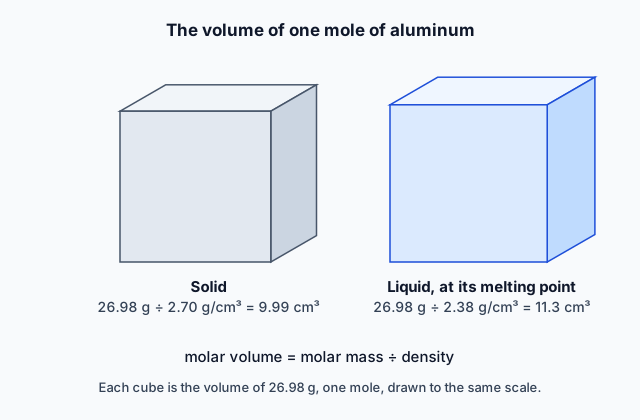
Because the particles are in close contact in both a solid and a liquid, the two phases of one substance have similar molar volumes. The molar volume is the volume one mole takes up:
molar volume = molar mass ÷ density
Example: aluminum, 26.98 g/mol. Solid aluminum has a density of 2.70 g/cm³, so its molar volume is 26.98 ÷ 2.70 = 9.99 cm³/mol. Liquid aluminum at its melting point has a density of 2.38 g/cm³, so its molar volume is 26.98 ÷ 2.38 = 11.3 cm³/mol, about 13% more than the solid's.
Quick check · Calculate
Ice has a density of 0.917 g/cm³, and liquid water at 0 °C has a density of 0.9998 g/cm³. The molar mass of water is 18.02 g/mol. By what percent is the molar volume of ice larger than the molar volume of liquid water at 0 °C? Give two significant figures.
2c. Gases: far apart and always moving
In a gas, the particles are in constant motion and far apart compared with their own size. They travel in straight lines between collisions with one another and with the walls of their container. The forces between them have little effect, so a gas has neither a definite volume nor a definite shape: it spreads out to fill whatever container holds it.
How far apart the particles are, on average, and how often they collide depend on the conditions:
- Volume. Squeeze the same gas into a smaller volume and its particles are closer together, so they collide more often.
- Temperature. Warm a gas and its particles collide more often, and harder.
- Pressure. At the same temperature, a gas at a higher pressure has its particles packed more closely, with less space between them.
Quick check · Fill the statement
A sealed, rigid steel tank of helium is carried from a cool room into hot sunlight. The tank's volume does not change, and no helium gets in or out. Complete the description of the helium inside.
The average spacing between the helium atoms , and the atoms collide with one another and with the walls often and .
Part 3 Watch it done Water and steam at 100 °C
Predict first, then watch each step, then finish the calculation yourself.
At 100 °C and 1 atm, liquid water has a density of 0.958 g/cm³ and steam has a density of 0.598 g/L. The molar mass of water is 18.02 g/mol. Find the molar volume of each phase and compare them.
Predict first
Before you open the first step, predict: how does the molar volume of the steam compare with that of the liquid water?
Step 1 · Recall the relationship
The molar volume is the volume of one mole, so molar volume = molar mass ÷ density. The units confirm it: (g/mol) ÷ (g/cm³) = cm³/mol.
Step 2 · Find the liquid's molar volume
18.02 g/mol ÷ 0.958 g/cm³ = 18.81 cm³/mol. That is close to the 18.07 cm³/mol of liquid water at 25 °C: warming the liquid hardly spreads its molecules apart, because they stay in contact.
Why this step?
Why does the same relationship work for steam?
Density is mass per volume for any sample, whether solid, liquid or gas, so dividing the molar mass by the density always gives the volume of one mole.
Your step · Calculate
Finish it. Steam at 100 °C and 1 atm has a density of 0.598 g/L, and the molar mass of water is 18.02 g/mol. What is the molar volume of the steam, in liters per mole? Give three significant figures.
L/mol
The steam's 30.1 L/mol is 30,100 cm³/mol, about 1600 times the liquid's 18.81 cm³/mol. The same molecules take up about 1600 times as much room as a gas, because in the gas they are far apart, while in the liquid they touch.
Part 4 Try it A syringe and a jar of honey
Two everyday situations to explain with particles: air squeezed in a syringe, and honey that pours faster when it is warm.
Try it · Decide and justify
A student seals the tip of a syringe full of air and pushes the plunger in until the air takes up half its starting volume. The student says each gas particle has been squeezed to half its size. Is the student right?
Which reason supports your decision?
Try it · Multiple choice
Honey from the refrigerator pours slowly, but the same honey warmed in a pan of hot water pours much faster. Which explanation fits a particulate model of a liquid?
Part 5 Explain it Bromine as a solid and a liquid
On the exam this is handwritten, so answer on paper first, and draw the models on paper too. Nothing you type here leaves this page. Then check your answer against the model and each scoring point.
Free response is 50% of the exam score. This one is shaped like a short-answer question, which is worth 4 points.
Free-response practice · Short-answer style
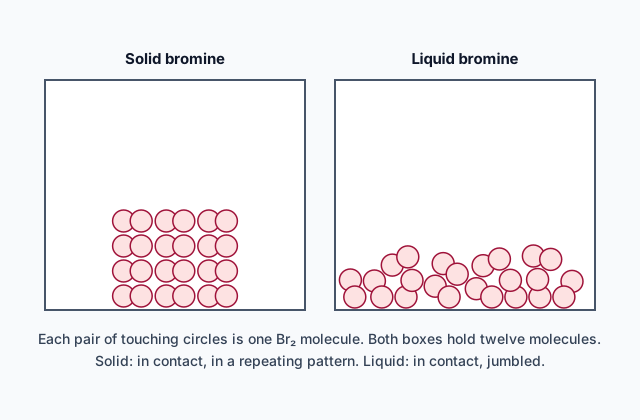
Bromine, Br₂, freezes at −7 °C and boils at 59 °C. In your drawings, show each Br₂ molecule as two touching circles.
(a) Represent on paper a box of solid bromine, a crystalline solid, with at least eight molecules.
(b) Represent on paper the same number of molecules as liquid bromine, in a box of the same size.
(c) Explain why the molar volume of liquid bromine is close to that of solid bromine.
(d) Explain why bromine gas fills a whole flask, while the same amount of liquid bromine stays at the bottom.
Model answer
(a) The molecules touch their neighbors and sit in a regular, repeating arrangement, all turned in the same pattern.
(b) The molecules still touch their neighbors and take up about the same space as in the solid, but they are jumbled, turned in different directions, with no repeating pattern.
(c) In both the solid and the liquid, the molecules are in close contact with their neighbors at all times. Melting lets them move past one another but does not spread them apart, so one mole takes up about the same volume.
(d) In the gas, the molecules are in constant motion and far apart, and the attractions between them have little effect, so they spread through the whole flask: a gas has no definite volume or shape. In the liquid, attractions keep the molecules in close contact, so the liquid keeps a definite volume and only takes the shape of the bottom of the flask.
 Tap to open the picture full size
Score your own answer. This is a self-check, not a grade. Tick each point your answer makes.
Part 6 Check yourself A student's models of argon
Both case questions use the table, and the second uses the figure too.
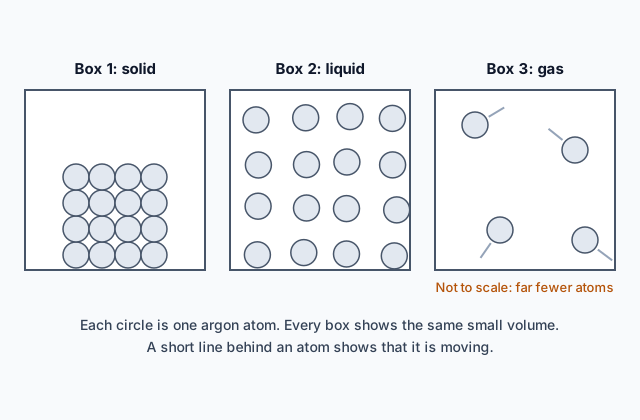
A student looked up the density of argon in each phase at 1 atm, then drew a particulate model of each phase. Each box in the figure shows the same small volume. The molar mass of argon is 39.95 g/mol.
| Phase | Temperature (°C) | Density |
|---|---|---|
| Solid | −190 | 1.62 g/cm³ |
| Liquid | −186 | 1.40 g/cm³ |
| Gas | 25 | 1.63 g/L |
 Tap to open the picture full size
Case question 1 · Calculate
Using the table: what is the molar volume of liquid argon, in cubic centimeters per mole? Give three significant figures.
Case question 2 · Decide and justify
Using the table and the figure: is the student's model of liquid argon, box 2, consistent with the data?
Which reason supports your decision?
The rest stand on their own and do not use the case.
Check yourself · Spot the error
A student explains why a gas has no definite shape. Tap the line with the mistake.
Check yourself · Select all
Which two statements are true of liquid water but not of ice? Select two.
Select 2 answers, then check.
Part 7 Keep it Bring back earlier ideas
This lesson leans on two earlier ideas: the particle-level reasons for the properties of different kinds of solids, and converting between the moles and the mass of a substance with its molar mass. Pulling them back up is what makes them last.
From 3.2 Properties of Solids · Match
Match each property to the particle-level reason for it.
From 1.1 Moles and Molar Mass · Spot the error
A student finds the mass of 0.150 mol of calcium carbonate, CaCO₃, the main ingredient of many antacid tablets. Atomic masses: Ca 40.08 amu, C 12.01 amu, O 16.00 amu. Tap the line with the mistake.
In three lines
- In a solid, particles vibrate in fixed places: in a repeating pattern in a crystalline solid, with no pattern in an amorphous one.
- In a liquid, particles stay in close contact but keep moving past one another, so a solid and its liquid have similar molar volumes.
- In a gas, particles are far apart and always moving, with spacing and collisions set by temperature, pressure and volume, so a gas fills its container.
Exam strategy for this topic
- Section I, Multiple Choice: 60 questions in 90 minutes.
- Section II, Free Response: 7 questions in 105 minutes.
- A scientific or graphing calculator is recommended for use on both sections of the exam.
When you draw particulate models of the phases of one substance, make every difference one a reader can check: particles touching in the solid and the liquid, a repeating pattern in a crystalline solid, a jumbled arrangement in the liquid, and particles far apart in the gas. Use the same particle size in every box.
Questions students ask
What is the difference between a crystalline and an amorphous solid?
In a crystalline solid, the particles are arranged in a regular three-dimensional pattern that repeats, as in quartz or table salt. In an amorphous solid, such as glass, the particles are held in place with no regular arrangement.
Why do a solid and its liquid have similar molar volumes?
In both phases the particles are in close contact with their neighbors at all times. Melting lets them move past one another, but it does not spread them apart.
Why does a gas fill its container?
Gas particles are in constant motion and far apart, and the forces between them have little effect, so they keep moving until they are spread through the whole container.
How do you find a molar volume?
Divide the molar mass by the density. For solid aluminum, 26.98 g/mol ÷ 2.70 g/cm³ = 9.99 cm³/mol.
Do particles change size when a substance changes phase?
No. The particles stay the same; what changes is how close together they are and how freely they move.
Beyond the AP Exam
College Board sets this limit on what the AP Exam asks about this topic. Anything past it is not on the exam.
Understanding/ interpreting phase diagrams will not be assessed on the AP Exam.
Course alignment, for teachers
AP Chemistry topic 3.3, Unit 3: Properties of Substances and Mixtures.
- Skill 3.C: Represent visually the relationship between the structures and interactions across multiple levels or scales (e.g., particulate to macroscopic).
This lesson maps all 4 essential knowledge statements of the topic to the part that teaches each one: 4 are checked by a scored question. The map is in the lesson file.