Unit 3 · Topic 3.4 · about 30 minutes · 7 parts · 11 scored checks, 1 of them multiple choice, plus 2 from earlier lessons
AP Chemistry 3.4: Ideal Gas Law
Unit 3: 18 to 22% of the multiple-choice section
What you'll be able to do
- Explain the relationship between the macroscopic properties of a sample of gas or mixture of gases using the ideal gas law.
Key vocabulary
| Term | What it means | The exam trap |
|---|---|---|
| Ideal gas law | The equation that links the pressure, volume, amount in moles and temperature of a gas sample through one constant, R. | Check that the unit of every quantity matches the units of the R you chose before you substitute. |
| Gas constant, R | The constant in the ideal gas law: 0.08206 L·atm/(mol·K) when pressure is in atmospheres and volume in liters. | R also equals 8.314 J/(mol·K), but that value needs pressure in pascals and volume in cubic meters. |
| Partial pressure | The part of a gas mixture’s total pressure that comes from one of the gases in it. | Partial pressures add up to the total pressure; they are never averaged. |
| Mole fraction | The moles of one component of a mixture divided by the total moles of all its components. | A mole fraction is a share of moles, so convert any masses to moles before you divide. |
 Tap to open the picture full size
Part 1 Think first A basketball left out overnight
Commit to a guess first. Being wrong now makes the right idea stick better.
Predict first
A basketball is pumped up in a gym at 22 °C and then left outside overnight, where the temperature falls to 0 °C. No air leaks out, and the ball’s size barely changes. By morning, what has happened to the pressure of the air inside the ball?
In short. The ideal gas law, PV = nRT, ties together the pressure, volume, amount in moles and Kelvin temperature of a gas, so any three of them give the fourth.
- Hold two of the properties fixed and the other two change together in a set way, with every temperature on the Kelvin scale.
- In a mixture, each gas’s partial pressure is its mole fraction times the total pressure, and the partial pressures add up to the total.
- Graphs show the same relationships: a straight line through the origin means two properties are proportional.
Part 2 Learn it The ideal gas law
2a. One equation for a gas sample
Four measurable properties describe a sample of gas: its pressure P, its volume V, the amount of gas in moles n, and its temperature T. For an ideal gas they are tied together by the ideal gas law:
PV = nRT
R is the gas constant. With pressure in atmospheres and volume in liters, R = 0.08206 L·atm/(mol·K). The units of the data have to match the units of R, and the temperature has to be in kelvins: K = °C + 273.15. A Celsius temperature gives a wrong answer, and a negative one gives a negative pressure, which no gas can have.
Know any three of the properties and the law gives the fourth. Example: 0.500 mol of a gas in a 10.0 L flask at 25.0 °C. First T = 25.0 + 273.15 = 298.15 K. Then
P = nRT/V = (0.500 mol)(0.08206 L·atm/(mol·K))(298.15 K)/(10.0 L) = 1.22 atm
Keep every figure until the last step, then round to the number of significant figures the data allow: three here.
Quick check · Calculate
A sealed 2.50 L flask holds 0.150 mol of nitrogen gas at 35.0 °C. What is the pressure of the gas, in atmospheres? Give three significant figures.
2b. Change one property, follow another
Hold two of the four properties fixed, and the ideal gas law says how the other two must change together:
- Pressure and volume (n and T fixed): PV stays constant, so halving the volume doubles the pressure.
- Pressure and temperature (n and V fixed): P/T stays constant, so the pressure is proportional to the Kelvin temperature.
- Volume and temperature (n and P fixed): V/T stays constant, so the volume is proportional to the Kelvin temperature.
- Pressure and amount (V and T fixed): P/n stays constant, so adding gas raises the pressure in proportion.
When several properties change at once, divide the law for the final state by the law for the starting state. R cancels:
P₁V₁/(n₁T₁) = P₂V₂/(n₂T₂)
Example: a syringe holds a gas at 1.00 atm. The plunger is pushed in until the volume is one third of what it was, at the same temperature, and no gas escapes. PV stays constant, so the pressure becomes 3 × 1.00 atm = 3.00 atm.
Proportional means a ratio of kelvins. Warming a gas from 10 °C to 20 °C takes it from 283 K to 293 K, a rise of about 3.5 percent, not a doubling.
Quick check · Fill the statement
Complete each sentence about a sample of gas. No gas enters or leaves unless a sentence says so.
A rigid steel tank of gas is warmed from 200 K to 800 K, so its pressure . A gas in a cylinder with a movable piston is pushed, at constant temperature, into half its volume, so its pressure . Half the gas in a rigid tank is let out, at constant temperature, so the pressure of the gas left behind .
2c. Mixtures: each gas has its share
In a mixture of ideal gases, each gas exerts its own pressure, its partial pressure, and that pressure does not depend on the other gases in the container. Two results follow.
The total pressure is the sum of the partial pressures:
P(total) = P(A) + P(B) + P(C) + …
Each gas’s partial pressure is its share of the total, set by its mole fraction, X: the moles of that gas divided by the total moles of gas.
P(A) = P(total) × X(A), where X(A) = moles of A / total moles
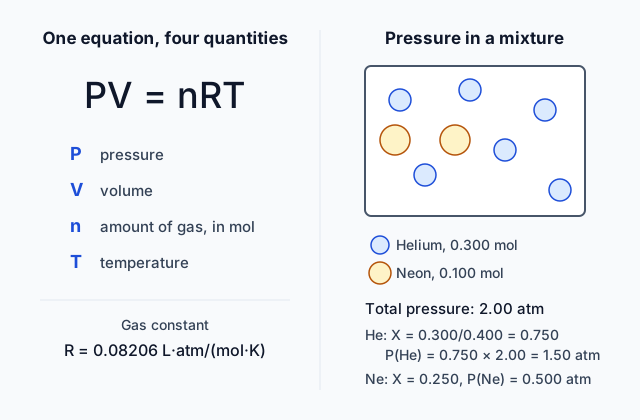
Example, the mixture in the diagram: 0.300 mol of helium and 0.100 mol of neon in one container, at a total pressure of 2.00 atm. The total is 0.400 mol, so X(He) = 0.300/0.400 = 0.750 and X(Ne) = 0.100/0.400 = 0.250. Then P(He) = 0.750 × 2.00 atm = 1.50 atm and P(Ne) = 0.250 × 2.00 atm = 0.500 atm. Check: 1.50 atm + 0.500 atm = 2.00 atm.
A mole fraction is a share of moles, not of mass. A gram of helium holds about five times as many atoms as a gram of neon.
Quick check · Calculate
A cylinder holds a mixture of 0.640 mol of oxygen and 1.36 mol of nitrogen at a total pressure of 3.00 atm. What is the partial pressure of the oxygen, in atmospheres? Give three significant figures.
2d. Gas behavior on a graph
Each relationship in the ideal gas law has a graph to recognize.
- Volume against Kelvin temperature (n and P fixed): a straight line that passes through the origin. Against Celsius temperature it is still a straight line, but it reaches zero volume at −273.15 °C, not at 0 °C.
- Pressure against Kelvin temperature (n and V fixed), and pressure against moles (V and T fixed): straight lines through the origin.
- Pressure against volume (n and T fixed): PV is constant, so the pressure falls as the volume grows, and doubling the volume halves the pressure. This graph is not a straight line.
A straight line through the origin is the sign that two properties are proportional. An inverse relationship, such as PV = constant, can be turned into one: plot pressure against 1/volume, and the points fall on a straight line through the origin.
Example: a gas whose volume is 2.00 L at 200. K and 3.00 L at 300. K, at a fixed pressure, gives points on one straight line through the origin, because V/T = 0.0100 L/K at both.
Quick check · Sketch the graph
A fixed amount of gas is held at constant temperature in a cylinder with a movable piston. At 1 L its pressure is 1200 kPa. Sketch how its pressure changes as the volume is raised one liter at a time to 6 L. The first point is placed for you; drag the others so the graph rises or falls the way the pressure does, and bends the same way along its whole length, as the pressure does.
One shape that fits
Drag a point up or down, or tap it and use the arrow keys. Only the shape is checked.
Part 3 Watch it done A balloon in the freezer
Predict first, then watch each step, then finish the problem yourself.
A party balloon is filled with helium to a volume of 2.50 L at 25.0 °C and is then put in a freezer at −18.0 °C. The pressure on the balloon stays at 1.00 atm, and no helium escapes. What is the balloon’s volume once the helium has cooled to the temperature of the freezer?
Predict first
Before you open the first step, predict: what happens to the balloon’s volume?
Step 1 · Decide what is fixed
The amount of helium does not change, and the pressure stays at 1.00 atm, so n and P are fixed. Only V and T change, and with n and P fixed, V/T stays constant: V₁/T₁ = V₂/T₂.
Why this step?
Why must both temperatures be in kelvins before they go into V₁/T₁ = V₂/T₂?
Volume is proportional to the temperature measured from absolute zero. On the Celsius scale the freezer is at −18.0 °C, and a ratio with a negative temperature would give a negative volume, which no gas can have.
Step 2 · Convert the temperatures
T₁ = 25.0 + 273.15 = 298.15 K and T₂ = −18.0 + 273.15 = 255.15 K.
Your step · Calculate
Finish it. A balloon holds 2.50 L of helium at 25.0 °C. It is cooled to −18.0 °C at a constant pressure of 1.00 atm, and no helium escapes. What is its new volume, in liters? Give three significant figures.
L
The balloon shrinks by only about 14 percent, because 255 K is about 86 percent of 298 K. Ratios of temperatures are always ratios of kelvins.
Part 4 Try it A welding cylinder and four flasks
Two more gas samples to work with: a steel cylinder of argon that is partly used up, and four flasks of different gases.
Try it · Calculate
A 10.0 L steel cylinder of argon reads 15.6 atm at 20.0 °C. After a day of welding it reads 4.80 atm, at the same temperature. How many moles of argon were used? Give three significant figures.
Try it · Rank it
Four sealed flasks each hold one gas, at the conditions listed. Treat every gas as ideal. Rank the flasks by the pressure inside.
Highest pressure first
Give each one a place, 1 for first. Give two the same place if they are equal.
Your ranking: none yet
Part 5 Explain it A mixture in a flask
On the exam this is handwritten, so answer on paper first. Nothing you type here leaves this page. Then check your answer against the model and each scoring point.
Free response is 50% of the exam score. This one is shaped like a short-answer question, which is worth 4 points.
Free-response practice · Short-answer style
A rigid 5.00 L flask holds 0.100 mol of oxygen, O₂, and 0.300 mol of nitrogen, N₂, at 300. K. Treat both as ideal gases.
(a) Calculate the total pressure in the flask, in atmospheres.
(b) Calculate the partial pressure of the oxygen.
(c) The flask is heated to 450. K. Determine the new partial pressure of the oxygen, and justify whether the mole fraction of the oxygen changes.
(d) Describe the shape of a graph of the total pressure in the flask against its Kelvin temperature as the flask is heated, and explain that shape using the ideal gas law.
Model answer
(a) n(total) = 0.100 + 0.300 = 0.400 mol. P = nRT/V = (0.400 mol)(0.08206 L·atm/(mol·K))(300. K)/(5.00 L) = 1.97 atm.
(b) X(O₂) = 0.100/0.400 = 0.250, so P(O₂) = 0.250 × 1.969 atm = 0.492 atm.
(c) No gas enters or leaves, so the moles of each gas, and so the mole fraction of oxygen, stay the same: 0.250. At constant volume the pressure is proportional to the Kelvin temperature, so P(O₂) = 0.4924 atm × 450./300. = 0.739 atm. (Or P(O₂) = (0.100 mol)(0.08206 L·atm/(mol·K))(450. K)/(5.00 L) = 0.739 atm.)
(d) A straight line that passes through the origin when extended. With n and V fixed, P = (nR/V) × T, so P is proportional to T, and the slope is nR/V = 0.00656 atm/K.
Score your own answer. This is a self-check, not a grade. Tick each point your answer makes.
Part 6 Check yourself Squeezing a syringe of air
Both case questions use the table.
A student traps some air in a sealed syringe at 22 °C and pushes on the plunger, recording the volume of the air at each pressure. The temperature does not change. These data are a teaching example.
| Pressure (atm) | Volume (mL) |
|---|---|
| 1.00 | 60.0 |
| 1.25 | 48.0 |
| 1.50 | 40.0 |
| 2.00 | 30.0 |
| 2.50 | 24.0 |
Case question 1 · Multiple choice
Using the table: which graph of these data is a straight line that passes through the origin?
Case question 2 · Calculate
Using the table: predict the volume of the trapped air at 3.00 atm, at the same temperature. Give three significant figures.
The rest stand on their own and do not use the case.
Check yourself · Decide and justify
A rigid flask holds nitrogen at a pressure of 0.800 atm. Argon is added until the total pressure is 1.40 atm, and the temperature does not change. Does the partial pressure of the nitrogen change?
Which reason supports your decision?
Check yourself · Spot the error
A student finds the pressure of 0.200 mol of methane in a sealed 4.00 L flask at 27.0 °C. Tap the line with the mistake.
Part 7 Keep it Bring back earlier ideas
This lesson leans on two earlier ideas: the mole as a way to count particles, and a gas as particles spread far apart, with their spacing set by temperature, pressure and volume. Pulling them back up is what makes them last.
From 3.3 Solids, Liquids, and Gases · Fill the statement
A sealed, rigid steel tank of helium is carried from a cool room into hot sunlight. The tank's volume does not change, and no helium gets in or out. Complete the description of the helium inside.
The average spacing between the helium atoms , and the atoms collide with one another and with the walls often and .
From 1.1 Moles and Molar Mass · Calculate
How many silver atoms are in 0.350 mol of silver? Give your answer to three significant figures, typed in e-notation (6.022 × 10²³ is typed 6.022e23).
In three lines
- PV = nRT links the pressure, volume, moles and Kelvin temperature of an ideal gas, with R = 0.08206 L·atm/(mol·K) for liters and atmospheres.
- Hold two properties fixed and the other two change together: PV constant, or P and V each proportional to the Kelvin temperature.
- In a mixture, P(A) = X(A) × P(total), the partial pressures add to the total, and each gas’s pressure is independent of the others.
Exam strategy for this topic
- Section I, Multiple Choice: 60 questions in 90 minutes.
- Section II, Free Response: 7 questions in 105 minutes.
- A scientific or graphing calculator is recommended for use on both sections of the exam.
In a gas calculation, write each quantity with its unit, convert every temperature to kelvins first, and use the value of R whose units match the data. When conditions change, cross out what is held fixed in P₁V₁/(n₁T₁) = P₂V₂/(n₂T₂), solve, and check the direction: a gas cooled at constant pressure must come out smaller.
Questions students ask
What is the ideal gas law?
PV = nRT. It relates the pressure, volume, moles and Kelvin temperature of a gas, with R = 0.08206 L·atm/(mol·K) when pressure is in atmospheres and volume in liters.
Why must the temperature be in kelvins?
Pressure and volume are proportional to the temperature measured from absolute zero. A Celsius temperature can be zero or negative, which would give a zero or negative pressure or volume.
How do you find the partial pressure of one gas in a mixture?
Multiply the total pressure by the gas’s mole fraction, its moles divided by the total moles of gas. The partial pressures add up to the total pressure.
How do you solve a problem in which the conditions of a gas change?
Write P₁V₁/(n₁T₁) = P₂V₂/(n₂T₂), cancel what is held fixed, put every temperature in kelvins and solve for the unknown. Then check that the change goes the way it should.
Which value of R should I use?
The one whose units match the data. With pressure in atmospheres and volume in liters, R = 0.08206 L·atm/(mol·K); with pascals and cubic meters, R = 8.314 J/(mol·K).
Course alignment, for teachers
AP Chemistry topic 3.4, Unit 3: Properties of Substances and Mixtures.
- Skill 5.C: Explain the relationship between variables within an equation when one variable changes.
This lesson maps all 3 essential knowledge statements of the topic to the part that teaches each one: 3 are checked by a scored question. The map is in the lesson file.