Unit 3 · Topic 3.5 · about 30 minutes · 7 parts · 10 scored checks, 1 of them multiple choice, plus 2 from earlier lessons
AP Chemistry 3.5: Kinetic Molecular Theory
Unit 3: 18 to 22% of the multiple-choice section
What you'll be able to do
- Explain the relationship between the motion of particles and the macroscopic properties of gases with the kinetic molecular theory, a particulate model and a graphical representation.
Key vocabulary
| Term | What it means | The exam trap |
|---|---|---|
| Kinetic molecular theory | A model that explains the measurable properties of a gas, such as its pressure and temperature, from the motion of its particles. | When a question asks for an explanation in terms of particles, describe what the particles do; quoting PV = nRT alone does not explain why. |
| Kinetic energy | The energy a particle has because it moves, which depends on both its mass and its speed. | With the mass in kilograms and the speed in meters per second, ½mv² comes out in joules; mixing units gives a wrong value. |
| Maxwell-Boltzmann distribution | A graph of how the particles of a sample at one temperature are spread over a range of speeds or kinetic energies. | Check whether the horizontal axis shows speed or kinetic energy before you compare two curves. |
| Most probable speed | The speed at the peak of a Maxwell-Boltzmann distribution of speeds: more particles have about that speed than any other. | The most probable speed is a little lower than the average speed, because the curve’s tail stretches out toward high speeds. |
 Tap to open the picture full size
Part 1 Think first Two balloons in one room
Commit to a guess first. Being wrong now makes the right idea stick better.
Predict first
Two balloons sit side by side in a classroom at 22 °C. One is filled with helium, and the other with air, which is mostly nitrogen. On average, how does the speed of a helium atom in the first balloon compare with the speed of a nitrogen molecule in the second?
In short. The kinetic molecular theory explains the pressure and temperature of a gas from the continuous, random motion of its particles.
- Pressure comes from particles striking the walls, and a particle’s kinetic energy is ½mv².
- The Kelvin temperature is proportional to the average kinetic energy of the particles, whatever the gas.
- A Maxwell-Boltzmann distribution graphs the range of particle speeds or energies in a sample at one temperature.
Part 2 Learn it The kinetic molecular theory
2a. Particles that never stop
The kinetic molecular theory (KMT) explains the properties of a gas that you can measure, such as its pressure and temperature, from the motion of its particles.
- All the particles in a sample of matter are in continuous, random motion. In a gas, each particle travels in a straight line until it collides with another particle or with a wall, then sets off in a new direction.
- Collisions trade energy between particles, so at any moment some particles are fast and some are slow. A sample has a range of speeds, not one speed.
- Each collision with a wall gives the wall a small push. Countless collisions every second add up to a steady force on each area of wall, which is the gas’s pressure.
The energy a particle has because it moves is its kinetic energy:
KE = ½mv²
where m is the particle’s mass and v its speed. Because the speed is squared, a particle moving twice as fast has four times the kinetic energy. The same equation relates the average kinetic energy of the particles in a sample to their average speed.
Quick check · Sort it
Each card describes the particles in a sealed flask of gas that has sat untouched on a bench at room temperature for a week. Tap a card, then the bin it belongs in.
Fits the kinetic molecular theory
Does not fit the kinetic molecular theory
2b. Temperature is average kinetic energy
The Kelvin temperature of a sample is proportional to the average kinetic energy of its particles. Double the Kelvin temperature and the average kinetic energy doubles. The proportion holds only on the Kelvin scale, which starts at absolute zero; a Celsius temperature has to be converted first.
Two results follow.
At the same temperature, every gas has the same average kinetic energy per particle, whatever its particles are. Since KE = ½mv², particles with a smaller mass must move faster to carry the same energy. A particle with one fourth the mass of another moves twice as fast for ½mv² to come out the same.
Raising the temperature raises the speeds, but not in proportion. Doubling the Kelvin temperature doubles the average kinetic energy, so v² doubles, and the average speed rises by a factor of √2, about 1.41.
Example: argon at 300 K and at 600 K. The average kinetic energy of the atoms at 600 K is twice that at 300 K, and their average speed is √2 ≈ 1.41 times as large.
Quick check · Calculate
A sample of neon is heated from 27.0 °C to 327.0 °C. By what factor does the average kinetic energy of its atoms increase? Give three significant figures.
2c. The Maxwell-Boltzmann distribution
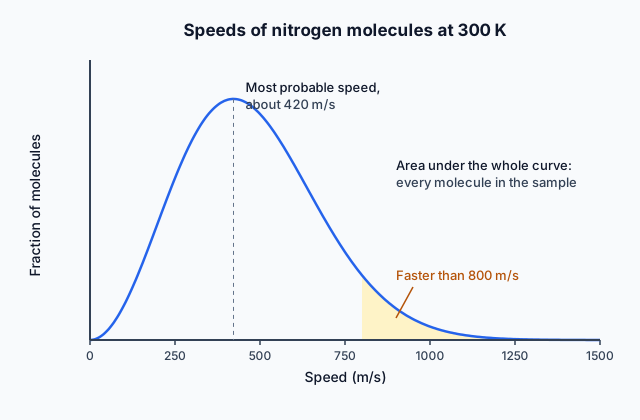
Because the particles in a sample have a range of speeds, the clearest picture of their motion is a graph. A Maxwell-Boltzmann distribution plots the fraction of particles against speed, or against kinetic energy, for a sample at one temperature. The diagram at the top of this lesson is one, for nitrogen at 300 K.
How to read it:
- The height of the curve at a speed shows how many particles move at about that speed.
- The peak is the most probable speed: more particles have about that speed than any other.
- The area under part of the curve is the fraction of particles in that range of speeds, and the area under the whole curve stands for every particle in the sample.
- The curve starts at zero, rises to the peak and has a long tail toward high speeds.
A higher temperature means a larger average kinetic energy, so the curve stretches out toward higher speeds. Every speed on the curve, the most probable speed included, changes by the same factor as the average speed. At one temperature, a gas of lighter particles has a curve stretched toward higher speeds in the same way.
Quick check · Select all
A sealed flask of oxygen is warmed from 300 K to 400 K. Which two statements describe how the Maxwell-Boltzmann distribution of the molecules’ speeds changes? Select two.
Select 2 answers, then check.
Part 3 Watch it done Helium and argon at the same temperature
Predict first, then watch each step, then finish the problem yourself.
Two flasks at 300 K hold helium (molar mass 4.003 g/mol) and argon (molar mass 39.95 g/mol). How do the average kinetic energies of their atoms compare, and how many times as fast, on average, does a helium atom move as an argon atom?
Predict first
Before you open the first step, predict: which atoms have the greater average kinetic energy?
Step 1 · Compare the kinetic energies
Both gases are at 300 K, and the average kinetic energy of the particles depends only on the Kelvin temperature. So a helium atom and an argon atom have the same average kinetic energy.
Step 2 · Set the kinetic energies equal
½ m(He) v(He)² = ½ m(Ar) v(Ar)². The halves cancel, and the masses of single atoms are in the same ratio as the molar masses, 4.003 and 39.95.
Why this step?
Why must the lighter atom move faster?
The kinetic energy is ½mv², and both atoms have the same average kinetic energy. A smaller mass has to be balanced by a larger v², so the helium atom moves faster.
Your step · Calculate
Finish it. A helium atom (4.003 g/mol) and an argon atom (39.95 g/mol) are at the same temperature, so they have the same average kinetic energy. Using KE = ½mv², how many times as fast does a helium atom move as an argon atom, on average? Give three significant figures.
times as fast
The two gases have the same average kinetic energy but very different speeds. Temperature fixes the energy, and the mass then sets the speed.
Part 4 Try it Compare samples of gas
Samples of gas that differ in temperature, in the mass of their particles, or in both.
Try it · Rank it
Four samples of gas are listed with their temperatures. Helium’s molar mass is 4.003 g/mol and argon’s is 39.95 g/mol. Rank the samples by the average speed of their atoms.
Slowest first
Give each one a place, 1 for first. Give two the same place if they are equal.
Your ranking: none yet
Try it · Decide and justify
Flask X holds oxygen at 300 K, and flask Y holds oxygen at 600 K. A student claims that every molecule in flask Y is moving faster than every molecule in flask X. Is the claim correct?
Which reason supports your decision?
Part 5 Explain it Neon and krypton side by side
On the exam this is handwritten, so answer on paper first, and sketch the curves on paper too. Nothing you type here leaves this page. Then check your answer against the model and each scoring point.
Free response is 50% of the exam score. This one is shaped like a short-answer question, which is worth 4 points.
Free-response practice · Short-answer style
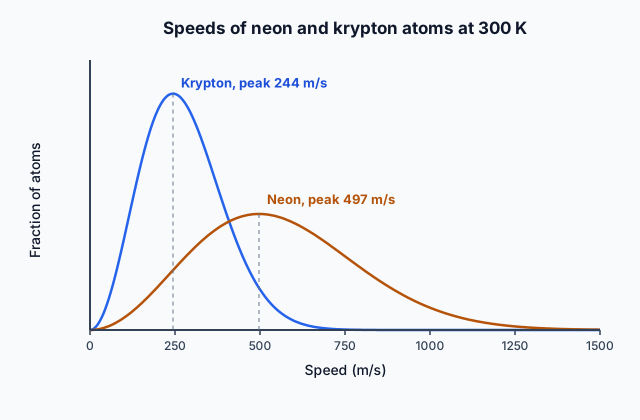
Two identical rigid 1.00 L flasks are both at 300. K. One holds 0.0400 mol of neon (20.18 g/mol); the other holds 0.0400 mol of krypton (83.80 g/mol).
(a) Identify which sample’s atoms have the greater average kinetic energy, or whether the two are equal, and justify your answer.
(b) Identify which sample’s atoms have the greater average speed, and justify your answer using KE = ½mv².
(c) Describe how the Maxwell-Boltzmann distribution of speeds for the neon compares with the one for the krypton. Sketch both curves on one set of axes on paper.
(d) The two flasks have the same pressure. Explain, in terms of the motion of the atoms and their collisions with the walls, how the krypton exerts the same pressure even though its atoms move more slowly.
Model answer
(a) They are equal. The average kinetic energy of the particles is proportional to the Kelvin temperature, and both flasks are at 300. K.
(b) The neon. ½mv² is the same for both, and a neon atom has about one fourth the mass of a krypton atom (20.18 g/mol against 83.80 g/mol), so a neon atom must move faster: about √(83.80/20.18) = 2.04 times as fast.
(c) The neon curve is stretched toward higher speeds: its peak is at a higher speed and is lower, and the curve spreads over a wider range of speeds. The krypton curve is narrower, with a taller peak at a lower speed. Both curves enclose the same area, since both samples hold the same number of atoms.
(d) A krypton atom moves more slowly, so it strikes the walls less often, but it is heavier, so each collision gives the wall a larger push. The two effects balance because the average kinetic energies are equal, so the same number of atoms at the same temperature, in the same volume, exert the same pressure.
 Tap to open the picture full size
Score your own answer. This is a self-check, not a grade. Tick each point your answer makes.
Part 6 Check yourself Two samples of nitrogen
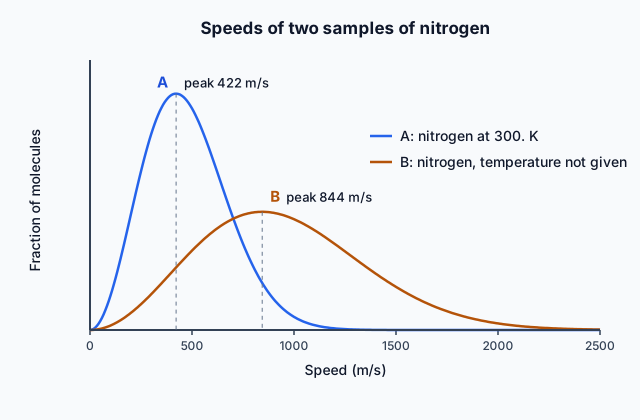
Both case questions use the figure.
The figure shows the Maxwell-Boltzmann distributions of molecular speeds for two samples of nitrogen gas. Sample A is at 300. K, and the temperature of sample B is not given. The dashed lines mark the most probable speed of each sample.
 Tap to open the picture full size
Case question 1 · Calculate
Using the figure: what is the temperature of sample B, in kelvins? Give three significant figures.
Case question 2 · Decide and justify
Using the figure: which sample has the greater fraction of its molecules moving faster than 1000 m/s?
Which reason supports your decision?
The rest stand on their own and do not use the case.
Check yourself · Spot the error
A student compares two flasks, one of hydrogen, H₂, and one of oxygen, O₂, both at 300 K. Tap the line with the mistake.
Check yourself · Multiple choice
A sealed, rigid can of gas is heated. Which statement best explains, in terms of particles, why the pressure inside the can rises?
Part 7 Keep it Bring back earlier ideas
This lesson leans on two earlier ideas: the ideal gas law, which ties pressure to the moles, volume and Kelvin temperature of a gas, and a gas as particles far apart in constant motion. Pulling them back up is what makes them last.
From 3.4 Ideal Gas Law · Calculate
A sealed 2.50 L flask holds 0.150 mol of nitrogen gas at 35.0 °C. What is the pressure of the gas, in atmospheres? Give three significant figures.
Two everyday situations to explain with particles: air squeezed in a syringe, and honey that pours faster when it is warm.
From 3.3 Solids, Liquids, and Gases · Decide and justify
A student seals the tip of a syringe full of air and pushes the plunger in until the air takes up half its starting volume. The student says each gas particle has been squeezed to half its size. Is the student right?
Which reason supports your decision?
In three lines
- Gas particles are in continuous, random motion, and their collisions with the walls are the gas’s pressure.
- The Kelvin temperature is proportional to the average kinetic energy, ½mv², so at one temperature lighter particles move faster.
- A Maxwell-Boltzmann distribution shows the range of speeds at one temperature; heating stretches it toward higher speeds with the same area.
Exam strategy for this topic
- Section I, Multiple Choice: 60 questions in 90 minutes.
- Section II, Free Response: 7 questions in 105 minutes.
- A scientific or graphing calculator is recommended for use on both sections of the exam.
When a question asks you to explain a gas property with the kinetic molecular theory, say what the particles do: how fast they move, how often they strike the walls and how hard. Tie temperature to average kinetic energy, never directly to speed, and get speeds from ½mv².
Questions students ask
What does the kinetic molecular theory say about gases?
A gas is made of particles in continuous, random motion. Their collisions with the walls are the gas’s pressure, and their average kinetic energy is proportional to the Kelvin temperature.
How is temperature related to kinetic energy?
The Kelvin temperature is proportional to the average kinetic energy of the particles. Doubling the Kelvin temperature doubles the average kinetic energy.
Do all gases at the same temperature move at the same speed?
No. They have the same average kinetic energy, ½mv², so particles with a smaller mass move faster on average.
What does a Maxwell-Boltzmann distribution show?
How the particles in a sample at one temperature are spread over a range of speeds or energies. The peak is the most probable speed, and the area under the curve stands for all the particles.
Is the most probable speed the same as the average speed?
No. The most probable speed is the speed at the peak of the curve. The average speed is a little higher, because the curve has a long tail toward high speeds.
Course alignment, for teachers
AP Chemistry topic 3.5, Unit 3: Properties of Substances and Mixtures.
- Skill 4.A: Predict and/or explain chemical properties or phenomena (e.g., of atoms or molecules) using given chemical theories, models, and representations.
This lesson maps all 4 essential knowledge statements of the topic to the part that teaches each one: 4 are checked by a scored question. The map is in the lesson file.