Unit 3 · Topic 3.6 · about 30 minutes · 7 parts · 10 scored checks, 1 of them multiple choice, plus 2 from earlier lessons
AP Chemistry 3.6: Deviation from Ideal Gas Law
Unit 3: 18 to 22% of the multiple-choice section
What you'll be able to do
- Explain the relationship among non-ideal behaviors of gases, interparticle forces, and/or volumes.
Key vocabulary
| Term | What it means | The exam trap |
|---|---|---|
| Ideal gas | A gas that would follow PV = nRT exactly, at every temperature and pressure. | When a question says to assume ideal behavior, use PV = nRT even for a gas you know is not ideal. |
| Real gas | An actual gas, whose measured pressure, volume, amount and temperature fit PV = nRT only approximately. | A real gas can follow PV = nRT closely under some conditions, so do not assume every real gas strays far from it. |
| Condensation | The change of a substance from a gas to a liquid. | A gas can be close to condensing at a temperature well above 0 °C, so compare with that substance’s own boiling point. |
| Interparticle attractions | Attractive forces between particles, such as dispersion forces, dipole-dipole forces and hydrogen bonds. | Name the strongest attraction each substance has before you compare two substances under the same conditions. |
 Tap to open the picture full size
Part 1 Think first Water vapor and helium
Commit to a guess first. Being wrong now makes the right idea stick better.
Predict first
A chemist fills two identical flasks, one with water vapor and one with helium, each with the same number of moles at 105 °C and a pressure near 1 atm. She uses PV = nRT to predict the pressure in each flask, then measures both. Which flask’s measured pressure is closer to her prediction?
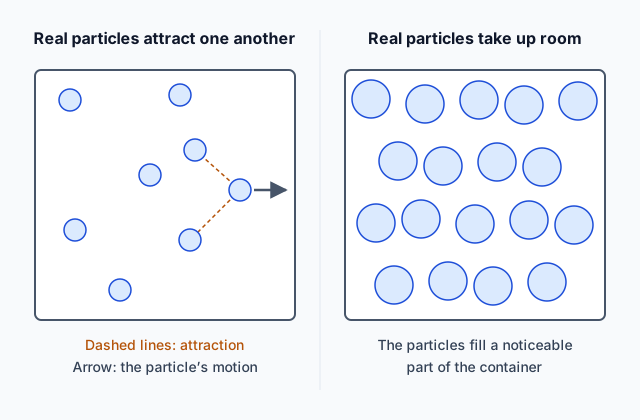
In short. Real gases stray from PV = nRT because their particles attract one another and take up room, and both effects grow as the particles crowd together and slow down.
- Attractions make the measured pressure lower than the ideal value, most of all close to condensation and for particles with strong intermolecular forces.
- The particles’ own volume makes the measured pressure higher than the ideal value, most of all at extremely high pressures.
- A real gas behaves most nearly like an ideal gas at low pressure and high temperature.
Part 2 Learn it Real gases
2a. Attractions pull the pressure down
The ideal gas law describes an ideal gas: particles that never attract one another and take up no space themselves. Real particles do both, so the ideal gas law does not explain the actual behavior of real gases. How far a real gas strays from PV = nRT depends on the gas and on its conditions.
The first cause is interparticle attractions: the dispersion forces, dipole-dipole forces and hydrogen bonds from earlier in this unit. A particle heading for a wall is tugged back by its neighbors, so it strikes the wall less hard, and particles that cling together for a moment make fewer separate collisions. The measured pressure comes out lower than PV = nRT predicts.
Attractions matter most when the particles are close together and moving slowly, which is when the gas is close to condensing. They also matter more for particles that attract one another more strongly. Under the same conditions, a gas of polar or hydrogen-bonding molecules, or of particles with large electron clouds, strays further than a gas of small nonpolar particles.
Example: at 1 atm and 300 K, chloromethane, CH₃Cl, strays further below the ideal pressure than nitrogen does, because its polar molecules attract one another through dipole-dipole forces as well as dispersion forces.
Quick check · Rank it
Three gases are each held at 400 K and 1 atm: methane, CH₄; water vapor, H₂O; and helium, He. Rank them by how closely their measured pressures match PV = nRT.
Closest to ideal first
Give each one a place, 1 for first. Give two the same place if they are equal.
Your ranking: none yet
2b. Particle volume pushes the pressure up
The second cause is the volume of the particles themselves. The ideal gas law treats the particles as points, so the whole container is space for them to move through. At ordinary pressures that is very nearly true. Example: 1.00 mol of nitrogen at 300 K and 1.00 atm fills 24.6 L, while the same molecules packed as tightly as they are in liquid nitrogen would fill only 34.7 mL, about 0.141 percent of that space.
At extremely high pressures the particles are squeezed so close together that their own volume is a noticeable part of the container. The space left for them to move through is smaller than the container’s volume, so they strike the walls more often than point particles would. The measured pressure comes out higher than PV = nRT predicts, and at a fixed pressure the measured volume comes out larger than predicted.
At high pressure both causes act at once: attractions pull the pressure down while particle volume pushes it up. Which one wins depends on the gas and on how high the pressure is, and at extremely high pressures particle volume wins.
Quick check · Calculate
1.00 mol of nitrogen molecules packed as tightly as they are in liquid nitrogen would fill 34.7 mL. The gas is squeezed, at 300. K, into the volume that PV = nRT predicts for 1.00 mol at 300. atm. What percent of that volume would the packed molecules fill? Give three significant figures.
2c. When a real gas is nearly ideal
Put the two causes together, and a real gas behaves most like an ideal gas when its particles are far apart and moving fast:
- At low pressure the particles are far apart, so their attractions are weak and their own volume is a tiny share of the container.
- At high temperature the particles move fast, so a brief tug from a neighbor changes their motion little, and the gas is far from condensing.
A real gas strays furthest from ideal behavior in two kinds of conditions:
- close to condensation, at a low temperature or at a pressure high enough to start turning it to liquid, where attractions dominate and the measured pressure is below the ideal value;
- at extremely high pressure, where particle volume dominates and the measured pressure is above the ideal value.
Example: methane at 500 K and 0.5 atm behaves almost exactly as PV = nRT predicts. The same methane cooled to just above its boiling point does not, because its molecules then attract one another strongly.
Quick check · Sort it
Each card describes a real gas sample. Tap a card, then the bin that says how the sample behaves compared with PV = nRT.
Close to ideal
Strays mainly because of attractions
Strays mainly because of particle volume
Part 3 Watch it done Ammonia in a steel flask
Predict first, then watch each step, then finish the problem yourself.
A 2.00 L steel flask holds 1.00 mol of ammonia, NH₃, at 350. K. Its measured pressure is 13.6 atm, a value from a model of real ammonia used here as a teaching example. Does the ammonia behave ideally, and if not, what mainly causes the difference?
Predict first
Before you open the first step, predict: how does the measured pressure compare with the pressure PV = nRT predicts?
Step 1 · Gather the data
n = 1.00 mol, V = 2.00 L, T = 350. K and the measured P = 13.6 atm. With liters and atmospheres, R = 0.08206 L·atm/(mol·K).
Step 2 · Find the ideal pressure
P = nRT/V = (1.00 mol)(0.08206 L·atm/(mol·K))(350. K)/(2.00 L) = 14.4 atm.
Why this step?
Why work out the ideal pressure before naming a cause?
A deviation only means something next to the value PV = nRT gives. Both its size and its direction come from comparing the measured pressure with that value.
Your step · Decide and justify
Finish it. The flask’s measured pressure is 13.6 atm, and PV = nRT gives 14.4 atm. Is the difference mainly caused by attractions between the molecules or by the volume of the molecules?
Which reason supports your decision?
The ammonia’s pressure is about 0.8 atm, or 5 percent, below the ideal value. For a polar, hydrogen-bonding gas at a moderate pressure, a pressure below the ideal value points to attractions.
Part 4 Try it Nitrogen under four conditions, and hot steam
Two more real gases to judge: one sample of nitrogen under four sets of conditions, and steam in a sealed tank.
Try it · Rank it
A sample of nitrogen is studied under four sets of conditions. Rank them by how closely the gas follows PV = nRT.
Closest to ideal first
Give each one a place, 1 for first. Give two the same place if they are equal.
Your ranking: none yet
Try it · Decide and justify
A sealed steel tank holds steam at 110 °C, just above the temperature at which it condenses at the tank’s pressure. The tank is heated to 400 °C, and its volume does not change. Does the steam now behave more like an ideal gas, less like one, or about the same?
Which reason supports your decision?
Part 5 Explain it Sulfur dioxide in a flask
On the exam this is handwritten, so answer on paper first. Nothing you type here leaves this page. Then check your answer against the model and each scoring point.
Free response is 50% of the exam score. This one is shaped like a short-answer question, which is worth 4 points.
Free-response practice · Short-answer style
A rigid 0.500 L flask holds 0.250 mol of sulfur dioxide, SO₂, at 400. K. Its measured pressure is 15.2 atm, a value from a model of real sulfur dioxide used here as a teaching example.
(a) Calculate the pressure that the ideal gas law predicts for this sample.
(b) Identify whether the measured pressure is above or below the ideal value, and explain the difference in terms of the interactions between SO₂ molecules.
(c) The flask is heated to 800. K. Predict whether the sample’s behavior becomes closer to ideal or further from it, and justify your prediction.
(d) Explain why a sample of helium under the same conditions as in (a) would behave more nearly ideally than the SO₂.
Model answer
(a) P = nRT/V = (0.250 mol)(0.08206 L·atm/(mol·K))(400. K)/(0.500 L) = 16.4 atm.
(b) Below: 15.2 atm is less than 16.4 atm. SO₂ molecules are polar, so they attract one another through dipole-dipole forces as well as dispersion forces. A molecule heading for a wall is pulled back by its neighbors, so the molecules strike the walls less hard, and less often, than particles with no attractions would.
(c) Closer to ideal. At 800. K the molecules move faster, so their attractions change their motion less, and the gas is further from condensing. The volume is fixed, so the molecules are no closer together.
(d) Helium atoms are small and nonpolar, with only two electrons each, so the dispersion forces between them are very weak. With almost no attractions to pull them back, helium atoms strike the walls nearly as ideal particles would.
Score your own answer. This is a self-check, not a grade. Tick each point your answer makes.
Part 6 Check yourself Noble gases in one-liter flasks
Both case questions use the table.
Four flasks each hold 1.00 mol of a noble gas in 1.00 L at 300. K, where PV = nRT predicts 24.6 atm for every one. The table gives each gas’s pressure from a model of real gases, used here as a teaching example.
| Gas | Electrons per atom | Pressure from the model (atm) | Ideal gas law (atm) |
|---|---|---|---|
| Helium | 2 | 25.2 | 24.6 |
| Neon | 10 | 24.8 | 24.6 |
| Argon | 18 | 24.1 | 24.6 |
| Krypton | 36 | 23.3 | 24.6 |
Case question 1 · Decide and justify
Using the table: xenon, with 54 electrons per atom, is put in a fifth flask under the same conditions. Will its pressure be above or below krypton’s 23.3 atm?
Which reason supports your decision?
Case question 2 · Multiple choice
Using the table: the pressures of helium and neon are above the ideal value, while those of argon and krypton are below it. Which statement best explains why helium’s pressure is above the ideal value?
The rest stand on their own and do not use the case.
Check yourself · Spot the error
A student explains how hydrogen chloride gas at 1 atm and 195 K behaves compared with PV = nRT. Tap the line with the mistake.
Check yourself · Fill the statement
Complete the description of nitrogen let out of a high-pressure tank.
A tank holds nitrogen at 200 atm and 300 K. Some of the gas is let out into a large balloon at 1 atm and the same temperature. In the balloon the molecules are apart than in the tank. Their attractions and their own volume therefore matter than in the tank, and the gas in the balloon is ideal behavior.
Part 7 Keep it Bring back earlier ideas
This lesson leans on two earlier ideas: the kinds and strengths of intermolecular forces, and gas pressure as the force of particles colliding with the walls. Pulling them back up is what makes them last.
From 3.5 Kinetic Molecular Theory · Multiple choice
A sealed, rigid can of gas is heated. Which statement best explains, in terms of particles, why the pressure inside the can rises?
From 3.1 Intermolecular and Interparticle Forces · Fill the statement
In HCl, chlorine is more electronegative than hydrogen. Complete the description of how two HCl molecules attract.
The H end of one HCl molecule is attracted most strongly when it points at the end of the other, which carries a partial charge. If instead the Cl end of one molecule points at the Cl end of the other, the two ends each other.
In three lines
- Real gases stray from PV = nRT because their particles attract one another and take up room.
- Attractions lower the measured pressure, most of all close to condensation and for particles with strong intermolecular forces.
- Particle volume raises it at extremely high pressures; a real gas is most nearly ideal at low pressure and high temperature.
Exam strategy for this topic
- Section I, Multiple Choice: 60 questions in 90 minutes.
- Section II, Free Response: 7 questions in 105 minutes.
- A scientific or graphing calculator is recommended for use on both sections of the exam.
When a question asks why a real gas deviates from ideal behavior, give the direction first, whether the measured pressure is above or below the ideal value, then the particle-level cause. Name the specific intermolecular force when attractions are the cause, and link it to the conditions: close to condensation, or an extremely high pressure.
Questions students ask
Why don’t real gases follow the ideal gas law exactly?
The ideal gas law treats particles as points that never attract one another. Real particles attract one another and take up room, so the measured behavior differs, most of all under some conditions.
When does a real gas behave most like an ideal gas?
At low pressure and high temperature, where the particles are far apart and moving fast, so their attractions and their own volume matter little.
Why is the pressure of a real gas often lower than PV = nRT predicts?
Attractions between the particles tug them back as they head for the walls, so they strike the walls less hard. The effect is largest close to condensation.
When is the pressure of a real gas higher than PV = nRT predicts?
At extremely high pressures, where the particles’ own volume is a noticeable part of the container, so they have less room to move and strike the walls more often.
Which gases deviate most from ideal behavior?
Gases whose particles attract one another strongly: polar molecules, hydrogen-bonding molecules such as water and ammonia, and particles with large electron clouds, especially near their condensation temperatures.
Course alignment, for teachers
AP Chemistry topic 3.6, Unit 3: Properties of Substances and Mixtures.
- Skill 6.E: Provide reasoning to justify a claim using connections between particulate and macroscopic scales or levels.
This lesson maps the one essential knowledge statement of the topic to the part that teaches each one: 1 is checked by a scored question. The map is in the lesson file.