Unit 3 · Topic 3.7 · about 30 minutes · 7 parts · 10 scored checks, 1 of them multiple choice, plus 2 from earlier lessons
AP Chemistry 3.7: Solutions and Mixtures
Unit 3: 18 to 22% of the multiple-choice section
What you'll be able to do
- Calculate the number of solute particles, the volume or the molarity of a solution, and tell a solution from a heterogeneous mixture by how its properties vary.
Key vocabulary
| Term | What it means | The exam trap |
|---|---|---|
| Solute | The substance dissolved in a solution, usually the one present in the smaller amount. | A solute need not be a solid: in air, the oxygen is a gas solute, so name the solute by amount, not by state. |
| Solvent | The substance the solute is dissolved in; in an aqueous solution it is water. | The symbol (aq) after a formula, as in NaCl(aq), means the substance is dissolved in water, not that it is a liquid on its own. |
| Molarity | The concentration of a solution in moles of solute per liter of solution, written M or mol/L. | Write the units at every step, so that a volume left in milliliters shows up before it reaches the answer. |
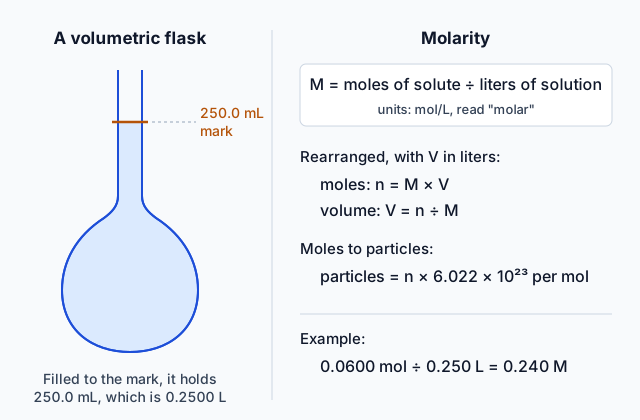
| Volumetric flask | A flask with one etched mark on its neck that holds an exact volume, such as 250.0 mL, when filled to that mark. | Read the mark at the bottom of the curved liquid surface, with your eye level with the mark. |
 Tap to open the picture full size
Part 1 Think first Two pots on the stove
Commit to a guess first. Being wrong now makes the right idea stick better.
Predict first
A cook stirs table salt into a pot of water until no crystals are left. In a second pot, a handful of sand is stirred into water. Both pots then sit for ten minutes, and the cook takes a spoonful from the top and a spoonful from the bottom of each pot. In which pot will the two spoonfuls differ?
In short. A solution is a mixture whose properties are the same in every sample, and its molarity is the moles of solute in each liter of solution.
- Solutions can be solids, liquids or gases; in a heterogeneous mixture the properties depend on where you sample.
- Molarity is moles of solute divided by liters of solution, the whole solution and not the water added.
- Rearranged, n = M × V gives moles and V = n ÷ M gives volume; Avogadro's number turns moles into particles.
Part 2 Learn it Solutions and molarity
2a. The same in every sample, or not
A solution is a mixture in which one substance is spread through another as separate particles, so evenly that its macroscopic properties, the ones you can see and measure, such as color, density and taste, are the same in every sample you take. Chemists also call a solution a homogeneous mixture.
Solutions are not only liquids:
- liquid: table salt dissolved in water, or vinegar;
- solid: an alloy such as brass, in which zinc is spread evenly through copper;
- gas: air, mostly nitrogen and oxygen.
In a heterogeneous mixture, the properties depend on where in the mixture you look. Sand stirred into water settles, so a sample from the bottom is gritty and one from the top is not. A slab of granite shows separate grains of different colors.
The test works for any mixture: take samples from different places and compare their properties. If every sample is the same, the mixture is a solution; if the samples differ, it is heterogeneous.
Quick check · Sort it
Each card names a mixture. Tap a card, then the bin it belongs in.
Solution
Heterogeneous mixture
2b. Molarity
Molarity, M, is the most common way to state how much solute a solution holds in the lab: the moles of solute in each liter of solution.
M = moles of solute ÷ liters of solution
Two details matter. The volume is in liters, so 250.0 mL is 0.2500 L. And it is the volume of the whole solution, not of the water that was added. To make a solution of known molarity, a chemist dissolves the solute in some water in a volumetric flask and then adds water up to the flask's etched mark.
Example: 9.01 g of glucose, C₆H₁₂O₆ (molar mass 180.16 g/mol), is dissolved and made up to 250.0 mL of solution.
- moles: 9.01 g ÷ 180.16 g/mol = 0.05001 mol
- liters: 250.0 mL = 0.2500 L
- molarity: 0.05001 mol ÷ 0.2500 L = 0.200 M, to three significant figures, as in 9.01 g
The solution is read "0.200 molar glucose", and because a solution is the same throughout, every sample of it, a drop or a liter, is 0.200 M.
Quick check · Calculate
A student dissolves 29.2 g of sodium chloride, NaCl (molar mass 58.44 g/mol), in water and adds water to make 250.0 mL of solution. What is the molarity of the solution? Give your answer to three significant figures.
2c. Moles, volume and particles
Rearrange M = n ÷ V to find whichever quantity is missing, with V in liters:
- moles of solute: n = M × V
- volume of solution: V = n ÷ M
Example: how many moles of glucose are in 75.0 mL of 0.200 M glucose? n = 0.200 mol/L × 0.0750 L = 0.0150 mol.
Example: what volume of 0.200 M glucose holds 0.0300 mol of glucose? V = 0.0300 mol ÷ 0.200 mol/L = 0.150 L, which is 150. mL.
To count solute particles, go one step further, as in Topic 1.1: multiply the moles by Avogadro's number, 6.022 × 10²³ particles per mole.
Let the units check the setup. mol/L × L leaves mol, and mol ÷ (mol/L) leaves L. If the units do not come out as the quantity you want, the equation is upside down.
Quick check · Calculate
A recipe for a yeast culture calls for 0.0400 mol of glucose. The lab has a 0.250 M glucose solution. What volume of the solution holds 0.0400 mol of glucose, in milliliters? Give your answer to three significant figures.
Part 3 Watch it done Counting glucose molecules
Watch each step, then finish the problem yourself.
A biology lab keeps a 0.300 M glucose solution for growing yeast. How many glucose molecules are in a 20.0 mL portion of it?
Step 1 · Plan the path
Molarity links a volume of solution to moles of solute, and Avogadro's number links moles to molecules. The path is volume → moles → molecules.
Step 2 · Put the volume in liters
20.0 mL × (1 L ÷ 1000 mL) = 0.0200 L.
Why this step?
Why must the volume be in liters before you use the molarity?
Molarity is moles per liter. Multiplying mol/L by a volume in liters cancels the liters and leaves moles; a volume in milliliters would give an answer 1000 times too large.
Your step · Calculate
Finish it. How many glucose molecules are in 20.0 mL (0.0200 L) of 0.300 M glucose? Give your answer to three significant figures, typed in e-notation (6.022 × 10²³ is typed 6.022e23).
molecules
The same two steps work for any solute: molarity times liters gives moles, and moles times Avogadro's number gives particles. Keep the unrounded moles on your calculator until the last step.
Part 4 Try it Making and diluting solutions
Two lab situations.
Try it · Decide and justify
Ana and Ben each want a 0.100 M glucose solution, and each weighs out 4.51 g of glucose (0.0250 mol). Ana adds the glucose to 250.0 mL of water in a beaker and stirs until it dissolves. Ben dissolves the glucose in about 150 mL of water in a 250.0 mL volumetric flask, then adds water up to the mark and mixes. Whose solution is 0.100 M?
Which reason supports your decision?
Try it · Calculate
A student uses a pipet to put 25.00 mL of 2.00 M glucose into a 100.0 mL volumetric flask, then adds water up to the mark and mixes. What is the molarity of the new solution? Give your answer to three significant figures.
Part 5 Explain it A copper(II) sulfate solution
On the exam this is handwritten, so answer on paper first. Nothing you type here leaves this page. Then check your answer against the model and each scoring point.
Free response is 50% of the exam score. This one is shaped like a short-answer question, which is worth 4 points.
Free-response practice · Short-answer style
A student dissolves 3.99 g of copper(II) sulfate, CuSO₄ (molar mass 159.61 g/mol), in water in a 250.0 mL volumetric flask, adds water up to the mark and mixes. The solution is blue.
(a) Calculate the number of moles of CuSO₄ the student used.
(b) Calculate the molarity of the solution.
(c) The student pours 40.0 mL of the solution into a test tube. Calculate the number of moles of CuSO₄ in the test tube.
(d) A classmate says the blue color will be darker at the bottom of the flask than at the top. Explain whether the classmate is correct.
Model answer
(a) n = 3.99 g ÷ 159.61 g/mol = 0.0250 mol of CuSO₄.
(b) M = 0.0250 mol ÷ 0.2500 L = 0.100 M.
(c) n = M × V = 0.100 mol/L × 0.0400 L = 0.00400 mol of CuSO₄.
(d) The classmate is not correct. The copper(II) sulfate is dissolved, so the mixture is a solution, and a solution's macroscopic properties, its color among them, are the same in every part of the sample. The top and the bottom are the same shade of blue.
Score your own answer. This is a self-check, not a grade. Tick each point your answer makes.
Part 6 Check yourself Four sugar solutions
Both case questions use the table.
A class made four sugar solutions, each in a volumetric flask filled to the mark. The data are a teaching example.
| Solution | Solute | Molar mass (g/mol) | Mass of solute (g) | Volume of solution (mL) |
|---|---|---|---|---|
| A | Glucose, C₆H₁₂O₆ | 180.16 | 27.0 | 500.0 |
| B | Sucrose, C₁₂H₂₂O₁₁ | 342.30 | 17.1 | 250.0 |
| C | Glucose, C₆H₁₂O₆ | 180.16 | 4.50 | 50.0 |
| D | Sucrose, C₁₂H₂₂O₁₁ | 342.30 | 68.5 | 500.0 |
Case question 1 · Rank it
Using the table: rank the four solutions by molarity.
Highest molarity first
Give each one a place, 1 for first. Give two the same place if they are equal.
Your ranking: none yet
Case question 2 · Calculate
Using the table: a student takes 10.0 mL of solution C. How many glucose molecules does the 10.0 mL hold? Give your answer to three significant figures, typed in e-notation (6.022 × 10²³ is typed 6.022e23).
The rest stand on their own and do not use the case.
Check yourself · Spot the error
A student finds the molarity of a solution made by dissolving 5.85 g of sodium chloride, NaCl, and adding water to make 250.0 mL of solution. Tap the line with the mistake.
Check yourself · Multiple choice
A liquid mixture stands for an hour. A student then takes samples from its top, middle and bottom and measures their densities: 0.88 g/mL, 1.00 g/mL and 1.24 g/mL. Which claim do the data support?
Part 7 Keep it Bring back earlier ideas
This lesson leans on two earlier ideas: a mole fraction gives one component's share of the particles in a mixture, and an alloy forms when atoms of another element take places in or between the atoms of a metal. Pulling them back up is what makes them last.
From 3.4 Ideal Gas Law · Calculate
A cylinder holds a mixture of 0.640 mol of oxygen and 1.36 mol of nitrogen at a total pressure of 3.00 atm. What is the partial pressure of the oxygen, in atmospheres? Give three significant figures.
From 2.4 Structure of Metals and Alloys · Sort it
Each card names an element added to a metal, with approximate atomic radii. Tap a card, then the kind of alloy it forms.
Interstitial
Substitutional
In three lines
- A solution is a mixture whose macroscopic properties are the same in every sample; it can be a solid, a liquid or a gas, while a heterogeneous mixture varies from place to place.
- Molarity is moles of solute divided by liters of the whole solution, so convert grams to moles and milliliters to liters first.
- n = M × V gives moles, V = n ÷ M gives volume, and moles times Avogadro's number gives the number of solute particles.
Exam strategy for this topic
- Section I, Multiple Choice: 60 questions in 90 minutes.
- Section II, Free Response: 7 questions in 105 minutes.
- A scientific or graphing calculator is recommended for use on both sections of the exam.
In a molarity calculation, write each quantity with its unit: grams to moles with the molar mass, milliliters to liters, then M = n ÷ V. Check that the units cancel to the quantity asked for, and give as many significant figures as the measurements carry.
Questions students ask
What is the difference between a solution and a heterogeneous mixture?
In a solution, also called a homogeneous mixture, the macroscopic properties are the same in every sample. In a heterogeneous mixture they depend on where you sample, as in sand settling in water.
Can a solution be a solid or a gas?
Yes. An alloy such as brass is a solid solution, and air is a gas solution. Salt water is a liquid solution.
How do you calculate molarity?
Divide the moles of solute by the volume of the solution in liters. For 0.05001 mol of glucose in 0.2500 L of solution, M = 0.200 M.
How do you find the moles of solute from molarity?
Multiply the molarity by the volume in liters: n = M × V. 75.0 mL of 0.200 M glucose holds 0.200 × 0.0750 = 0.0150 mol.
Why do you fill a volumetric flask to the mark instead of adding a measured volume of water?
Molarity divides by the volume of the whole solution. The dissolved solute takes up space too, so only filling to the mark gives exactly the volume of solution you want.
Course alignment, for teachers
AP Chemistry topic 3.7, Unit 3: Properties of Substances and Mixtures.
- Skill 5.F: Calculate, estimate, or predict an unknown quantity from known quantities by selecting and following a logical computational pathway and attending to precision (e.g., performing dimensional analysis and attending to significant figures).
This lesson maps all 2 essential knowledge statements of the topic to the part that teaches each one: 2 are checked by a scored question. The map is in the lesson file.