Unit 3 · Topic 3.8 · about 30 minutes · 7 parts · 10 scored checks, 1 of them multiple choice, plus 2 from earlier lessons
AP Chemistry 3.8: Representations of Solutions
Unit 3: 18 to 22% of the multiple-choice section
What you'll be able to do
- Represent a mixture with a particulate model that shows the interactions between its components and their relative concentrations.
Key vocabulary
| Term | What it means | The exam trap |
|---|---|---|
| Particulate representation | A drawing that shows the particles of a substance or mixture, each symbol standing for one particle. | Every symbol in a drawing needs a key or a label, so that a reader can tell which particle each one is. |
| Partial charge | A charge smaller than an electron's, written δ+ or δ−, on the atoms at the two ends of a polar bond. | A partial charge is not an ion's charge: write δ+ or δ− for it, and keep + and − for ions. |
| Concentration | How much solute is in a given volume of solution; molarity gives it in moles per liter. | Pouring part of a solution into another container does not change its concentration, only the amount of solute you have. |
 Tap to open the picture full size
Part 1 Think first Zooming in on salt water
Commit to a guess first. Being wrong now makes the right idea stick better.
Predict first
A student stirs table salt into a glass of water until no crystals are left. If you could zoom in on one drop far enough to see single particles, what would you see?
In short. A particulate drawing of a solution shows which particles it holds, how many of each there are in a given volume, and how those particles attract one another.
- A molecular solute is drawn as whole molecules; a dissolved ionic solute is drawn as separate ions in the ratio its charges set.
- At a fixed scale, the number of solute particles in a given volume shows the concentration.
- Water molecules turn their δ− O atom toward a cation and a δ+ H atom toward an anion.
Part 2 Learn it Drawing a solution
2a. Which particles to draw
A particulate representation of a solution draws its particles, each symbol standing for one particle, so that the picture shows what the solution is made of.
Start with the solute. What you draw depends on the kind of substance it is.
- A molecular solute, such as glucose, C₆H₁₂O₆, or ethanol, C₂H₅OH, dissolves as whole molecules. Its covalent bonds do not break, so each molecule is drawn intact. The OH in ethanol's formula is part of the molecule, not a hydroxide ion.
- An ionic solute that dissolves comes apart into its ions, which spread out separately among the water molecules. The drawing shows the ions in the ratio their charges set, and no formula units. A polyatomic ion such as CO₃²⁻ is held together by covalent bonds, so it stays one ion.
Example: potassium carbonate, K₂CO₃, dissolved in water is drawn as K⁺ ions and CO₃²⁻ ions, two K⁺ for every CO₃²⁻, each one separate from the others.
Then add the solvent. In a real solution, water molecules far outnumber the solute particles, so a drawing usually shows only some of them, often the ones right beside a solute particle.
Quick check · Sort it
Each card names a solute dissolved in water. Tap a card, then the way a particulate drawing of the solution shows that solute.
As separate ions
As whole molecules
2b. Counting shows concentration
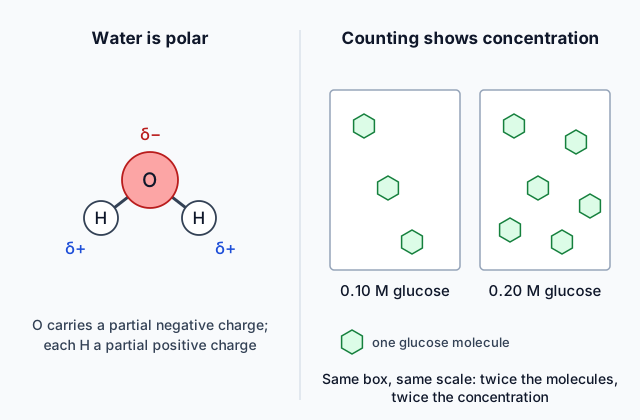
A drawing can also show concentration. Draw the particles at a fixed scale, so that each symbol stands for the same amount of substance. Then the number of solute particles in a given volume shows the concentration.
- Two boxes of the same size: the one with more solute particles is the more concentrated solution, and twice as many particles means twice the molarity.
- Boxes of different sizes: compare the particles per unit of volume. A box twice as large needs twice as many particles to show the same concentration.
For an ionic solute, count each kind of ion. Each K₂CO₃ unit gives two K⁺ ions and one CO₃²⁻ ion, so a 0.10 M K₂CO₃ solution is 0.20 M in K⁺ ions and 0.10 M in CO₃²⁻ ions, and its drawing shows twice as many K⁺ ions as CO₃²⁻ ions.
A drawing shows a few dozen particles at most, so it is a model of the ratios in the solution, not of the real numbers.
Quick check · Rank it
A student draws four glucose solutions at the same scale, so every glucose molecule drawn stands for the same amount of glucose. Box A holds 8 molecules in a volume of 2V. Box B holds 6 molecules in a volume of V. Box C holds 9 molecules in a volume of 3V. Box D holds 10 molecules in a volume of 2V. Rank the solutions by concentration.
Most concentrated first
Give each one a place, 1 for first. Give two the same place if they are equal.
Your ranking: none yet
2c. Drawing the attractions
A drawing can show the interactions among the components, too, using the forces from Topic 3.1.
A water molecule is polar. Its O atom carries a partial negative charge, δ−, and its two H atoms carry partial positive charges, δ+. Around a dissolved ion, the water molecules turn so that the end with the opposite partial charge faces the ion. This ion-dipole attraction is drawn by the way each water molecule points.
- Next to a cation, such as K⁺, each water molecule points its O atom at the ion, with the H atoms facing away.
- Next to an anion, the water molecules are turned the other way round.
A polar molecular solute with O-H or N-H bonds, such as glucose, forms hydrogen bonds with water. They are drawn as dotted lines from an H atom bonded to O or N on one molecule to a lone pair on an O or N atom of another.
A nonpolar solute in a nonpolar solvent, such as iodine, I₂, in hexane, is held only by dispersion forces, so no particular orientation is drawn.
Quick check · Decide and justify
A student draws a bromide ion, Br⁻, dissolved in water, with four water molecules around it. Each water molecule points its O atom at the Br⁻ ion. Is the drawing correct?
Which reason supports your decision?
Part 3 Watch it done A drawing of calcium chloride
Watch each step, then finish the drawing yourself.
A student's drawing of a 0.10 M calcium chloride, CaCl₂, solution shows 2 Ca²⁺ ions in a box. She now draws a 0.30 M CaCl₂ solution in a box of the same size, at the same scale. How many Cl⁻ ions should the new drawing show?
Step 1 · Name the particles
CaCl₂ is ionic, so dissolved it is drawn as separate Ca²⁺ and Cl⁻ ions. Each Ca²⁺ carries +2 and each Cl⁻ carries −1, so there are two Cl⁻ for every Ca²⁺. The 0.10 M box therefore holds 2 Ca²⁺ ions and 4 Cl⁻ ions.
Why this step?
Why does the drawing show separate Ca²⁺ and Cl⁻ ions rather than CaCl₂ units?
When an ionic compound dissolves, its ions come apart and each one is surrounded by water molecules. A formula such as CaCl₂ gives the ratio of the ions, not a particle that exists in the solution.
Step 2 · Keep the scale
The box is the same size and each ion stands for the same amount as before, so the number of each kind of ion drawn is proportional to its concentration.
Your step · Calculate
Finish it. The 0.10 M CaCl₂ box shows 2 Ca²⁺ ions and 4 Cl⁻ ions. How many Cl⁻ ions should a box of the same size, at the same scale, show for 0.30 M CaCl₂? Give a whole number.
ions
A drawing at a fixed scale turns concentrations into counts. Keep the box size and the scale the same when you compare, and count each kind of ion on its own.
Part 4 Try it Two more drawings
Two drawings of solutions the lesson has not shown: a molecular solute that hydrogen bonds with water, and two solutes drawn side by side.
Try it · Fill the statement
Complete the description of a correct drawing of methanol, CH₃OH, dissolved in water.
The methanol is drawn as . A dotted line for a hydrogen bond runs from the atom of one molecule's O-H group to a lone pair on the atom of the other molecule.
Try it · Decide and justify
At one scale, a student draws a 0.20 M glucose solution as 4 glucose molecules in a box. At the same scale, in a box of the same size, she draws a 0.10 M sodium chloride solution as 2 Na⁺ ions and 2 Cl⁻ ions. Is the sodium chloride drawing consistent with its concentration?
Which reason supports your decision?
Part 5 Explain it Represent potassium iodide in water
On the exam this is handwritten, so answer on paper first, and draw on paper too. Nothing you type here leaves this page. Then check your answer against the model and each scoring point.
Free response is 50% of the exam score. This one is shaped like a short-answer question, which is worth 4 points.
Free-response practice · Short-answer style
A student is asked to represent solutions of potassium iodide, KI, in water, using boxes of the same size drawn at the same scale.
(a) The box for a 0.20 M KI solution shows 4 K⁺ ions. Determine how many I⁻ ions it must show, and justify your answer.
(b) Represent one K⁺ ion and one I⁻ ion from the box on paper, each with at least two water molecules beside it. Draw each water molecule as an O atom bonded to two H atoms, turned the right way.
(c) Explain, using the partial charges on a water molecule, why the water molecules beside the two ions are turned in opposite directions.
(d) Determine how many K⁺ ions and how many I⁻ ions a box for a 0.10 M KI solution shows, at the same size and scale.
Model answer
(a) 4 I⁻ ions. KI is ionic, and each formula unit gives one K⁺ (+1) and one I⁻ (−1), so the solution holds equal numbers of the two ions and the box has no net charge.
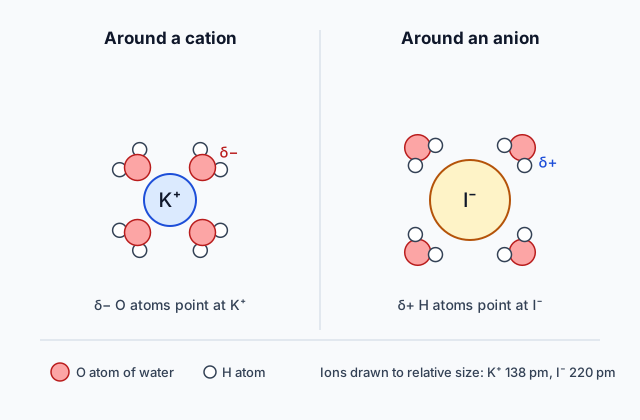
(b) The figure below shows one way. The K⁺ ion with two or more water molecules around it, each pointing its O atom at the K⁺ and its H atoms away. The I⁻ ion with two or more water molecules around it, each pointing an H atom at the I⁻. The two ions are drawn apart from each other.
(c) The O atom of a water molecule carries a partial negative charge and the H atoms carry partial positive charges. Opposite charges attract, so the δ− O end faces the positive K⁺ ion and a δ+ H end faces the negative I⁻ ion.
(d) 2 K⁺ ions and 2 I⁻ ions. The solution is half as concentrated, and at the same box size and scale the number of each ion is proportional to its concentration, so each count is halved.
 Tap to open the picture full size
Score your own answer. This is a self-check, not a grade. Tick each point your answer makes.
Part 6 Check yourself Four drawings of sodium sulfate
Both case questions use the figure.
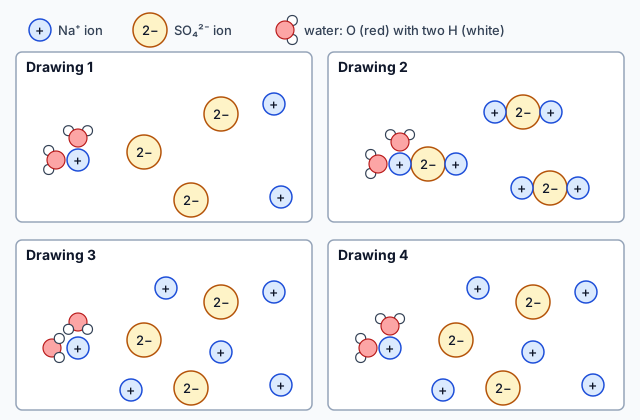
Four students each drew a solution of sodium sulfate, Na₂SO₄, in water, in boxes of the same size. To keep the drawings clear, each student drew water molecules beside only one Na⁺ ion.
 Tap to open the picture full size
Case question 1 · Multiple choice
Using the figure: which drawing correctly represents sodium sulfate dissolved in water?
Case question 2 · Calculate
Using the figure: in drawing 3, each ion drawn stands for 0.050 mol/L of that ion. What molarity of sodium sulfate does drawing 3 represent? Give your answer to two significant figures.
The rest stand on their own and do not use the case.
Check yourself · Spot the error
A student plans a drawing of magnesium nitrate, Mg(NO₃)₂, dissolved in water. Tap the line with the mistake.
Check yourself · Rank it
Four sodium solutions are drawn in boxes of the same size, all at one scale. Rank the boxes by the number of Na⁺ ions each one shows.
Most Na⁺ ions first; equal numbers share a place
Give each one a place, 1 for first. Give two the same place if they are equal.
Your ranking: none yet
Part 7 Keep it Bring back earlier ideas
This lesson leans on two earlier ideas: the molarity of a solution from the mass of solute and the volume of solution, and the charges of ions set the ratio in which they combine. Pulling them back up is what makes them last.
From 3.7 Solutions and Mixtures · Calculate
A student dissolves 29.2 g of sodium chloride, NaCl (molar mass 58.44 g/mol), in water and adds water to make 250.0 mL of solution. What is the molarity of the solution? Give your answer to three significant figures.
Radium sits at the bottom of group 2, below barium. Marie and Pierre Curie discovered it in 1898, and Marie Curie first isolated radium as a salt, radium chloride. Barium's chloride is BaCl₂.
From 1.8 Valence Electrons and Ionic Compounds · Decide and justify
What is the formula of radium chloride?
Which reason supports your decision?
In three lines
- A molecular solute is drawn as whole molecules; a dissolved ionic solute is drawn as separate ions in the ratio its charges set, with polyatomic ions kept whole.
- At a fixed scale, the number of each particle in a given volume shows its concentration, so compare boxes of the same size or count per volume.
- Water's δ− O atom faces a cation and a δ+ H atom faces an anion; hydrogen bonds to a polar solute are drawn as dotted lines.
Exam strategy for this topic
- Section I, Multiple Choice: 60 questions in 90 minutes.
- Section II, Free Response: 7 questions in 105 minutes.
- A scientific or graphing calculator is recommended for use on both sections of the exam.
When a question asks you to draw a solution, make three things easy to check: the solute's particles (whole molecules, or separate ions in the ratio their charges set), the number of each particle matched to its concentration, and the way the water molecules are turned. Add a key for every symbol you use.
Questions students ask
How do you draw an ionic compound dissolved in water?
As separate ions, in the ratio their charges set, each surrounded by water molecules. Dissolved CaCl₂ is drawn as Ca²⁺ ions and twice as many Cl⁻ ions, with no CaCl₂ units.
How does a particle drawing show concentration?
At a fixed scale, each symbol stands for the same amount of substance, so the number of solute particles in a given volume shows the concentration. In boxes of the same size, twice the particles is twice the molarity.
Which way do water molecules point around an ion?
The O atom of water is δ− and the H atoms are δ+. Each ion attracts the end with the opposite partial charge, so the water molecules around a cation and around an anion point opposite ways.
Does a polyatomic ion break apart in water?
No. A polyatomic ion such as CO₃²⁻ is held together by covalent bonds, so it stays one ion when its compound dissolves.
What is the concentration of each ion in a solution of an ionic compound?
Multiply the compound's molarity by the number of that ion in one formula unit. A 0.10 M K₂CO₃ solution is 0.20 M in K⁺ and 0.10 M in CO₃²⁻.
Beyond the AP Exam
College Board sets these limits on what the AP Exam asks about this topic. Anything past them is not on the exam.
Colligative properties will not be assessed on the AP Exam.
Calculations of molality, percent by mass, and percent by volume for solutions will not be assessed on the AP Exam.
Course alignment, for teachers
AP Chemistry topic 3.8, Unit 3: Properties of Substances and Mixtures.
- Skill 3.C: Represent visually the relationship between the structures and interactions across multiple levels or scales (e.g., particulate to macroscopic).
This lesson maps the one essential knowledge statement of the topic to the part that teaches each one: 1 is checked by a scored question. The map is in the lesson file.