Unit 4 · Topic 4.2 · about 30 minutes · 7 parts · 11 scored checks, 1 of them multiple choice, plus 2 from earlier lessons
AP Chemistry 4.2: Net Ionic Equations
Unit 4: 7 to 9% of the multiple-choice section
What you'll be able to do
- Represent changes in matter with a balanced chemical or net ionic equation: for physical changes, for given information about the identity of the reactants and/or product, and for ions in a given chemical reaction.
Key vocabulary
| Term | What it means | The exam trap |
|---|---|---|
| Molecular equation | An equation that writes every reactant and product as a whole formula, without splitting any compound into ions. | The name does not mean every substance in it is made of molecules; ionic compounds such as CaCl₂ are written this way too. |
| Complete ionic equation | An equation that writes every dissolved ionic compound as its separate ions. | A complete ionic equation is long, so write the state symbol on every species to keep track of which ones are dissolved. |
| Net ionic equation | An equation that shows only the species that change, with the spectator ions left out. | Keep the state symbols in a net ionic equation too; the (s) on a product is what shows that a solid formed. |
| Spectator ion | An ion that is present, unchanged, both before and after a reaction in solution. | Spectator ions are left out of the net ionic equation, not out of the beaker; they are still dissolved there. |
 Tap to open the picture full size
Part 1 Think first A reaction on a balance
Commit to a guess first. Being wrong now makes the right idea stick better.
Predict first
A student stands a small test tube of silver nitrate solution inside a flask of salt water, closes the flask with a stopper, and weighs it: 152.36 g. She tips the flask so the two solutions mix, and a white solid forms at once. What does the balance read now?
In short. A balanced equation represents a physical or chemical change with the same number of atoms of every element, and the same total charge, on both sides.
- Atoms are rearranged in a chemical change, never made or destroyed, so mass and charge are conserved.
- A complete ionic equation writes each dissolved ionic compound as its ions; solids, liquids and gases keep their formulas.
- A net ionic equation leaves out the spectator ions, the ions that are unchanged on both sides.
Part 2 Learn it Writing balanced equations
2a. An equation for every change
Any change, physical or chemical, can be written as a balanced equation. A state symbol after each formula says what form the substance is in: (s) solid, (l) liquid, (g) gas, or (aq) dissolved in water.
Physical changes. Ice melting is H₂O(s) → H₂O(l), and sugar dissolving is C₁₂H₂₂O₁₁(s) → C₁₂H₂₂O₁₁(aq). The formula is the same on both sides; only the state changes.
Chemical changes. The atoms are rearranged into new combinations. None is made and none is destroyed, so a balanced equation has equal numbers of atoms of every element before and after:
2H₂(g) + O₂(g) → 2H₂O(l)
On the left are 2 × 2 = 4 H atoms and 2 O atoms; on the right, two water molecules hold 4 H atoms and 2 O atoms.
Because every atom is still there, the mass is conserved too. 4.03 g of hydrogen and 32.00 g of oxygen react to make 36.03 g of water. If a product seems to weigh less than the reactants, look for a product, such as a gas, that escaped.
Quick check · Calculate
A student heats 2.50 g of calcium carbonate in an open crucible until it stops changing: CaCO₃(s) → CaO(s) + CO₂(g). The carbon dioxide escapes into the air, and the solid left, calcium oxide, has a mass of 1.40 g. What mass of carbon dioxide was produced? Give your answer to three significant figures.
2b. Atoms and charge both balance
Equal numbers of atoms of every element is the first test of a balanced equation. When ions appear in it, there is a second test: the total charge must be the same on both sides, because charge is conserved too.
Example: a copper wire in a solution of silver ions gives copper(II) ions and silver metal.
Cu(s) + Ag⁺(aq) → Cu²⁺(aq) + Ag(s)
This has one Cu and one Ag on each side, so the atoms balance. But the total charge is +1 on the left and +2 on the right, so the equation is not balanced. Doubling the silver fixes both:
Cu(s) + 2Ag⁺(aq) → Cu²⁺(aq) + 2Ag(s)
Now each side has 1 Cu and 2 Ag, and each side carries a total charge of +2.
Balance by changing coefficients only, the numbers in front of the formulas. A subscript is part of a formula: change it and you have written a different substance, as H₂O₂ is a different substance from H₂O.
Quick check · Calculate
Aluminum metal in a solution of copper(II) ions gives aluminum ions and copper metal: Al(s) + Cu²⁺(aq) → Al³⁺(aq) + Cu(s). Balance the equation with the smallest whole-number coefficients. What is the coefficient of Cu²⁺(aq)? Give a whole number.
2c. Three ways to write one reaction
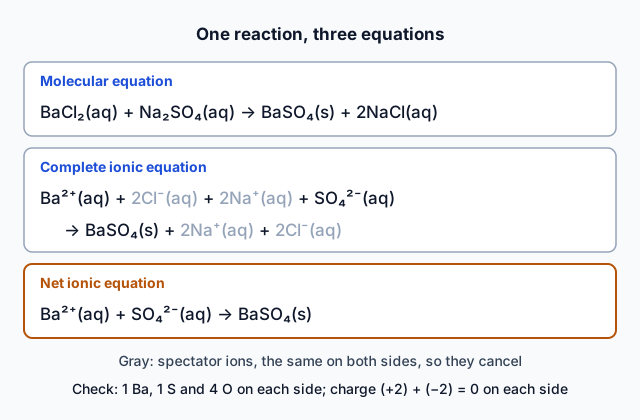
In water, a dissolved ionic compound is present as separate ions, so a reaction in solution can be written three ways. Mixing solutions of barium chloride and sodium sulfate gives a white solid, barium sulfate.
- Molecular equation: BaCl₂(aq) + Na₂SO₄(aq) → BaSO₄(s) + 2NaCl(aq). Each substance is a whole formula.
- Complete ionic equation: each dissolved ionic compound is written as its ions, each ion multiplied by the coefficient: Ba²⁺(aq) + 2Cl⁻(aq) + 2Na⁺(aq) + SO₄²⁻(aq) → BaSO₄(s) + 2Na⁺(aq) + 2Cl⁻(aq). The solid stays as one formula, and a polyatomic ion such as SO₄²⁻ stays whole.
- Net ionic equation: Na⁺ and Cl⁻ appear unchanged on both sides. These spectator ions cancel, leaving Ba²⁺(aq) + SO₄²⁻(aq) → BaSO₄(s).
Which form you use depends on what the equation is for. The molecular equation names the compounds you weigh out of their bottles. The complete ionic equation shows every particle in the beaker. The net ionic equation shows only the change, and it is the same whenever a dissolved barium compound meets a dissolved sulfate and the other ions stay dissolved.
Every question in this lesson names the solid that forms.
Quick check · Sort it
Solutions of lead(II) nitrate and potassium iodide are mixed: Pb(NO₃)₂(aq) + 2KI(aq) → PbI₂(s) + 2KNO₃(aq). Sort each species in the complete ionic equation.
Appears in the net ionic equation
A spectator ion
Part 3 Watch it done Calcium phosphate from two solutions
Watch each step, then finish the equation yourself.
Solutions of calcium chloride, CaCl₂, and sodium phosphate, Na₃PO₄, are mixed, and a white solid, calcium phosphate, Ca₃(PO₄)₂, forms. What is the net ionic equation?
Step 1 · Write the balanced molecular equation
3CaCl₂(aq) + 2Na₃PO₄(aq) → Ca₃(PO₄)₂(s) + 6NaCl(aq). Check it: 3 Ca, 6 Cl, 6 Na and 2 PO₄ groups on each side.
Step 2 · Decide what to write as ions
CaCl₂, Na₃PO₄ and NaCl are dissolved ionic compounds, so each is written as its separate ions. Ca₃(PO₄)₂ is a solid, so it stays as one formula, and the phosphate ion, PO₄³⁻, stays whole wherever it appears.
Why this step?
Why does Ca₃(PO₄)₂ stay as one formula when the other compounds are split into ions?
It is a solid: its ions are held together in the precipitate rather than moving freely through the water. An equation shows the particles as they are, and forming that solid is the change.
Your step · Fill the statement
Finish it. On paper, write the complete ionic equation, cross out the spectator ions, and write the net ionic equation with the smallest whole-number coefficients. Then complete the sentences.
On each side of the complete ionic equation, Na⁺ ions cancel. The net ionic equation has Ca²⁺ ions and PO₄³⁻ ions on the left, and the total charge on its left side is .
Check both conservation laws. Each side has 3 Ca, 2 P and 8 O. The charge on the left is 3 × (+2) + 2 × (−3) = 0, which matches the neutral solid on the right.
Part 4 Try it Two more reactions in solution
Each of these names the solid that forms, so you can focus on the equations.
Try it · Match
Solutions of nickel(II) chloride and sodium hydroxide are mixed in a beaker, and a green solid, nickel(II) hydroxide, forms. The solid is filtered off, and the water in the liquid that passes through later evaporates. Match each purpose to the equation that serves it.
Try it · Spot the error
Solutions of silver nitrate, AgNO₃, and potassium bromide, KBr, are mixed, and a pale yellow solid, silver bromide, AgBr, forms. A student works out the net ionic equation. Tap the line where the reasoning first goes wrong.
Part 5 Explain it Silver chromate
On the exam this is handwritten, so answer on paper first. Nothing you type here leaves this page. Then check your answer against the model and each scoring point.
Free response is 50% of the exam score. This one is shaped like a short-answer question, which is worth 4 points.
Free-response practice · Short-answer style
A student mixes a solution of silver nitrate, AgNO₃, with a solution of potassium chromate, K₂CrO₄. A red-brown solid, silver chromate, Ag₂CrO₄, forms.
(a) Determine the balanced molecular equation for the reaction, with a state symbol for each substance.
(b) Determine the balanced net ionic equation for the reaction.
(c) Identify the spectator ions, and explain why they do not appear in the net ionic equation.
(d) Justify the claim that your net ionic equation shows that both mass and charge are conserved.
Model answer
(a) 2AgNO₃(aq) + K₂CrO₄(aq) → Ag₂CrO₄(s) + 2KNO₃(aq).
(b) 2Ag⁺(aq) + CrO₄²⁻(aq) → Ag₂CrO₄(s).
(c) K⁺ and NO₃⁻. They are dissolved before and after the reaction and appear unchanged on both sides of the complete ionic equation, so they cancel; they take no part in forming the solid.
(d) Each side has 2 Ag, 1 Cr and 4 O atoms, so no atom is made or destroyed and the mass is the same. The charge on the left is 2 × (+1) + (−2) = 0, and the solid on the right is neutral, so the charge is the same on both sides.
Score your own answer. This is a self-check, not a grade. Tick each point your answer makes.
Part 6 Check yourself Three mixtures of solutions
All three case questions use the table.
A student mixed three pairs of solutions. Where a solid formed, the teacher told the class what it was.
| Mixture | Solutions mixed | What happened |
|---|---|---|
| 1 | Sodium carbonate, Na₂CO₃, and calcium chloride, CaCl₂ | A white solid, calcium carbonate, CaCO₃, formed |
| 2 | Iron(III) nitrate, Fe(NO₃)₃, and potassium hydroxide, KOH | An orange-brown solid, iron(III) hydroxide, Fe(OH)₃, formed |
| 3 | Potassium nitrate, KNO₃, and sodium chloride, NaCl | No solid formed, and nothing else changed |
Case question 1 · Calculate
Using the table: write the net ionic equation for mixture 2 with the smallest whole-number coefficients. What is the sum of its coefficients? Give a whole number.
Case question 2 · Decide and justify
Using the table: a student writes Na⁺(aq) + Cl⁻(aq) → NaCl(s) as the net ionic equation for mixture 3. Is that equation consistent with what happened?
Which reason supports your decision?
Case question 3 · Multiple choice
Using the table: which is the net ionic equation for mixture 1?
The rest stand on their own and do not use the case.
Check yourself · Select all
Which two of these equations are balanced in both atoms and charge? Select two.
Select 2 answers, then check.
Check yourself · Put it in order
Put the steps for writing a net ionic equation in order.
Part 7 Keep it Bring back earlier ideas
This lesson leans on two earlier ideas: a dissolved ionic compound gives its ions in the ratio its formula sets, and the charges of ions set the formula of a compound. Pulling them back up is what makes them last.
From 3.8 Representations of Solutions · Rank it
Four sodium solutions are drawn in boxes of the same size, all at one scale. Rank the boxes by the number of Na⁺ ions each one shows.
Most Na⁺ ions first; equal numbers share a place
Give each one a place, 1 for first. Give two the same place if they are equal.
Your ranking: none yet
From 1.8 Valence Electrons and Ionic Compounds · Spot the error
A student works out the formula of magnesium nitride. Tap the line with the mistake.
In three lines
- Every physical and chemical change can be written as a balanced equation, with the same number of atoms of each element on both sides, so mass is conserved.
- When ions appear, the total charge must also be the same on both sides; balance by changing coefficients, never subscripts.
- A molecular equation shows whole compounds, a complete ionic equation shows every dissolved ion, and a net ionic equation drops the spectator ions to show only the change.
Exam strategy for this topic
- Section I, Multiple Choice: 60 questions in 90 minutes.
- Section II, Free Response: 7 questions in 105 minutes.
- A scientific or graphing calculator is recommended for use on both sections of the exam.
When a question asks for a net ionic equation, give the states, keep every solid, liquid, gas and polyatomic ion whole, and use the smallest whole-number coefficients. Then check the atoms and the total charge, since a reader scores both.
Questions students ask
What is a net ionic equation?
An equation for a reaction in solution that shows only the species that change, with the spectator ions, the ions unchanged on both sides, left out.
How do you write a net ionic equation?
Write the balanced molecular equation with states, rewrite each dissolved ionic compound as its ions, cross out the ions that appear unchanged on both sides, and check that the atoms and charge balance.
What is a spectator ion?
An ion that is dissolved before and after the reaction and appears unchanged on both sides of the complete ionic equation, such as Na⁺ and Cl⁻ when barium sulfate forms from barium chloride and sodium sulfate.
Why must charge balance in an equation?
Charge is conserved, like mass. An equation with ions must have the same total charge on both sides, so Cu(s) + Ag⁺(aq) → Cu²⁺(aq) + Ag(s) needs 2Ag⁺ and 2Ag to balance.
When do you use a molecular equation instead of a net ionic one?
Use the molecular equation when you need the compounds themselves, as when you weigh them out. Use the net ionic equation to show the change, which is the same whatever the spectator ions are, as long as they stay dissolved.
Course alignment, for teachers
AP Chemistry topic 4.2, Unit 4: Chemical Reactions.
- Skill 5.E: Determine a balanced chemical equation for a given chemical phenomenon.
This lesson maps all 3 essential knowledge statements of the topic to the part that teaches each one: 3 are checked by a scored question. The map is in the lesson file.