Unit 4 · Topic 4.3 · about 30 minutes · 7 parts · 10 scored checks, 1 of them multiple choice, plus 2 from earlier lessons
AP Chemistry 4.3: Representations of Reactions
Unit 4: 7 to 9% of the multiple-choice section
What you'll be able to do
- Represent a given chemical reaction or physical process with a consistent particulate model.
Key vocabulary
| Term | What it means | The exam trap |
|---|---|---|
| Particulate representation | A drawing that shows a substance, or a change, as its atoms, ions or molecules. | A drawing of a change needs a before box and an after box at the same scale, or a count across the two means nothing. |
| Key | The part of a particle drawing that says which element or ion each kind of circle stands for. | Two drawings can use different keys, so read each key before you compare them. |
| State symbol | The (s), (l), (g) or (aq) after a formula, giving the state of the substance. | (aq) means dissolved in water, which is not the same as (l), a pure liquid. |
| Spectator ion | An ion that is present, unchanged, before and after a reaction in solution. | The spectator ions differ from one reaction to the next, so find them from each complete ionic equation. |
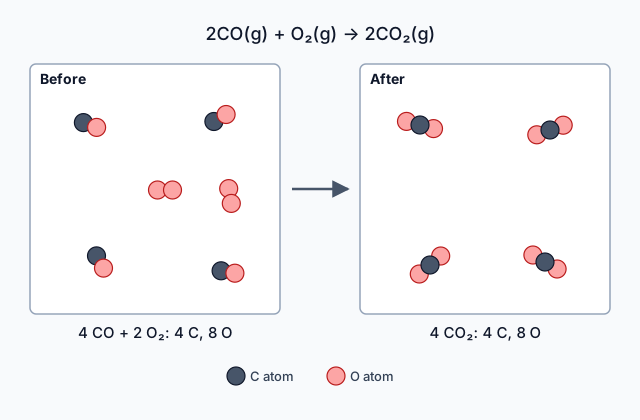 Tap to open the picture full size
Part 1 Think first Sugar in a glass of water
Commit to a guess first. Being wrong now makes the right idea stick better.
Predict first
A student stirs a spoonful of sugar into a glass of water until no crystals can be seen. She wants to draw what the sugar water would look like if she could see its particles. What should her drawing show?
In short. A particulate representation of a change draws the particles before and after, consistent with the balanced equation for it.
- Each formula is one kind of particle, and the coefficients give how many of each, relative to the others.
- Every atom in the before box appears in the after box, though the number of particles can change.
- The state symbols set the spacing, and spectator ions are drawn unchanged, still dissolved.
Part 2 Learn it Drawing equations as particles
2a. Physical processes: same particles, new places
A particulate representation draws a substance or a change as its particles, usually as a before box and an after box, with a key that says what each circle stands for. The equation tells you which particles to draw.
In a physical process the particles keep their identity, and only their arrangement changes.
- H₂O(l) → H₂O(g): the after box holds the same H₂O molecules, each still one O atom joined to two H atoms, now far apart from one another.
- C₁₂H₂₂O₁₁(s) → C₁₂H₂₂O₁₁(aq): whole sugar molecules, no longer packed together, are spread out among the water molecules.
Dissolving an ionic solid is drawn just as its equation reads: NaCl(s) → Na⁺(aq) + Cl⁻(aq) puts the ions apart, spread through the water, one Na⁺ for every Cl⁻.
The state symbol sets the spacing. In a solid the particles touch in a regular pattern; in a liquid they touch but are disordered; in a gas they are far apart. In a solution the dissolved particles are spread among the solvent's, which a drawing may leave out to keep it clear.
Quick check · Decide and justify
A student draws calcium chloride dissolving in water: CaCl₂(s) → Ca²⁺(aq) + 2Cl⁻(aq). Her after box shows 3 Ca²⁺ ions and 3 Cl⁻ ions, each one apart from all the others. Is the drawing consistent with the equation?
Which reason supports your decision?
2b. Chemical reactions: the atoms regroup
In a chemical reaction the atoms are rearranged into new particles. Read each part of the equation as an instruction for the drawing.
- A formula is one particle. Its subscripts say how many atoms of each element it holds: H₂O is one O atom joined to two H atoms, and H₂ is two H atoms joined together.
- A coefficient says how many of that particle there are, relative to the others: 2H₂O is two separate water molecules.
- Elements such as H₂, O₂, N₂ and Cl₂ are drawn as pairs of joined atoms, not as loose atoms.
For 2H₂(g) + O₂(g) → 2H₂O(g), a before box with 2 H₂ molecules and 1 O₂ molecule becomes an after box with 2 H₂O molecules. Count the atoms: 4 H and 2 O on each side, because no atom is made or destroyed. The number of particles is not conserved, though: 3 molecules become 2. And the product particles must have exactly the formula in the equation, since the same atoms grouped any other way would be a different substance.
Quick check · Match
Match each part of an equation to the particles a drawing shows for it.
2c. Ions in a reaction
When solutions of ionic compounds react, draw the ions that each solution holds. Mixing solutions of barium chloride and sodium sulfate gives solid barium sulfate: Ba²⁺(aq) + SO₄²⁻(aq) → BaSO₄(s), with Na⁺ and Cl⁻ as spectator ions.
- Before mixing, each beaker shows its own ions spread through the water: Ba²⁺ and Cl⁻ in one, Na⁺ and SO₄²⁻ in the other, in the ratio their formulas give.
- After mixing, each Ba²⁺ that meets an SO₄²⁻ ends up in the solid, drawn as a cluster of alternating ions packed together, usually at the bottom of the box.
- The spectator ions are drawn in the after box too, still spread through the solution, in the same numbers as before.
A polyatomic ion such as SO₄²⁻ stays whole, so it is drawn as one particle, often a single labeled circle.
Quick check · Sort it
Solutions of silver nitrate and potassium chloride, holding equal numbers of Ag⁺ and Cl⁻ ions, are mixed, and solid silver chloride forms: Ag⁺(aq) + Cl⁻(aq) → AgCl(s). Sort each set of ions by how a drawing should show it.
Packed together in a solid
Spread through the solution
Part 3 Watch it done Drawing ammonia forming
Watch each step, then finish the drawing yourself.
Nitrogen and hydrogen react to form ammonia: N₂(g) + 3H₂(g) → 2NH₃(g). A before box holds 2 N₂ molecules and 6 H₂ molecules, which react completely. What should the after box show?
Step 1 · Count the atoms in the before box
Each N₂ molecule holds 2 N atoms, so 2 N₂ hold 4 N atoms. Each H₂ molecule holds 2 H atoms, so 6 H₂ hold 12 H atoms.
Why this step?
Why must the after box hold exactly 4 N atoms and 12 H atoms?
The reaction rearranges the atoms into new molecules; it does not make or destroy any. Every atom in the before box has to be somewhere in the after box.
Step 2 · Read the states
The (g) after each formula says every substance is a gas, so the molecules in the after box are drawn far apart. The reactants react completely, so no N₂ or H₂ is left over.
Your step · Calculate
Finish it. How many NH₃ molecules should the after box show? Give a whole number.
molecules
Check: 4 NH₃ molecules hold 4 N atoms and 12 H atoms, as the before box did. The box goes from 8 molecules to 4, while every atom is kept.
Part 4 Try it Two more after boxes
Plan each after box from its equation and its before box, as you would before drawing it on paper.
Try it · Spot the error
Methane burns in oxygen: CH₄(g) + 2O₂(g) → CO₂(g) + 2H₂O(g). A before box holds 2 CH₄ molecules and 4 O₂ molecules, which react completely. A student plans the after box. Tap the line where the reasoning first goes wrong.
Try it · Rank it
In each reaction below, a before box holds 6 reactant molecules, in the ratio of the coefficients, and they react completely. Rank the reactions by the number of molecules in the after box.
Fewest molecules first
Give each one a place, 1 for first. Give two the same place if they are equal.
Your ranking: none yet
Part 5 Explain it Draw lead(II) iodide forming
On the exam this is handwritten, so answer on paper first, and draw the after box on paper too. Nothing you type here leaves this page. Then check your answer against the model and each scoring point.
Free response is 50% of the exam score. This one is shaped like a short-answer question, which is worth 4 points.
Free-response practice · Short-answer style
Solutions of lead(II) nitrate and potassium iodide are mixed: Pb(NO₃)₂(aq) + 2KI(aq) → PbI₂(s) + 2KNO₃(aq). Before mixing, a drawing of the first solution shows 2 Pb²⁺ ions and 4 NO₃⁻ ions, and a drawing of the second shows 4 K⁺ ions and 4 I⁻ ions. All of the Pb²⁺ and I⁻ ions react.
(a) Identify how many formula units of PbI₂ form, and justify your answer using the equation.
(b) Represent the contents of the beaker after mixing, on paper. Draw each ion as a labeled circle, and leave out the water molecules.
(c) Explain why your drawing shows the K⁺ and NO₃⁻ ions in the same numbers as before mixing.
(d) Explain why your drawing shows the Pb²⁺ and I⁻ ions packed together, while the K⁺ and NO₃⁻ ions are spread apart.
Model answer
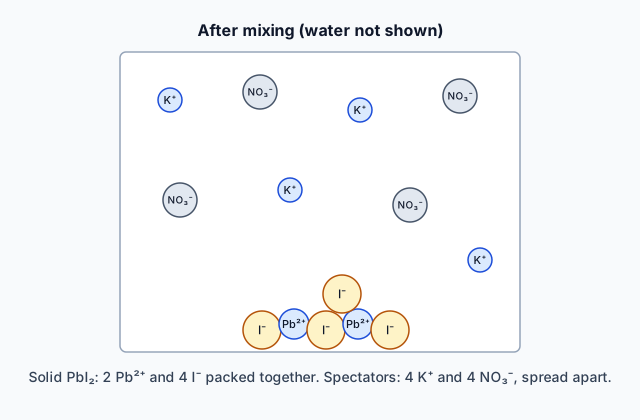
(a) 2 formula units. Each PbI₂ takes one Pb²⁺ and two I⁻. The 2 Pb²⁺ and 4 I⁻ make exactly 2 PbI₂, with every ion of both kinds used.
(b) A cluster of 2 Pb²⁺ and 4 I⁻ packed together and touching, with each Pb²⁺ beside I⁻ ions, at the bottom of the box. Spread through the rest of the box, apart from one another, are 4 K⁺ and 4 NO₃⁻. The figure shows one such drawing.
(c) K⁺ and NO₃⁻ are spectator ions. They appear unchanged on both sides of the complete ionic equation, so none is used up or made.
(d) PbI₂ is marked (s), a solid, so its ions are held together in a packed array. K⁺ and NO₃⁻ stay dissolved, (aq), so they are spread through the solution.
 Tap to open the picture full size
Score your own answer. This is a self-check, not a grade. Tick each point your answer makes.
Part 6 Check yourself Four drawings of hydrogen chloride
Both case questions use the figure.
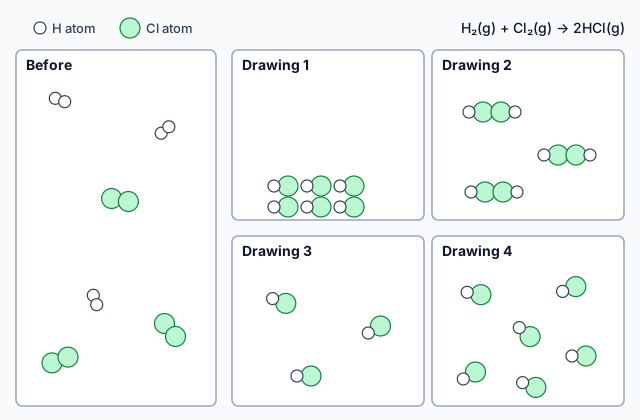
A before box holds 3 H₂ molecules and 3 Cl₂ molecules, all gases, which react completely: H₂(g) + Cl₂(g) → 2HCl(g). Four students each drew the after box.
 Tap to open the picture full size
Case question 1 · Multiple choice
Using the figure: which drawing shows product particles with a formula the equation does not give?
Case question 2 · Decide and justify
Using the figure: drawing 1 shows 6 HCl molecules, which hold every H atom and every Cl atom from the before box. Is drawing 1 consistent with the equation?
Which reason supports your decision?
The rest stand on their own and do not use the case.
Check yourself · Calculate
Ammonia burns in oxygen: 4NH₃(g) + 3O₂(g) → 2N₂(g) + 6H₂O(g). A before box holds 8 NH₃ molecules and 6 O₂ molecules, which react completely. How many H₂O molecules should the after box show? Give a whole number.
Check yourself · Fill the statement
Liquid bromine evaporates: Br₂(l) → Br₂(g). Complete the description of a drawing of the vapor that forms.
Each particle in the after box is . The particles are than in the liquid, and there are of them as in the before box.
Part 7 Keep it Bring back earlier ideas
This lesson leans on two earlier ideas: mass is conserved when a substance reacts, and a particulate drawing of a solution shows each solute as the particles it dissolves into. Pulling them back up is what makes them last.
From 4.2 Net Ionic Equations · Calculate
A student heats 2.50 g of calcium carbonate in an open crucible until it stops changing: CaCO₃(s) → CaO(s) + CO₂(g). The carbon dioxide escapes into the air, and the solid left, calcium oxide, has a mass of 1.40 g. What mass of carbon dioxide was produced? Give your answer to three significant figures.
Two drawings of solutions the lesson has not shown: a molecular solute that hydrogen bonds with water, and two solutes drawn side by side.
From 3.8 Representations of Solutions · Fill the statement
Complete the description of a correct drawing of methanol, CH₃OH, dissolved in water.
The methanol is drawn as . A dotted line for a hydrogen bond runs from the atom of one molecule's O-H group to a lone pair on the atom of the other molecule.
In three lines
- In a physical process the particles keep their identity, and only their spacing changes, as the state symbols say.
- In a reaction a formula is one particle and a coefficient counts particles in ratio; atoms are conserved between the boxes, but particles are not.
- For ions in solution, draw a precipitate as packed ions and the spectator ions still spread through the solution, in the same numbers as before.
Exam strategy for this topic
- Section I, Multiple Choice: 60 questions in 90 minutes.
- Section II, Free Response: 7 questions in 105 minutes.
- A scientific or graphing calculator is recommended for use on both sections of the exam.
When you draw a change, make three things easy to check: the same number of each kind of atom in the before and after boxes, particles with exactly the formulas the equation names, and spacing that matches each state symbol. Add a key for every kind of circle.
Questions students ask
What is a particulate representation of a reaction?
A drawing of the particles before and after a change, usually two boxes with a key, that is consistent with the balanced equation for the change.
Does the number of molecules stay the same in a reaction?
Not always. Atoms are conserved, but molecules are not: in 2H₂ + O₂ → 2H₂O, three molecules become two while every atom is kept.
How do coefficients show up in a particle drawing?
A coefficient says how many of a particle to draw relative to the others. A box can hold any multiple of that ratio, so 2H₂ + O₂ can be drawn as 4 H₂ and 2 O₂.
How do you draw a precipitation reaction?
Draw the solid as ions packed together, and draw the spectator ions still spread through the solution, in the same numbers they had before mixing.
How do you draw a physical change such as evaporation?
Draw the same particles before and after, each still whole, with the spacing changed to match the new state: far apart for a gas.
Course alignment, for teachers
AP Chemistry topic 4.3, Unit 4: Chemical Reactions.
- Skill 3.B: Represent chemical substances or phenomena with appropriate diagrams or models (e.g., electron configuration).
This lesson maps the one essential knowledge statement of the topic to the part that teaches each one: 1 is checked by a scored question. The map is in the lesson file.