Unit 4 · Topic 4.4 · about 30 minutes · 7 parts · 10 scored checks, 2 of them multiple choice, plus 2 from earlier lessons
AP Chemistry 4.4: Physical and Chemical Changes
Unit 4: 7 to 9% of the multiple-choice section
What you'll be able to do
- Explain how what you observe in a chemical process or a physical process relates to the bonds and interactions between the particles.
Key vocabulary
| Term | What it means | The exam trap |
|---|---|---|
| Chemical process | A process in which substances are turned into different substances. | A label on its own earns little; say what happens to the bonds inside the particles. |
| Physical process | A process in which the substances present at the end are the same substances present at the start. | Physical does not mean nothing happens to the particles, so say which attractions between them change. |
| Intermolecular interactions | The attractions between separate molecules, or between ions and molecules, as distinct from the bonds that hold atoms together inside a molecule. | A hydrogen bond is an attraction between molecules, not a bond inside one, despite its name. |
| Dissolution | The process of a solute dispersing into a solvent to form a solution. | Name the solute's particles before you describe what dissolving breaks. |
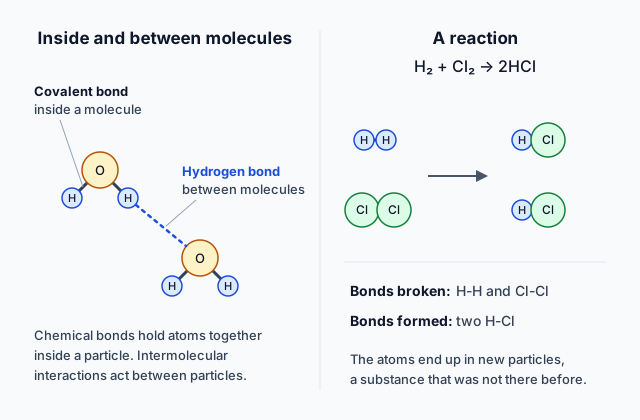 Tap to open the picture full size
Part 1 Think first Bubbles in a boiling pot
Commit to a guess first. Being wrong now makes the right idea stick better.
Predict first
A pot of water is boiling hard on a stove, with large bubbles rising from the bottom and bursting at the surface. What is inside those bubbles?
In short. A chemical process breaks and/or forms chemical bonds, while a physical process, such as a phase change, changes only the interactions between particles.
- Properties measured before and after show which happened: the same substance at the end means the same particles.
- Bubbling, glowing or a change of color does not decide it on its own.
- Dissolving a salt breaks ionic bonds and forms ion-dipole interactions, so it can be argued to be either kind of process.
Part 2 Learn it Bonds, interactions and the processes that change them
2a. Bonds inside, attractions between
Every substance has two kinds of attraction to think about. Chemical bonds hold atoms together inside a particle: the covalent bonds inside a water molecule, or the ionic bonds that hold the ions of a salt crystal together. Intermolecular interactions are the attractions between separate particles: London dispersion forces, dipole-dipole interactions and hydrogen bonds.
A process is classified by which of these it changes.
- A process that involves the breaking and/or formation of chemical bonds is typically classified as a chemical process. When hydrogen burns, H-H and O=O bonds break and O-H bonds form, so water molecules exist that were not there before.
- A process that involves only changes in intermolecular interactions is typically classified as a physical process. Phase changes are the main example. When liquid ethanol evaporates, the ethanol molecules move apart, but every bond inside them stays intact, so the vapor is still ethanol.
To classify a process, ask what happens to the particles themselves. If the particles at the end are the same particles you started with, only the attractions between them changed.
Quick check · Sort it
Sort each process by how it is typically classified. Tap a card, then its bin.
Chemical process
Physical process
2b. From what you see to what the particles do
You cannot watch a bond break, so link what you can measure to what the particles must be doing.
Properties such as boiling point, melting point, density and how a substance reacts belong to the substance. If a substance comes out of a process with its properties unchanged, its particles came out unchanged too, and only the attractions between them changed. Liquid bromine that evaporates and is then cooled condenses back into a red-brown liquid that boils at 59 °C, as bromine does, so its Br₂ molecules were never broken apart.
If a process leaves substances with different properties, and cooling or evaporating does not bring the starting substance back, the particles themselves changed: bonds were broken and new ones formed. Sugar heated strongly leaves a black solid that does not melt or dissolve as sugar does, and gives off water vapor. Bonds inside the sugar molecules broke, and the atoms ended up in new substances.
The evidence is the properties, compared before and after. How a change looks while it happens is not enough to decide it.
Quick check · Multiple choice
A student boils a sample of a colorless liquid, collects the vapor and cools it. The liquid she collects has the same boiling point and the same density as the liquid she started with. What does this show about the particles?
2c. Dissolving a salt: an argument both ways
Some processes do not sort cleanly. Sometimes a process usually called physical still involves breaking chemical bonds, and dissolving a salt in water is the standard example.
When sodium chloride dissolves, the ionic bonds that hold Na⁺ and Cl⁻ together in the crystal are broken. Each ion is then surrounded by water molecules held to it by ion-dipole interactions: the attraction between an ion and the oppositely charged end of a polar water molecule.
Plausible arguments can be made either way:
- For a chemical process: ionic bonds are broken, and strong new interactions form between the ions and the water.
- For a physical process: no new substance forms. The solution holds the same Na⁺ and Cl⁻ ions that were in the crystal, and evaporating the water leaves solid sodium chloride with its original properties.
So a label alone says little here. What makes an answer is the reasoning behind it: name the bonds that are broken and the interactions that form, and argue from them.
Quick check · Fill the statement
Complete the two arguments about dissolving calcium chloride, CaCl₂, in water.
When CaCl₂ dissolves, the between the Ca²⁺ and Cl⁻ ions in the crystal are broken, and form between the ions and the water molecules. Someone arguing that dissolving is a chemical process points to the . Someone arguing that it is a physical process points out that evaporating the water gives back .
Part 3 Watch it done Two flasks of water
Predict first, then watch each step, then finish the problem yourself.
A student runs two experiments on water. In flask A, she boils pure water and cools the gas that comes off; it condenses into a colorless liquid that boils at 100 °C. In flask B, she passes an electric current through water with a little sodium sulfate dissolved in it so that it conducts. Two gases collect, one with about twice the volume of the other. The larger sample burns with a squeaky pop, and the smaller one makes a glowing splint burst into flame. Cooled to room temperature, both stay gases. Which flask shows a chemical process?
Predict first
Before you open the first step, predict: in which flask are bonds inside water molecules broken?
Step 1 · Flask A: compare before and after
The liquid that condenses is colorless and boils at 100 °C, like the water she started with. It has water's properties, so it is made of water molecules. Boiling pulled the molecules away from one another, breaking hydrogen bonds between them, and cooling let them come back together. No O-H bond broke, so flask A shows a physical process.
Why this step?
Why is the boiling point of the condensed liquid good evidence?
A boiling point is a property of a substance. A liquid with water's boiling point and appearance is water, so the molecules that left the flask came back unchanged.
Step 2 · Flask B: decide what to compare
Apply the same test to flask B. Compare the properties of the two gases with the properties of water, and ask whether cooling brings water back. If the products are different substances, their atoms must be bonded differently from the atoms in water.
Your step · Decide and justify
Finish it. In flask B, one gas burns with a pop and the other relights a glowing splint, and both stay gases when cooled to room temperature. Is passing the current through the water a chemical process?
Which reason supports your decision?
The same test works for any process: compare the properties of what you end with to those of what you started with. The same substance means the same particles; different substances mean different bonds.
Part 4 Try it Two claims to test
Two students make claims about what happened in their experiments. Test each claim against the evidence.
Try it · Decide and justify
A student dissolves 5.00 g of table sugar, sucrose (C₁₂H₂₂O₁₁), in water, and the crystals disappear. She evaporates all of the water and is left with 5.00 g of white crystals with the same properties as the sugar she started with. She claims that dissolving the sugar was a chemical process, because the crystals disappeared. Do her results support her claim?
Which reason supports your decision?
Try it · Spot the error
A student explains what happens when solid iodine is warmed gently in a sealed tube. Tap the line with the mistake.
Part 5 Explain it Ethanol, two ways
On the exam this is handwritten, so answer on paper first. Nothing you type here leaves this page. Then check your answer against the model and each scoring point.
Free response is 50% of the exam score. This one is shaped like a short-answer question, which is worth 4 points.
Free-response practice · Short-answer style
A student studies two processes involving ethanol, C₂H₅OH.
Process 1: a few drops of ethanol on a lab bench evaporate. The vapor, collected and cooled, condenses into a liquid that boils at 78 °C, as ethanol does.
Process 2: ethanol burns in air, and the only products are carbon dioxide and water.
(a) Identify each process as physical or chemical.
(b) Justify your answer for process 1, using the data and what happens to the bonds and interactions in ethanol.
(c) Explain what happens to bonds in process 2 that does not happen in process 1.
(d) A second student dissolves sodium chloride in water and says it is clearly a physical process. Describe one argument, in terms of bonds or interactions, that a chemist could make for calling it a chemical process.
Model answer
(a) Process 1 is physical; process 2 is chemical.
(b) The condensed liquid boils at 78 °C, the boiling point of ethanol, so it is still ethanol and its molecules are intact. Evaporation overcame only the intermolecular interactions (hydrogen bonds and London dispersion forces) between ethanol molecules; no covalent bond inside a molecule broke.
(c) In burning, covalent bonds inside the ethanol molecules (C-H, C-C, C-O and O-H) and the O=O bonds in oxygen break, and new bonds form: C=O bonds in CO₂ and O-H bonds in H₂O. New substances form. In evaporation, no bond inside a molecule breaks.
(d) Dissolving breaks the ionic bonds that hold Na⁺ and Cl⁻ together in the crystal, and new ion-dipole interactions form between the ions and water molecules. A process that breaks chemical bonds and forms strong new interactions can be argued to be chemical.
Score your own answer. This is a self-check, not a grade. Tick each point your answer makes.
Part 6 Check yourself Four samples, heated and cooled
Both case questions use the table.
A student heats or warms four samples, lets each one cool, and records what she sees. The masses and temperatures are a teaching example.
| Sample | What she did | Mass before (g) | Mass after (g) | What she observed |
|---|---|---|---|---|
| 1 | Melted paraffin wax, then let it cool | 5.00 | 5.00 | Solid again; it melts at 54 °C, as it did before |
| 2 | Heated baking soda, NaHCO₃, strongly | 5.00 | 3.15 | A gas came off; the white solid left gives off no gas when heated again |
| 3 | Heated copper wire in a flame, in air | 5.00 | 5.40 | The wire is coated with a black powder that rubs off |
| 4 | Warmed isopropyl alcohol (2-propanol) and cooled its vapor in a cold tube | 5.00 | 4.97 | Liquid collected; it boils at 82 °C, as it did before |
Case question 1 · Decide and justify
Using the table: a classmate claims that the isopropyl alcohol in sample 4 changed chemically, because its mass went down. Do the data support the claim?
Which reason supports your decision?
Case question 2 · Multiple choice
Using the table: in which sample do the masses alone show that atoms from the air became bonded into the sample?
The rest stand on their own and do not use the case.
Check yourself · Select all
Which two statements could a chemist use to argue that dissolving potassium bromide, KBr, in water is a physical process? Select two.
Select 2 answers, then check.
Check yourself · Fill the statement
Complete the description of liquid hexane, C₆H₁₄, evaporating from an open dish.
As the hexane evaporates, the between hexane molecules are overcome, while the inside each molecule stay intact. The vapor is made of , so evaporation is a process.
Part 7 Keep it Bring back earlier ideas
This lesson leans on two earlier ideas: heat, light and new substances are evidence of a chemical change, and substances are held together by ionic, covalent or metallic bonding. Pulling them back up is what makes them last.
From 4.1 Introduction for Reactions · Fill the statement
Complete the description of a burning candle.
Melting the wax near the wick is a change, because the wax keeps its . Burning the wax vapor in the flame is a change: it makes carbon dioxide and water, and the the flame gives off is evidence of it.
From 2.1 Types of Chemical Bonds · Sort it
Each card names a substance. Tap a card, then the bin for the kind of bonding that holds it together.
Ionic
Covalent
Metallic
In three lines
- A process that breaks and/or forms chemical bonds is typically chemical; one that changes only intermolecular interactions, such as a phase change, is typically physical.
- Properties compared before and after are the evidence: a substance that comes back with its properties unchanged was never broken apart.
- Dissolving a salt breaks ionic bonds and forms ion-dipole interactions, so it can be argued either way, and the reasoning is what counts.
Exam strategy for this topic
- Section I, Multiple Choice: 60 questions in 90 minutes.
- Section II, Free Response: 7 questions in 105 minutes.
- A scientific or graphing calculator is recommended for use on both sections of the exam.
When a question asks whether a process is physical or chemical, give the label and then the particle-level reason: name the bonds broken or formed, or say that only the attractions between particles change. Where data are given, quote the property that stayed the same or changed. For dissolving a salt, either label can be argued, so the reasoning carries the answer.
Questions students ask
What is the difference between a physical and a chemical process?
A chemical process breaks and/or forms chemical bonds, so new substances form. A physical process, such as melting or boiling, changes only the interactions between particles, and the particles themselves stay the same.
Is boiling water a chemical change?
No. Boiling separates whole water molecules from one another by overcoming the hydrogen bonds between them. The vapor condenses back into water, so no O-H bond inside a molecule broke.
Is dissolving salt in water physical or chemical?
It can be argued either way. Ionic bonds in the crystal break and ion-dipole interactions form, which supports chemical; no new substance forms and evaporation returns the salt, which supports physical.
Does a color change always mean a chemical change?
No. A substance can look different as a solid, a liquid or a gas without any bond inside its particles breaking: bromine is a dark red-brown liquid and an orange-brown vapor, and both are Br₂ molecules. Decide from the properties of what is left.
How can data show that bonds were broken?
Compare properties before and after. A product with a different melting point, boiling point or reactivity, or a change in mass from atoms joining or leaving, shows new substances and so new bonds.
Course alignment, for teachers
AP Chemistry topic 4.4, Unit 4: Chemical Reactions.
- Skill 6.B: Support a claim with evidence from experimental data.
This lesson maps all 2 essential knowledge statements of the topic to the part that teaches each one: 2 are checked by a scored question. The map is in the lesson file.