Unit 4 · Topic 4.5 · about 30 minutes · 7 parts · 10 scored checks, 0 of them multiple choice, plus 2 from earlier lessons
AP Chemistry 4.5: Stoichiometry
Unit 4: 7 to 9% of the multiple-choice section
What you'll be able to do
- Explain how the amounts of reactants and products change in a chemical process, using its balanced equation.
Key vocabulary
| Term | What it means | The exam trap |
|---|---|---|
| Stoichiometry | The calculation of the amounts of substances that react and form in a chemical process, from its balanced equation. | A question may give amounts in grams, liters or molarity, so change each one to moles before you use the equation. |
| Mole ratio | A ratio of the moles of two substances in a reaction, taken from the coefficients of the balanced equation. | Read the ratio from the coefficients, not from the subscripts inside a formula. |
| Limiting reactant | The reactant that is used up first in a reaction, which sets the amount of product that forms. | A question may give the reactants in grams, so change both to moles before you compare them. |
| Excess reactant | A reactant present in more than the amount the limiting reactant can use, so some of it is left at the end. | The amount left over comes from the limiting reactant's moles, so find the limiting reactant first. |
 Tap to open the picture full size
Part 1 Think first Fuel for a rocket
Commit to a guess first. Being wrong now makes the right idea stick better.
Predict first
A rocket engine burns liquid hydrogen with liquid oxygen to make water: 2H₂ + O₂ → 2H₂O. To burn 1.00 kg of hydrogen completely, about how much oxygen does the engine need?
In short. Stoichiometry uses the coefficients of a balanced equation as mole ratios to calculate the amount of one substance that reacts or forms from a known amount of another.
- Atoms are conserved, so the coefficients fix the proportions in moles, never in grams.
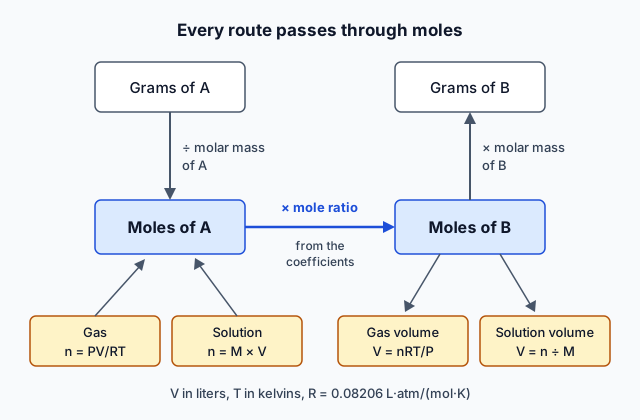
- Every calculation passes through moles: grams by molar mass, gases by PV = nRT, solutions by molarity times volume.
- When two reactant amounts are given, the one that runs out first, the limiting reactant, sets the amount of product.
Part 2 Learn it Amounts from a balanced equation
2a. Coefficients are mole ratios
In a chemical process, atoms are rearranged but never created or destroyed. A balanced equation shows this: every atom on the left appears on the right. So its coefficients give the proportions in which substances react and form, counted in particles or in moles.
N₂ + 3H₂ → 2NH₃
reads: 1 mol of N₂ reacts with 3 mol of H₂ to form 2 mol of NH₃. Each side holds 2 N atoms and 6 H atoms. Any two substances in the equation give a mole ratio, such as 2 mol NH₃ / 3 mol H₂.
To go from moles of one substance to moles of another, multiply by the mole ratio, with the substance you want on top:
0.600 mol H₂ × (2 mol NH₃ / 3 mol H₂) = 0.400 mol NH₃
The ratio works in either direction, so a product amount gives the reactant amount needed: making 0.400 mol of NH₃ takes 0.400 mol NH₃ × (1 mol N₂ / 2 mol NH₃) = 0.200 mol of N₂.
The coefficients are ratios of moles, not of grams. The 3 mol of H₂ in the equation have a much smaller mass than the 1 mol of N₂.
Quick check · Calculate
Propane burns in oxygen: C₃H₈ + 5O₂ → 3CO₂ + 4H₂O. How many moles of O₂ react completely with 0.250 mol of C₃H₈? Give your answer to three significant figures.
2b. Grams to grams, through moles
A balance measures grams, but an equation counts moles, so a mass calculation passes through moles in three steps:
- Grams of the known substance ÷ its molar mass = moles of it.
- Moles of the known substance × the mole ratio = moles of the substance you want.
- Moles of the wanted substance × its molar mass = grams of it.
Example: magnesium burns in oxygen, 2Mg + O₂ → 2MgO. What mass of MgO forms from 4.86 g of Mg? (Mg 24.31 g/mol, O 16.00 g/mol.)
- 4.86 g ÷ 24.31 g/mol = 0.19992 mol Mg
- 0.19992 mol Mg × (2 mol MgO / 2 mol Mg) = 0.19992 mol MgO
- 0.19992 mol × 40.31 g/mol = 8.06 g MgO
Keep the unrounded value between steps and round once, at the end, to the significant figures of the data (three here). Every step multiplies or divides by a fixed number, so the mass of product is proportional to the mass of the reactant that is used up.
Quick check · Calculate
In a blast furnace, iron is made from iron(III) oxide: Fe₂O₃ + 3CO → 2Fe + 3CO₂. What mass of Fe₂O₃ is needed to make 10.0 g of iron? (Fe 55.85 g/mol, O 16.00 g/mol.) Give your answer to three significant figures.
2c. Gases and solutions
For a gas or a solution, the moles come from other measurements, and the middle step stays the same.
- A gas: n = PV/RT, with P in atmospheres, V in liters, T in kelvins and R = 0.08206 L·atm/(mol·K).
- A solution: moles of solute = molarity × volume in liters, since M = n/L.
Example: calcium carbonate reacts with hydrochloric acid: CaCO₃(s) + 2HCl(aq) → CaCl₂(aq) + H₂O(l) + CO₂(g). What volume of CO₂ forms from 5.00 g of CaCO₃ (100.09 g/mol) at 1.00 atm and 25.0 °C?
- 5.00 g ÷ 100.09 g/mol = 0.049955 mol CaCO₃
- 0.049955 mol CaCO₃ × (1 mol CO₂ / 1 mol CaCO₃) = 0.049955 mol CO₂
- V = nRT/P = (0.049955 mol)(0.08206 L·atm/(mol·K))(298.15 K) ÷ 1.00 atm = 1.22 L
How much 2.00 M HCl does this take? 0.049955 mol CaCO₃ × (2 mol HCl / 1 mol CaCO₃) = 0.099910 mol HCl, and 0.099910 mol ÷ 2.00 mol/L = 0.0500 L, or 50.0 mL.
Quick check · Calculate
A student adds more than enough silver nitrate solution to 25.0 mL of 0.200 M NaCl, and solid silver chloride forms: NaCl(aq) + AgNO₃(aq) → AgCl(s) + NaNO₃(aq). What mass of AgCl forms? (AgCl 143.32 g/mol.) Give your answer to three significant figures.
2d. The reactant that runs out
When amounts of two reactants are given, the reaction stops as soon as one of them is used up. That one is the limiting reactant: it sets how much product forms. The other is left over, in excess.
To find it, take one reactant and work out how much of the other it needs, using the mole ratio.
Example: N₂ + 3H₂ → 2NH₃, with 2.00 mol of N₂ and 4.50 mol of H₂. Using all of the N₂ would take 2.00 mol × 3 = 6.00 mol of H₂, but only 4.50 mol is there. So the H₂ runs out first and is the limiting reactant, even though there are more moles of it. The product comes from the H₂: 4.50 mol H₂ × (2 mol NH₃ / 3 mol H₂) = 3.00 mol NH₃. The N₂ used is 4.50 mol × (1/3) = 1.50 mol, so 0.50 mol of N₂ is left over.
Compare in moles, through the coefficients. Comparing grams, or comparing moles without the coefficients, can name the wrong reactant.
Quick check · Decide and justify
Aluminum reacts with chlorine: 2Al + 3Cl₂ → 2AlCl₃. A flask holds 0.400 mol of Al and 0.500 mol of Cl₂. Which is the limiting reactant?
Which reason supports your decision?
Part 3 Watch it done Oxygen from potassium chlorate
Predict first, then watch each step, then finish the problem yourself.
Heating potassium chlorate releases oxygen gas: 2KClO₃(s) → 2KCl(s) + 3O₂(g). A student heats 1.226 g of KClO₃ (122.55 g/mol) until all of it has decomposed. What volume of O₂ forms, measured at 1.00 atm and 25.0 °C?
Predict first
Before you open the first step, predict: will the number of moles of O₂ be more than, less than or equal to the number of moles of KClO₃?
Step 1 · Moles of the known substance
1.226 g ÷ 122.55 g/mol = 0.010004 mol KClO₃.
Step 2 · Read the mole ratio
The coefficients give 3 mol of O₂ for every 2 mol of KClO₃, so the ratio to multiply by is (3 mol O₂ / 2 mol KClO₃).
Why this step?
Why go through moles instead of using the masses directly?
The coefficients count particles, and moles count particles. A gram of KClO₃ and a gram of O₂ hold different numbers of particles, so the ratio applies only to moles.
Step 3 · Set up the gas law
The volume comes from V = nRT/P, with T in kelvins: 25.0 °C + 273.15 = 298.15 K, and R = 0.08206 L·atm/(mol·K).
Your step · Calculate
Finish it. 1.226 g of KClO₃, which is 0.010004 mol, decomposes completely: 2KClO₃ → 2KCl + 3O₂. What volume of O₂ forms at 1.00 atm and 298.15 K? Give your answer in liters to three significant figures.
L
Every stoichiometry problem has the same middle: moles of one substance, times a mole ratio, give moles of another. Only the first and last steps change with what you measure: grams, a gas volume or a solution.
Part 4 Try it Baking soda and acid
Baking soda, NaHCO₃, reacts with hydrochloric acid: NaHCO₃(s) + HCl(aq) → NaCl(aq) + H₂O(l) + CO₂(g). A student reacts a weighed sample of baking soda with more than enough HCl and collects the CO₂ at a fixed pressure.
Try it · Fill the statement
Complete each prediction about the student's CO₂. Change only the one thing each sentence names.
If she uses twice the mass of baking soda, with the HCl still more than enough, the moles of CO₂ will change by a factor of . If she collects the gas at a higher temperature, at the same pressure, its volume will . If she uses HCl that is twice as concentrated, still more than enough, the moles of CO₂ will .
Part 5 Explain it Oxygen from hydrogen peroxide
On the exam this is handwritten, so answer on paper first. Nothing you type here leaves this page. Then check your answer against the model and each scoring point.
Free response is 50% of the exam score. This one is shaped like a short-answer question, which is worth 4 points.
Free-response practice · Short-answer style
Hydrogen peroxide decomposes when a little manganese dioxide is added: 2H₂O₂(aq) → 2H₂O(l) + O₂(g). A student adds manganese dioxide to 50.0 mL of 0.880 M H₂O₂, and all of the H₂O₂ decomposes.
(a) Calculate the number of moles of H₂O₂ in the sample.
(b) Calculate the number of moles of O₂ that form.
(c) Calculate the volume of the O₂ at 1.00 atm and 25.0 °C. (R = 0.08206 L·atm/(mol·K))
(d) The student repeats the experiment with 50.0 mL of 0.440 M H₂O₂ at the same pressure and temperature. Predict the volume of O₂ that forms, and justify your prediction using the relationship between the amounts in the balanced equation.
Model answer
(a) n = MV = (0.880 mol/L)(0.0500 L) = 0.0440 mol H₂O₂.
(b) 0.0440 mol H₂O₂ × (1 mol O₂ / 2 mol H₂O₂) = 0.0220 mol O₂.
(c) V = nRT/P = (0.0220 mol)(0.08206 L·atm/(mol·K))(298.15 K) ÷ 1.00 atm = 0.538 L.
(d) About 0.269 L. Half the concentration in the same volume gives half the moles of H₂O₂, 0.0220 mol. The coefficients fix the mole ratio, so the moles of O₂ also halve, to 0.0110 mol, and at the same P and T the volume is proportional to the moles: 0.538 L ÷ 2 = 0.269 L.
Score your own answer. This is a self-check, not a grade. Tick each point your answer makes.
Part 6 Check yourself Magnesium in acid
Both case questions use the table.
In each of four trials, a student drops a different mass of magnesium ribbon into 50.0 mL of 0.600 M HCl and collects the hydrogen at 1.00 atm and 25.0 °C: Mg(s) + 2HCl(aq) → MgCl₂(aq) + H₂(g). (Mg 24.31 g/mol.) The data are a teaching example.
| Trial | Mass of Mg (g) | Volume of H₂ (mL) |
|---|---|---|
| 1 | 0.120 | 121 |
| 2 | 0.240 | 242 |
| 3 | 0.480 | 367 |
| 4 | 0.600 | 367 |
Case question 1 · Decide and justify
Using the table: is magnesium the limiting reactant in trial 2?
Which reason supports your decision?
Case question 2 · Calculate
Using the table: what mass of magnesium is left unreacted at the end of trial 4? Give your answer to three significant figures.
The rest stand on their own and do not use the case.
Check yourself · Sketch the graph
Sulfur dioxide reacts with oxygen to form sulfur trioxide, 2SO₂ + O₂ → 2SO₃, with more than enough SO₂ present. Sketch the moles of SO₃ formed against the moles of O₂ that react, from 0 to 2.0 mol of O₂. The first point, at 0 mol, is placed for you; drag each of the others to the moles of SO₃ that amount of O₂ forms.
One shape that fits
Drag a point up or down, or tap it and use the arrow keys. The shape is checked, and so are the values the question lets you work out.
Check yourself · Spot the error
A student finds the mass of water formed when 8.00 g of O₂ reacts completely with hydrogen: 2H₂ + O₂ → 2H₂O. Tap the line with the mistake.
Part 7 Keep it Bring back earlier ideas
This lesson leans on two earlier ideas: the ideal gas law gives the moles of a gas from its pressure, volume and temperature, and Avogadro's number connects moles to a count of particles. Pulling them back up is what makes them last.
Two more gas samples to work with: a steel cylinder of argon that is partly used up, and four flasks of different gases.
From 3.4 Ideal Gas Law · Calculate
A 10.0 L steel cylinder of argon reads 15.6 atm at 20.0 °C. After a day of welding it reads 4.80 atm, at the same temperature. How many moles of argon were used? Give three significant figures.
From 1.1 Moles and Molar Mass · Calculate
How many silver atoms are in 0.350 mol of silver? Give your answer to three significant figures, typed in e-notation (6.022 × 10²³ is typed 6.022e23).
In three lines
- Atoms are conserved, so the coefficients of a balanced equation are mole ratios that link the amount of any substance to any other.
- Every calculation passes through moles: grams by molar mass, gases by n = PV/RT and solutions by moles = molarity × volume in liters.
- With two reactant amounts given, the one that runs out first, found through the mole ratio, is the limiting reactant and sets the product.
Exam strategy for this topic
- Section I, Multiple Choice: 60 questions in 90 minutes.
- Section II, Free Response: 7 questions in 105 minutes.
- A scientific or graphing calculator is recommended for use on both sections of the exam.
Write every number with its unit and its substance, such as 0.0440 mol H₂O₂, so that the mole ratio visibly cancels the substance you start with. Keep unrounded values until the last step, give the answer with the significant figures of the data, and change mL to L and °C to K before using molarity or PV = nRT.
Questions students ask
What is stoichiometry?
The calculation of how much of each substance reacts and forms in a chemical process. It uses the coefficients of the balanced equation as mole ratios.
How do you convert grams of one substance to grams of another?
Divide by the first substance's molar mass to get moles, multiply by the mole ratio from the equation, then multiply by the second substance's molar mass.
Why can't you use the coefficients with grams?
The coefficients count particles, and equal numbers of particles of different substances have different masses. One mole of O₂ has about 16 times the mass of one mole of H₂.
How do you find the limiting reactant?
Take one reactant, use the mole ratio to work out how much of the other it needs, and compare that with what is present. If there is not enough of the other, the other one is limiting.
How does the ideal gas law fit into stoichiometry?
It turns a gas measurement into moles, n = PV/RT, or moles into a gas volume, V = nRT/P. The mole ratio step in the middle does not change.
Course alignment, for teachers
AP Chemistry topic 4.5, Unit 4: Chemical Reactions.
- Skill 5.C: Explain the relationship between variables within an equation when one variable changes.
This lesson maps all 3 essential knowledge statements of the topic to the part that teaches each one: 3 are checked by a scored question. The map is in the lesson file.