Unit 4 · Topic 4.6 · about 30 minutes · 7 parts · 10 scored checks, 1 of them multiple choice, plus 2 from earlier lessons
AP Chemistry 4.6: Introduction to Titration
Unit 4: 7 to 9% of the multiple-choice section
What you'll be able to do
- Identify the equivalence point of a titration from the amounts of titrant and analyte, assuming the reaction goes to completion.
Key vocabulary
| Term | What it means | The exam trap |
|---|---|---|
| Titration | A procedure that finds the amount of a substance in solution from how much of a solution of known concentration reacts with it. | Buret readings carry two decimal places in milliliters, so keep four significant figures through the calculation. |
| Titrant | The solution added from the buret, which reacts with the substance being measured. | The titrant is not always a base; an acid or another reagent can fill the buret. |
| Analyte | The substance in the flask whose amount the titration finds. | A question may give the analyte's volume in milliliters, so change it to liters before you find a concentration. |
| Equivalence point | The point in a titration at which the titrant added has totally consumed the analyte. | It is set by the amounts, which you calculate; you cannot see it directly. |
| Endpoint | The observable change, such as a change of color, that signals that the equivalence point has been reached. | The endpoint is observed and the equivalence point is calculated, so a question may ask about either; read which one it means. |
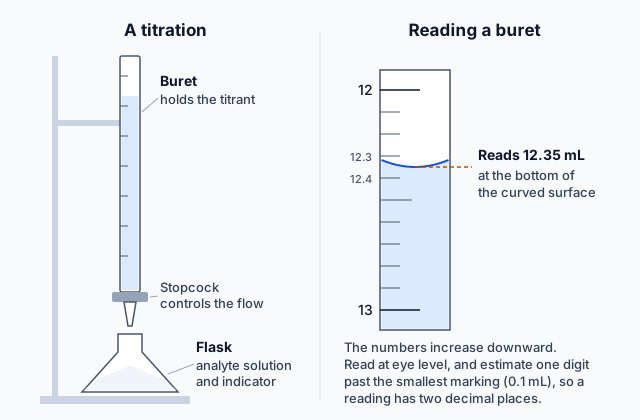 Tap to open the picture full size
Part 1 Think first How strong is the vinegar?
Commit to a guess first. Being wrong now makes the right idea stick better.
Predict first
A food lab checks the strength of a batch of vinegar. A technician puts 10 mL of the vinegar in one flask and 20 mL of the same vinegar in another, adds a few drops of a dye to each, and then adds a sodium hydroxide solution from a long tube with a tap until the color of the dye changes. How does the volume of sodium hydroxide solution needed for the 20 mL flask compare with the volume needed for the 10 mL flask?
In short. A titration finds the amount of a dissolved substance, the analyte, by adding a solution of known concentration, the titrant, until the analyte is totally consumed.
- The titrant reacts specifically and completely with the analyte, so its moles, molarity times volume, give the analyte's moles through the balanced equation.
- The equivalence point is where the titrant added has consumed all of the analyte, in the ratio of the coefficients.
- The endpoint is the observable signal, usually a color change, that the equivalence point has been reached.
Part 2 Learn it Titration
2a. What a titration measures
A titration finds the amount of a substance dissolved in a sample, called the analyte. A solution of known concentration, the titrant, is added from a buret to a measured volume of the analyte solution in a flask.
Two things make it work.
- The titrant contains a species that reacts specifically with the analyte, with nothing else in the flask, and quantitatively: completely, in the ratio of the balanced equation.
- The titrant's concentration is known, so the volume added tells you its moles: moles = molarity × volume in liters.
A buret is read before and after, to two decimal places in milliliters, and the volume delivered is the difference between the two readings. From the moles of titrant and the balanced equation you can calculate the moles of analyte, and from the volume of the analyte solution, its concentration.
Example: a flask holds 25.00 mL of hydrochloric acid of unknown concentration, and the buret holds 0.1000 M sodium hydroxide. The NaOH is the titrant, and the HCl is the analyte.
Quick check · Sort it
A student titrates 20.00 mL of diluted household ammonia with 0.1000 M hydrochloric acid. Sort each quantity by where it comes from. Tap a card, then its bin.
Known before the titration starts
Found from the buret readings
Calculated from the results
2b. The equivalence point
The equivalence point of a titration is reached when the analyte has been totally consumed by the titrant: the moles of titrant added are exactly the amount the balanced equation says react with the analyte present. Before it, some analyte is left; after it, titrant is in excess.
The coefficients decide where it falls.
- HCl + NaOH → NaCl + H₂O reacts 1 : 1, so at the equivalence point the moles of NaOH added equal the moles of HCl in the flask.
- H₂SO₄ + 2NaOH → Na₂SO₄ + 2H₂O reacts 1 : 2, so at the equivalence point the moles of NaOH added are twice the moles of H₂SO₄.
Example: a flask holds 25.00 mL of 0.08000 M HCl, and the buret holds 0.1000 M NaOH. Where is the equivalence point?
- Moles of HCl = 0.02500 L × 0.08000 mol/L = 0.002000 mol
- Moles of NaOH needed = 0.002000 mol (1 : 1)
- Volume of NaOH = 0.002000 mol ÷ 0.1000 mol/L = 0.02000 L, or 20.00 mL
Run the other way, a measured equivalence volume gives the analyte's amount, which is how a titration finds an unknown.
Quick check · Calculate
A flask holds 15.00 mL of 0.1200 M sulfuric acid, which reacts with sodium hydroxide: H₂SO₄ + 2NaOH → Na₂SO₄ + 2H₂O. What volume of 0.1500 M NaOH must be added to reach the equivalence point? Give your answer in milliliters to four significant figures.
2c. The endpoint
Nobody can see the last molecules of analyte react, so a titration needs a signal. The equivalence point is often indicated by a change in a property, most often a color, that happens when it is reached. That observable event is the endpoint of the titration.
Often the signal comes from an indicator, a dye added in a few drops. Phenolphthalein is a common one when NaOH is the titrant: it is colorless while acid remains in the flask, and it turns pink once a drop of NaOH has nothing left to react with. Sometimes the titrant gives the signal itself, because it is colored and its products are not.
The endpoint is what you see; the equivalence point is the chemistry. With a well-chosen signal they come at nearly the same volume, so a careful student adds the titrant drop by drop near the end, swirls, and stops at the first color change that lasts. The buret reading at that moment is the endpoint volume, taken as the equivalence volume.
Quick check · Decide and justify
A student titrates hydrochloric acid with 0.1000 M NaOH, using phenolphthalein. She looks away for a moment while the NaOH is running, and when she looks back the flask is bright pink. She records the buret reading then. Is the volume she records larger or smaller than the volume at the equivalence point?
Which reason supports your decision?
Part 3 Watch it done Acid in vinegar
Predict first, then watch each step, then finish the problem yourself.
A technician titrates 10.00 mL of vinegar with 0.5000 M NaOH, using phenolphthalein. The buret reads 0.40 mL at the start and 17.05 mL at the first lasting pink. The acid in vinegar is acetic acid, which reacts with NaOH 1 : 1: CH₃COOH(aq) + NaOH(aq) → NaCH₃COO(aq) + H₂O(l). What is the concentration of acetic acid in the vinegar?
Predict first
Before you open the first step, predict: is the concentration of the acetic acid greater than, less than or equal to the 0.5000 M of the NaOH?
Step 1 · Volume of titrant delivered
17.05 mL − 0.40 mL = 16.65 mL, which is 0.01665 L.
Step 2 · Volume of the analyte
The vinegar sample is 10.00 mL, which is 0.01000 L. Its concentration will be its moles of acetic acid divided by this volume.
Why this step?
Why can the NaOH tell you how much acetic acid there was?
The NaOH reacts specifically and completely with the acetic acid, and the endpoint marks where the acid was used up. So the NaOH added is the amount that reacted with all of the acid, in the ratio of the equation.
Your step · Calculate
Finish it. The 10.00 mL of vinegar took 16.65 mL of 0.5000 M NaOH to reach the endpoint. What is the concentration of acetic acid in the vinegar, in mol/L? Give your answer to four significant figures.
mol/L
That is about 50 g of acetic acid (60.05 g/mol) in each liter of vinegar. The method is the same for any titration: volume delivered, moles of titrant, mole ratio, then the analyte's moles over the analyte's own volume.
Part 4 Try it Sodium hydroxide as the titrant
More titrations, each with sodium hydroxide in the buret. (1 mmol = 0.001 mol, and millimoles divided by milliliters give mol/L.)
Try it · Sketch the graph
A flask holds 20.00 mL of 0.1500 M HCl, which reacts 1 : 1 with NaOH: HCl + NaOH → NaCl + H₂O. A student adds 0.2000 M NaOH from a buret, 3.00 mL at a time. Sketch the millimoles of HCl left in the flask against the total volume of NaOH added, from 0 mL to 15.00 mL. The first point is placed for you; drag each of the others to the millimoles of HCl left after that much NaOH.
One shape that fits
Drag a point up or down, or tap it and use the arrow keys. The shape is checked, and so are the values the question lets you work out.
Try it · Rank it
Each flask is titrated with the same 0.1000 M NaOH. Flask A holds 25.00 mL of 0.1000 M HCl. Flask B holds 15.00 mL of 0.0900 M H₂SO₄. Flask C holds 20.00 mL of 0.0600 M HCl. The reactions are HCl + NaOH → NaCl + H₂O and H₂SO₄ + 2NaOH → Na₂SO₄ + 2H₂O. Rank the flasks by the volume of NaOH needed to reach the equivalence point.
Smallest volume first
Give each one a place, 1 for first. Give two the same place if they are equal.
Your ranking: none yet
Part 5 Explain it Titrating barium hydroxide
On the exam this is handwritten, so answer on paper first. Nothing you type here leaves this page. Then check your answer against the model and each scoring point.
Free response is 50% of the exam score. This one is shaped like a short-answer question, which is worth 4 points.
Free-response practice · Short-answer style
A student titrates 25.00 mL of a barium hydroxide solution with 0.1000 M HCl: Ba(OH)₂(aq) + 2HCl(aq) → BaCl₂(aq) + 2H₂O(l). The first lasting color change of the indicator comes after 31.60 mL of HCl has been added.
(a) Explain why the result depends on the HCl reacting completely, and only, with the Ba(OH)₂ in the flask.
(b) Calculate the number of moles of HCl added to reach the endpoint.
(c) Calculate the concentration of Ba(OH)₂ in the solution.
(d) A second student rinses the buret with water but not with the HCl, so water left inside dilutes the HCl she then fills it with. She still uses 0.1000 M in her calculation. Predict whether her calculated concentration of Ba(OH)₂ is higher or lower than the first student's, and justify your prediction.
Model answer
(a) The calculation turns the moles of HCl added into moles of Ba(OH)₂ with the 1 : 2 ratio. That is true only if every mole of HCl reacted with Ba(OH)₂: if the reaction stopped short, or if the HCl also reacted with something else in the flask, the HCl used would not match the Ba(OH)₂ present.
(b) 0.03160 L × 0.1000 mol/L = 0.003160 mol HCl.
(c) 0.003160 mol HCl × (1 mol Ba(OH)₂ / 2 mol HCl) = 0.001580 mol Ba(OH)₂, and 0.001580 mol ÷ 0.02500 L = 0.06320 M.
(d) Higher. The diluted HCl holds fewer moles in each milliliter, so a larger volume of it is needed to consume the same Ba(OH)₂. Multiplying that larger volume by 0.1000 M overstates the moles of HCl, so the calculated moles of Ba(OH)₂, and its concentration, come out too high.
Score your own answer. This is a self-check, not a grade. Tick each point your answer makes.
Part 6 Check yourself Iron in a sample
Both case questions use the table.
A student titrates 20.00 mL samples of an iron(II) solution with 0.02000 M potassium permanganate: MnO₄⁻(aq) + 5Fe²⁺(aq) + 8H⁺(aq) → Mn²⁺(aq) + 5Fe³⁺(aq) + 4H₂O(l). The permanganate ion is deep purple and the products are nearly colorless, so the first drop of permanganate that has no iron(II) left to react with leaves a faint purple color that lasts. The readings are a teaching example.
| Trial | Initial reading (mL) | Final reading (mL) | Color of the flask at the end |
|---|---|---|---|
| 1 | 0.20 | 19.45 | Dark purple |
| 2 | 0.35 | 18.73 | Faint purple |
| 3 | 0.10 | 18.52 | Faint purple |
Case question 1 · Multiple choice
Using the table: which trial's volume should the student leave out when she averages her results?
Case question 2 · Calculate
Using the table: from trial 2 alone, what is the concentration of Fe²⁺ in the iron(II) solution, in mol/L? Give your answer to four significant figures.
The rest stand on their own and do not use the case.
Check yourself · Spot the error
A student finds the concentration of a NaOH solution: a 20.00 mL sample reaches the endpoint with 15.20 mL of 0.1000 M HCl, and HCl + NaOH → NaCl + H₂O. Tap the line with the mistake.
Check yourself · Sort it
A flask holds 1.500 mmol of oxalic acid, H₂C₂O₄, which reacts with NaOH: H₂C₂O₄ + 2NaOH → Na₂C₂O₄ + 2H₂O. Sort each amount of NaOH added by where it leaves the titration. Tap a card, then its bin.
Before the equivalence point
At the equivalence point
Past the equivalence point
Part 7 Keep it Bring back earlier ideas
This lesson leans on two earlier ideas: molarity is the moles of solute in each liter of solution, and the coefficients of a balanced equation give the mole ratio of the species. Pulling them back up is what makes them last.
From 3.7 Solutions and Mixtures · Calculate
A student dissolves 29.2 g of sodium chloride, NaCl (molar mass 58.44 g/mol), in water and adds water to make 250.0 mL of solution. What is the molarity of the solution? Give your answer to three significant figures.
From 4.5 Stoichiometry · Calculate
Propane burns in oxygen: C₃H₈ + 5O₂ → 3CO₂ + 4H₂O. How many moles of O₂ react completely with 0.250 mol of C₃H₈? Give your answer to three significant figures.
In three lines
- A titration finds the amount of an analyte from the volume of a titrant of known concentration that reacts specifically and completely with it.
- At the equivalence point the analyte is totally consumed, and the moles of titrant added match the analyte's moles in the ratio of the coefficients.
- The endpoint is the observable change, usually a color, that signals the equivalence point; stop at the first change that lasts.
Exam strategy for this topic
- Section I, Multiple Choice: 60 questions in 90 minutes.
- Section II, Free Response: 7 questions in 105 minutes.
- A scientific or graphing calculator is recommended for use on both sections of the exam.
In a titration calculation, write the balanced equation first and show four steps: the volume delivered from the two buret readings, the moles of titrant, the mole ratio to the analyte, and the analyte's moles divided by the analyte's own volume in liters. Keep the four significant figures that buret readings and stock concentrations carry.
Questions students ask
What is the equivalence point of a titration?
The point at which the titrant added has totally consumed the analyte, so the moles of titrant match the moles of analyte in the ratio of the balanced equation.
What is the difference between the endpoint and the equivalence point?
The equivalence point is set by the amounts that react. The endpoint is the color change you observe that signals it; with a good indicator the two come at nearly the same volume.
What is the difference between a titrant and an analyte?
The titrant is the solution of known concentration added from the buret. The analyte is the substance in the flask whose amount is being found.
How do you calculate a concentration from a titration?
Multiply the titrant's molarity by the volume delivered in liters, use the mole ratio to get the analyte's moles, and divide by the analyte solution's volume in liters.
What happens if you add titrant past the endpoint?
The extra titrant has no analyte to react with, but the calculation counts it, so the analyte's calculated amount comes out too large.
Course alignment, for teachers
AP Chemistry topic 4.6, Unit 4: Chemical Reactions.
- Skill 3.A: Represent chemical phenomena using appropriate graphing techniques, including correct scale and units.
This lesson maps the one essential knowledge statement of the topic to the part that teaches each one: 1 is checked by a scored question. The map is in the lesson file.