Unit 4 · Topic 4.7 · about 30 minutes · 7 parts · 10 scored checks, 1 of them multiple choice, plus 2 from earlier lessons
AP Chemistry 4.7: Types of Chemical Reactions
Unit 4: 7 to 9% of the multiple-choice section
What you'll be able to do
- Identify a reaction as acid-base, oxidation-reduction, or precipitation.
Key vocabulary
| Term | What it means | The exam trap |
|---|---|---|
| Oxidation number | The charge an atom would carry if every bond in its substance were ionic, assigned by a short list of rules. | An oxidation number is bookkeeping, so a value such as +6 does not mean the atom exists as an ion with that charge. |
| Precipitate | An ionic solid that forms when dissolved ions combine and do not stay in solution. | Read the phase labels on the product side: (s) marks a solid that formed, and (aq) marks ions that stayed dissolved. |
| Combustion | A reaction in which a substance reacts with oxygen gas, usually giving off heat and light. | Write the oxygen as O₂, the gas made of O₂ molecules, not as single O atoms. |
| Soluble | Able to dissolve in water to a large extent; a soluble ionic compound stays as separate ions in solution. | Solubility belongs to a compound, not a single ion, so judge each possible pairing of a cation with an anion. |
 Tap to open the picture full size
Part 1 Think first Two changes in a kitchen
Commit to a guess first. Being wrong now makes the right idea stick better.
Predict first
Baking soda dropped into vinegar fizzes as carbon dioxide forms. A wet steel wool pad left by the sink slowly turns to rust as its iron combines with oxygen from the air. Both are chemical reactions. What passes from one particle to another in each?
In short. Most reactions in water are sorted into three types by what passes between the reacting species: a proton in an acid-base reaction, electrons in a redox reaction, and ions joining into a solid in a precipitation reaction.
- An acid-base reaction moves a proton, H⁺, from one species to another.
- A redox reaction moves electrons, which shows up as a change in oxidation numbers; combustion in oxygen gas is one kind.
- A precipitation reaction forms an ionic solid from dissolved ions, and every sodium, potassium, ammonium and nitrate salt is soluble.
Part 2 Learn it Three types of reaction
2a. A proton passes, or a solid forms
Most reactions in water fall into one of three types, named for what passes between the reacting species. This chunk covers two of them.
In an acid-base reaction, a proton passes from one species to another. A proton here is a hydrogen ion, H⁺: a hydrogen atom without its electron. Example: acetic acid meeting ammonia, HC₂H₃O₂(aq) + NH₃(aq) → C₂H₃O₂⁻(aq) + NH₄⁺(aq). Compare each reactant with the product it becomes. Acetic acid ends with one H fewer and a 1− charge; ammonia ends with one H more and a 1+ charge. One H⁺ moved.
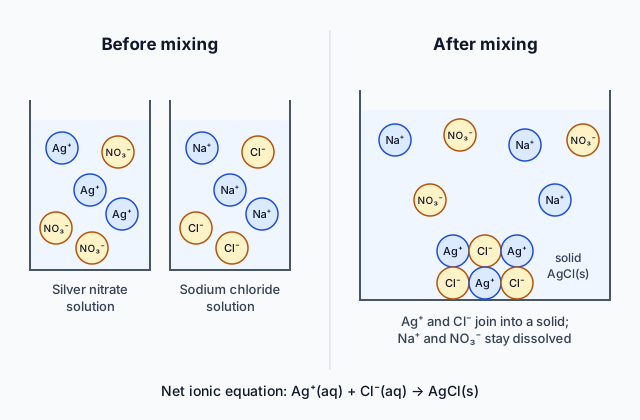
In a precipitation reaction, ions in solution join into an ionic solid that does not dissolve, or dissolves only slightly. Example: mixing silver nitrate and sodium chloride solutions forms solid silver chloride, Ag⁺(aq) + Cl⁻(aq) → AgCl(s).
Which pairing forms the solid? One rule settles many cases: every sodium, potassium, ammonium and nitrate salt is soluble in water. So Na⁺ and NO₃⁻ stay dissolved, and the solid has to be the other pairing, AgCl.
A solid among the reactants does not make a reaction a precipitation. Look for a solid among the products, formed from ions that were dissolved.
Quick check · Sort it
Each card is a net ionic equation for a reaction in water. Tap a card, then the type of reaction it shows.
Acid-base
Precipitation
2b. Oxidation numbers
The third type, redox, is found by bookkeeping. An oxidation number is the charge an atom would carry if every bond in its substance were ionic, with the shared electrons given to the more electronegative atom. Assign oxidation numbers with these rules:
- An atom in an element on its own (Fe, O₂, Cl₂) is 0.
- A monatomic ion is its charge: Na⁺ is +1 and S²⁻ is −2. Group 1 metals are +1 and group 2 metals +2 in their compounds.
- Fluorine is −1. Oxygen is −2 in most compounds (−1 in peroxides such as H₂O₂), and hydrogen is +1 when bonded to nonmetals.
- The oxidation numbers in a formula add up to its overall charge: 0 for a compound, and the ion's charge for an ion.
Example: chromium in the dichromate ion, Cr₂O₇²⁻. Seven oxygens give 7 × (−2) = −14. The total must be −2, so the two chromium atoms carry +12 together: 2x − 14 = −2, and x = +6.
An oxidation number is bookkeeping, not a real charge. The chromium in dichromate is not a Cr⁶⁺ ion; its electrons are shared with oxygen, and the rules give each shared pair to oxygen.
Quick check · Calculate
Potassium permanganate, KMnO₄, dissolves in water to give the permanganate ion, MnO₄⁻. What is the oxidation number of manganese in MnO₄⁻? Give the number with its sign.
2c. Electrons pass: redox and combustion
In an oxidation-reduction (redox) reaction, electrons pass from one species to another, and the change shows up in oxidation numbers.
- The species that loses electrons is oxidized: its oxidation number goes up.
- The species that gains them is reduced: its oxidation number goes down.
- Electrons pass from the species oxidized to the species reduced, so neither change happens without the other.
Example: zinc metal in copper(II) sulfate solution, Zn(s) + Cu²⁺(aq) → Zn²⁺(aq) + Cu(s). Zinc goes from 0 to +2, so it is oxidized; copper goes from +2 to 0, so it is reduced. Electrons passed from the zinc atoms to the copper ions.
To decide whether a reaction is redox, assign an oxidation number to every atom on both sides. If any of them changes, the reaction is redox. If none does, it is not.
Combustion is an important kind of redox reaction, in which a substance reacts with oxygen gas. A hydrocarbon, a compound of only carbon and hydrogen, burns completely to carbon dioxide and water. For propane: C₃H₈(g) + 5O₂(g) → 3CO₂(g) + 4H₂O(g).
Quick check · Fill the statement
Magnesium ribbon burns in air with a bright white flame: 2Mg(s) + O₂(g) → 2MgO(s). Complete the description.
Magnesium's oxidation number goes from to , so magnesium is . Electrons pass from . A hydrocarbon such as butane, C₄H₁₀, also burns in oxygen gas, and when it burns completely its products are .
Part 3 Watch it done Burning natural gas
Watch each step, then finish the last one yourself.
Natural gas is mostly methane, which burns completely in a stove: CH₄(g) + 2O₂(g) → CO₂(g) + 2H₂O(g). What type of reaction is this, and what happens to carbon?
Step 1 · Rule out precipitation
Every species is a gas, and no dissolved ions join into a solid. This is not a precipitation.
Step 2 · Look for a proton passing on
The hydrogen atoms move from carbon to oxygen as bonds break and form, but no species hands an H⁺ to another, the way acetic acid did to ammonia. This is not an acid-base reaction.
Why this step?
Why assign oxidation numbers here instead of looking for ions?
Every species is a molecule, so no ion charges show electrons moving. Oxidation numbers track electrons even when they are shared, by giving each shared pair to the more electronegative atom.
Step 3 · Assign oxygen and hydrogen
Oxygen is 0 in O₂, an element on its own, and −2 in both CO₂ and H₂O. Hydrogen is +1 in both CH₄ and H₂O. Oxygen's oxidation number falls, so oxygen is reduced and the reaction is redox: a combustion.
Your step · Calculate
Finish it. In CH₄(g) + 2O₂(g) → CO₂(g) + 2H₂O(g), by how much does the oxidation number of carbon change from methane to carbon dioxide? Give the change with its sign: positive for a rise, negative for a fall.
A combustion looks nothing like zinc in a copper solution, yet the bookkeeping shows the same thing: one element's oxidation number rises while another's falls.
Part 4 Try it Mixing solutions in a well plate
A student mixes pairs of clear solutions in a well plate and watches for a solid.
Try it · Decide and justify
The student mixes sodium nitrate solution with potassium chloride solution, KCl(aq). Will a solid form?
Which reason supports your decision?
Try it · Multiple choice
Next the student mixes lead(II) nitrate solution, Pb(NO₃)₂(aq), with potassium iodide solution, KI(aq), and a bright yellow solid forms. Which compound is the solid?
Part 5 Explain it Copper wire in silver nitrate
On the exam this is handwritten, so answer on paper first. Nothing you type here leaves this page. Then check your answer against the model and each scoring point.
Free response is 50% of the exam score. This one is shaped like a short-answer question, which is worth 4 points.
Free-response practice · Short-answer style
A coil of copper wire is placed in a colorless solution of silver nitrate. Over an hour, shiny silver crystals grow on the wire and the solution turns blue. The net ionic equation is Cu(s) + 2Ag⁺(aq) → Cu²⁺(aq) + 2Ag(s).
(a) Identify the type of reaction, acid-base, redox or precipitation, and justify your answer using oxidation numbers.
(b) Identify the species that is oxidized, and justify your answer.
(c) Describe the direction in which electrons are transferred, and determine how many electrons each copper atom gives up.
(d) The solution ends up holding Cu²⁺ ions and NO₃⁻ ions. Explain why no solid copper(II) nitrate forms.
Model answer
(a) Redox. Copper goes from 0 in the metal to +2 in Cu²⁺, and silver goes from +1 in Ag⁺ to 0 in the metal. Oxidation numbers change, so electrons are transferred. A solid forms, but it is silver metal made from reduced ions, not an ionic solid made by dissolved ions joining, so this is not a precipitation.
(b) Copper, Cu. Its oxidation number rises from 0 to +2, so it loses electrons.
(c) Electrons pass from the copper atoms, which are oxidized, to the silver ions, which are reduced. Each copper atom gives up two electrons, one to each of two Ag⁺ ions.
(d) Every nitrate salt is soluble in water, so Cu²⁺ and NO₃⁻ stay dissolved. The nitrate ions take no part in the reaction.
Score your own answer. This is a self-check, not a grade. Tick each point your answer makes.
Part 6 Check yourself Four wells
Both case questions use the table.
A student mixes reactants in four wells of a well plate and records what she sees. Her net ionic equation for each well is in the table.
| Well | Reactants | Observation | Net ionic equation |
|---|---|---|---|
| 1 | Na₂CO₃(aq) and CaCl₂(aq) | A white solid forms | Ca²⁺(aq) + CO₃²⁻(aq) → CaCO₃(s) |
| 2 | Zn(s) and HCl(aq) | The metal fizzes and dissolves | Zn(s) + 2H⁺(aq) → Zn²⁺(aq) + H₂(g) |
| 3 | NaOH(aq) and HNO₃(aq) | The well warms; nothing else changes | H⁺(aq) + OH⁻(aq) → H₂O(l) |
| 4 | KNO₃(aq) and NaCl(aq) | No change | No reaction |
Case question 1 · Fill the statement
Using the table, complete the description of well 1.
The cation that takes no part and stays dissolved is , and the anion that does the same is . The solid cannot be sodium chloride, because .
Case question 2 · Decide and justify
Using the table: a classmate says well 2 is a redox reaction, even though hydrochloric acid is one of the reactants. Is the classmate right?
Which reason supports your decision?
The rest stand on their own and do not use the case.
Check yourself · Rank it
Nitrogen appears in many oxidation states. Rank these four species by the oxidation number of nitrogen in each.
Lowest oxidation number first
Give each one a place, 1 for first. Give two the same place if they are equal.
Your ranking: none yet
Check yourself · Spot the error
A student decides whether 2SO₂(g) + O₂(g) → 2SO₃(g) is a redox reaction, and which species change. Tap the line where the work first goes wrong.
Part 7 Keep it Bring back earlier ideas
This lesson leans on two earlier ideas: a net ionic equation keeps only the species that change, and the charge of a particle is its protons minus its electrons. Pulling them back up is what makes them last.
Each of these names the solid that forms, so you can focus on the equations.
From 4.2 Net Ionic Equations · Match
Solutions of nickel(II) chloride and sodium hydroxide are mixed in a beaker, and a green solid, nickel(II) hydroxide, forms. The solid is filtered off, and the water in the liquid that passes through later evaporates. Match each purpose to the equation that serves it.
From 1.5 Atomic Structure and Electron Configuration · Calculate
A particle has 12 protons, 12 neutrons and 10 electrons. What is its charge? Give a whole number, with a minus sign if it is negative.
In three lines
- Acid-base reactions pass a proton, H⁺, from one species to another; precipitation reactions join dissolved ions into an ionic solid.
- Redox reactions pass electrons from the species oxidized, whose oxidation number rises, to the species reduced, whose oxidation number falls; combustion in oxygen gas is one kind.
- Oxidation numbers add up to the overall charge of a formula, and every sodium, potassium, ammonium and nitrate salt is soluble in water.
Exam strategy for this topic
- Section I, Multiple Choice: 60 questions in 90 minutes.
- Section II, Free Response: 7 questions in 105 minutes.
- A scientific or graphing calculator is recommended for use on both sections of the exam.
When a question asks you to identify a reaction type, back it up with evidence from the equation: name the species that gained or lost an H⁺, give the oxidation numbers that change, or point to the solid that forms from dissolved ions. A name with no evidence may not earn the point.
Questions students ask
What are the three main types of reactions in AP Chemistry?
Acid-base, redox and precipitation. An acid-base reaction passes a proton, H⁺, between species; a redox reaction passes electrons; a precipitation reaction joins dissolved ions into an ionic solid that does not dissolve.
How do you tell whether a reaction is redox?
Assign an oxidation number to every atom on both sides of the equation. If any of them changes, electrons were transferred and the reaction is redox.
Is combustion a redox reaction?
Yes. In a combustion a substance reacts with oxygen gas, and oxygen goes from 0 in O₂ to −2 in the products. A hydrocarbon burns completely to carbon dioxide and water.
Which salts are soluble in water?
Every sodium, potassium, ammonium and nitrate salt is soluble. When two solutions are mixed and a solid forms, the solid is a pairing that leaves out those ions.
How do you find an oxidation number?
Use the rules: an element on its own is 0, a monatomic ion is its charge, oxygen is usually −2 and hydrogen +1 with nonmetals, and the numbers in a formula add up to its overall charge.
Beyond the AP Exam
College Board sets these limits on what the AP Exam asks about this topic. Anything past them is not on the exam.
The meaning of the terms "reducing agent" and "oxidizing agent" will not be assessed on the AP Exam.
Rote memorization of "solubility rules" other than those implied in topic 4.7 will not be assessed on the AP Exam.
Course alignment, for teachers
AP Chemistry topic 4.7, Unit 4: Chemical Reactions.
- Skill 1.B: Describe the components of and quantitative information from models and representations that illustrate both particulate-level and macroscopic-level properties.
This lesson maps all 5 essential knowledge statements of the topic to the part that teaches each one: 5 are checked by a scored question. The map is in the lesson file.