Unit 4 · Topic 4.8 · about 30 minutes · 7 parts · 10 scored checks, 2 of them multiple choice, plus 2 from earlier lessons
AP Chemistry 4.8: Introduction to Acid-Base Reactions
Unit 4: 7 to 9% of the multiple-choice section
What you'll be able to do
- Identify species as Brønsted-Lowry acids, bases, and/or conjugate acid-base pairs, based on proton-transfer involving those species.
Key vocabulary
| Term | What it means | The exam trap |
|---|---|---|
| Brønsted-Lowry acid | A species that donates a proton, H⁺, to another species. | Find the acid by comparing formulas across the arrow, not by looking for an H at the front of a formula. |
| Brønsted-Lowry base | A species that accepts a proton, H⁺, from another species. | Count the hydrogens on both sides of the arrow, because a base is named by the H it gains, not by its charge. |
| Conjugate acid-base pair | Two species whose formulas differ by exactly one proton, H⁺, such as HF and F⁻. | Write both members of a pair with their charges, because a formula without its charge can stand for the wrong species. |
| Proton | In acid-base chemistry, a hydrogen ion, H⁺: a hydrogen atom that has lost its only electron. | Proton and hydrogen ion mean the same particle here, so a question may use either name. |
 Tap to open the picture full size
Part 1 Think first Ammonia cleaner
Commit to a guess first. Being wrong now makes the right idea stick better.
Predict first
A bottle of household ammonia cleaner is ammonia gas, NH₃, dissolved in water. Tests show that the solution contains hydroxide ions, OH⁻, yet an ammonia molecule has no oxygen atom in it. Where do the OH⁻ ions come from?
In short. In a Brønsted-Lowry acid-base reaction, an acid donates a proton, H⁺, to a base, and each becomes its conjugate: the acid turns into its conjugate base and the base into its conjugate acid.
- An acid and its conjugate base differ by one H⁺, so their formulas differ by one H and their charges by one.
- In aqueous solution, water can accept a proton from a dissolved acid or donate one to a dissolved base.
- The more readily an acid gives up its proton, the weaker its conjugate base is as a proton acceptor.
Part 2 Learn it Proton donors and acceptors
2a. Donor and acceptor
An acid-base reaction is a proton transfer, and the Brønsted-Lowry definitions name each species for what it does with the proton:
- a Brønsted-Lowry acid is a proton donor: it gives up an H⁺;
- a Brønsted-Lowry base is a proton acceptor: it takes one.
To find them, compare each reactant with the product it becomes. Example: HF(aq) + NH₃(aq) ⇌ F⁻(aq) + NH₄⁺(aq). HF becomes F⁻, with one H fewer and one more negative charge, so HF donated a proton and is the acid. NH₃ becomes NH₄⁺, with one H more and one more positive charge, so NH₃ accepted the proton and is the base.
A proton carries a 1+ charge. Losing one lowers a species' charge by one, and gaining one raises it by one, so the charges are a quick check that you have followed the H⁺ the right way.
The double arrow ⇌ marks a reaction that also runs in reverse, which matters in the third chunk.
Quick check · Fill the statement
Hydrogen sulfide, H₂S, reacts with hydroxide ion: H₂S(aq) + OH⁻(aq) → HS⁻(aq) + H₂O(l). Complete the description.
The proton donor is , so it is the acid. The proton acceptor is , so it is the base. After the reaction, the transferred proton is part of .
2b. Water goes both ways
In aqueous solution, water is more than the solvent. A water molecule has hydrogen atoms it can give up as H⁺, and its oxygen atom can take on one more H⁺, so it can do either job:
- Water accepts a proton from a dissolved acid and becomes the hydronium ion, H₃O⁺: HCl(aq) + H₂O(l) → H₃O⁺(aq) + Cl⁻(aq). Here water is the base.
- Water donates a proton to a dissolved base and is left as the hydroxide ion, OH⁻: NH₃(aq) + H₂O(l) ⇌ NH₄⁺(aq) + OH⁻(aq). Here water is the acid.
So water's role depends on its partner, and you read it from the products: water that ends up as H₃O⁺ accepted a proton, and water that ends up as OH⁻ donated one.
This double role belongs to reactions in water. The acid-base reactions in this course take place in aqueous solution, where water is very often one of the two partners.
Quick check · Sort it
Each card is a reaction in water. Tap a card, then the role water plays in it.
Water is the acid
Water is the base
2c. Conjugate pairs and their strengths
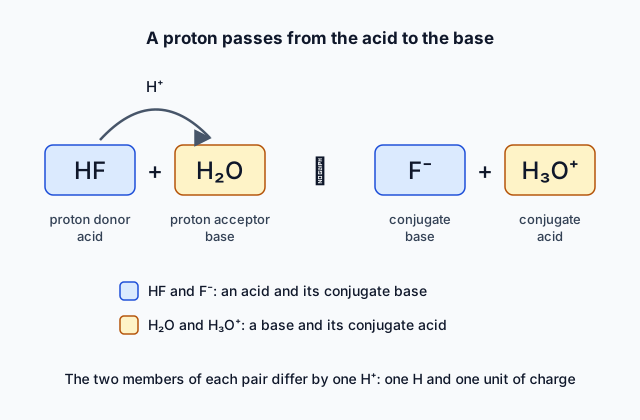
A proton transfer can run in reverse, and the reverse is an acid-base reaction too. In HF(aq) + H₂O(l) ⇌ F⁻(aq) + H₃O⁺(aq), F⁻ can take the proton back, so it acts as a base, and H₃O⁺ can give one, so it acts as an acid.
Two species that differ by exactly one H⁺ form a conjugate acid-base pair:
- HF and F⁻: F⁻ is the conjugate base of HF;
- H₂O and H₃O⁺: H₃O⁺ is the conjugate acid of H₂O.
Each reaction has two such pairs, and each pair has one reactant and one product. The two members of a pair differ by one H and by one unit of charge.
The members of a pair are linked in strength. An acid that gives up its proton readily has a conjugate base that holds a proton only weakly, and an acid that holds on to its proton has a conjugate base that takes one readily. The stronger the acid, the weaker its conjugate base. Example: nitric acid gives up a proton far more readily than water does, so nitrate, NO₃⁻, is a far weaker base than hydroxide, OH⁻.
Quick check · Rank it
Three acids give up protons to water. Hydrochloric acid, HCl, does so most readily, hydrofluoric acid, HF, less readily, and hydrocyanic acid, HCN, least readily. Rank their conjugate bases by how strongly each one accepts a proton.
Strongest base first
Give each one a place, 1 for first. Give two the same place if they are equal.
Your ranking: none yet
Part 3 Watch it done Hydrogen sulfate in water
Watch each step, then finish the last one yourself.
The hydrogen sulfate ion reacts with water: H₂O(l) + HSO₄⁻(aq) ⇌ H₃O⁺(aq) + SO₄²⁻(aq). Name the role of every species.
Step 1 · Pair the species that differ by one H
H₂O and H₃O⁺ differ by one H, and so do HSO₄⁻ and SO₄²⁻. Those are the two conjugate pairs, each with one reactant and one product. The order the species are written in does not matter; their formulas do.
Step 2 · Check the charges
Each pair also differs by exactly one unit of charge, as a conjugate pair must. A proton moves as H⁺, so one H and one unit of charge always move together.
Why this step?
Why pair the species before naming any of them acid or base?
The names come from the direction the proton moves. Once each reactant is matched to the product it becomes, you can see which one lost the H⁺ and which one gained it.
Your step · Match
Finish it. In H₂O(l) + HSO₄⁻(aq) ⇌ H₃O⁺(aq) + SO₄²⁻(aq), match each species to its role.
Every Brønsted-Lowry reaction has this shape: acid + base ⇌ conjugate base + conjugate acid, with each pair split across the arrow, whatever order the species are written in.
Part 4 Try it Baking soda and fertilizer
Baking soda and some garden fertilizers contain ions that have hydrogen in them. Two questions about them.
Try it · Decide and justify
The hydrogen carbonate ion, HCO₃⁻, from baking soda takes part in two reactions. Reaction 1: HCO₃⁻(aq) + OH⁻(aq) → CO₃²⁻(aq) + H₂O(l). Reaction 2: HCO₃⁻(aq) + H₃O⁺(aq) → H₂CO₃(aq) + H₂O(l). A student says HCO₃⁻ is a Brønsted-Lowry acid in both reactions. Is the student right?
Which reason supports your decision?
Try it · Multiple choice
A phosphate fertilizer releases the dihydrogen phosphate ion, H₂PO₄⁻, into soil water. What is the conjugate base of H₂PO₄⁻?
Part 5 Explain it Nitrous acid and hydrazine
On the exam this is handwritten, so answer on paper first. Nothing you type here leaves this page. Then check your answer against the model and each scoring point.
Free response is 50% of the exam score. This one is shaped like a short-answer question, which is worth 4 points.
Free-response practice · Short-answer style
Nitrous acid, HNO₂, reacts with water: HNO₂(aq) + H₂O(l) ⇌ NO₂⁻(aq) + H₃O⁺(aq).
(a) Identify the Brønsted-Lowry acid and the Brønsted-Lowry base among the reactants, and justify your answer.
(b) Identify both conjugate acid-base pairs in the reaction.
(c) Hydrazine, N₂H₄, also reacts with water: N₂H₄(aq) + H₂O(l) ⇌ N₂H₅⁺(aq) + OH⁻(aq). Describe the role water plays in this reaction, and explain how it differs from water's role in the nitrous acid reaction.
(d) Nitrous acid gives up its proton to water more readily than acetic acid, HC₂H₃O₂, does. Predict which conjugate base, NO₂⁻ or C₂H₃O₂⁻, is the stronger base, and justify your prediction.
Model answer
(a) HNO₂ is the acid and H₂O is the base. HNO₂ loses an H⁺ and becomes NO₂⁻, so it donates a proton; H₂O gains that H⁺ and becomes H₃O⁺, so it accepts one.
(b) HNO₂ and NO₂⁻, an acid and its conjugate base; H₂O and H₃O⁺, a base and its conjugate acid.
(c) Water donates a proton to N₂H₄ and is left as OH⁻, so here water is the Brønsted-Lowry acid. With nitrous acid it accepted a proton and acted as the base. In aqueous solution water can do either, depending on its partner.
(d) C₂H₃O₂⁻ is the stronger base. Acetic acid gives up its proton less readily, so its conjugate base holds a proton more strongly. The stronger acid, HNO₂, has the weaker conjugate base.
Score your own answer. This is a self-check, not a grade. Tick each point your answer makes.
Part 6 Check yourself Two solutions in the lab
Both case questions use the table.
A student dissolves hypochlorous acid, HClO, in one beaker of water and methylamine, CH₃NH₂, in another, and writes an equation for each.
| Reaction | Equation |
|---|---|
| 1 | HClO(aq) + H₂O(l) ⇌ ClO⁻(aq) + H₃O⁺(aq) |
| 2 | CH₃NH₂(aq) + H₂O(l) ⇌ CH₃NH₃⁺(aq) + OH⁻(aq) |
Case question 1 · Multiple choice
Using the table: which two species in reaction 1 form a conjugate acid-base pair?
Case question 2 · Fill the statement
Using the table, complete the description of water's role in each reaction.
In reaction 1, water acts as . In reaction 2, water acts as , and the conjugate acid of CH₃NH₂ is .
The rest stand on their own and do not use the case.
Check yourself · Spot the error
A student analyzes the reaction of formic acid with ammonia: HCOOH(aq) + NH₃(aq) ⇌ HCOO⁻(aq) + NH₄⁺(aq). Tap the line where the work first goes wrong.
Check yourself · Select all
Which two species can act as either a Brønsted-Lowry acid or a Brønsted-Lowry base in water? Select two.
Select 2 answers, then check.
Part 7 Keep it Bring back earlier ideas
This lesson leans on two earlier ideas: reactions sort into kinds by what passes between the species, and water's partial charges let it surround and hold dissolved ions. Pulling them back up is what makes them last.
From 4.7 Types of Chemical Reactions · Fill the statement
Magnesium ribbon burns in air with a bright white flame: 2Mg(s) + O₂(g) → 2MgO(s). Complete the description.
Magnesium's oxidation number goes from to , so magnesium is . Electrons pass from . A hydrocarbon such as butane, C₄H₁₀, also burns in oxygen gas, and when it burns completely its products are .
From 3.8 Representations of Solutions · Decide and justify
A student draws a bromide ion, Br⁻, dissolved in water, with four water molecules around it. Each water molecule points its O atom at the Br⁻ ion. Is the drawing correct?
Which reason supports your decision?
In three lines
- A Brønsted-Lowry acid donates a proton, H⁺, and a Brønsted-Lowry base accepts it.
- In aqueous solution, water accepts a proton to become H₃O⁺ or donates one to be left as OH⁻, depending on its partner.
- A conjugate acid-base pair differs by one H⁺, and the stronger the acid, the weaker its conjugate base.
Exam strategy for this topic
- Section I, Multiple Choice: 60 questions in 90 minutes.
- Section II, Free Response: 7 questions in 105 minutes.
- A scientific or graphing calculator is recommended for use on both sections of the exam.
When you identify an acid, a base or a conjugate pair, show the proton moving: name the species that loses the H⁺ and the species it becomes. Writing each pair with its charges, such as HF and F⁻, shows the reader you followed one H⁺.
Questions students ask
What is a Brønsted-Lowry acid?
A proton donor: a species that gives up an H⁺ to another species. The species that takes the H⁺ is the Brønsted-Lowry base.
How do you find a conjugate acid-base pair?
Look for a reactant and a product that differ by exactly one H⁺, which means one H and one unit of charge. HF and F⁻ are a pair, and so are H₂O and H₃O⁺.
Is water an acid or a base?
Either, depending on its partner. Water accepts a proton from an acid such as HCl and becomes H₃O⁺, and it donates a proton to a base such as NH₃ and is left as OH⁻.
How are the strengths of an acid and its conjugate base related?
The stronger the acid, the weaker its conjugate base. An acid that gives up its proton readily leaves a conjugate base that holds a proton only weakly.
What is the difference between a conjugate acid and a conjugate base?
A conjugate base is what an acid becomes after it gives up a proton. A conjugate acid is what a base becomes after it takes one on.
Beyond the AP Exam
College Board sets this limit on what the AP Exam asks about this topic. Anything past it is not on the exam.
Lewis acid-base concepts will not be assessed on the AP Exam. The emphasis in AP Chemistry is on reactions in aqueous solution.
Course alignment, for teachers
AP Chemistry topic 4.8, Unit 4: Chemical Reactions.
- Skill 1.B: Describe the components of and quantitative information from models and representations that illustrate both particulate-level and macroscopic-level properties.
This lesson maps all 3 essential knowledge statements of the topic to the part that teaches each one: 3 are checked by a scored question. The map is in the lesson file.