Unit 4 · Topic 4.9 · about 30 minutes · 7 parts · 10 scored checks, 1 of them multiple choice, plus 2 from earlier lessons
AP Chemistry 4.9: Oxidation-Reduction (Redox) Reactions
Unit 4: 7 to 9% of the multiple-choice section
What you'll be able to do
- Represent a balanced redox reaction equation using half-reactions.
Key vocabulary
| Term | What it means | The exam trap |
|---|---|---|
| Half-reaction | An equation for either the oxidation or the reduction part of a redox reaction, with the electrons written in as e⁻. | A half-reaction must balance in charge as well as in atoms, so count the charge on each side before you move on. |
| Oxidation | The loss of electrons by a species, which raises its oxidation number. | Oxidation does not need oxygen: any loss of electrons counts, whether or not oxygen takes part. |
| Reduction | The gain of electrons by a species, which lowers its oxidation number. | The name describes the oxidation number going down, so a species that gains electrons is reduced even though it gains something. |
 Tap to open the picture full size
Part 1 Think first Aluminum foil in a blue solution
Commit to a guess first. Being wrong now makes the right idea stick better.
Predict first
In a classroom demonstration, a ball of aluminum foil is dropped into blue copper(II) chloride solution. The foil dissolves as aluminum ions, Al³⁺, and reddish copper metal forms from the copper(II) ions, Cu²⁺. For every 2 aluminum atoms that dissolve, how many copper atoms form?
In short. A half-reaction shows one side of a redox reaction with its electrons written in, and two half-reactions that move the same number of electrons add up to the balanced equation.
- Electrons are products in the oxidation half-reaction and reactants in the reduction half-reaction.
- Multiply each half-reaction so the electrons lost equal the electrons gained, then add and cancel.
- In acidic solution, balance oxygen with H₂O, hydrogen with H⁺ and charge with electrons.
Part 2 Learn it Building equations from half-reactions
2a. Two halves of one reaction
A redox reaction moves electrons from the species oxidized to the species reduced. A half-reaction writes each side of that transfer on its own, with the electrons shown as e⁻.
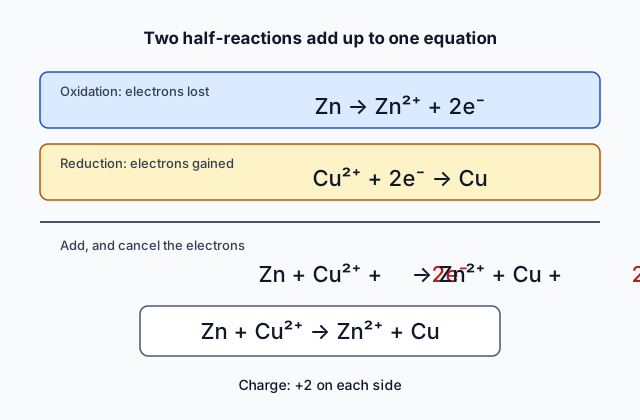
Example: zinc metal in copper(II) sulfate solution, Zn(s) + Cu²⁺(aq) → Zn²⁺(aq) + Cu(s).
- Oxidation half-reaction: Zn(s) → Zn²⁺(aq) + 2e⁻. Zinc loses electrons, so they appear on the product side.
- Reduction half-reaction: Cu²⁺(aq) + 2e⁻ → Cu(s). The copper ions gain electrons, so they appear on the reactant side.
Each half-reaction must balance on its own, in atoms and in charge. In the zinc half-reaction, the left side has a charge of 0 and the right side has +2 + 2(−1) = 0. Counting the charge on each side is how you know how many electrons to write.
To split a reaction, find the element whose oxidation number rises and write its half-reaction, then do the same for the element whose oxidation number falls.
Quick check · Sort it
Each card is a balanced half-reaction. Tap a card, then the kind of half-reaction it is.
Oxidation
Reduction
2b. Match the electrons, then add
Electrons are not made or destroyed in a reaction, so the electrons given up in the oxidation must equal the electrons taken in by the reduction. When the two half-reactions move different numbers, multiply each one by a whole number until they match.
Example: zinc in silver nitrate solution.
- Oxidation: Zn(s) → Zn²⁺(aq) + 2e⁻, 2 electrons lost.
- Reduction: Ag⁺(aq) + e⁻ → Ag(s), 1 electron gained.
Multiply the reduction by 2, to 2Ag⁺(aq) + 2e⁻ → 2Ag(s), so that each half moves 2 electrons. Add the two and cancel the 2e⁻ that now appear on both sides:
Zn(s) + 2Ag⁺(aq) → Zn²⁺(aq) + 2Ag(s)
Then check it twice. Atoms: one Zn and two Ag on each side. Charge: 2(+1) = +2 on the left and +2 on the right. Atoms alone are not enough: Zn + Ag⁺ → Zn²⁺ + Ag has the right atoms, but a charge of +1 on the left and +2 on the right, so it is not balanced.
Quick check · Calculate
Aluminum metal reacts with silver ions: Al(s) + Ag⁺(aq) → Al³⁺(aq) + Ag(s), not yet balanced. Build the balanced equation from half-reactions, with the smallest whole-number coefficients. How many electrons are transferred in it? Give a whole number.
2c. Half-reactions in acidic solution
Many redox reactions run in acidic solution, where water molecules and H⁺ ions are on hand, and a half-reaction there may need both to balance. Work in this order:
- Balance every element except oxygen and hydrogen.
- Balance oxygen by adding H₂O.
- Balance hydrogen by adding H⁺.
- Balance charge by adding electrons.
Example: permanganate ion turning into manganese(II) ion. Start with MnO₄⁻ → Mn²⁺. Manganese is already balanced. Four oxygens on the left need 4H₂O on the right. Those bring 8 hydrogens, so add 8H⁺ to the left: MnO₄⁻ + 8H⁺ → Mn²⁺ + 4H₂O. Now the charge is −1 + 8 = +7 on the left and +2 on the right, so add 5e⁻ to the left:
MnO₄⁻(aq) + 8H⁺(aq) + 5e⁻ → Mn²⁺(aq) + 4H₂O(l)
The 5 electrons agree with the oxidation numbers, since manganese falls from +7 to +2. From here, match the electrons with the other half-reaction and add, as before.
Quick check · Fill the statement
Iodate ion is reduced to iodine in acidic solution. Complete the balanced half-reaction by filling in the coefficients.
IO₃⁻(aq) + H⁺(aq) + e⁻ → I₂(aq) + H₂O(l)
Part 3 Watch it done Dichromate and iron(II)
Watch each step, then finish the last one yourself.
In acidic solution, orange dichromate ions react with iron(II) ions: Cr₂O₇²⁻(aq) + Fe²⁺(aq) → Cr³⁺(aq) + Fe³⁺(aq), not yet balanced. Build the balanced equation from half-reactions.
Step 1 · Split it
Iron goes from +2 to +3, so iron is oxidized and its half-reaction is Fe²⁺ → Fe³⁺ + e⁻. Chromium is the element that is reduced, so the other half-reaction starts as Cr₂O₇²⁻ → Cr³⁺.
Step 2 · Balance chromium, then oxygen
Two chromium atoms on the left need 2Cr³⁺ on the right. Seven oxygens on the left need 7H₂O on the right: Cr₂O₇²⁻ → 2Cr³⁺ + 7H₂O.
Step 3 · Balance hydrogen
Seven water molecules hold 14 hydrogens, so add 14H⁺ to the left: Cr₂O₇²⁻ + 14H⁺ → 2Cr³⁺ + 7H₂O.
Why this step?
Why balance the oxygen with water and not with O₂?
In acidic solution the oxygen atoms end up in water molecules, which are all around. No oxygen gas forms or is used up in this reaction, so writing O₂ would describe a different reaction.
Your step · Calculate
Finish it. Balance the charge of Cr₂O₇²⁻ + 14H⁺ → 2Cr³⁺ + 7H₂O with electrons, then match its electrons with Fe²⁺ → Fe³⁺ + e⁻. In the balanced equation, how many Fe²⁺ ions react with one Cr₂O₇²⁻ ion? Give a whole number.
ions
Check the whole equation: the charge on the left is −2 + 14 + 6(+2) = +24, and on the right it is 2(+3) + 6(+3) = +24.
Part 4 Try it Two new reactions
One reaction runs in a titration flask, and the other etches copper from circuit boards.
Try it · Fill the statement
In acidic solution, permanganate reacts with tin(II) ions. The half-reactions are MnO₄⁻(aq) + 8H⁺(aq) + 5e⁻ → Mn²⁺(aq) + 4H₂O(l) and Sn²⁺(aq) → Sn⁴⁺(aq) + 2e⁻. Complete the steps that combine them.
Multiply the manganese half-reaction by and the tin half-reaction by , so that electrons cancel. The balanced equation then has H⁺ ions on the left.
Try it · Decide and justify
Circuit boards are etched with iron(III) chloride solution, which dissolves copper. A student writes Cu(s) + Fe³⁺(aq) → Cu²⁺(aq) + Fe²⁺(aq). Is the equation balanced?
Which reason supports your decision?
Part 5 Explain it Copper in nitric acid
On the exam this is handwritten, so answer on paper first. Nothing you type here leaves this page. Then check your answer against the model and each scoring point.
Free response is 50% of the exam score. This one is shaped like a short-answer question, which is worth 4 points.
Free-response practice · Short-answer style
Copper metal dissolves in nitric acid, giving blue Cu²⁺ ions and colorless nitrogen monoxide gas, NO. The unbalanced equation, in acidic solution, is Cu(s) + NO₃⁻(aq) → Cu²⁺(aq) + NO(g).
(a) Represent the oxidation half-reaction, balanced in atoms and in charge.
(b) Represent the reduction half-reaction, balanced in acidic solution with H₂O, H⁺ and electrons.
(c) Represent the balanced net ionic equation for the overall reaction, with the smallest whole-number coefficients.
(d) Justify that your equation in (c) conserves charge by giving the total charge on each side.
Model answer
(a) Cu(s) → Cu²⁺(aq) + 2e⁻
(b) NO₃⁻(aq) + 4H⁺(aq) + 3e⁻ → NO(g) + 2H₂O(l). Two H₂O balance the oxygen, 4H⁺ balance their hydrogen, and 3e⁻ bring the charge on the left from −1 + 4 = +3 down to 0, the charge on the right. Nitrogen falls from +5 to +2, which agrees with 3 electrons.
(c) Multiply (a) by 3 and (b) by 2, so 6 electrons cancel: 3Cu(s) + 2NO₃⁻(aq) + 8H⁺(aq) → 3Cu²⁺(aq) + 2NO(g) + 4H₂O(l)
(d) Left: 2(−1) + 8(+1) = +6. Right: 3(+2) = +6. The totals are equal, so charge is conserved.
Score your own answer. This is a self-check, not a grade. Tick each point your answer makes.
Part 6 Check yourself Half-reactions from a handout
Both case questions use the table.
A lab handout lists three half-reactions, each written in the direction it runs in that week's reactions.
| Half-reaction | Equation |
|---|---|
| 1 | Ag⁺(aq) + e⁻ → Ag(s) |
| 2 | Ni(s) → Ni²⁺(aq) + 2e⁻ |
| 3 | O₂(g) + 4H⁺(aq) + 4e⁻ → 2H₂O(l) |
Case question 1 · Calculate
Using the table: half-reactions 1 and 2 combine into the balanced equation for nickel metal reacting with silver ions. With the smallest whole-number coefficients, what is the coefficient of Ag⁺? Give a whole number.
Case question 2 · Multiple choice
Using the table: which equation correctly combines half-reactions 2 and 3?
The rest stand on their own and do not use the case.
Check yourself · Spot the error
A student builds the balanced equation for aluminum metal dissolving in acid, Al(s) + H⁺(aq) → Al³⁺(aq) + H₂(g). Tap the line where the work first goes wrong.
Check yourself · Match
Match each change to the electrons its balanced half-reaction shows.
Part 7 Keep it Bring back earlier ideas
This lesson leans on two earlier ideas: oxidation numbers show which species gain or lose electrons, and a net ionic equation keeps only the species that change. Pulling them back up is what makes them last.
From 4.7 Types of Chemical Reactions · Spot the error
A student decides whether 2SO₂(g) + O₂(g) → 2SO₃(g) is a redox reaction, and which species change. Tap the line where the work first goes wrong.
From 4.2 Net Ionic Equations · Put it in order
Put the steps for writing a net ionic equation in order.
In three lines
- A half-reaction shows the oxidation or the reduction on its own, with electrons as products in an oxidation and as reactants in a reduction.
- Multiply the half-reactions so the electrons lost equal the electrons gained, add them, and cancel the electrons.
- In acidic solution, balance other elements first, then oxygen with H₂O, hydrogen with H⁺ and charge with electrons.
Exam strategy for this topic
- Section I, Multiple Choice: 60 questions in 90 minutes.
- Section II, Free Response: 7 questions in 105 minutes.
- A scientific or graphing calculator is recommended for use on both sections of the exam.
When a question asks for a balanced redox equation, show the two half-reactions first, then the multipliers, then the sum. Check the final equation for atoms and for total charge; an equation that balances atoms alone may not earn the point.
Questions students ask
What is a half-reaction?
An equation for one part of a redox reaction, either the oxidation or the reduction, with the electrons written in. Zn → Zn²⁺ + 2e⁻ is the oxidation half-reaction when zinc reacts with copper(II) ions.
How do you balance a redox equation with half-reactions?
Split the reaction into its oxidation and reduction, balance each one in atoms and charge, multiply them so the electrons lost equal the electrons gained, then add them and cancel the electrons.
How do you balance a half-reaction in acidic solution?
Balance every element but oxygen and hydrogen, then add H₂O to balance oxygen, H⁺ to balance hydrogen, and electrons to balance the charge.
Why must the electrons cancel in a redox equation?
Electrons are not made or destroyed; every electron the oxidized species gives up is taken in by the reduced species. If they do not cancel, the charge of the equation will not balance.
Course alignment, for teachers
AP Chemistry topic 4.9, Unit 4: Chemical Reactions.
- Skill 5.E: Determine a balanced chemical equation for a given chemical phenomenon.
This lesson maps the one essential knowledge statement of the topic to the part that teaches each one: 1 is checked by a scored question. The map is in the lesson file.