Unit 5 · Topic 5.1 · about 30 minutes · 7 parts · 11 scored checks, 1 of them multiple choice, plus 2 from earlier lessons
AP Chemistry 5.1: Reaction Rates
Unit 5: 7 to 9% of the multiple-choice section
What you'll be able to do
- Explain how a reaction's rate is measured and linked to the balanced equation, and how concentration, temperature, surface area and a catalyst change it.
Key vocabulary
| Term | What it means | The exam trap |
|---|---|---|
| Kinetics | The study of the rate at which reactants are converted to products. | How fast a reaction goes and how far it goes are different questions, so check which one you are asked. |
| Reaction rate | The amount of reactant converted to product per unit of time, usually a change in concentration per second, in M/s. | A rate has to name its species and its interval, so check both before you compare two numbers. |
| Average rate | The change in a concentration divided by the time over which it changed. | Read whether a question is about a species being used or one being formed before you decide on a sign. |
| Catalyst | A substance that speeds up a reaction without being used up. | Ask what a catalyst changes about a reaction before you credit it with anything beyond speed. |
| Surface area | The area of a solid that is exposed and able to meet other reactants. | One substance can come in forms with very different values of this, so look at how each sample is divided up. |
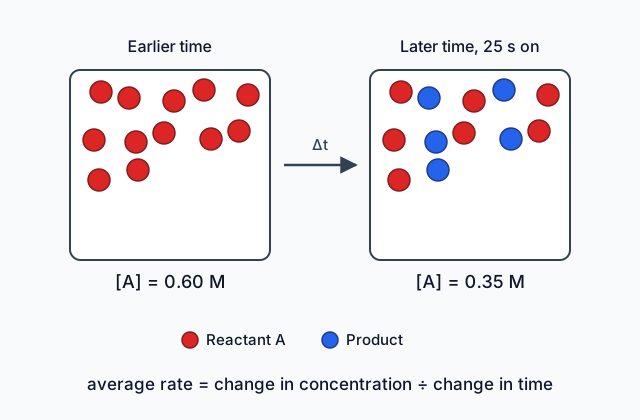 Tap to open the picture full size
Part 1 Think first Flour on a griddle, flour in the air
Commit to a guess first. Being wrong now makes the right idea stick better.
Predict first
A cook sprinkles a spoonful of flour on a hot griddle, and it browns slowly. A baker tosses the same spoonful of flour into the air above a flame, and it can flash into a fireball. It is the same flour, the same amount and the same air in both cases. Why does the airborne flour burn so much faster?
In short. The rate of a reaction is how fast reactants are converted to products, measured as a change in concentration per unit of time.
- The rates at which different species in one equation change are in the ratio of their coefficients.
- A higher concentration, a higher temperature, more surface area and a catalyst usually raise the rate.
- A rate usually falls as a reaction proceeds, because the reactants are being used up.
Part 2 Learn it Putting a number on how fast
2a. Rate is change per unit of time
Some reactions finish in a flash and some take years. Kinetics is the study of how fast a reaction goes: the rate at which an amount of reactant is converted to product per unit of time.
In a solution or a sealed container, the amount is measured as a concentration in mol/L, written M, so a rate has units of M/s. The average rate over an interval is the change in concentration divided by the time that passed:
average rate of use of A = −Δ[A]/Δt
Brackets mean concentration, and Δ means final minus initial. A reactant is used up, so Δ[A] is negative, and the minus sign makes its rate positive. A product builds up, so its rate is +Δ[P]/Δt.
Example: if [A] falls from 0.500 M to 0.350 M in 30.0 s, then Δ[A] = −0.150 M, and the average rate is 0.150 M ÷ 30.0 s = 0.00500 M/s.
A rate belongs to a stated stretch of time. As the reactants are used up the rate usually changes, so an average over an interval is not the rate at every moment inside it.
Quick check · Calculate
The concentration of a reactant falls from 0.800 M to 0.560 M in 40.0 s. What is the average rate at which the reactant is used? Give your answer in units of 10⁻³ M/s, to three significant figures.
2b. The equation links the rates of different species
A balanced equation counts particles. In 2 N₂O₅ → 4 NO₂ + O₂, every 2 molecules of N₂O₅ used make 4 molecules of NO₂ and 1 of O₂. In one container, over the same time, the concentrations change in that same ratio. So the rates at which the species change are in the ratio of their coefficients:
- N₂O₅ is used at a rate of 2 units.
- NO₂ forms at a rate of 4 units, twice as fast as N₂O₅ is used.
- O₂ forms at a rate of 1 unit, half as fast as N₂O₅ is used.
To get one species' rate from another's, multiply by the ratio of the two coefficients. The rate of O₂ formation is (1/2) × the rate of N₂O₅ use.
This is why a rate has to name its species. "The rate of the reaction" means nothing until you say what is being measured: here the NO₂ rate is four times the O₂ rate.
Quick check · Fill the statement
In one experiment on 2 N₂O₅ → 4 NO₂ + O₂, the N₂O₅ is used at 0.0300 M/s. Complete the statements.
NO₂ forms at . O₂ forms at . The rates of the three species are in the same ratio as the in the balanced equation.
2c. What changes a rate
Several things you can control change how fast a reaction goes, and each has a reason at the particle level. Reactant particles have to collide to react, so anything that changes how often they collide, or how much energy they carry when they do, changes the rate.
- Concentration. More particles in each liter meet more often, so a higher concentration usually gives a higher rate.
- Temperature. At a higher temperature the particles have a higher average kinetic energy and move faster (Topic 3.5), so they collide more often, and they collide with more energy. Both effects raise the rate. A later topic shows how the energy of the collisions is shared out among the particles.
- Surface area. When a solid reacts, the reaction happens at its surface. Crushing a solid exposes more surface, so more of it can react each second.
- A catalyst is a substance that speeds up a reaction without being used up. Adding the right one raises the rate. How it does that is a later topic.
Other environmental factors matter too, such as the solvent or, for gases, the pressure. In every case, ask what changes the number of collisions between reactant particles each second, or how energetic they are.
Quick check · Sort it
Each card describes a change made to a reaction mixture. Tap a card, then the bin for what the change does to the rate.
Raises the rate
Lowers the rate
Part 3 Watch it done How fast is N₂O₅ used, and how fast does O₂ form?
Predict first, then watch each step, then finish the calculation yourself.
In a sealed flask at a constant temperature, dinitrogen pentoxide decomposes: 2 N₂O₅(g) → 4 NO₂(g) + O₂(g). A student measures [N₂O₅]: 1.000 M at 0 s, 0.800 M at 100. s, 0.640 M at 200. s and 0.512 M at 300. s. These numbers are a teaching example. What is the average rate at which O₂ forms during the first 100. s?
Predict first
Before you open the first step, predict: will the average rate of N₂O₅ use from 200. s to 300. s be greater than, equal to, or less than the rate from 0 s to 100. s?
Step 1 · Find the rate of N₂O₅ use from 0 to 100. s
Δ[N₂O₅] = 0.800 − 1.000 = −0.200 M over 100. s. The rate of use is 0.200 M ÷ 100. s = 2.00 × 10⁻³ M/s.
Step 2 · Compare with 200. to 300. s
Δ[N₂O₅] = 0.512 − 0.640 = −0.128 M, so the rate of use is 0.128 M ÷ 100. s = 1.28 × 10⁻³ M/s. The same length of time, but a smaller change: the reaction slowed as the N₂O₅ was used up.
Why this step?
Why is the rate smaller in the later interval?
Less N₂O₅ is left in each liter, so there are fewer reactant particles to meet and react each second. A lower concentration usually means a lower rate.
Step 3 · Use the equation for O₂
The question asks about O₂, not N₂O₅. In 2 N₂O₅ → 4 NO₂ + O₂, one O₂ forms for every two N₂O₅ used, so O₂ forms at half the rate at which N₂O₅ is used.
Your step · Calculate
Finish it. The N₂O₅ was used at 2.00 × 10⁻³ M/s from 0 to 100. s. At what average rate does O₂ form in that time? Give your answer in units of 10⁻³ M/s, to three significant figures.
× 10⁻³ M/s
An average rate belongs to an interval. The same reaction had an average rate of 2.00 × 10⁻³ M/s over its first 100. s and 1.28 × 10⁻³ M/s over its last 100. s shown, so "the rate" is not one number until you say when and for which species.
Part 4 Try it Marble chips and powder in acid
Marble is calcium carbonate: CaCO₃(s) + 2 HCl(aq) → CaCl₂(aq) + H₂O(l) + CO₂(g). A student drops equal masses of marble into two flasks, each holding 1.00 M hydrochloric acid at the same temperature, with marble in excess. In flask X the marble is whole chips. In flask Y it is a powder. After 60.0 s, [HCl] is 0.920 M in flask X and 0.580 M in flask Y. These numbers are a teaching example.
Try it · Decide and justify
In which flask is the reaction faster over the first 60.0 s?
Which reason supports your decision?
Try it · Calculate
At what average rate does Ca²⁺ form in flask Y over the 60.0 s? Give your answer in units of 10⁻³ M/s, to three significant figures.
Part 5 Explain it N₂O₅ in a sealed flask
On the exam this is handwritten, so answer on paper first. Nothing you type here leaves this page. Then check your answer against the model and each scoring point.
Free response is 50% of the exam score. This one is shaped like a short-answer question, which is worth 4 points.
Free-response practice · Short-answer style
In a sealed, rigid flask at a constant temperature, 2 N₂O₅(g) → 4 NO₂(g) + O₂(g). A student measures [N₂O₅]: 0.800 M at 0 s, 0.620 M at 60.0 s and 0.480 M at 120. s. These numbers are a teaching example.
(a) Calculate the average rate at which N₂O₅ is used from 0 s to 60.0 s.
(b) Calculate the average rate at which NO₂ forms over the same 60.0 s.
(c) The average rate of N₂O₅ use from 60.0 s to 120. s is smaller than your answer to (a). Identify the change in the flask that explains this.
(d) The student repeats the experiment at a higher temperature. Explain, in terms of particles, why N₂O₅ is used faster at the higher temperature.
Model answer
(a) Δ[N₂O₅] = 0.620 − 0.800 = −0.180 M, so the average rate of use is 0.180 M ÷ 60.0 s = 3.00 × 10⁻³ M/s.
(b) NO₂ has coefficient 4 and N₂O₅ has coefficient 2, so NO₂ forms twice as fast as N₂O₅ is used: 2 × 3.00 × 10⁻³ = 6.00 × 10⁻³ M/s.
(c) The concentration of N₂O₅ is lower in the later interval, because some has already been used up, so the rate is lower. (From 60.0 s to 120. s the rate is 0.140 M ÷ 60.0 s = 2.33 × 10⁻³ M/s.)
(d) At a higher temperature the particles have a higher average kinetic energy and move faster, so they collide more often and with more energy, and more reactions happen each second.
Score your own answer. This is a self-check, not a grade. Tick each point your answer makes.
Part 6 Check yourself Magnesium in acid, four trials
All three case questions use the table.
A student drops 100. mg of magnesium into hydrochloric acid, Mg + 2 HCl → MgCl₂ + H₂, with the acid in large excess. Each trial changes something, and the student records the time for all of the magnesium to react. These numbers are a teaching example.
| Trial | HCl concentration (M) | Temperature (°C) | Form of magnesium | Time to react completely (s) |
|---|---|---|---|---|
| 1 | 1.00 | 25 | Ribbon | 120. |
| 2 | 1.00 | 25 | Powder | 8.0 |
| 3 | 2.00 | 25 | Ribbon | 55. |
| 4 | 1.00 | 45 | Ribbon | 52. |
Case question 1 · Calculate
Using the table: what is the average rate at which magnesium is used in trial 1, in mg/s? Give your answer to three significant figures.
Case question 2 · Rank it
Using the table: rank the four trials by the average rate at which magnesium is used.
Fastest first
Give each one a place, 1 for first. Give two the same place if they are equal.
Your ranking: none yet
Case question 3 · Multiple choice
Using the table: a classmate claims that grinding magnesium into a powder speeds up its reaction with acid. Which comparison of trials best supports the claim?
The rest stand on their own and do not use the case.
Check yourself · Spot the error
In the reaction N₂ + 3 H₂ → 2 NH₃, hydrogen is used at 0.0600 M/s. A student finds the rate at which ammonia forms. Tap the line with the mistake.
Check yourself · Match
Match each change to the reason it changes the rate.
Part 7 Keep it Bring back earlier ideas
This lesson leans on two earlier ideas: temperature as the average kinetic energy of particles, and concentration as moles per liter. Pulling them back up is what makes them last.
From 3.5 Kinetic Molecular Theory · Calculate
A sample of neon is heated from 27.0 °C to 327.0 °C. By what factor does the average kinetic energy of its atoms increase? Give three significant figures.
From 3.7 Solutions and Mixtures · Calculate
A student dissolves 29.2 g of sodium chloride, NaCl (molar mass 58.44 g/mol), in water and adds water to make 250.0 mL of solution. What is the molarity of the solution? Give your answer to three significant figures.
In three lines
- The average rate of a reaction is a change in concentration divided by the time it took, −Δ[A]/Δt for a reactant, and it is reported as a positive number in M/s.
- The rates of different species in one equation are in the ratio of their coefficients, so a rate has to name its species.
- A higher concentration, a higher temperature, more surface area and a catalyst raise the rate, because they raise how many reactant particles collide each second, and a higher temperature also makes each collision more energetic.
Exam strategy for this topic
- Section I, Multiple Choice: 60 questions in 90 minutes.
- Section II, Free Response: 7 questions in 105 minutes.
- A scientific or graphing calculator is recommended for use on both sections of the exam.
State a rate with its species, its units (M/s) and a positive sign, and when an equation is given, scale from one species to another by the coefficients. When a question asks why a change speeds a reaction up, answer in terms of particles: more collisions each second, and for temperature, collisions that are also more energetic.
Questions students ask
What is the rate of a chemical reaction?
It is the amount of reactant converted to product per unit of time, usually measured as the change in a concentration divided by the time, in M/s.
How do you find the rate of one species from another?
Multiply by the ratio of their coefficients in the balanced equation. In 2 N₂O₅ → 4 NO₂ + O₂, NO₂ forms twice as fast as N₂O₅ is used.
What factors affect the rate of a reaction?
Concentrations of the reactants, temperature, the surface area of a solid reactant, a catalyst, and other environmental factors such as the solvent.
Why does a reaction slow down as it proceeds?
The reactants are used up, so their concentrations fall, and with fewer reactant particles in each liter there are fewer meetings each second.
Why is a rate always positive?
A rate is reported for a species being used or formed, with the sign set by the definition: −Δ[A]/Δt for a reactant, since Δ[A] is negative, and +Δ[P]/Δt for a product.
Course alignment, for teachers
AP Chemistry topic 5.1, Unit 5: Kinetics.
- Skill 6.E: Provide reasoning to justify a claim using connections between particulate and macroscopic scales or levels.
This lesson maps all 3 essential knowledge statements of the topic to the part that teaches each one: 3 are checked by a scored question. The map is in the lesson file.