Unit 5 · Topic 5.2 · about 30 minutes · 7 parts · 13 scored checks, 2 of them multiple choice, plus 2 from earlier lessons
AP Chemistry 5.2: Introduction to Rate Law
Unit 5: 7 to 9% of the multiple-choice section
What you'll be able to do
- Represent experimental data with a rate law, naming each order and the overall order, the rate constant and its units.
Key vocabulary
| Term | What it means | The exam trap |
|---|---|---|
| Rate law | An equation that expresses the rate of a reaction as proportional to the concentration of each reactant raised to a power. | A rate law is built from measurements, so check where each power in a given rate law came from. |
| Order | The power of a reactant's concentration in the rate law, which says how the rate responds when that concentration changes. | Orders can be zero, so do not assume every reactant in an equation appears in its rate law. |
| Overall order | The sum of the powers of the reactant concentrations in the rate law. | Add every power in the rate law, not only the largest one, and include any reactant of order one. |
| Rate constant | The proportionality constant k in the rate law, which depends on temperature and has units that reflect the overall order. | A value of k belongs to one temperature, and its units are part of the answer. |
| Initial rate | The rate at the start of a reaction, before the reactants are used up, used to compare experiments. | Check that two experiments being compared differ in only the quantity you are testing. |
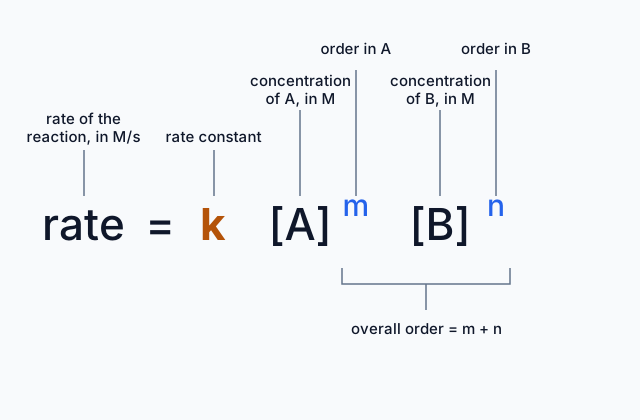 Tap to open the picture full size
Part 1 Think first Two clear solutions that turn yellow
Commit to a guess first. Being wrong now makes the right idea stick better.
Predict first
A student mixes two clear solutions, A and B, that slowly produce a yellow product. In one test she doubles the amount of A and the yellow appears twice as fast. In another test she doubles the amount of B instead and the yellow appears four times as fast. In a third test she doubles both A and B at once. How fast does the yellow appear, compared with the original mixture?
In short. A rate law shows how a reaction's rate depends on the concentration of each reactant: rate = k[A]ᵐ[B]ⁿ, with powers m and n found by experiment.
- Each power is the order in that reactant, and the overall order is the sum of the powers.
- Compare initial rates in experiments that change one concentration at a time to find each order.
- The rate constant k depends on temperature, and its units depend on the overall order.
Part 2 Learn it The rate law
2a. rate = k[A]ᵐ[B]ⁿ
A rate law expresses the rate of a reaction as proportional to the concentration of each reactant raised to a power:
rate = k[A]ᵐ[B]ⁿ
The power on each concentration is the order of the reaction with respect to that reactant. If m = 1, the reaction is first order in A. If n = 2, it is second order in B. A reactant with a power of 0 has no effect on the rate. The overall order is the sum of the powers, m + n.
For example, experiments on 2 NO + 2 H₂ → N₂ + 2 H₂O show rate = k[NO]²[H₂]. The reaction is second order in NO, first order in H₂, and third order overall (2 + 1).
The powers come from experiments, not from the balanced equation. In 2 N₂O₅ → 4 NO₂ + O₂, the coefficient of N₂O₅ is 2, yet experiments show rate = k[N₂O₅], first order. A coefficient in the balanced equation does not fix a power, so you cannot read an order off the equation.
Quick check · Decide and justify
The balanced equation is 2 N₂O₅ → 4 NO₂ + O₂. A student writes the rate law rate = k[N₂O₅]² because the coefficient of N₂O₅ is 2. Is that a sound way to find the rate law?
Which reason supports your decision?
2b. What an order means
The order says how the rate responds when a concentration changes. Suppose one concentration is doubled and nothing else changes:
- Zero order: the rate does not change, because 2⁰ = 1.
- First order: the rate doubles, because 2¹ = 2.
- Second order: the rate is multiplied by 4, because 2² = 4.
The rule works for any change. If [A] is multiplied by a factor f, the rate is multiplied by fᵐ, where m is the order in A. In a second-order reaction, tripling [A] multiplies the rate by 3² = 9. In a first-order reaction, halving [A] multiplies the rate by (1/2)¹ = 1/2.
When two concentrations change at once, find the factor for each and multiply the factors. The rate constant k does not change, as long as the temperature does not.
Quick check · Calculate
A reaction has the rate law rate = k[A][B]². At a constant temperature, [A] is doubled and [B] is halved. By what factor does the rate change? Give your answer to three significant figures.
2c. Finding orders from initial rates
Orders are found by experiment. One way is to monitor the amount of a reactant or product over time, for example a colored reactant fading or the pressure of a gas rising, and use how quickly it changes to get the rate.
The initial rate is the rate at the very start, before the reactants are used up and the concentrations drift. Because the concentrations at that moment are the ones you mixed, initial rates from different experiments can be compared fairly.
To find the order in A:
- Choose two experiments in which [A] changes and every other concentration stays the same.
- Divide the larger rate by the smaller. The result is the factor in [A] raised to the order m.
- Ask what power m makes that true.
If [A] doubles and the rate goes up by a factor of 8, then 2ᵐ = 8, so m = 3. If [A] doubles and the rate does not change, then 2ᵐ = 1 and m = 0. Repeat the method for each of the other reactants with a different pair of experiments. In this course the orders you meet are almost always 0, 1 or 2.
Quick check · Calculate
Two experiments use the same [B]. With [A] = 0.100 M the initial rate is 2.00 × 10⁻³ M/s, and with [A] = 0.300 M it is 1.80 × 10⁻² M/s. What is the order of the reaction in A? Give a whole number.
2d. The rate constant and its units
In rate = k[A]ᵐ[B]ⁿ, the proportionality constant k is the rate constant. Once the orders are known, any experiment gives k:
k = rate ÷ ([A]ᵐ[B]ⁿ)
Two things about k matter. First, its value depends on the temperature: the same reaction has one k at one temperature and a different k at another, so a k is only meaningful with its temperature. Second, its units reflect the overall order. The rate is in M/s, so k has whatever units turn the concentrations in the rate law into M/s. For a second-order reaction, k = (M/s) ÷ M² = M⁻¹·s⁻¹.
| Overall order | Units of k |
|---|---|
| 0 | M·s⁻¹ |
| 1 | s⁻¹ |
| 2 | M⁻¹·s⁻¹ |
| 3 | M⁻²·s⁻¹ |
Quick check · Match
Match each rate law to the units of its rate constant, with the rate in M/s and concentrations in M.
Part 3 Watch it done Finding a rate law from a table
Predict first, then watch each step, then finish the calculation yourself.
Nitric oxide reacts with oxygen: 2 NO(g) + O₂(g) → 2 NO₂(g). A student measures the initial rate in four experiments at one temperature. These numbers are a teaching example.
- Experiment 1: [NO] = 0.0100 M, [O₂] = 0.0100 M, initial rate = 7.00 × 10⁻³ M/s
- Experiment 2: [NO] = 0.0200 M, [O₂] = 0.0100 M, initial rate = 2.80 × 10⁻² M/s
- Experiment 3: [NO] = 0.0100 M, [O₂] = 0.0200 M, initial rate = 1.40 × 10⁻² M/s
- Experiment 4: [NO] = 0.0300 M, [O₂] = 0.0100 M, initial rate = 6.30 × 10⁻² M/s
Find the rate law and the rate constant.
Predict first
Before you open the first step, predict: experiment 2 doubles [NO] and experiment 3 doubles [O₂], with everything else the same as in experiment 1. Which doubling changes the initial rate more?
Step 1 · Compare experiments 1 and 2
Only [NO] changes: 0.0100 M to 0.0200 M, a factor of 2. The rate goes from 7.00 × 10⁻³ to 2.80 × 10⁻² M/s, a factor of 4.00. So 2ᵐ = 4 and m = 2: second order in NO.
Step 2 · Compare experiments 1 and 3
Only [O₂] changes: a factor of 2. The rate goes from 7.00 × 10⁻³ to 1.40 × 10⁻² M/s, a factor of 2.00. So 2ⁿ = 2 and n = 1: first order in O₂.
Why this step?
Why compare experiments 1 and 2, and 1 and 3, rather than 2 and 3?
Experiments 2 and 3 differ in both concentrations at once, so a change in rate could not be put down to one of them. Each of the other pairs changes exactly one concentration.
Step 3 · Write the rate law
rate = k[NO]²[O₂]. The reaction is second order in NO, first order in O₂, and third order overall, 2 + 1. The units of k are then M⁻²·s⁻¹.
Your step · Calculate
Finish it. Use experiment 4 and the rate law rate = k[NO]²[O₂] to find k. Give your answer in M⁻²·s⁻¹, to three significant figures (7.00 × 10³ is typed 7.00e3).
M⁻²·s⁻¹
The whole method is in those steps: change one concentration at a time, find each power from the ratio of rates, write the rate law, and use any experiment to find k. A different experiment, such as experiment 1, gives the same k, because k does not depend on concentration.
Part 4 Try it A reactant that does not matter
Now a reaction you have not seen: NO₂(g) + CO(g) → NO(g) + CO₂(g). A student measures the initial rate at one temperature. These numbers are a teaching example.
| Experiment | [NO₂] (M) | [CO] (M) | Initial rate (M/s) |
|---|---|---|---|
| 1 | 0.100 | 0.100 | 5.00 × 10⁻³ |
| 2 | 0.200 | 0.100 | 2.00 × 10⁻² |
| 3 | 0.100 | 0.300 | 5.00 × 10⁻³ |
Try it · Fill the statement
Use the table to complete the statement about the orders.
The reaction is order in NO₂ and order in CO, and its overall order is .
Try it · Calculate
Using the table, find the rate law and then the rate constant. What is the initial rate when [NO₂] = 0.300 M and [CO] = 0.500 M? Give your answer in units of 10⁻³ M/s, to three significant figures.
Part 5 Explain it Hydrogen peroxide and iodide
On the exam this is handwritten, so answer on paper first. Nothing you type here leaves this page. Then check your answer against the model and each scoring point.
Free response is 50% of the exam score. This one is shaped like a short-answer question, which is worth 4 points.
Free-response practice · Short-answer style
In an acidic solution kept at a constant acidity, hydrogen peroxide reacts with iodide ions: H₂O₂ + 2 I⁻ + 2 H⁺ → I₂ + 2 H₂O. A student measures the initial rate in three experiments at one temperature. These numbers are a teaching example.
- Experiment 1: [H₂O₂] = 0.0500 M, [I⁻] = 0.0800 M, initial rate = 4.60 × 10⁻⁵ M/s
- Experiment 2: [H₂O₂] = 0.100 M, [I⁻] = 0.0800 M, initial rate = 9.20 × 10⁻⁵ M/s
- Experiment 3: [H₂O₂] = 0.0500 M, [I⁻] = 0.240 M, initial rate = 1.38 × 10⁻⁴ M/s
(a) Determine the order of the reaction with respect to H₂O₂ and with respect to I⁻.
(b) Represent the rate law for the reaction as an equation.
(c) Calculate the rate constant, with its units.
(d) Predict the factor by which the initial rate changes if [H₂O₂] is tripled and [I⁻] is halved.
Model answer
(a) Experiments 1 and 2 change only [H₂O₂], doubling it, and the rate doubles, 2ᵐ = 2, so the order in H₂O₂ is 1. Experiments 1 and 3 change only [I⁻], tripling it, and the rate triples, 3ⁿ = 3, so the order in I⁻ is 1.
(b) rate = k[H₂O₂][I⁻].
(c) k = rate ÷ ([H₂O₂][I⁻]) = (4.60 × 10⁻⁵ M/s) ÷ ((0.0500 M)(0.0800 M)) = 0.0115 M⁻¹·s⁻¹. The reaction is second order overall, so the units of k are M⁻¹·s⁻¹.
(d) Tripling [H₂O₂] multiplies the rate by 3¹ = 3, and halving [I⁻] multiplies it by (1/2)¹ = 1/2. The rate changes by 3 × 1/2 = 1.5, so it is 1.5 times as great.
Score your own answer. This is a self-check, not a grade. Tick each point your answer makes.
Part 6 Check yourself Bromate, bromide and acid
All three case questions use the table.
In acidic solution, bromate ions react with bromide ions: BrO₃⁻ + 5 Br⁻ + 6 H⁺ → 3 Br₂ + 3 H₂O. A student measures the initial rate at one temperature. These numbers are a teaching example.
| Experiment | [BrO₃⁻] (M) | [Br⁻] (M) | [H⁺] (M) | Initial rate (M/s) |
|---|---|---|---|---|
| 1 | 0.100 | 0.100 | 0.100 | 2.00 × 10⁻⁴ |
| 2 | 0.200 | 0.100 | 0.100 | 4.00 × 10⁻⁴ |
| 3 | 0.100 | 0.200 | 0.100 | 4.00 × 10⁻⁴ |
| 4 | 0.100 | 0.100 | 0.200 | 8.00 × 10⁻⁴ |
Case question 1 · Calculate
Using the table: what is the order of the reaction in H⁺? Give a whole number.
Case question 2 · Multiple choice
Using the table: what is the rate constant k, with its units? Find the orders first, then use any one experiment.
Case question 3 · Multiple choice
Using the table: which pair of experiments should you compare to find the order of the reaction in Br⁻?
The rest stand on their own and do not use the case.
Check yourself · Put it in order
A student wants to find the order of a reaction in reactant A, whose color fades as it reacts. Put the steps in order.
Check yourself · Spot the error
A student finds the units of k for a reaction with the rate law rate = k[A]²[B]. Tap the line with the mistake.
Check yourself · Decide and justify
A reaction is run twice with the same starting concentrations, once at 25 °C and once at 45 °C. The initial rate is greater at 45 °C. In the rate law rate = k[A]ᵐ[B]ⁿ, which quantity has a different value at 45 °C?
Which reason supports your decision?
Part 7 Keep it Bring back earlier ideas
A rate law is written with concentrations and builds on the idea of a rate from the last lesson. Pulling them back up is what makes them last.
From 5.1 Reaction Rates · Calculate
The concentration of a reactant falls from 0.800 M to 0.560 M in 40.0 s. What is the average rate at which the reactant is used? Give your answer in units of 10⁻³ M/s, to three significant figures.
From 3.7 Solutions and Mixtures · Calculate
A student dissolves 29.2 g of sodium chloride, NaCl (molar mass 58.44 g/mol), in water and adds water to make 250.0 mL of solution. What is the molarity of the solution? Give your answer to three significant figures.
In three lines
- A rate law, rate = k[A]ᵐ[B]ⁿ, gives the rate in terms of reactant concentrations; each power is an order found by experiment, and the overall order is their sum.
- To find an order, compare initial rates in two experiments where only one concentration changes; if the concentration is multiplied by f and the rate by F, then fᵐ = F.
- The rate constant k depends on temperature, and its units follow from the overall order, for example M⁻¹·s⁻¹ for a second-order reaction.
Exam strategy for this topic
- Section I, Multiple Choice: 60 questions in 90 minutes.
- Section II, Free Response: 7 questions in 105 minutes.
- A scientific or graphing calculator is recommended for use on both sections of the exam.
When a table of initial rates is given, name the two experiments you compare and state which single concentration differs between them, then show the ratio of rates as a power of the ratio of concentrations. Give k with units that match the overall order, and keep the significant figures the data allow.
Questions students ask
What is a rate law?
An equation that expresses the rate of a reaction as proportional to the concentration of each reactant raised to a power, written rate = k[A]ᵐ[B]ⁿ.
How do you find the order of a reaction from data?
Compare the initial rates of two experiments in which only one concentration changes. If that concentration is multiplied by f and the rate by F, then fᵐ = F, and m is the order.
What is the overall order of a reaction?
The sum of the powers of the reactant concentrations in the rate law. A rate law of rate = k[NO]²[H₂] has an overall order of 3.
Are the orders the same as the coefficients in the balanced equation?
Not necessarily. The powers in a rate law are found by experiment, so a coefficient in the balanced equation does not fix an order.
What are the units of the rate constant?
They depend on the overall order: M·s⁻¹ for order 0, s⁻¹ for order 1, M⁻¹·s⁻¹ for order 2, and M⁻²·s⁻¹ for order 3.
Does the rate constant change with temperature?
Yes. The value of k depends on temperature, so the same concentrations give a different rate at a different temperature.
Course alignment, for teachers
AP Chemistry topic 5.2, Unit 5: Kinetics.
- Skill 5.C: Explain the relationship between variables within an equation when one variable changes.
This lesson maps all 5 essential knowledge statements of the topic to the part that teaches each one: 5 are checked by a scored question. The map is in the lesson file.