Unit 6 · Topic 6.1 · about 30 minutes · 7 parts · 12 scored checks, 1 of them multiple choice, plus 2 from earlier lessons
AP Chemistry 6.1: Endothermic and Exothermic Processes
Unit 6: 7 to 9% of the multiple-choice section
What you'll be able to do
- Explain what an observation, such as a temperature change, shows about the energy change of a chemical or physical transformation.
Key vocabulary
| Term | What it means | The exam trap |
|---|---|---|
| System | The part of the universe being studied, such as the reacting species, a dissolving solid or a melting ice cube. | Decide which part is the system before you say whether a process is exothermic or endothermic, because the same event can look different from the other side. |
| Surroundings | Everything outside the system that can exchange energy with it, such as the water, the cup and the air. | Before you use a thermometer reading, decide which part of the setup the thermometer is actually in. |
| Exothermic process | A process in which the energy of the system decreases because energy goes out to the surroundings. | The word describes the system, so match it to the system’s energy rather than to how the surroundings feel. |
| Endothermic process | A process in which the energy of the system increases because energy comes in from the surroundings. | Many processes that look lively are not endothermic or exothermic for the reason you might expect, so go by the direction of the energy. |
| Work | Energy transferred when a system pushes on something, or something pushes on it, as a gas pushes a piston. | Energy can leave a system as heat, as work, or as both, so do not assume a temperature change is the only evidence. |
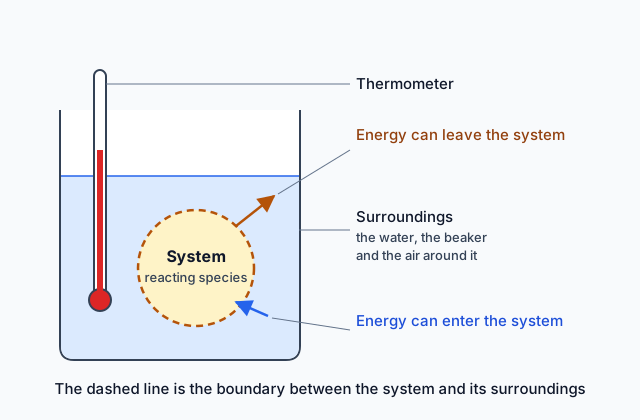 Tap to open the picture full size
Part 1 Think first A cold cup of fizz
Commit to a guess first. Being wrong now makes the right idea stick better.
Predict first
A student pours vinegar onto baking soda in a plastic cup. The mixture fizzes hard, and when she wraps her hand around the cup it feels cold. What does the cold cup tell her?
In short. An exothermic process lowers the energy of the system and gives that energy to its surroundings; an endothermic process raises the energy of the system by taking energy in from its surroundings.
- A temperature change is the clue: if the surroundings warm up, the system released energy, and if they cool down, the system absorbed energy.
- Heating, melting and boiling a substance are endothermic; cooling, freezing and condensing are exothermic; a chemical reaction or a dissolving can be either.
- Dissolving is exothermic when the attractions formed between solute and solvent are stronger than the ones broken, and endothermic when they are weaker.
Part 2 Learn it Endothermic and exothermic processes
2a. A temperature change is an energy change
You cannot see energy, but a thermometer lets you follow it. When the temperature of a substance changes, its energy has changed: warming means it gained energy, and cooling means it lost energy. For the same amount of the same material, a bigger temperature change means a bigger change in energy.
To say where the energy went, chemists split the world in two:
- The system is the part you are studying: the reacting species, the solid that is dissolving, the ice that is melting.
- The surroundings are everything else that can exchange energy with it: the water in the cup, the cup itself, the air around it.
A thermometer in a cup of water usually reads the surroundings, not the system. If the water gets warmer, the surroundings gained energy, and that energy can only have come from the system. If the water gets colder, the surroundings lost energy, and the system took it in. Energy is conserved, so what one side loses, the other gains.
Example: you hold an ice cube in your hand. The ice is the system and your hand is part of the surroundings. Your hand feels cold because it lost energy, and the ice gained it.
Quick check · Decide and justify
A student drops magnesium ribbon into hydrochloric acid in a foam cup. A thermometer in the solution reads 21.0 °C before the reaction and 34.5 °C after it. Is the reaction of the magnesium and the acid exothermic or endothermic?
Which reason supports your decision?
2b. Exothermic and endothermic
The two words describe what happens to the energy of the system. The prefix tells you the direction: exo- means out and endo- means in.
- An exothermic process lowers the energy of the system. The system gives energy out to its surroundings.
- An endothermic process raises the energy of the system. The system takes energy in from its surroundings.
Chemists sort the changes a system can go through into three kinds, and each kind can go either way:
- Heating or cooling a substance. Heating adds energy, so it is endothermic for the substance; cooling removes energy, so it is exothermic.
- Phase changes. Melting, evaporating and boiling take in energy, so they are endothermic; freezing and condensing give energy out, so they are exothermic.
- Chemical transformations. A reaction can be either. Burning a fuel is exothermic; the reaction in a cold pack is endothermic.
The words always depend on which part you call the system. When ice melts in a drink, the melting ice takes in energy (endothermic) and the cooling drink loses it (exothermic). Name the system first.
Quick check · Sort it
Each card names a change. Tap a card, then the bin that says whether the process is exothermic or endothermic for the substance or reacting species named.
Exothermic
Endothermic
2c. Where the energy goes
In a chemical reaction the energy of the system, the reacting species, does one of three things: it decreases (an exothermic reaction), it increases (an endothermic reaction), or it stays the same.
Energy is conserved, so the surroundings always change by the same amount in the opposite direction:
- In an exothermic reaction, the energy lost by the reacting species is gained by the surroundings.
- In an endothermic reaction, the system gains energy from the surroundings, so the surroundings lose it.
Energy can cross between the system and the surroundings in two ways. One is heat transfer, energy that moves because of a difference in temperature. The other is work, energy transferred when the system pushes on something, or something pushes on it. A burning fuel in an engine does both: some energy warms the cylinder walls, and some pushes the piston.
As numbers, the two changes are equal in size and opposite in sign. If the energy of the system changes by −250 kJ, the energy of the surroundings changes by +250 kJ.
Quick check · Calculate
In a teaching example, an endothermic reaction in a foam cup raises the energy of the reacting species by 42.5 kJ. What is the change in the energy of the surroundings, in kJ? Include its sign, and give your answer to three significant figures.
2d. Why dissolving can warm or cool the water
Forming a solution can be exothermic or endothermic. Look at the attractions between particles before and after.
When a solid dissolves in water:
- The attractions holding the solute particles together are broken. This takes in energy.
- Some of the attractions between water molecules are broken to make room. This also takes in energy.
- New attractions form between the solute particles and the water molecules. This releases energy.
Then compare the totals:
- If the attractions formed are stronger than the ones broken, more energy is released than taken in. Dissolving is exothermic and the water warms.
- If the attractions formed are weaker than the ones broken, more energy is taken in than released. Dissolving is endothermic and the water cools.
Each pair of substances has its own balance. Calcium chloride warms the water it dissolves in, and potassium nitrate cools it. A thermometer in the water tells you which side won.
Quick check · Fill the statement
Ammonium nitrate dissolves in water and the water cools. Complete the explanation in terms of the attractions between particles.
Pulling the solid’s ions apart and moving water molecules apart energy. Attractions forming between the ions and the water molecules energy. The water cooled, so the dissolving is , and the attractions formed are than the attractions broken.
Part 3 Watch it done A hand warmer
Predict first, then watch each step, then finish the work yourself.
A hand warmer pouch holds iron powder, salt and water. When it is opened to the air, the iron reacts with oxygen. A thermometer pressed into the pouch reads 20.5 °C before it is opened and 52.0 °C a few minutes later. Is the reaction exothermic or endothermic, and which way did the energy go?
Predict first
Before you open the first step, predict: once the reaction in the hand warmer is running, is the energy of the reacting iron and oxygen higher or lower than before?
Step 1 · Name the system and the surroundings
The system is the iron and oxygen that are reacting. The surroundings are the rest of the pouch, the pouch itself and your hand. The thermometer is in the pouch, so it reads the surroundings.
Step 2 · Read the thermometer
The pouch went from 20.5 °C to 52.0 °C, a change of 52.0 − 20.5 = +31.5 °C. The temperature of the surroundings rose, so the surroundings gained energy.
Why this step?
Why does a rise in the temperature of the pouch mean the reacting species lost energy?
Energy is conserved. The energy the surroundings gained cannot appear from nowhere, and the reacting species are the only thing in the pouch changing in a way that could supply it. So the system lost the energy that the surroundings gained.
Step 3 · Name the process
The energy of the reacting species decreased, and it passed to the surroundings as heat. A process in which the system loses energy is exothermic. That is why the pouch feels hot.
Your step · Calculate
Finish it. A second pouch holds a different mixture. Its thermometer reads 23.0 °C before the pouch is opened and 17.5 °C afterward. What is the change in temperature of the surroundings, in °C? Include its sign, and give your answer to the nearest 0.1 °C.
°C
The thermometer gave the evidence, and the system’s energy was what you worked out from it. The first pouch warmed, so its reaction gave energy out. The second cooled, so its reaction took energy in.
Part 4 Try it Four solids in water
A student dissolves four different solids in equal masses of water and watches the thermometer. Compare how much energy each dissolving gave to the water, and what that says about the attractions that formed and broke. The temperatures are a teaching example.
Try it · Rank it
Four solids, A to D, are each dissolved in 100.0 g of water in a foam cup. The water’s temperature goes from 24.0 °C to 30.0 °C for A, 18.0 °C to 29.5 °C for B, 25.0 °C to 22.0 °C for C, and 20.0 °C to 15.0 °C for D. Rank the solids by how much energy the dissolving gave to the water, from the most energy given to the water to the least. These numbers are a teaching example.
Most energy given to the water first
Give each one a place, 1 for first. Give two the same place if they are equal.
Your ranking: none yet
Try it · Match
Match each observation made while a solid dissolves in water to what it says about the attractions.
Part 5 Explain it Explain a cooling cup
On the exam this is handwritten, so answer on paper first. Nothing you type here leaves this page. Then check your answer against the model and each scoring point.
Free response is 50% of the exam score. This one is shaped like a short-answer question, which is worth 4 points.
Free-response practice · Short-answer style
A student dissolves 5.00 g of a solid in 50.0 g of water in a foam cup. The temperature of the water falls from 22.5 °C to 19.0 °C. This is a teaching example.
(a) Identify whether dissolving the solid is exothermic or endothermic.
(b) Explain, using the temperatures and conservation of energy, how the data show which way energy moved between the dissolving solid and the water.
(c) Justify your answer to (a) by comparing the attractions broken with the attractions formed when the solid dissolves.
(d) Predict how the temperature of the water would change if a different solid dissolved with the attractions formed stronger than the attractions broken.
Model answer
(a) Endothermic.
(b) The temperature of the water fell by 3.5 °C (19.0 − 22.5), so the water lost energy. Energy is conserved, so the energy the water lost was gained by the dissolving solid: energy moved from the water (the surroundings) into the dissolving process (the system).
(c) Dissolving breaks attractions between the solute particles and between water molecules, which takes in energy, and forms attractions between the solute particles and water molecules, which releases energy. The dissolving took in energy overall, so the energy needed to break the attractions was greater than the energy released forming new ones: the attractions formed are weaker than the attractions broken.
(d) The temperature of the water would rise. More energy is released forming the attractions than is taken in breaking the others, so the energy the dissolving particles lose is gained by the water.
Score your own answer. This is a self-check, not a grade. Tick each point your answer makes.
Part 6 Check yourself Four solids, four thermometers
All three case questions use the table.
A student dissolves 5.00 g of each of four solids, P to S, in 50.0 g of water in a foam cup and records the temperature of the water. These numbers are a teaching example.
| Solid | Starting temperature (°C) | Final temperature (°C) |
|---|---|---|
| P | 20.5 | 26.0 |
| Q | 20.5 | 16.5 |
| R | 20.5 | 22.0 |
| S | 20.5 | 18.5 |
Case question 1 · Select all
Using the table: select the two solids whose dissolving is endothermic.
Select 2 answers, then check.
Case question 2 · Decide and justify
Using the table: when solid Q dissolves, are the attractions that form between its particles and water molecules stronger or weaker than the attractions broken?
Which reason supports your decision?
Case question 3 · Multiple choice
Using the table: which statement describes the energy change when solid R dissolves?
The rest stand on their own and do not use the case.
Check yourself · Spot the error
A student explains a reaction in which the water in the cup got colder. Tap the line with the mistake.
Check yourself · Sort it
Each card describes energy leaving a system in which a fuel burns and the energy of the reacting species decreases. Tap a card, then the bin for the way that energy crosses to the surroundings.
Heat transfer
Work
Part 7 Keep it Bring back earlier ideas
This lesson leans on two earlier ideas: that temperature measures the energy of moving particles, and that attractions between particles decide how well a solute dissolves. Pulling them back up is what makes them last.
Samples of gas that differ in temperature, in the mass of their particles, or in both.
From 3.5 Kinetic Molecular Theory · Decide and justify
Flask X holds oxygen at 300 K, and flask Y holds oxygen at 600 K. A student claims that every molecule in flask Y is moving faster than every molecule in flask X. Is the claim correct?
Which reason supports your decision?
A few iodine crystals, I₂, shaken with water give a pale brown liquid. Shaken with hexane, the same crystals give a deep purple solution. Then four more solutes, each dissolving in water.
From 3.10 Solubility · Decide and justify
Chloromethane, CH₃Cl, is a polar molecule. Methane, CH₄, is nonpolar. Which one dissolves to a greater extent in water?
Which reason supports your decision?
In three lines
- A temperature change is evidence of an energy change: the thermometer reads the surroundings, so warmer surroundings mean the system released energy and cooler surroundings mean it absorbed energy.
- An exothermic process lowers the energy of the system and the surroundings gain it, as heat or work; an endothermic process raises it. Heating, melting and boiling are endothermic, and reactions and dissolving can be either.
- Dissolving is exothermic when the attractions formed between solute and solvent are stronger than the ones broken, and endothermic when they are weaker.
Exam strategy for this topic
- Section I, Multiple Choice: 60 questions in 90 minutes.
- Section II, Free Response: 7 questions in 105 minutes.
- A scientific or graphing calculator is recommended for use on both sections of the exam.
When a question gives you a temperature change, name the system, say which way the temperature of the surroundings moved, and then state the system’s energy change in the opposite direction. Write the word exothermic or endothermic, and say that the energy lost by one part is gained by the other.
Questions students ask
What is the difference between endothermic and exothermic?
In an exothermic process the energy of the system decreases and the surroundings gain that energy. In an endothermic process the energy of the system increases, taking energy in from the surroundings.
How can you tell from an experiment whether a process is exothermic or endothermic?
Watch the temperature of the surroundings. If it rises, the system released energy and the process is exothermic. If it falls, the system absorbed energy and the process is endothermic.
Is melting ice endothermic or exothermic?
Endothermic. Melting takes in energy from the surroundings. Freezing is the reverse and is exothermic.
Can dissolving a solid in water be exothermic or endothermic?
Both happen. It depends on whether the attractions formed between the solute and the water are stronger or weaker than the ones broken. Stronger means exothermic, weaker means endothermic.
Is energy created or destroyed in an exothermic reaction?
No. Energy is conserved. The energy the reacting species lose is gained by the surroundings, as heat or as work.
Course alignment, for teachers
AP Chemistry topic 6.1, Unit 6: Thermochemistry.
- Skill 6.D: Provide reasoning to justify a claim using chemical principles or laws, or using mathematical justification.
This lesson maps all 4 essential knowledge statements of the topic to the part that teaches each one: 4 are checked by a scored question. The map is in the lesson file.