Unit 5 · Topic 5.4 · about 30 minutes · 7 parts · 12 scored checks, 2 of them multiple choice, plus 2 from earlier lessons
AP Chemistry 5.4: Elementary Reactions
Unit 5: 7 to 9% of the multiple-choice section
What you'll be able to do
- Represent an elementary reaction as a rate law, using the number of particles that collide, and say why an overall equation does not give a rate law the same way.
Key vocabulary
| Term | What it means | The exam trap |
|---|---|---|
| Elementary reaction | A single step in which the reactant particles collide once and are turned into the product particles. | Questions may state that a reaction is elementary, so look for that wording before you decide how to use its coefficients. |
| Molecularity | The number of reactant particles that collide in an elementary reaction: one is unimolecular, two is bimolecular and three is termolecular. | A coefficient such as the 2 in 2A can be miscounted, so read the whole reactant side before you count. |
| Rate law | An expression that gives the rate of a reaction as the rate constant times the concentrations of the reactants, each raised to a power. | A rate law is written with concentrations, so check which species appear in it before you use it. |
| Rate constant (k) | The proportionality constant in a rate law, which has the same value for a reaction at a given temperature whatever the concentrations are. | The units of k depend on the rate law, so work them out and write them with the answer. |
 Tap to open the picture full size
Part 1 Think first Three marbles on a table
Commit to a guess first. Being wrong now makes the right idea stick better.
Predict first
Lena rolls three marbles at random across a large, flat table. During one minute, two of the marbles touch each other many times. How often will all three marbles touch at the same instant?
In short. An elementary reaction is a single collision, so its rate law can be written straight from its equation, with each reactant’s coefficient as its exponent.
- The coefficients of an elementary reaction count the particles that collide, so A + B gives rate = k[A][B] and 2A gives rate = k[A]².
- A collision of three or more particles at once is rare, so most elementary reactions have one or two reactant particles.
- The coefficients of an overall equation do not give its rate law; only an elementary step does.
Part 2 Learn it One collision, one rate law
2a. An elementary reaction is one collision
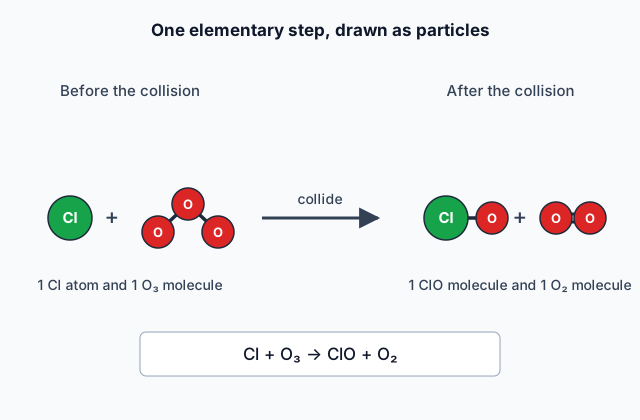
A balanced equation shows what changes overall. An elementary reaction, or elementary step, is a single event in which bonds break and form to give the particles on the right. If there are several particles on the left they collide once; if there is only one, it changes on its own. Nothing happens in between.
Because it is one event, the coefficients of an elementary reaction count real particles. In Cl + O₃ → ClO + O₂, one Cl atom hits one O₃ molecule. In 2 NO₂ → NO₃ + NO, two NO₂ molecules hit each other.
The number of reactant particles that take part in the event is the step’s molecularity:
- one particle: unimolecular, as in O₃ → O₂ + O
- two particles: bimolecular, as in Cl + O₃ → ClO + O₂
- three particles: termolecular
Count the reactant particles that take part, not the kinds of particle: the 2 in 2 NO₂ means two particles take part, so that step is bimolecular. The products do not count, because they form after the collision.
Quick check · Sort it
Each card shows an elementary reaction. Tap a card, then the bin that gives its molecularity.
Unimolecular
Bimolecular
Termolecular
2b. Reading a rate law from the equation
How fast a step goes depends on how often its particles meet. Take A + B → products. Doubling [A] doubles the number of A particles that can meet a B, and doubling [B] does the same, so the rate depends on [A] and on [B], each to the first power:
rate = k[A][B]
Now take 2A → products. A collision needs two A particles at the same place, and each one’s arrival depends on [A], so the rate depends on [A] twice over:
rate = k[A]²
The rule for an elementary reaction: each reactant’s exponent is its coefficient, and k is the rate constant.
- A → products: rate = k[A]
- A + B → products: rate = k[A][B]
- 2A → products: rate = k[A]²
- 2A + B → products: rate = k[A]²[B]
The coefficient becomes an exponent. It is not a multiplier, so 2A gives [A]², not 2[A].
Quick check · Calculate
The elementary reaction 2A → B is run twice at the same temperature. In the second run [A] is four times as large as in the first. By what factor is the rate of the second run larger than the first? Give a whole number.
2c. Why three-particle collisions are rare
In a gas, each particle collides with others billions of times every second, so two particles meeting is an everyday event. For three to collide in one step, a third particle has to be in the same tiny region at the same instant, and each extra particle multiplies the odds down.
Teaching example: suppose the chance that a second particle is in contact with a given particle at any moment is 1 in 1000. The chance that two others are in contact with it at once is about 1 in 1000 × 1000, which is 1 in 1,000,000.
That is why elementary reactions involving the simultaneous collision of three or more particles are rare. Most elementary reactions are unimolecular or bimolecular. A reaction that seems to need three or more particles to meet is much more likely to happen in several smaller steps than in one.
Quick check · Multiple choice
Which statement best explains why elementary steps with three or more colliding particles are rare?
2d. An overall equation is not a rate law
The rule “exponent equals coefficient” works for one kind of equation only: an elementary reaction, because it describes a single collision.
An overall equation can add up several steps. Its coefficients show the amounts that react, not the particles that collide in one event, so they do not have to match the exponents in the rate law. For an overall reaction the rate law has to be measured by experiment.
Teaching example: for the overall reaction X + 2Y → Z, an experiment finds that doubling [X] doubles the rate and doubling [Y] changes nothing, so rate = k[X]. The coefficients would have predicted k[X][Y]². Since three reactant particles are involved, and a three-particle collision is rare, the overall reaction probably takes place in more than one step, a possibility a later topic follows up.
Quick check · Decide and justify
Teaching example: for the overall reaction X + 2Y → Z, doubling [Y] while [X] is held constant does not change the rate, and doubling [X] doubles the rate. A student writes rate = k[X][Y]² from the equation. Is the student’s rate law right for this reaction?
Which reason supports your decision?
Part 3 Watch it done From a step to a rate
Predict first, then watch each step, then finish the calculation yourself.
Teaching example: in the elementary reaction 2 NO₂ → NO₃ + NO, the rate is measured as 4.0 × 10⁻² M/s when [NO₂] = 0.10 M. What is the rate when [NO₂] is raised to 0.30 M at the same temperature?
Predict first
Before you open the first step, predict: [NO₂] triples, from 0.10 M to 0.30 M. What happens to the rate?
Step 1 · Count the colliding particles
The equation is an elementary reaction with the coefficient 2 on NO₂, so two NO₂ molecules collide. The step is bimolecular.
Step 2 · Write the rate law
Each reactant’s exponent is its coefficient, so rate = k[NO₂]².
Why this step?
Why is [NO₂] squared and not multiplied by 2?
Two NO₂ molecules have to meet, and each one’s arrival depends on [NO₂]. The coefficient says how many particles collide, so it becomes an exponent. A multiplier would mean the concentration mattered only once.
Step 3 · Find k from the measurement
Rearrange: k = rate/[NO₂]² = (4.0 × 10⁻² M/s)/(0.10 M)² = 4.0 M⁻¹·s⁻¹. The units of k come out of the rate law, because rate is in M/s.
Your step · Calculate
Finish it. With rate = k[NO₂]² and k = 4.0 M⁻¹·s⁻¹, what is the rate, in M/s, when [NO₂] = 0.30 M? Give your answer to two significant figures.
M/s
Tripling [NO₂] raised the rate from 4.0 × 10⁻² M/s to 0.36 M/s, nine times larger. A coefficient of 2 in an elementary reaction turns into a square, and a square turns a tripling into a factor of nine.
Part 4 Try it More steps, more rate laws
Now use the same rule on steps you have not seen. In each, the equation is one elementary reaction.
Try it · Match
Match each elementary reaction to its rate law.
Try it · Rank it
Each of these is an elementary reaction. In each case every reactant concentration is doubled at the same temperature. Rank the steps by how many times larger the rate becomes.
Largest increase first
Give each one a place, 1 for first. Give two the same place if they are equal.
Your ranking: none yet
Part 5 Explain it Rate law and molecularity of a step
On the exam this is handwritten, so answer on paper first. Nothing you type here leaves this page. Then check your answer against the model and each scoring point.
Free response is 50% of the exam score. This one is shaped like a short-answer question, which is worth 4 points.
Free-response practice · Short-answer style
Teaching example. The reaction O + O₃ → 2 O₂ takes place as a single elementary step.
(a) Identify the molecularity of the step.
(b) Represent the step as a rate law, using k as the rate constant.
(c) A student writes rate = k[A][B]² for the overall reaction A + 2B → C using only its coefficients. Explain why that reasoning does not work for an overall reaction.
(d) Explain why a single step in which three reactant particles must collide at once is rare.
Model answer
(a) The step is bimolecular: one O atom and one O₃ molecule collide. The two O₂ molecules are products, so they do not count.
(b) rate = k[O][O₃]. Each reactant has the coefficient 1, so each appears to the first power.
(c) An elementary reaction is a single collision, so its coefficients count the colliding particles and become exponents. An overall equation can add up several steps, so its coefficients need not match the exponents. Its rate law has to be found from experimental data.
(d) Three particles would have to be at the same place at the same instant. That is far less likely than two particles meeting.
Score your own answer. This is a self-check, not a grade. Tick each point your answer makes.
Part 6 Check yourself Nitric oxide and ozone
All three case questions use the table.
A student studies the elementary reaction NO + O₃ → NO₂ + O₂ at one constant temperature. The student measures the rate of the step with three starting mixtures. These numbers are a teaching example.
| Experiment | [NO] (M) | [O₃] (M) | Rate (M/s) |
|---|---|---|---|
| 1 | 0.010 | 0.010 | 0.0025 |
| 2 | 0.020 | 0.010 | 0.0050 |
| 3 | 0.010 | 0.030 | 0.0075 |
Case question 1 · Calculate
Using the table: what is the rate constant k of the step, in M⁻¹·s⁻¹, from experiment 1? Give your answer to two significant figures.
Case question 2 · Decide and justify
Using the table: do the three experiments agree with the rate law rate = k[NO][O₃] that the step predicts?
Which piece of evidence supports your decision?
Case question 3 · Multiple choice
Using the table: starting from experiment 1, [NO] is doubled and [O₃] is cut in half. What happens to the rate?
The rest stand on their own and do not use the case.
Check yourself · Fill the statement
Complete the description of an elementary reaction.
An elementary reaction happens in a single . Its coefficients count the that take part, and the exponents in its rate law match those . A step in which or more particles must collide at once is rare.
Check yourself · Spot the error
A student finds the rate law of the elementary reaction 2 NO₂ → NO₃ + NO and predicts the effect of a change. Tap the line with the mistake.
Part 7 Keep it Bring back earlier ideas
This lesson leans on two earlier ideas: gas particles keep moving and colliding, and squeezing a gas puts the particles closer together. Pulling them back up is what makes them last.
From 3.5 Kinetic Molecular Theory · Sort it
Each card describes the particles in a sealed flask of gas that has sat untouched on a bench at room temperature for a week. Tap a card, then the bin it belongs in.
Fits the kinetic molecular theory
Does not fit the kinetic molecular theory
Two everyday situations to explain with particles: air squeezed in a syringe, and honey that pours faster when it is warm.
From 3.3 Solids, Liquids, and Gases · Decide and justify
A student seals the tip of a syringe full of air and pushes the plunger in until the air takes up half its starting volume. The student says each gas particle has been squeezed to half its size. Is the student right?
Which reason supports your decision?
In three lines
- An elementary reaction is a single collision, so its coefficients count the colliding particles and become the exponents of its rate law.
- A step in which three or more particles must collide at once is rare, so most elementary reactions are unimolecular or bimolecular.
- The coefficients of an overall equation do not give its rate law; it has to be found from experimental data.
Exam strategy for this topic
- Section I, Multiple Choice: 60 questions in 90 minutes.
- Section II, Free Response: 7 questions in 105 minutes.
- A scientific or graphing calculator is recommended for use on both sections of the exam.
Before you write a rate law, decide whether the equation is one elementary step or an overall reaction. For an elementary step, take each exponent from its coefficient; otherwise use the data. Show the rate law, then substitute with units, and keep significant figures in line with the data.
Questions students ask
What is an elementary reaction?
It is a single collision event: the reactant particles collide once, and bonds break and form to give the products, with nothing happening in between.
How do you write the rate law of an elementary reaction?
Use the coefficients as exponents: A + B gives rate = k[A][B], and 2A gives rate = k[A]². This works only for an elementary reaction.
What is molecularity?
It is the number of reactant particles that collide in an elementary reaction: one is unimolecular, two is bimolecular and three is termolecular.
Why are steps with three or more colliding particles rare?
All the particles would have to meet at the same place at the same instant, which is far less likely than two particles meeting.
Can I read the rate law from an overall equation?
No. An overall equation can add up several steps, so its coefficients need not match the exponents in the rate law, which has to be found by experiment.
Course alignment, for teachers
AP Chemistry topic 5.4, Unit 5: Kinetics.
- Skill 5.E: Determine a balanced chemical equation for a given chemical phenomenon.
This lesson maps all 2 essential knowledge statements of the topic to the part that teaches each one: 2 are checked by a scored question. The map is in the lesson file.