Unit 5 · Topic 5.5 · about 30 minutes · 7 parts · 12 scored checks, 1 of them multiple choice, plus 2 from earlier lessons
AP Chemistry 5.5: Collision Model
Unit 5: 7 to 9% of the multiple-choice section
What you'll be able to do
- Explain how the rate of an elementary reaction depends on the frequency, the energy and the orientation of the collisions between particles, and how temperature changes the share of collisions with enough energy.
Key vocabulary
| Term | What it means | The exam trap |
|---|---|---|
| Collision frequency | How many collisions occur between reactant particles each second, which rises with concentration and, slightly, with temperature. | A rate can change for more than one reason, so check which factors a question is asking about. |
| Activation energy (Ea) | The minimum energy that colliding particles must have for a collision to start breaking and making bonds. | A question may give Ea as a number, so check what it is being compared with before you use it. |
| Orientation | How colliding particles are lined up when they meet, which decides whether the atoms that must bond are in contact. | Orientation is about how particles meet, so keep it apart from how much energy they have. |
| Maxwell-Boltzmann distribution | The curve that shows how the energies of particles in a sample are spread, with the area under it standing for all of them. | Read the axes before the curve: it shows a share of particles at each energy, not a count of them. |
 Tap to open the picture full size
Part 1 Think first Glow sticks in hot and cold water
Commit to a guess first. Being wrong now makes the right idea stick better.
Predict first
A glow stick glows because of a chemical reaction inside it. Dropped into hot water, it glows brightly but fades within minutes. An identical one in ice water glows dimly and lasts for hours. Why is the reaction so much faster when the stick is warm?
In short. A reaction needs particles to collide with at least the activation energy and in the right orientation, and only a small share of collisions do both.
- Collisions begin a reaction by breaking some bonds and making others, but most collisions have too little energy or the wrong orientation.
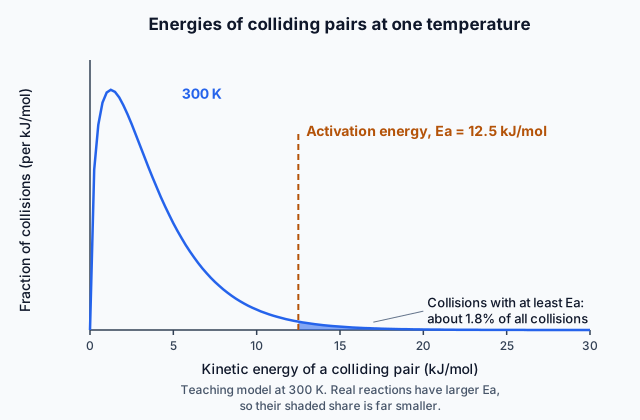
- The Maxwell-Boltzmann distribution shows how collision energies are spread, and the part of it beyond the activation energy is the share that can react.
- Raising the temperature stretches the distribution toward higher energies, so a larger share of collisions can react and the rate rises.
Part 2 Learn it What makes a collision work
2a. Reactions begin with collisions
For two particles to react they have to meet. A reaction begins with a collision, and in a successful one, bonds in the reactants break while new bonds form to make the products. With no collision, nothing happens.
How often particles collide is the frequency of collisions. Anything that puts particles closer together raises it. Doubling the concentration of a reactant means more of its particles in each region, so more collisions every second, and a faster reaction.
But collisions alone do not decide the rate. In most reactions only a small fraction of the collisions lead to a reaction. A gas particle at room temperature collides billions of times a second, and yet many gas mixtures react very slowly or not at all. The next chunk explains what a collision needs.
Quick check · Put it in order
Put the events of one successful collision between two reactant particles in order.
2b. Energy and orientation
A collision leads to a reaction only if it passes two tests at once.
1. Enough energy. Bonds only break if the colliding particles bring enough kinetic energy. The minimum is the activation energy, Ea. A collision with less energy than Ea leaves the particles bouncing apart unchanged.
2. The right orientation. The atoms that make new bonds have to meet. In the reaction of CO with NO₂, the carbon end of CO must strike an oxygen atom of NO₂ for an oxygen atom to move across. If the oxygen end of CO strikes first, the particles bounce apart however hard they hit. Teaching example.
So only a small fraction of collisions lead to a reaction, because many collisions fail one test or both. The rate depends on three things: how often particles collide, what share have at least Ea, and what share have a suitable orientation.
Quick check · Sort it
Each card describes one meeting of two reactant particles. Tap a card, then the bin for its result.
Leads to a reaction
Does not lead to a reaction
2c. The spread of energies and temperature
Colliding particles do not all have the same energy. At any temperature there is a spread, drawn as a Maxwell-Boltzmann distribution (a curve with a peak at low energy and a long tail toward high energy, as in the figure below). The area under the curve stands for every collision, and the part of it at or beyond Ea is the fraction with enough energy to react. In most reactions that is a small tail.
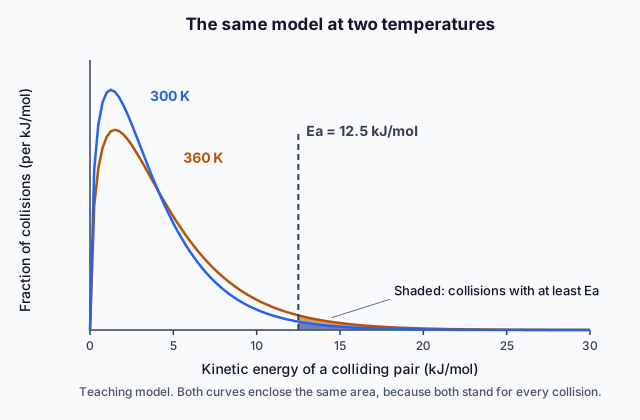
Raise the temperature and the average kinetic energy rises. The curve stretches toward higher energies and flattens, but the total area stays the same, because it is still every collision. The tail beyond Ea grows a lot, because it sits where the curve is low and falling steeply. Ea itself does not move.
Hotter particles also move faster, so they collide more often. That frequency rises in proportion to the average speed, which is proportional to √T. This effect is small next to the change in the tail.
 Tap to open the picture full size
Quick check · Select all
A sample of gas is warmed from 300 K to 360 K. Which two statements describe how the distribution of collision energies changes? Select two.
Select 2 answers, then check.
2d. Which change affects which factor
When a question asks why a rate changed, name the factor and tie it to particles.
- More concentrated reactants put particles closer together: more collisions each second. The share with enough energy and the share with a suitable orientation do not change.
- A higher temperature gives a slight rise in collision frequency and a large rise in the share of collisions with at least Ea. Orientation does not change, because it depends on the shapes of the particles.
- A larger activation energy means that, at the same temperature, a smaller share of collisions reaches Ea, so the reaction is slower.
Only one factor does most of the work for a temperature change, and it is energy.
Quick check · Decide and justify
A gas-phase reaction goes much faster at 360 K than at 300 K. A student says the main cause is that the particles collide many more times each second. Is the student right?
Which reason supports your decision?
Part 3 Watch it done Warming from 300 K to 360 K
Predict first, then watch each step, then finish the calculation yourself.
In the teaching model, the fraction of collisions with at least Ea = 12.5 kJ/mol is 0.0184 at 300 K and 0.0393 at 360 K. Compare how much the number of collisions per second and the fraction with enough energy change when the temperature rises from 300 K to 360 K.
Predict first
Before you open the first step, predict: which grows by the larger factor between 300 K and 360 K?
Step 1 · Find the change in collision frequency
Collisions per second rise in proportion to the average speed, which is proportional to √T. The factor is √(360/300) = √1.200 = 1.10, so about 10% more collisions every second.
Step 2 · Set up the change in the fraction
Divide the new fraction by the old one, both taken from the model: 0.0393 ÷ 0.0184.
Why this step?
Why does a small rise in temperature change the fraction so much more than the collision frequency?
Beyond Ea the curve is low and falling steeply, so stretching the curve adds a large amount compared with what was there before. The collision frequency depends only on the average speed, which changes slowly with temperature.
Your step · Calculate
Finish it. The fraction of collisions with at least Ea is 0.0184 at 300 K and 0.0393 at 360 K. By what factor does the fraction increase? Give your answer to three significant figures.
The number of collisions per second rose by a factor of 1.10, and the fraction with enough energy by 2.14. Both help, and the second matters more. Real reactions have larger activation energies than this model, so their tails are smaller and their fractions change by an even larger factor.
Part 4 Try it Compare reactions and explanations
Use the collision model on situations the lesson has not shown.
Try it · Rank it
Four gas-phase reactions are run at the same temperature. They differ only in activation energy. Rank them by the fraction of collisions that have at least the activation energy.
Largest fraction first
Give each one a place, 1 for first. Give two the same place if they are equal.
Your ranking: none yet
Try it · Spot the error
A student explains why heating makes a reaction faster. Tap the line with the mistake.
Part 5 Explain it Why a rise in temperature speeds up a reaction
On the exam this is handwritten, so answer on paper first. Nothing you type here leaves this page. Then check your answer against the model and each scoring point.
Free response is 50% of the exam score. This one is shaped like a short-answer question, which is worth 4 points.
Free-response practice · Short-answer style
Teaching example. The gas-phase reaction A + B → C + D is run at 300 K and again at 360 K, with the same concentrations of A and B.
(a) Identify the two requirements, besides a collision, for a collision between A and B to lead to a reaction.
(b) Explain why only a small fraction of the collisions lead to a reaction.
(c) Describe how the distribution of collision energies at 360 K differs from the distribution at 300 K.
(d) Explain why the reaction is faster at 360 K.
Model answer
(a) The colliding particles must have at least the activation energy, and they must meet in an orientation that lets the bonds rearrange.
(b) Most collisions have less energy than the activation energy, because only the tail of the energy distribution reaches it, and many also meet in the wrong orientation, so only a small fraction pass both tests.
(c) At 360 K the distribution is stretched toward higher energies, with a lower peak and a longer tail. The total area is the same, because it still stands for every collision.
(d) A larger share of the area lies at or beyond the activation energy, so a larger fraction of collisions has enough energy to react. The collisions are also slightly more frequent. The activation energy and the orientation requirement do not change.
Score your own answer. This is a self-check, not a grade. Tick each point your answer makes.
Part 6 Check yourself Two reactions, three temperatures
All three case questions use the table.
A teaching model compares two gas-phase reactions, X and Y. They have the same collision frequency and the same orientation requirement, but different activation energies: X has Ea = 10.0 kJ/mol and Y has Ea = 15.0 kJ/mol. The table gives the fraction of collisions with at least Ea at three temperatures.
| Temperature (K) | Reaction X | Reaction Y |
|---|---|---|
| 300 | 0.0456 | 0.00729 |
| 340 | 0.0695 | 0.0140 |
| 400 | 0.111 | 0.0290 |
Case question 1 · Calculate
Using the table: by what factor does the fraction of collisions with at least Ea increase for reaction Y between 300 K and 400 K? Give your answer to three significant figures.
Case question 2 · Multiple choice
Using the table: between 300 K and 400 K, the fraction with at least Ea rises by a larger factor for one reaction than for the other. Which statement is supported by the data?
Case question 3 · Calculate
The number of collisions per second is proportional to √T. By what percent does the number of collisions per second rise from 300 K to 400 K? Give your answer to three significant figures.
The rest stand on their own and do not use the case.
Check yourself · Fill the statement
Complete the description of why reactions are slower than the collision frequency suggests.
A reaction begins with a between reactant particles. Only a small of collisions lead to a reaction: those with at least the energy and a suitable .
Check yourself · Match
Match each change to its effect on the particles.
Part 7 Keep it Bring back earlier ideas
This lesson leans on two earlier ideas: gas molecules have a spread of speeds, and the rate of an elementary step depends on how often particles meet. Pulling them back up is what makes them last.
Samples of gas that differ in temperature, in the mass of their particles, or in both.
From 3.5 Kinetic Molecular Theory · Decide and justify
Flask X holds oxygen at 300 K, and flask Y holds oxygen at 600 K. A student claims that every molecule in flask Y is moving faster than every molecule in flask X. Is the claim correct?
Which reason supports your decision?
From 5.4 Elementary Reactions · Calculate
The elementary reaction 2A → B is run twice at the same temperature. In the second run [A] is four times as large as in the first. By what factor is the rate of the second run larger than the first? Give a whole number.
In three lines
- A reaction begins with a collision, and only a small fraction of collisions lead to a reaction: those with at least Ea of energy and a suitable orientation.
- The Maxwell-Boltzmann distribution shows how collision energies are spread, and the part beyond Ea is the share with enough energy to react.
- Raising the temperature stretches the distribution toward higher energies, so a larger share reaches Ea and the rate rises; Ea itself does not change.
Exam strategy for this topic
- Section I, Multiple Choice: 60 questions in 90 minutes.
- Section II, Free Response: 7 questions in 105 minutes.
- A scientific or graphing calculator is recommended for use on both sections of the exam.
When you explain a change in rate, name which of the three factors changed (collision frequency, share with enough energy, or orientation) and say what happens to the particles. For temperature, refer to the distribution of energies and the part beyond the activation energy, and say the activation energy itself is unchanged.
Questions students ask
Why do only a small fraction of collisions lead to a reaction?
Most collisions have less energy than the activation energy or meet in an orientation that cannot rearrange the bonds, so most particles just bounce apart.
What is the activation energy?
It is the minimum energy colliding particles must have for the collision to start breaking and making bonds.
How does temperature change the rate of a reaction?
A higher temperature stretches the distribution of energies toward higher values, so a larger fraction of collisions has at least the activation energy. Collisions also become slightly more frequent.
Does raising the temperature lower the activation energy?
No. The activation energy belongs to the reaction. Raising the temperature increases the fraction of collisions that reach it.
What does the Maxwell-Boltzmann distribution show here?
It shows how the energies of colliding particles are spread. The area beyond the activation energy is the fraction of collisions with enough energy to react.
Course alignment, for teachers
AP Chemistry topic 5.5, Unit 5: Kinetics.
- Skill 6.E: Provide reasoning to justify a claim using connections between particulate and macroscopic scales or levels.
This lesson maps all 3 essential knowledge statements of the topic to the part that teaches each one: 3 are checked by a scored question. The map is in the lesson file.