Unit 5 · Topic 5.6 · about 30 minutes · 7 parts · 12 scored checks, 2 of them multiple choice, plus 2 from earlier lessons
AP Chemistry 5.6: Reaction Energy Profile
Unit 5: 7 to 9% of the multiple-choice section
What you'll be able to do
- Represent the activation energy and the overall energy change of an elementary reaction on a reaction energy profile.
Key vocabulary
| Term | What it means | The exam trap |
|---|---|---|
| Reaction coordinate | The axis of a reaction energy profile, which measures progress along the path as reactants are rearranged into products. | Each axis carries part of the meaning of a graph, so read what both measure before you read the curve. |
| Transition state | The arrangement of atoms at the top of the energy barrier, where old bonds are partly broken and new bonds are partly formed. | It is a point on a path, so choose your words with care when you describe what it is. |
| Activation energy (Ea) | The energy difference between the reactants and the transition state for the forward reaction. | It is a difference between two levels, so read both levels before you subtract. |
| Arrhenius equation | The relationship that links the rate constant of an elementary reaction to its temperature and its activation energy. | Calculations with it are not assessed, so learn what it says in words about k, temperature and Ea. |
 Tap to open the picture full size
Part 1 Think first A match in its box
Commit to a guess first. Being wrong now makes the right idea stick better.
Predict first
A match head holds chemicals that release a great deal of energy when they burn. Even so, a match can sit in its box for years, and it lights only when it is scraped on the striking strip. Why does it not light by itself?
In short. A reaction energy profile plots energy along the reaction coordinate, from reactants over a transition state to products, so it shows both the activation energy and the overall energy change.
- The activation energy of the forward reaction is the energy of the transition state minus the energy of the reactants.
- The overall energy change is the energy of the products minus the energy of the reactants: negative if energy is released, positive if it is absorbed.
- The rate depends on temperature because the share of collisions with enough energy to reach the transition state changes with it.
Part 2 Learn it Reading and drawing an energy profile
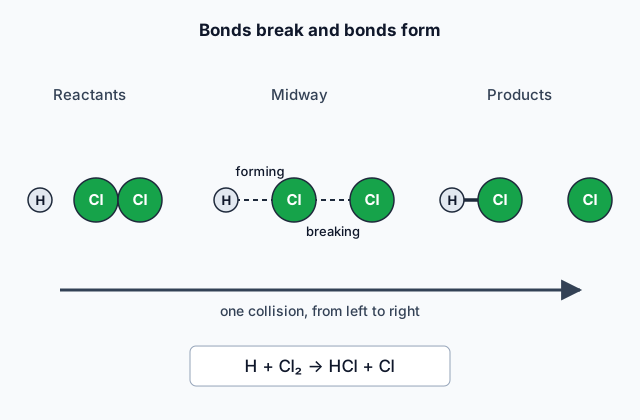
2a. Bonds break and bonds form
An elementary reaction typically breaks some bonds and forms new ones. In Br + H₂ → HBr + H, the H-H bond in H₂ breaks while an H-Br bond forms.
The two halves of that change have opposite energy effects:
- Breaking a bond takes energy in. The atoms are held together, and pulling them apart needs energy.
- Forming a bond gives energy out. When atoms bond, they settle into a lower-energy arrangement and release the difference.
The energy of a reaction is the result of both. If the bonds that form release more than the bonds that break take in, the reaction releases energy overall. If less, it absorbs energy overall.
During the collision the two changes overlap. Midway, the old bonds are partly broken and the new ones are partly formed, an arrangement of atoms that exists only for an instant. The next chunk gives it a name.
Quick check · Multiple choice
In the elementary reaction Br + H₂ → HBr + H, what happens to the bonds?
2b. The profile, the transition state and Ea
A reaction energy profile is a graph of energy as one elementary reaction proceeds. The horizontal axis is the reaction coordinate. It is not time. It measures progress along the path from reactants to products, and it lets one axis stand in for the complex set of motions as the atoms rearrange. The vertical axis is energy.
The curve starts at the energy of the reactants, climbs to a peak, and falls to the energy of the products. The peak is the transition state: the arrangement midway, with old bonds partly broken and new ones partly formed. It has the highest energy on the path, and it is not a species you can collect in a jar.
Two differences are read from the graph:
- Activation energy of the forward reaction: energy of the transition state minus energy of the reactants.
- Overall energy change: energy of the products minus energy of the reactants. It is negative if the products are lower (energy is released) and positive if they are higher (energy is absorbed).
Every elementary reaction has one transition state.
Quick check · Calculate
In a reaction energy profile, the reactants are at 35 kJ/mol, the transition state is at 110 kJ/mol and the products are at 15 kJ/mol. What is the activation energy of the forward reaction, in kJ/mol? Give your answer to two significant figures.
2c. A barrier either way
If the products are lower than the reactants, the reaction is exothermic: its overall energy change is negative, and energy is released. If the products are higher, it is endothermic: the change is positive, and energy is absorbed.
On either profile, there is a hill between reactants and products. Bonds must start to break before the new bonds are formed, so even a reaction that releases energy overall has an activation energy. The size of the hill and the overall energy change are separate: a reaction can have a small barrier and a large energy release, or a large barrier and a small one.
A profile also works backward. Read from right to left it shows the reverse reaction, which starts at the products and climbs to the same transition state. The reverse reaction’s activation energy is the energy of the transition state minus the energy of the products.
Quick check · Decide and justify
In a reaction’s energy profile, the products are 40 kJ/mol lower in energy than the reactants. A student says the reaction therefore has no activation energy. Is the student right?
Which reason supports your decision?
2d. Temperature and the Arrhenius equation
The rate of an elementary reaction depends on temperature because the share of collisions with enough energy to reach the transition state depends on temperature. A higher temperature puts more collisions over the barrier.
The Arrhenius equation puts this into one relationship. It links the rate constant k to the temperature and to the activation energy, and it shows the same two patterns you have seen:
- at one activation energy, a higher temperature gives a larger k;
- at one temperature, a larger activation energy gives a smaller k.
The AP Exam does not ask you to calculate with the Arrhenius equation, so use it as a way of reasoning. A reaction with a high barrier is slow because few collisions reach the top, and warming helps it more than it helps a reaction with a low barrier. The barrier itself, the activation energy, does not change when the temperature does.
Quick check · Multiple choice
Elementary reactions P and Q run at the same temperature. P has an activation energy of 50 kJ/mol and Q has one of 80 kJ/mol. Which statement about their rate constants is correct?
Part 3 Watch it done Reading a profile from its points
Predict first, then watch each step, then finish the calculation yourself.
Teaching example: an elementary reaction has these energies along its reaction coordinate, in kJ/mol: reactants 50; one quarter of the way 85; halfway 120; three quarters of the way 60; products 20. Find the transition state, the activation energy of the forward reaction, and the overall energy change.
Predict first
Before you open the first step, predict: does this reaction release energy overall, or absorb it?
Step 1 · Find the transition state
The transition state is the highest point on the path. Of 50, 85, 120, 60 and 20, the highest is 120 kJ/mol, halfway along the reaction coordinate.
Step 2 · Find the activation energy
Ea = E(transition state) − E(reactants) = 120 − 50 = 70 kJ/mol.
Why this step?
Why is the activation energy measured from the reactants and not from the products?
The forward reaction starts with the reactants, and the barrier is how far they must climb to reach the transition state. Measuring from the products would give the barrier for the reverse reaction.
Your step · Calculate
Finish it. Using the reactants at 50 kJ/mol and the products at 20 kJ/mol, what is the overall energy change of the reaction, in kJ/mol? Include its sign, and give your answer to two significant figures.
kJ/mol
The same profile gives two readings: a barrier of 70 kJ/mol to climb, and an overall change of −30 kJ/mol, so 30 kJ/mol is released. The reverse reaction would have a barrier of 120 − 20 = 100 kJ/mol.
Part 4 Try it Draw it and compare it
Draw a profile of your own, then compare four reactions by their barriers. These numbers are a teaching example.
Try it · Sketch the graph
Represent an elementary reaction with an energy profile. Its reactants are at 60 kJ/mol, its transition state is at 120 kJ/mol and its products are at 20 kJ/mol. Points 0 to 4 run along the reaction coordinate: point 0 is the reactants, point 2 is the transition state and point 4 is the products. Sketch the energy at each point. The first point is fixed at 60 kJ/mol.
One shape that fits
Drag a point up or down, or tap it and use the arrow keys. The shape is checked, and so are the values the question lets you work out.
Try it · Rank it
Four elementary reactions have these energies, in kJ/mol. Reaction A: reactants 20, transition state 80, products 0. Reaction B: reactants 40, transition state 85, products 10. Reaction C: reactants 10, transition state 90, products 60. Reaction D: reactants 30, transition state 75, products 70. Rank them by the activation energy of the forward reaction.
Largest activation energy first
Give each one a place, 1 for first. Give two the same place if they are equal.
Your ranking: none yet
Part 5 Explain it Read and draw an energy profile
On the exam this is handwritten, so answer on paper first. Nothing you type here leaves this page. Then check your answer against the model and each scoring point.
Free response is 50% of the exam score. This one is shaped like a short-answer question, which is worth 4 points.
Free-response practice · Short-answer style
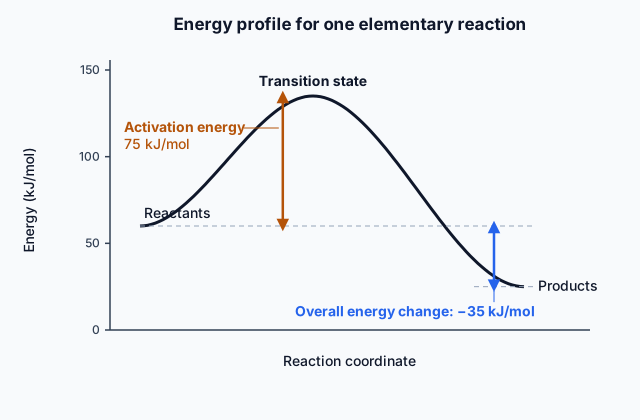
Teaching example. In an elementary reaction, the reactants have an energy of 60 kJ/mol, the transition state has an energy of 135 kJ/mol, and the products have an energy of 25 kJ/mol.
(a) Calculate the activation energy of the forward reaction.
(b) Calculate the overall energy change, and identify whether the reaction releases or absorbs energy.
(c) On paper, draw the reaction energy profile, with the reaction coordinate on the horizontal axis. Label the reactants, the transition state, the products, the activation energy and the overall energy change.
(d) Explain why the rate of the reaction increases when the temperature is raised, in terms of the transition state.
Model answer
(a) Ea = 135 − 60 = 75 kJ/mol.
(b) ΔE = 25 − 60 = −35 kJ/mol. The products are lower than the reactants, so the reaction releases energy.
(c) The drawing below shows the profile. It starts at the reactants, at 60, rises to a single peak labeled the transition state, at 135, and falls to the products, at 25. The activation energy is the arrow from the reactants up to the peak, and the overall energy change is the arrow from the reactants down to the products.
(d) A higher temperature stretches the distribution of collision energies, so a larger share of collisions has at least 75 kJ/mol, the energy needed to reach the transition state. More collisions get over the barrier each second, so the rate rises. The barrier itself does not change.
 Tap to open the picture full size
Score your own answer. This is a self-check, not a grade. Tick each point your answer makes.
Part 6 Check yourself An endothermic profile
All three case questions use the figure.
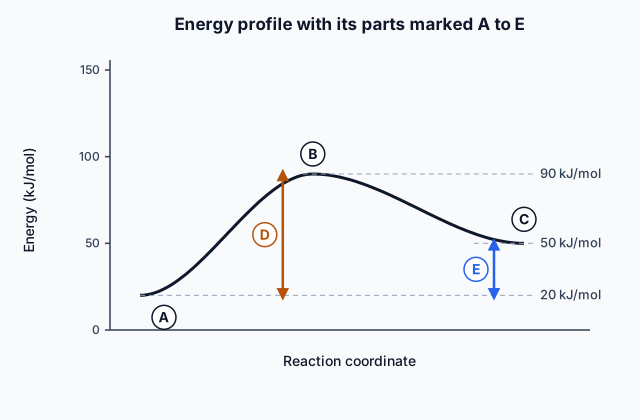
A student draws the energy profile of an elementary reaction and marks its parts with the letters A to E. The energies are in kilojoules per mole. These numbers are a teaching example.
 Tap to open the picture full size
Case question 1 · Match
Using the figure: match each letter to what it shows.
Case question 2 · Calculate
Using the figure: what is the activation energy of the reverse reaction, in kJ/mol? Give your answer to two significant figures.
Case question 3 · Decide and justify
Using the figure: is the forward reaction exothermic or endothermic?
Which reason supports your decision?
The rest stand on their own and do not use the case.
Check yourself · Fill the statement
Complete the description of a reaction energy profile.
The horizontal axis of an energy profile is the , which measures progress from reactants to products. The highest point is the , and the energy difference between the reactants and that point is the .
Check yourself · Spot the error
A student reads an energy profile whose reactants are at 30 kJ/mol, transition state at 100 kJ/mol and products at 10 kJ/mol. Tap the line with the mistake.
Part 7 Keep it Bring back earlier ideas
This lesson leans on two earlier ideas: a stronger bond takes more energy to break, and warming a sample stretches the distribution of particle energies. Pulling them back up is what makes them last.
From 2.2 Intramolecular Force and Potential Energy · Rank it
Carbon and oxygen are joined by a single bond in methanol, CH₃OH, by a triple bond in carbon monoxide, CO, and by double bonds in carbon dioxide, CO₂. Rank these carbon-oxygen bonds by bond energy.
Largest bond energy first
Give each one a place, 1 for first. Give two the same place if they are equal.
Your ranking: none yet
From 3.5 Kinetic Molecular Theory · Select all
A sealed flask of oxygen is warmed from 300 K to 400 K. Which two statements describe how the Maxwell-Boltzmann distribution of the molecules’ speeds changes? Select two.
Select 2 answers, then check.
In three lines
- A reaction energy profile plots energy along the reaction coordinate, from the reactants over a single transition state to the products.
- The activation energy of the forward reaction is the energy of the transition state minus that of the reactants; the overall energy change is the products minus the reactants.
- Temperature changes the rate because it changes the share of collisions with enough energy to reach the transition state; the Arrhenius equation links k, T and Ea.
Exam strategy for this topic
- Section I, Multiple Choice: 60 questions in 90 minutes.
- Section II, Free Response: 7 questions in 105 minutes.
- A scientific or graphing calculator is recommended for use on both sections of the exam.
When you draw a profile, label the axes, then the reactants, one transition state at the top and the products. Draw the activation energy from the reactants up to the peak and the overall energy change from the reactants to the products, and keep the sign of the change. On paper, label every level with its energy.
Questions students ask
What is a reaction energy profile?
It is a graph of energy along the reaction coordinate for one elementary reaction, from the reactants over the transition state to the products.
What is the transition state?
It is the highest-energy arrangement on the path from reactants to products, where old bonds are partly broken and new ones are partly formed.
How do you find the activation energy from a profile?
Subtract the energy of the reactants from the energy of the transition state. That gives the activation energy of the forward reaction.
How do you tell an exothermic reaction from an endothermic one on a profile?
Compare the products with the reactants. Products lower than the reactants mean energy is released; products higher mean energy is absorbed.
Do you need to calculate with the Arrhenius equation?
No. Calculations with it are not assessed on the AP Exam. You need the pattern: a higher temperature or a lower activation energy gives a larger rate constant.
Beyond the AP Exam
College Board sets this limit on what the AP Exam asks about this topic. Anything past it is not on the exam.
Calculations involving the Arrhenius equation will not be assessed on the AP Exam.
Course alignment, for teachers
AP Chemistry topic 5.6, Unit 5: Kinetics.
- Skill 3.B: Represent chemical substances or phenomena with appropriate diagrams or models (e.g., electron configuration).
This lesson maps all 4 essential knowledge statements of the topic to the part that teaches each one: 4 are checked by a scored question. The map is in the lesson file.