Unit 6 · Topic 6.3 · about 25 minutes · 7 parts · 10 scored checks, 1 of them multiple choice, plus 2 from earlier lessons
AP Chemistry 6.3: Heat Transfer and Thermal Equilibrium
Unit 6: 7 to 9% of the multiple-choice section
What you'll be able to do
- Explain how collisions between the particles of two bodies in thermal contact transfer energy as heat until the bodies reach thermal equilibrium.
Key vocabulary
| Term | What it means | The exam trap |
|---|---|---|
| Temperature | A measure of the average kinetic energy of the particles of a body. | Check whether a question asks about the average for one particle or the total for the whole body, because the two behave differently. |
| Thermal contact | Contact between two bodies that lets their particles collide and exchange energy. | Look for what is moving between the bodies, and in which direction, before deciding anything else. |
| Heat transfer (heat exchange) | The transfer of energy as heat: energy passing between bodies in thermal contact through collisions between their particles. | Heat is a transfer, so describe where energy goes rather than what a body has. |
| Thermal equilibrium | The state in which two bodies in thermal contact have the same average particle kinetic energy and therefore the same temperature. | When a question says a quantity has stopped changing, ask exactly which quantity, and whether the particles have changed what they are doing. |
| Average kinetic energy | The mean of the kinetic energies of all the particles in a body, which differ from one particle to the next. | An average describes the body as a whole, so it does not tell you about any one particle. |
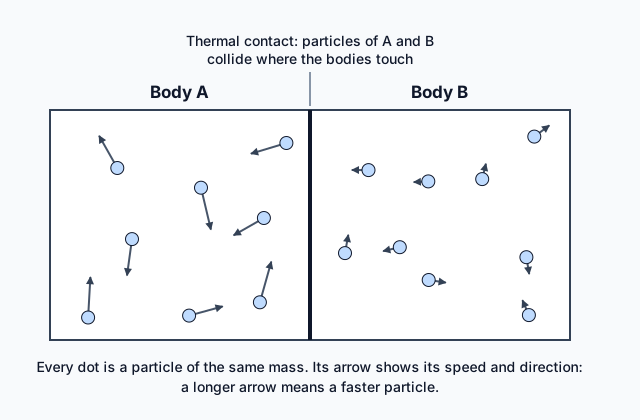 Tap to open the picture full size
Part 1 Think first A cup of tea that stops cooling
Commit to a guess first. Being wrong now makes the right idea stick better.
Predict first
You pour hot tea into a covered mug and leave it on a desk in a 22 °C room. Hours later a thermometer in the tea reads 22 °C, and it stays there however long you wait. Why does the tea stop cooling at that temperature?
In short. When two bodies are in thermal contact, collisions between their particles transfer energy as heat from the warmer body to the cooler one until the two have the same temperature.
- The particles in a warmer body have a greater average kinetic energy than those in a cooler body.
- Heat transfer is energy passing from particle to particle in collisions where the two bodies touch.
- At thermal equilibrium the average kinetic energy of both bodies is the same, so their temperatures are the same, and the particles keep colliding.
Part 2 Learn it From collisions to the same temperature
2a. Temperature and average kinetic energy
Every particle in a body is in continuous, random motion, so every particle has kinetic energy. They do not all have the same amount. Collisions trade energy, so at any moment some particles are fast and some are slow.
The particles in a warmer body have a greater average kinetic energy than those in a cooler body. Temperature is the measure of that average.
Two cautions:
- Temperature is not the total energy of a body. The average is per particle, so it does not depend on how much of a substance you have. A drop and a lake of water at 20 °C have the same average kinetic energy per particle, although the lake has far more total kinetic energy because it has far more particles.
- The same temperature does not mean the same speed. At one temperature the particles of any substance have the same average kinetic energy, so lighter particles move faster than heavier ones.
Quick check · Rank it
Four samples are listed with their masses and temperatures. Rank them by the average kinetic energy of one of their particles, largest first. A tie is allowed.
Largest average kinetic energy per particle first
Give each one a place, 1 for first. Give two the same place if they are equal.
Your ranking: none yet
2b. Heat transfer by collisions
When two bodies touch, particles at the boundary collide. In a collision between a particle with more kinetic energy and one with less, energy typically passes to the one with less: the first loses some kinetic energy and the second gains some. Any single collision can go either way, but across countless collisions the net transfer is from the body with the greater average kinetic energy to the one with the lesser.
This transfer of energy by collisions is called heat transfer, heat exchange, or transfer of energy as heat. Two bodies able to exchange energy this way are in thermal contact.
Heat is energy on the move, not energy a body stores. A body does not contain heat the way a jar contains water; its particles have kinetic energy, and heat is what passes when the body touches another at a different temperature. Once energy reaches the surface of a body, collisions among its own particles spread it inward, which is why the handle of a spoon in hot soup warms along its length.
Quick check · Put it in order
A hot metal block is dropped into cool water. Put these particle-level events in the order they happen.
2c. Thermal equilibrium
The collisions keep happening, so the transfer continues until the two bodies have the same average kinetic energy. That state is thermal equilibrium: the average kinetic energy of both bodies is the same, and hence their temperatures are the same.
Three points to hold on to:
- Collisions do not stop at equilibrium. Particles of the two bodies still collide and still trade energy, but about as much passes each way, so neither body's average changes. A thermometer holds steady because the trading is balanced.
- The final temperature lies between the two starting temperatures. The warmer body cools and the cooler body warms; neither passes the other.
- Equal temperature is not equal total energy or equal speed. A large body holds more total kinetic energy than a small one at the same temperature, and the lighter particles move faster.
Quick check · Decide and justify
A warm metal block has sat in an insulated cup of cool water for an hour, and a thermometer shows the two at the same temperature. A student says the particles of the block and the water have stopped colliding with each other. Is the student right?
Which reason supports your decision?
Part 3 Watch it done Mixing hot and cool water
Predict first, then watch each step, then finish the calculation yourself.
A student pours 100.0 g of water at 80.0 °C into 100.0 g of water at 20.0 °C in an insulated cup and stirs until the temperature stops changing. Assume no energy leaves the cup. What is the temperature at thermal equilibrium?
Predict first
Before you open the first step, predict where the final temperature will be.
Step 1 · Compare the two portions
Both portions are water and have the same mass, so each holds the same number of identical particles. The particles of the 80.0 °C portion have the greater average kinetic energy, so the net transfer of energy is from the hot portion to the cool one.
Step 2 · Use what stays the same
No energy leaves the cup, so the total energy of the water in the cup is the same after mixing as before. At thermal equilibrium every particle in the cup has the same average kinetic energy.
Why this step?
Why is the final average kinetic energy the mean of the two starting averages?
The particles are identical and equal in number, so the combined kinetic energy ends up shared evenly among the same number of particles. Each portion started with a different average, and the shared average is their mean. Temperature tracks average kinetic energy, so the final temperature is the mean of the two starting temperatures.
Step 3 · Set up the mean
Add the two starting temperatures and divide by two. Putting the temperatures in kelvins first gives the same result as using degrees Celsius, because the two scales differ by a fixed amount.
Your step · Calculate
Finish it. 50.0 g of water at 70.0 °C is mixed with 50.0 g of water at 10.0 °C in an insulated cup, so no energy leaves. The two portions contain equal numbers of identical particles. What temperature do they reach at thermal equilibrium, in °C? Give your answer to three significant figures.
°C
The answer is exactly halfway only because the two portions are the same substance in the same amount. With different amounts, or different substances, the two portions meet somewhere else, and a later topic shows how to find the temperature.
Part 4 Try it A thermometer in hot water
A lab thermometer that has sat on the bench at 22.0 °C is placed in a beaker of water at 80.0 °C. The reading climbs for a few seconds and then holds steady. These numbers are a teaching example.
Try it · Fill the statement
A thermometer at room temperature is placed in hot water, and its reading climbs and then holds steady. Complete the particle-level explanation.
Water particles at the thermometer's surface with the particles of the thermometer. Energy passes from the particles with more kinetic energy to those with less, so the thermometer's particles . The reading holds steady when the thermometer and the water have the same average , a state called thermal .
Try it · Select all
The thermometer's reading has now held steady at the temperature of the water. Which two statements are true of the thermometer and the water? Select two.
Select 2 answers, then check.
Part 5 Explain it Why the block stops cooling
On the exam this is handwritten, so answer on paper first. Nothing you type here leaves this page. Then check your answer against the model and each scoring point.
Free response is 50% of the exam score. This one is shaped like a short-answer question, which is worth 4 points.
Free-response practice · Short-answer style
A block of aluminum at 90 °C is placed in water at 20 °C in an insulated cup. A thermometer in the water shows its temperature rising for a while, and then it stops changing.
(a) Identify the direction of the net transfer of energy between the aluminum and the water.
(b) Describe, in terms of particles, how energy is transferred between the aluminum and the water.
(c) Predict how the average kinetic energy of the aluminum atoms compares with the average kinetic energy of the water molecules after a long time, and give the reason.
(d) Explain why the temperatures stop changing even though the particles of the aluminum and the water are still colliding.
Model answer
(a) The net transfer of energy is from the aluminum, which is hotter, to the water, which is cooler.
(b) Particles at the boundary collide. In these collisions energy passes from the aluminum atoms, which have the greater kinetic energy on average, to the water molecules, which have less, so the atoms slow down and the molecules speed up. Collisions among the water molecules then spread the energy through the water.
(c) The average kinetic energies are equal, because the aluminum and the water have reached thermal equilibrium, and bodies at equilibrium have the same temperature.
(d) The collisions continue and energy still passes between the particles, but about as much passes from the water to the aluminum as from the aluminum to the water. The net transfer is zero, so neither body's average kinetic energy changes, and neither temperature changes.
Score your own answer. This is a self-check, not a grade. Tick each point your answer makes.
Part 6 Check yourself A metal block cools in water
Both case questions use the table.
A student drops a metal block heated to 90.0 °C into water at 20.0 °C in an insulated cup, stirs, and records the temperature of each every 20 s. These numbers are a teaching example.
| Time (s) | Metal (°C) | Water (°C) |
|---|---|---|
| 0 | 90.0 | 20.0 |
| 20 | 55.9 | 30.1 |
| 40 | 43.3 | 33.8 |
| 60 | 38.7 | 35.2 |
| 80 | 37.0 | 35.7 |
| 100 | 36.4 | 35.9 |
| 120 | 36.1 | 36.0 |
| 140 | 36.0 | 36.0 |
| 160 | 36.0 | 36.0 |
Case question 1 · Calculate
Using the table: what is the temperature, in °C, of the metal and the water at thermal equilibrium? Give your answer to three significant figures.
Case question 2 · Multiple choice
Using the table: the cup is insulated. Which statement best describes what happened between 0 s and 40 s?
The rest stand on their own and do not use the case.
Check yourself · Spot the error
A cold metal cube is dropped into warm water in an insulated cup. A student explains what happens next. Tap the line with the mistake.
Check yourself · Sort it
Each card describes either temperature or heat transfer. Tap a card, then the bin it belongs in.
Temperature
Heat transfer
Part 7 Keep it Bring back earlier ideas
This lesson leans on two earlier ideas: how temperature sets the average kinetic energy and the spread of speeds in a sample, and what an exothermic or endothermic process does to the energy of a system. Pulling them back up is what makes them last.
Samples of gas that differ in temperature, in the mass of their particles, or in both.
From 3.5 Kinetic Molecular Theory · Decide and justify
Flask X holds oxygen at 300 K, and flask Y holds oxygen at 600 K. A student claims that every molecule in flask Y is moving faster than every molecule in flask X. Is the claim correct?
Which reason supports your decision?
Now read diagrams you have not seen. Every number here is a teaching example. For each one, find the gap between the levels, its sign and its size.
From 6.2 Energy Diagrams · Sort it
Each card describes an energy diagram. Tap a card, then the bin for the kind of process it shows.
Exothermic
Endothermic
In three lines
- The particles in a warmer body have a greater average kinetic energy than those in a cooler body, and temperature measures that average.
- Heat transfer is energy passing in collisions between the particles of bodies in thermal contact, from the warmer body to the cooler one.
- At thermal equilibrium the average kinetic energy of both bodies is the same, so their temperatures are the same, and the particles keep colliding.
Exam strategy for this topic
- Section I, Multiple Choice: 60 questions in 90 minutes.
- Section II, Free Response: 7 questions in 105 minutes.
- A scientific or graphing calculator is recommended for use on both sections of the exam.
When you explain heat transfer, name the particles and the collisions: energy passes from the particles of the warmer body, which have the greater average kinetic energy, to the particles of the cooler body. For thermal equilibrium, say that the average kinetic energy, and so the temperature, is the same for both bodies, and that the particles keep colliding.
Questions students ask
What is the difference between heat and temperature?
Temperature measures the average kinetic energy of the particles in a body. Heat is the energy that passes between two bodies in thermal contact because of a difference in temperature.
How does heat transfer happen at the particle level?
Particles of the two bodies collide where the bodies touch. In these collisions energy passes, on average, from the particles of the warmer body, which have the greater average kinetic energy, to the particles of the cooler body.
What is thermal equilibrium?
It is the state in which two bodies in thermal contact have the same average particle kinetic energy and so the same temperature.
Do collisions stop at thermal equilibrium?
No. The particles keep colliding and trading energy, but about as much energy passes each way, so neither body's average kinetic energy changes.
Does the same temperature mean the same total energy?
No. Temperature is an average per particle, so a larger body at the same temperature holds more total kinetic energy than a smaller one.
Course alignment, for teachers
AP Chemistry topic 6.3, Unit 6: Thermochemistry.
- Skill 6.E: Provide reasoning to justify a claim using connections between particulate and macroscopic scales or levels.
This lesson maps all 3 essential knowledge statements of the topic to the part that teaches each one: 3 are checked by a scored question. The map is in the lesson file.