Unit 6 · Topic 6.4 · about 30 minutes · 7 parts · 14 scored checks, 2 of them multiple choice
AP Chemistry 6.4: Heat Capacity and Calorimetry
Unit 6: 7 to 9% of the multiple-choice section
What you'll be able to do
- Calculate the heat absorbed or released by a substance that is heated or cooled, from its amount, its heat capacity and its change in temperature.
Key vocabulary
| Term | What it means | The exam trap |
|---|---|---|
| Heat (q) | Energy transferred between two bodies because of a difference in temperature, measured in joules. | A sign is part of the answer, so decide whether the body you are describing gained or lost energy before you write q. |
| Specific heat capacity (c) | The energy needed to raise the temperature of 1 gram of a substance by 1 °C, in J/(g·°C). | Questions often give two substances and one amount of energy, so compare their heat capacities before comparing their temperatures. |
| Molar heat capacity | The energy needed to raise the temperature of 1 mole of a substance by 1 °C, in J/(mol·°C). | Read the units of every value given, because a per-mole and a per-gram value for the same substance are different numbers. |
| Calorimetry | Measuring the heat of a process from the temperature change of a known mass of water or solution around it. | The thermometer reads the water, not the process, so be careful which of the two a question asks about. |
| First law of thermodynamics | Energy is conserved in chemical and physical processes: it moves between parts of a system and its surroundings, but the total stays the same. | Conservation is about totals, so track where each joule went rather than which part ended up warmer. |
 Tap to open the picture full size
Part 1 Think first An instant cold pack
Commit to a guess first. Being wrong now makes the right idea stick better.
Predict first
An instant cold pack holds water and a solid in separate pouches. You squeeze it, the inner pouch breaks, the solid dissolves, and within seconds the pack feels cold on a sprained ankle. Nothing was plugged in and nothing was cold to begin with. What is going on?
In short. The heat a substance absorbs or releases when its temperature changes is q = mcΔT: its mass, times its specific heat capacity, times its change in temperature.
- Energy is conserved, so in a calorimeter the energy one part loses is the energy the other part gains.
- A substance with a lower specific heat capacity changes temperature more for the same energy.
- When something dissolves in a calorimeter, a rise in temperature means the process released energy, and a fall means it absorbed energy.
Part 2 Learn it Putting a number on heat
2a. q = mcΔT
When a cooler body is warmed by a warmer one, energy moves between them as heat. You cannot see heat, but you can calculate it from three things you can measure:
q = mcΔT
- q is the heat, in joules (J).
- m is the mass of the substance, in grams.
- c is its specific heat capacity, the energy needed to warm 1 gram of it by 1 °C, in J/(g·°C). Liquid water's is 4.18 J/(g·°C).
- ΔT is the change in temperature, final minus initial.
The sign carries meaning. Heating a substance increases its energy, so ΔT and q are positive. Cooling it decreases its energy, so ΔT and q are negative.
Example: warming 100. g of water from 20.0 °C to 30.0 °C takes q = (100. g)(4.18 J/(g·°C))(10.0 °C) = 4180 J, or 4.18 kJ. Notice that ΔT has three significant figures here; a change of 5.0 °C would have only two, and the answer could keep only two. A calorimetry experiment measures heat exactly this way: it measures a temperature change and turns it into q.
Quick check · Calculate
How much heat, in joules, does it take to warm 50.0 g of water from 22.0 °C to 34.5 °C? The specific heat capacity of water is 4.18 J/(g·°C). Give your answer to three significant figures.
2b. Same energy, different temperature change
Give the same amount of energy to equal masses of two different substances and their temperatures will not rise by the same amount. Rearranging q = mcΔT shows why: ΔT = q/(mc). With q and m the same, a substance with a smaller specific heat capacity gets a larger temperature change.
Water's 4.18 J/(g·°C) is large. Iron's is 0.449 J/(g·°C), less than a ninth of water's, so the same energy warms a gram of iron about nine times as much as a gram of water.
Heat capacity can also be given per mole. The molar heat capacity is the energy to warm 1 mole of a substance by 1 °C, in J/(mol·°C). Both are used in energy calculations: use specific heat capacity with a mass in grams, and molar heat capacity with an amount in moles. To turn one into the other, multiply the specific heat capacity by the molar mass.
Quick check · Rank it
Four 10.0 g metal samples each absorb 100. J of energy. Their specific heat capacities, in J/(g·°C), are aluminum 0.897, iron 0.449, copper 0.385 and gold 0.129. Rank the samples by how much their temperature rises.
Largest temperature rise first
Give each one a place, 1 for first. Give two the same place if they are equal.
Your ranking: none yet
2c. Energy moves; it is not made or lost
The first law of thermodynamics says that energy is conserved in chemical and physical processes. Energy can move from one part of a system to another, or between a system and its surroundings, but the total does not change.
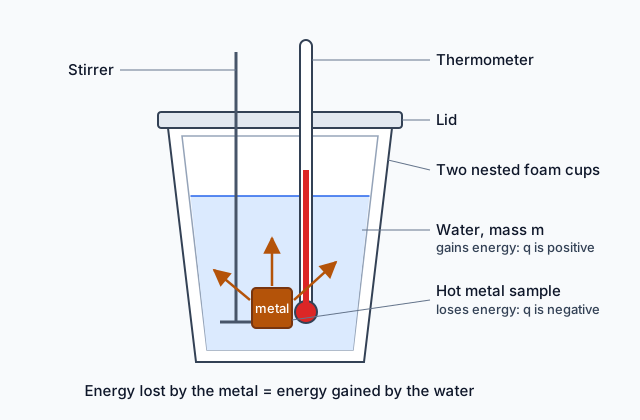
In a calorimeter, that means the energy one part loses is the energy the other part gains. If a hot metal is dropped into cool water, the metal cools (its q is negative) and the water warms (its q is positive), by the same amount:
q(metal) = −q(water)
A chemical system changes its energy in three main ways:
- heating or cooling, a change in temperature (this lesson);
- a phase transition, such as melting or boiling, where a substance changes state;
- a chemical reaction, which can release or absorb energy as bonds change.
Only the first is calculated with q = mcΔT. Spotting which process is happening is the first step of any energy problem.
Quick check · Sort it
Each card describes a change in a chemical system. Tap a card, then the bin for the process that changes the system's energy.
Heating or cooling
Phase transition
Chemical reaction
2d. Reading a calorimeter
A coffee-cup calorimeter is two nested foam cups with a lid, some water, a thermometer and a stirrer. The foam and lid keep energy from leaving to the room, so any energy a process inside releases or absorbs shows up as a temperature change of the water.
That makes the thermometer a direction finder. Suppose a solid dissolves in the water:
- If the temperature of the mixture rises, thermal energy was released by the dissolution process into the water. The process is exothermic.
- If the temperature of the mixture falls, thermal energy was absorbed by the dissolution process from the water. The process is endothermic.
Keep the two parts separate in your head. The water's q has the opposite sign from the process's. When the water warms, the water gained energy, which means the dissolving lost it. That sign flip, from the first law, is a step that is easy to skip.
Quick check · Decide and justify
A student dissolves a few grams of calcium chloride in 50.0 g of water in a coffee-cup calorimeter. The thermometer reads 21.0 °C before and 30.5 °C after the solid dissolves. Is dissolving calcium chloride exothermic or endothermic?
Which reason supports your decision?
Part 3 Watch it done Which metal is it?
Predict first, then watch each step, then finish the calculation yourself.
A student heats a 100.0 g sample of an unknown metal to 99.0 °C in boiling water, then drops it into 50.0 g of water at 15.0 °C in a coffee-cup calorimeter. After stirring, the metal and water reach the same final temperature, 28.1 °C. The specific heat capacity of water is 4.18 J/(g·°C). Assume no energy leaves the calorimeter. What is the specific heat capacity of the metal?
Predict first
Before you open the first step, predict: whose temperature changes more, the metal's or the water's?
Step 1 · Find the heat gained by the water
The water went from 15.0 °C to 28.1 °C, so ΔT = +13.1 °C. q(water) = (50.0 g)(4.18 J/(g·°C))(13.1 °C) = 2737.9 J, about +2740 J. Positive, because the water gained energy. Keep the unrounded value for the next step.
Step 2 · Use the first law for the metal
No energy left the calorimeter, so everything the water gained came from the metal: q(metal) = −q(water) = −2737.9 J.
Why this step?
Why can the metal's q be found from the water's?
Energy is conserved. The metal and the water are the only two things exchanging energy inside the insulated cup, so the energy the metal lost must equal the energy the water gained.
Step 3 · Find the metal's temperature change
The metal went from 99.0 °C to 28.1 °C, so its ΔT = 28.1 − 99.0 = −70.9 °C. Its temperature changed far more than the water's 13.1 °C, even though the energy was the same and the metal has twice the water's mass.
Your step · Calculate
Finish it. With q(metal) = −2737.9 J, m = 100.0 g and ΔT = −70.9 °C, what is the specific heat capacity of the metal, in J/(g·°C)? Give your answer to three significant figures.
J/(g·°C)
The same energy moved the water by 13.1 °C and the metal, with twice the mass, by 70.9 °C. That difference is the specific heat capacities at work, and it is the reason a calorimeter uses water: its large specific heat capacity keeps its temperature change small and easy to measure precisely.
Part 4 Try it Inside a cold pack
Back to the cold pack, now in a lab. A student dissolves 20.0 g of ammonium nitrate, NH₄NO₃, in 100.0 g of water in a coffee-cup calorimeter. The temperature falls from 23.0 °C to 10.2 °C. Treat the solution as 120.0 g with a specific heat capacity of 4.18 J/(g·°C). These numbers are a teaching example.
Try it · Calculate
What is q for the solution, in joules, as the ammonium nitrate dissolves? Include its sign, and give your answer to three significant figures.
Try it · Decide and justify
Is dissolving ammonium nitrate in water exothermic or endothermic?
Which piece of evidence supports your decision?
Part 5 Explain it Find the specific heat of a metal
On the exam this is handwritten, so answer on paper first. Nothing you type here leaves this page. Then check your answer against the model and each scoring point.
Free response is 50% of the exam score. This one is shaped like a short-answer question, which is worth 4 points.
Free-response practice · Short-answer style
A student heats a 150.0 g sample of a metal to 100.0 °C and places it in 50.0 g of water at 20.0 °C in a coffee-cup calorimeter. The final temperature of the metal and water is 39.5 °C. The specific heat capacity of water is 4.18 J/(g·°C).
(a) Identify the direction in which thermal energy flowed between the metal and the water.
(b) Calculate the heat gained by the water, in joules.
(c) Calculate the specific heat capacity of the metal. Assume all the energy lost by the metal was gained by the water.
(d) Some energy actually escaped from the cup to the room. Explain whether the student's calculated specific heat capacity of the metal is too high or too low because of this.
Model answer
(a) Thermal energy flowed from the metal, which was hotter, to the water, which was cooler.
(b) q(water) = mcΔT = (50.0 g)(4.18 J/(g·°C))(39.5 °C − 20.0 °C) = 4075.5 J, which is 4080 J to three significant figures.
(c) q(metal) = −4075.5 J and ΔT(metal) = 39.5 °C − 100.0 °C = −60.5 °C, so c = q/(mΔT) = (−4075.5 J)/((150.0 g)(−60.5 °C)) = 0.449 J/(g·°C).
(d) Too low. Some of the energy the metal released went to the room, so the water gained less than the metal lost. Using the water's smaller q for the metal gives a value of c that is smaller than the true value.
Score your own answer. This is a self-check, not a grade. Tick each point your answer makes.
Part 6 Check yourself Four samples, the same energy
All three case questions use the table.
A student gives 250. J of energy to each of four 25.0 g samples, A to D, and records how much each one's temperature rises. None of the samples changes phase. These numbers are a teaching example.
| Sample | Temperature rise (°C) |
|---|---|
| A | 2.39 |
| B | 11.1 |
| C | 22.3 |
| D | 26.0 |
Case question 1 · Calculate
Using the table: what is the specific heat capacity of sample C, in J/(g·°C)? Give your answer to three significant figures.
Case question 2 · Multiple choice
Using the table: which sample has the largest specific heat capacity?
Case question 3 · Calculate
Using the table: sample C is iron, whose molar mass is 55.85 g/mol. From sample C's data, what is the molar heat capacity of iron, in J/(mol·°C)? Give your answer to three significant figures.
The rest stand on their own and do not use the case.
Check yourself · Put it in order
A student wants to find the specific heat capacity of a metal with a coffee-cup calorimeter. Put the steps in order.
Check yourself · Spot the error
A hot metal is placed in cool water in a calorimeter, and the water warms by 3.0 °C. A student explains the result. Tap the line with the mistake.
Part 7 Keep it Bring back earlier ideas
This lesson leans on two earlier ideas: what happens when a warm body touches a cool one, and how a mass becomes moles. Pulling them back up is what makes them last.
Bring it back · Multiple choice
A warm metal block is placed in cool water in an insulated cup. The two are left in thermal contact for a long time. Which statement describes them at thermal equilibrium?
Bring it back · Calculate
How many moles of water are in 36.0 g of water? The molar mass of water is 18.02 g/mol. Give your answer to three significant figures.
In three lines
- The heat a substance absorbs or releases as its temperature changes is q = mcΔT, with ΔT = final − initial; heating makes q positive and cooling makes it negative.
- The same energy changes the temperature of a substance with a smaller specific heat capacity more; heat capacity can be per gram or per mole.
- Energy is conserved, so in a calorimeter q(process) = −q(water): a rise in temperature means the process released energy, and a fall means it absorbed energy.
Exam strategy for this topic
- Section I, Multiple Choice: 60 questions in 90 minutes.
- Section II, Free Response: 7 questions in 105 minutes.
- A scientific or graphing calculator is recommended for use on both sections of the exam.
In a calorimetry calculation, write each quantity with its unit and its sign, find q for the water first, and then state the process's q as its negative. Keep as many significant figures as the measurements allow, and name the direction of energy flow in words as well, since a written explanation may ask for it.
Questions students ask
What does q = mcΔT mean?
It gives the heat q a substance absorbs or releases when its temperature changes: its mass m, times its specific heat capacity c, times its change in temperature ΔT.
Is q positive or negative?
Positive when a substance is heated and gains energy, negative when it is cooled and loses energy. In a calorimeter the water and the process inside it have opposite signs.
What is the difference between specific heat capacity and molar heat capacity?
Specific heat capacity is per gram, in J/(g·°C); molar heat capacity is per mole, in J/(mol·°C). Multiply a specific heat capacity by the molar mass to get the molar one.
How does a calorimeter show whether dissolving is exothermic or endothermic?
If the temperature of the mixture rises, the dissolving released energy and is exothermic. If it falls, the dissolving absorbed energy and is endothermic.
Why does a metal heat up faster than water?
Most metals have a much smaller specific heat capacity than water, so the same energy raises their temperature more.
Course alignment, for teachers
AP Chemistry topic 6.4, Unit 6: Thermochemistry.
- Skill 2.D: Make observations or collect data from representations of laboratory setups or results, while attending to precision where appropriate.
This lesson maps all 7 essential knowledge statements of the topic to the part that teaches each one: 7 are checked by a scored question. The map is in the lesson file.