Unit 6 · Topic 6.5 · about 30 minutes · 7 parts · 12 scored checks, 1 of them multiple choice, plus 2 from earlier lessons
AP Chemistry 6.5: Energy of Phase Changes
Unit 6: 7 to 9% of the multiple-choice section
What you'll be able to do
- Explain and calculate the heat absorbed or released by a system undergoing a phase transition, from the amount of the substance in moles and the molar enthalpy of the transition.
Key vocabulary
| Term | What it means | The exam trap |
|---|---|---|
| Phase change (phase transition) | A change of a substance from one state to another, such as melting, freezing, boiling or condensing. | Before you pick an equation, decide whether the substance is changing its temperature or changing its state. |
| Molar enthalpy of fusion | The energy absorbed when 1 mole of a solid melts, in kJ/mol. The same amount is released when 1 mole of the liquid freezes. | A molar quantity is per mole, so check the units of every number before you multiply. |
| Molar enthalpy of vaporization | The energy absorbed when 1 mole of a liquid boils, in kJ/mol. The same amount is released when 1 mole of the gas condenses. | Read the direction of the change in the question, because the sign of the heat depends on it. |
| Molar enthalpy of condensation | The energy change when 1 mole of a gas condenses to a liquid, in kJ/mol. It is the negative of the molar enthalpy of vaporization. | Pay attention to which value the question hands you and which change it asks about. |
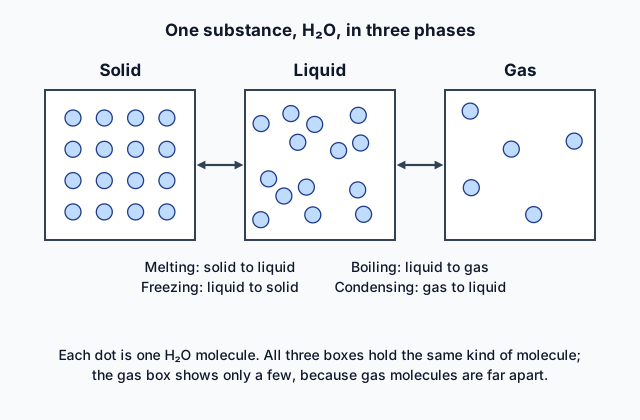 Tap to open the picture full size
Part 1 Think first A glass of ice water
Commit to a guess first. Being wrong now makes the right idea stick better.
Predict first
You leave a glass of ice and water on a table in a warm room. An hour later there is still ice in the glass, but less of it, and a thermometer in the glass reads 0 °C. Energy has been flowing in from the warm room the whole hour. Where did all that energy go?
In short. Melting and boiling absorb energy, freezing and condensing release the same energy, the temperature of a pure substance stays constant throughout, and the heat for n moles is q = nΔH.
- Energy must be transferred to a system for it to melt (or boil), and a system releases that energy when it freezes (or condenses).
- The heat of a phase change is q = n × ΔH, with n in moles and ΔH the molar enthalpy of the change, and ΔH(condensation) = −ΔH(vaporization).
- Energy added during a phase change goes into overcoming attractions between particles, not into speeding them up, so the temperature stays constant.
Part 2 Learn it The energy of melting, boiling, freezing and condensing
2a. Energy in, energy out
A phase change is a change of state of a substance: solid to liquid, liquid to gas, or the reverse. It changes how the particles are arranged, and that takes energy or gives it back.
- Energy must be transferred to a system to make a substance melt (or boil). The energy of the system increases as it goes from solid to liquid (or from liquid to gas). These changes absorb energy.
- A system releases energy when it freezes (or condenses). The energy of the system decreases as it goes from liquid to solid (or from gas to liquid). These changes release energy.
At the particle level, melting loosens particles out of their fixed places, and boiling pulls them apart from one another altogether. Overcoming the attractions between particles takes energy. When the attractions re-form as a substance freezes or condenses, that energy is released.
An ice cube in a warm drink melts by absorbing energy from the drink. A drop of dew forms on a blade of grass by condensing, and it releases energy to the grass.
Quick check · Sort it
Each card describes a phase change. Tap a card, then the bin for whether the system absorbs or releases energy.
Absorbs energy
Releases energy
2b. The temperature stays constant
Warm a pot of ice and water on a stove, stirring, with a thermometer in it. While any ice is left, the reading holds at 0 °C, although energy flows in the whole time. When the last ice is gone, the temperature starts to rise. It rises until the water boils, and then it holds at 100 °C until the last liquid has boiled away.
The temperature of a pure substance remains constant during a phase change.
Temperature measures the average kinetic energy of the particles (Topic 6.3). During a phase change the energy added does not make the particles move faster. It goes into overcoming the attractions between them, so their average kinetic energy, and so the temperature, does not change until the change is complete. During the change, both phases are present together.
The same happens in reverse. As water freezes, energy leaves it, yet its temperature holds at 0 °C until the last liquid has frozen. A graph of temperature against energy added shows this as a rising line with a flat step at each melting point and boiling point.
Quick check · Decide and justify
A student adds energy at a steady rate to a stirred mixture of pure ice and water at 0 °C, with a thermometer in it. While some ice is still left, does the thermometer reading rise?
Which reason supports your decision?
2c. q = nΔH
How much energy a phase change absorbs or releases depends on how much substance changes. The energy per mole is the molar enthalpy of the change, ΔH, in kJ/mol. For n moles, the heat is
q = n × ΔH
For water at its normal melting and boiling points:
- molar enthalpy of fusion (melting): ΔH(fusion) = +6.01 kJ/mol
- molar enthalpy of vaporization (boiling): ΔH(vaporization) = +40.7 kJ/mol
A positive ΔH means the system absorbs energy, so q is positive. Melting 2.00 mol of ice: q = (2.00 mol)(6.01 kJ/mol) = +12.0 kJ.
Two things to watch. First, n must be in moles, so convert a mass first, n = m/M, with M = 18.02 g/mol for water. Second, the temperature does not change during a phase change, so there is no ΔT, and q = nΔH is used instead of q = mcΔT.
Boiling takes far more energy per mole than melting (40.7 kJ against 6.01 kJ for water) because boiling pulls the particles completely apart, while melting only frees them to slide past one another.
Quick check · Calculate
What is q, in kJ, for 25.0 g of ice at 0 °C as it melts completely to water at 0 °C? Include its sign, and give your answer to three significant figures. The molar enthalpy of fusion of water is 6.01 kJ/mol and its molar mass is 18.02 g/mol.
2d. A change and its reverse
The energy absorbed in a phase change is equal to the energy released in the complementary change in the opposite direction. Condensing steam gives back exactly the energy it took to boil the water, and freezing water gives back what melting the ice took. So the molar enthalpies are equal in size and opposite in sign:
- ΔH(condensation) = −ΔH(vaporization)
- ΔH(freezing) = −ΔH(fusion)
For water that makes ΔH(freezing) = −6.01 kJ/mol and ΔH(condensation) = −40.7 kJ/mol. A negative ΔH means the system releases energy, and q = nΔH gives a negative q.
Only one value per substance has to be known. The molar enthalpy of fusion can be used to find the energy absorbed when melting a substance and the energy released when freezing it. If 1.00 mol of ice absorbs 6.01 kJ as it melts, then 1.00 mol of water releases 6.01 kJ as it freezes, and q for the water is −6.01 kJ.
Quick check · Match
Match each change in 1.00 mol of water to its q. The molar enthalpy of fusion is +6.01 kJ/mol and the molar enthalpy of vaporization is +40.7 kJ/mol.
Part 3 Watch it done Steam turning back to water
Predict first, then watch each step, then finish the calculation yourself.
54.0 g of steam at 100 °C condenses completely into liquid water at 100 °C on a cold surface. The molar enthalpy of vaporization of water is +40.7 kJ/mol and its molar mass is 18.02 g/mol. How much energy does the steam release?
Predict first
Before you open the first step, predict the sign of q for the steam.
Step 1 · Name the phase change
Steam turning into liquid water is condensation, a gas-to-liquid change. Condensing releases energy, so q for the steam is negative. The temperature holds at 100 °C throughout, so there is no ΔT and q = mcΔT does not apply; use q = nΔH.
Step 2 · Find the moles
n = m/M = (54.0 g)/(18.02 g/mol) = 2.9967 mol. Keep the unrounded value for the next step.
Why this step?
Why use −40.7 kJ/mol for condensing when the molar enthalpy of vaporization is +40.7 kJ/mol?
Condensing is vaporizing in reverse. The energy released when steam condenses equals the energy absorbed when the water boils, so the molar enthalpy has the same size and the opposite sign.
Step 3 · Choose the molar enthalpy
ΔH(condensation) = −ΔH(vaporization) = −40.7 kJ/mol, a negative value because the system releases energy.
Your step · Calculate
Finish it. 54.0 g of steam at 100 °C condenses completely to liquid water at 100 °C. The molar enthalpy of vaporization of water is +40.7 kJ/mol and its molar mass is 18.02 g/mol. What is q for the steam, in kJ? Include its sign, and give your answer to three significant figures.
kJ
The steam gave up 122 kJ without changing its temperature at all. That is why a steam burn is worse than a burn from boiling water at the same temperature: the condensing steam hands a large amount of energy to the skin before the liquid even begins to cool.
Part 4 Try it Melting and boiling water
Ice cools a drink by absorbing energy as it melts. The two items below use the molar enthalpies of fusion and vaporization of water.
Try it · Calculate
A drink gives up 12.5 kJ of energy, all of it absorbed by ice at 0 °C as the ice melts completely to water at 0 °C. What mass of ice melts, in grams? The molar enthalpy of fusion of water is 6.01 kJ/mol and its molar mass is 18.02 g/mol. Give your answer to three significant figures.
Try it · Rank it
Four phase changes of water are listed. Rank them by q, with the most positive q first. The molar enthalpy of fusion is +6.01 kJ/mol and the molar enthalpy of vaporization is +40.7 kJ/mol.
Most positive q first
Give each one a place, 1 for first. Give two the same place if they are equal.
Your ranking: none yet
Part 5 Explain it Melting a block of ice
On the exam this is handwritten, so answer on paper first. Nothing you type here leaves this page. Then check your answer against the model and each scoring point.
Free response is 50% of the exam score. This one is shaped like a short-answer question, which is worth 4 points.
Free-response practice · Short-answer style
A student heats 45.0 g of ice at 0 °C in a sealed container with a thermometer, adding energy until all the ice has melted to liquid water at 0 °C. The molar enthalpy of fusion of water is 6.01 kJ/mol, its molar enthalpy of vaporization is 40.7 kJ/mol, and its molar mass is 18.02 g/mol.
(a) Calculate the energy absorbed by the ice as it melts, in kJ.
(b) Describe how the thermometer reading changes while the ice is melting, and explain why in terms of the particles.
(c) Determine q, with its sign, when this same water freezes back to ice at 0 °C.
(d) Justify, with a calculation, the claim that boiling 45.0 g of water takes more energy than melting 45.0 g of ice.
Model answer
(a) n = (45.0 g)/(18.02 g/mol) = 2.497 mol, so q = nΔH = (2.497 mol)(6.01 kJ/mol) = 15.0 kJ.
(b) The reading stays at 0 °C while any ice is left. The energy added goes into overcoming the attractions between the particles as they leave their fixed places, not into raising their average kinetic energy, so the temperature does not change until all the ice has melted.
(c) Freezing is the reverse of melting, so the energy released equals the energy absorbed: q = −15.0 kJ.
(d) Boiling the 2.497 mol takes q = (2.497 mol)(40.7 kJ/mol) = 102 kJ, which is much more than the 15.0 kJ for melting, because the molar enthalpy of vaporization is larger than the molar enthalpy of fusion for the same amount.
Score your own answer. This is a self-check, not a grade. Tick each point your answer makes.
Part 6 Check yourself Heating a pure substance X
All three case questions use the table.
A student adds energy at a steady rate to a 2.50 mol sample of a pure substance, X, in a stirred, sealed container, and records the temperature. X is a teaching example, not a real substance.
| Energy added (kJ) | Temperature (°C) | What the student sees |
|---|---|---|
| 0.00 | 10.0 | Solid X only |
| 3.00 | 30.0 | First drops of liquid appear |
| 17.0 | 30.0 | Solid and liquid together |
| 31.0 | 30.0 | Last of the solid disappears |
| 43.0 | 90.0 | Liquid begins to boil |
| 88.0 | 90.0 | Liquid and gas together |
| 133.0 | 90.0 | Last of the liquid boils away |
Case question 1 · Calculate
Using the table: what is the molar enthalpy of vaporization of X, in kJ/mol? Give your answer to three significant figures.
Case question 2 · Calculate
Using the table: what is q for X, in kJ, when 4.00 mol of liquid X freezes completely to solid X at its freezing point? Include its sign, and give your answer to three significant figures.
Case question 3 · Multiple choice
Using the table: a student claims that no energy was absorbed while the solid was melting, because the temperature did not change then. Which statement evaluates the claim?
The rest stand on their own and do not use the case.
Check yourself · Spot the error
A student finds the energy transferred when 36.04 g of steam at 100 °C condenses to liquid water at 100 °C. The molar enthalpy of vaporization of water is +40.7 kJ/mol and its molar mass is 18.02 g/mol. Tap the first line that goes wrong.
Check yourself · Fill the statement
Water boils in a pot on a stove, and a thermometer is in the water until the pot is nearly dry. Complete the explanation.
While the water boils, the system energy. The added energy goes into the attractions between molecules, not into raising their average , so the temperature until all the liquid has boiled.
Part 7 Keep it Bring back earlier ideas
This lesson leans on two earlier ideas: the heat of a substance that is warmed or cooled, and how a mass becomes moles. Pulling them back up is what makes them last.
From 6.4 Heat Capacity and Calorimetry · Calculate
How much heat, in joules, does it take to warm 50.0 g of water from 22.0 °C to 34.5 °C? The specific heat capacity of water is 4.18 J/(g·°C). Give your answer to three significant figures.
From 1.1 Moles and Molar Mass · Calculate
How many moles of sodium chloride, NaCl, are in 10.0 g of it? The molar mass of NaCl is 58.44 g/mol. Give your answer to three significant figures.
In three lines
- Energy must be transferred to a system for it to melt (or boil), and a system releases that energy when it freezes (or condenses); the temperature of a pure substance stays constant during the change.
- The heat of a phase change is q = nΔH, with n in moles and ΔH in kJ/mol; q is positive when energy is absorbed and negative when it is released.
- A change and its reverse have equal and opposite energies, so ΔH(condensation) = −ΔH(vaporization) and ΔH(freezing) = −ΔH(fusion).
Exam strategy for this topic
- Section I, Multiple Choice: 60 questions in 90 minutes.
- Section II, Free Response: 7 questions in 105 minutes.
- A scientific or graphing calculator is recommended for use on both sections of the exam.
Start by naming the phase change and deciding whether it absorbs or releases energy, and give q that sign. Convert any mass to moles before multiplying by the molar enthalpy, and keep the units on every number. Do not use mcΔT for a phase change, because the temperature does not change. In an explanation, say that the energy goes into overcoming attractions between particles, not into raising their average kinetic energy.
Questions students ask
Why does the temperature stay constant during a phase change?
Temperature measures the average kinetic energy of the particles. During a phase change the energy goes into overcoming the attractions between particles, not into making them move faster, so the temperature of a pure substance stays constant until the change is complete.
What is the equation for the heat of a phase change?
q = n × ΔH, where n is the amount in moles and ΔH is the molar enthalpy of the phase change in kJ/mol. Convert a mass to moles first.
Is q positive or negative for a phase change?
Positive when the system absorbs energy, as in melting and boiling. Negative when it releases energy, as in freezing and condensing.
How are the molar enthalpies of fusion and freezing related?
They are equal in size and opposite in sign: ΔH(freezing) = −ΔH(fusion). In the same way, ΔH(condensation) = −ΔH(vaporization).
Why does boiling take more energy than melting?
Boiling pulls the particles completely apart, while melting only frees them to move past one another, so the molar enthalpy of vaporization is much larger than the molar enthalpy of fusion.
Course alignment, for teachers
AP Chemistry topic 6.5, Unit 6: Thermochemistry.
- Skill 1.B: Describe the components of and quantitative information from models and representations that illustrate both particulate-level and macroscopic-level properties.
This lesson maps all 2 essential knowledge statements of the topic to the part that teaches each one: 2 are checked by a scored question. The map is in the lesson file.