Unit 6 · Topic 6.6 · about 30 minutes · 7 parts · 11 scored checks, 1 of them multiple choice, plus 2 from earlier lessons
AP Chemistry 6.6: Introduction to Enthalpy of Reaction
Unit 6: 7 to 9% of the multiple-choice section
What you'll be able to do
- Calculate the heat released or absorbed by a reaction from the moles of the reacting substance and its molar enthalpy of reaction.
Key vocabulary
| Term | What it means | The exam trap |
|---|---|---|
| Enthalpy change of reaction (ΔH) | The heat a reaction releases (negative) or absorbs (positive) at constant pressure, in kJ per mole of a named substance. | The sign is written from the reaction's side, so decide whose energy a question is asking about before you read it. |
| Exothermic | A reaction that releases heat, with a negative ΔH. | A thermometer reads the surroundings, not the reaction, so check which of the two the question describes. |
| Endothermic | A reaction that absorbs heat, with a positive ΔH. | The sign of ΔH, not the starting temperature, gives the direction, so read the sign before you decide. |
| Molar enthalpy of reaction | The enthalpy change per mole of a named reacting substance, in kJ/mol. | The unit says per mole of one particular substance, so check which substance before you multiply. |
| Chemical potential energy | Energy stored in the bonds and in the attractions between particles. | It is a different kind of energy from kinetic energy, so a temperature change involves both. |
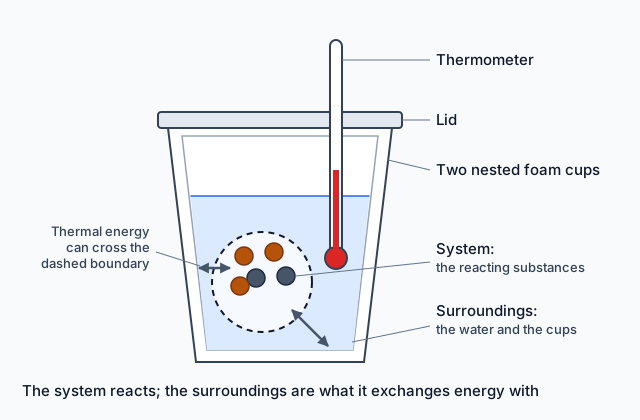
| Surroundings | Everything the reacting substances can exchange energy with, such as the water and the cup in a calorimeter. | Decide whether a q belongs to the water or to the reaction before you write its sign. |
 Tap to open the picture full size
Part 1 Think first A hand warmer
Commit to a guess first. Being wrong now makes the right idea stick better.
Predict first
A disposable hand warmer is a sealed pouch of iron powder, salt and water. When you open the pouch to the air it starts to warm up, and it stays warm for hours. There is no battery and no flame. What is going on?
In short. The enthalpy change of a reaction, ΔH, is the heat the reaction releases (negative) or absorbs (positive) at constant pressure, and for n moles of the reacting substance the heat is q = nΔH.
- A negative ΔH means thermal energy is transferred to the surroundings, so the reaction is exothermic; a positive ΔH means it is transferred from the surroundings, so the reaction is endothermic.
- The products hold a different amount of chemical potential energy than the reactants, and the difference changes the kinetic energy of the particles, which shows up as a temperature change.
- ΔH is given per mole of a named substance, so convert a mass to moles before multiplying.
Part 2 Learn it Heat from a reaction
2a. The sign of ΔH
A chemical reaction can give energy off or take it in. The enthalpy change of a reaction, ΔH, says which, and how much. At constant pressure, which is how most reactions in open flasks and foam cups run, ΔH is the heat the reaction releases or absorbs.
- A negative ΔH means the reaction releases heat. It is exothermic.
- A positive ΔH means the reaction absorbs heat. It is endothermic.
The sign is written from the reaction's side. Negative means energy leaves the reacting substances.
Where does it go? If the products are warmer than their surroundings, the two exchange energy until they reach thermal equilibrium. In an exothermic reaction, thermal energy is transferred to the surroundings as the reactants convert to products, so the surroundings warm. In an endothermic reaction, thermal energy is transferred from the surroundings, so the surroundings cool.
A thermometer in the surroundings therefore reads the opposite of the reaction's own sign: a warming cup means a negative ΔH, and a cooling cup means a positive one.
Quick check · Sort it
Each card describes a chemical reaction at constant pressure. Tap a card, then the bin for the sign of its ΔH.
ΔH negative (exothermic)
ΔH positive (endothermic)
2b. Where the energy comes from
Why does a reaction release or absorb energy at all? Chemical potential energy is stored in the bonds and in the attractions between particles. In a reaction, bonds in the reactants break and new bonds form in the products, so the products hold a different amount of chemical potential energy than the reactants did.
Energy is conserved, so the difference does not disappear. It changes the kinetic energy of the particles:
- If the products hold less chemical potential energy, the extra becomes kinetic energy. The particles move faster, and the mixture's temperature rises. The reaction is exothermic.
- If the products hold more chemical potential energy, that energy comes out of the kinetic energy of the particles. They move more slowly, and the mixture's temperature falls. The reaction is endothermic.
Nothing is made or destroyed. Chemical potential energy and kinetic energy trade places, and the temperature change is the sign that they did.
Quick check · Fill the statement
A reaction in a beaker makes the water bath around it colder. Complete the explanation.
The products hold chemical potential energy than the reactants, because bonds break and form. The difference comes out of the energy of the particles, so the temperature of the mixture .
2c. How much heat: q = nΔH
How much heat a reaction gives off depends on how much reacts, so ΔH is given per mole of a named substance. This is the molar enthalpy of reaction, in kJ/mol. For burning methane, ΔH = −890. kJ/mol of CH₄: each mole of methane that burns releases 890 kJ.
The heat for any amount comes from the number of moles, n, of that substance:
q = nΔH
q is the heat of the reaction, and it takes ΔH's sign: negative when heat is released, positive when it is absorbed. The formula has no mass in it, so a mass in grams must first become moles with the molar mass.
Example: if 0.500 mol of CH₄ burns, q = (0.500 mol)(−890. kJ/mol) = −445 kJ.
The surroundings receive what the reaction gives up, and give up what it takes in, so as in any calorimeter, q(surroundings) = −q(reaction). In a calorimeter you measure the water's q from its temperature change and flip the sign to get the reaction's q.
Quick check · Calculate
In a teaching example, the decomposition of hydrogen peroxide, H₂O₂, has a molar enthalpy of reaction of −98.0 kJ per mole of H₂O₂. What is q for the reaction when 0.250 mol of H₂O₂ decomposes? Include its sign, and give your answer to three significant figures.
Part 3 Watch it done Heat from burning methane
Predict first, then watch each step, then finish the calculation yourself.
Methane, CH₄, burns in oxygen: CH₄ + 2 O₂ → CO₂ + 2 H₂O. The molar enthalpy of reaction is −890. kJ per mole of CH₄. How much heat does the reaction release when 2.50 g of methane burns completely? The molar mass of CH₄ is 16.04 g/mol.
Predict first
Before you open the first step, predict: how would the heat released change if 5.00 g of methane burned instead of 2.50 g?
Step 1 · Turn the mass into moles
ΔH is given per mole, so the amount has to be in moles. n = (2.50 g)/(16.04 g/mol) = 0.155860 mol. Keep the unrounded value for the next step.
Why this step?
Why convert grams to moles before using ΔH?
The molar enthalpy of reaction is energy per mole of CH₄. Only an amount in moles cancels the "per mole" and leaves kJ.
Step 2 · Decide the sign first
Burning methane releases heat, so the reaction is exothermic and q must be negative. Writing the sign down before multiplying lets you catch a slip at the end.
Your step · Calculate
Finish it. Methane burns with a molar enthalpy of reaction of −890. kJ per mole of CH₄, and 2.50 g of it is 0.155860 mol. What is q for the reaction, in kJ? Include its sign, and give your answer to three significant figures.
kJ
The surroundings get what the reaction gives up, so q(surroundings) = −q(reaction) = +139 kJ here, and a calorimeter around the flame would warm. Because q = nΔH, doubling the moles doubles the heat: 5.00 g of methane would release about 277 kJ.
Part 4 Try it A reaction in a calorimeter
Back to the foam cup, now with a reaction inside it. When a strong acid meets a strong base, they react and the cup warms. Work from the water's heat to the reaction's heat, then to the heat per mole.
Try it · Calculate
In a teaching example, a student mixes 50.0 mL of 1.00 M HCl with 50.0 mL of 1.00 M NaOH in a foam cup. The temperature of the mixture rises from 21.00 °C to 27.82 °C. Treat the mixture as 100.0 g of solution with a specific heat capacity of 4.18 J/(g·°C), and assume no energy leaves the cup. What is q for the reaction, in joules? Include its sign, and give your answer to three significant figures.
Try it · Calculate
In a teaching example, 0.0500 mol of HCl reacts with excess NaOH in a foam cup, and the reaction releases 2850 J of heat to the solution. What is the molar enthalpy of reaction, in kJ per mole of HCl? Include its sign, and give your answer to three significant figures.
Part 5 Explain it A reaction that cools its surroundings
On the exam this is handwritten, so answer on paper first. Nothing you type here leaves this page. Then check your answer against the model and each scoring point.
Free response is 50% of the exam score. This one is shaped like a short-answer question, which is worth 4 points.
Free-response practice · Short-answer style
In a teaching example, a student drops 0.0250 mol of a solid reactant into 75.0 g of water in a foam cup. The solid reacts completely, and the temperature of the water falls from 24.80 °C to 21.00 °C. The specific heat capacity of the solution is 4.18 J/(g·°C). Assume the water is the only thing that exchanges energy with the reaction.
(a) Identify whether the reaction is exothermic or endothermic, and the direction in which thermal energy was transferred.
(b) Calculate q for the reaction, in joules.
(c) Calculate the molar enthalpy of reaction, in kJ per mole of solid.
(d) Explain, in terms of chemical potential energy and the kinetic energy of the particles, why the temperature of the water fell.
Model answer
(a) The reaction is endothermic. Thermal energy was transferred from the water, the surroundings, to the reacting substances, which is why the water got colder.
(b) q(water) = mcΔT = (75.0 g)(4.18 J/(g·°C))(21.00 °C − 24.80 °C) = −1191.3 J. The reaction took in that energy, so q(reaction) = +1191.3 J, which is +1190 J to three significant figures.
(c) ΔH = q/n = (+1191.3 J)/(0.0250 mol) = 47652 J/mol, which is +47.7 kJ/mol.
(d) The products hold more chemical potential energy than the reactants. That extra energy comes out of the kinetic energy of the particles in the water, so they move more slowly and the temperature falls.
Score your own answer. This is a self-check, not a grade. Tick each point your answer makes.
Part 6 Check yourself Three reactions in identical cups
The first three questions use the table.
A student runs three reactions, P, Q and R, one at a time. Each goes in an identical foam cup holding the same mass of water at the same starting temperature, and nothing else exchanges energy with the cup. The table gives each reaction's molar enthalpy of reaction, per mole of reactant A, and the moles of A that react. These numbers are a teaching example.
| Reaction | ΔH (kJ per mole of A) | Moles of A that react |
|---|---|---|
| P | −132 | 0.100 |
| Q | +58.5 | 0.200 |
| R | −75.6 | 0.300 |
Case question 1 · Calculate
Using the table: what is q for reaction Q, in kilojoules? Include its sign, and give your answer to three significant figures.
Case question 2 · Rank it
Using the table: rank the three experiments by the final temperature of the water, highest first.
Highest final temperature first
Give each one a place, 1 for first. Give two the same place if they are equal.
Your ranking: none yet
Case question 3 · Multiple choice
Using the table: which statement best explains, in terms of energy, why the water around reaction Q gets colder?
The rest stand on their own and do not use the case.
Check yourself · Spot the error
A reaction in a foam cup has ΔH = −55 kJ/mol. A student explains why the water in the cup changes temperature. Tap the line with the mistake.
Check yourself · Select all
A reaction at constant pressure has ΔH = +45 kJ/mol. Which two statements are true? Select two.
Select 2 answers, then check.
Part 7 Keep it Bring back earlier ideas
This lesson leans on two earlier ideas: reading a thermometer in a calorimeter, and turning a mass into moles. Pulling them back up is what makes them last.
Back to the cold pack, now in a lab. A student dissolves 20.0 g of ammonium nitrate, NH₄NO₃, in 100.0 g of water in a coffee-cup calorimeter. The temperature falls from 23.0 °C to 10.2 °C. Treat the solution as 120.0 g with a specific heat capacity of 4.18 J/(g·°C). These numbers are a teaching example.
From 6.4 Heat Capacity and Calorimetry · Decide and justify
Is dissolving ammonium nitrate in water exothermic or endothermic?
Which piece of evidence supports your decision?
From 1.1 Moles and Molar Mass · Calculate
How many moles of sodium chloride, NaCl, are in 10.0 g of it? The molar mass of NaCl is 58.44 g/mol. Give your answer to three significant figures.
In three lines
- ΔH is the heat a reaction releases (negative) or absorbs (positive) at constant pressure, and q = nΔH gives the heat for n moles of the named substance.
- In an exothermic reaction thermal energy is transferred to the surroundings, and in an endothermic reaction it is transferred from them, so a thermometer in the surroundings reads the opposite of the reaction.
- The products hold a different amount of chemical potential energy than the reactants, and the difference changes the kinetic energy of the particles, which is the temperature change.
Exam strategy for this topic
- Section I, Multiple Choice: 60 questions in 90 minutes.
- Section II, Free Response: 7 questions in 105 minutes.
- A scientific or graphing calculator is recommended for use on both sections of the exam.
Write the sign of every ΔH and q, turn a mass into moles before you multiply, and say in words which way thermal energy was transferred, since a written answer may ask for the direction as well as the number.
Questions students ask
What does the enthalpy change of a reaction mean?
ΔH is the heat a reaction releases or absorbs at constant pressure. A negative ΔH means heat is released and the reaction is exothermic; a positive ΔH means heat is absorbed and the reaction is endothermic.
How do you find the heat from the moles of a reactant?
Multiply the moles of the named substance by the molar enthalpy of reaction: q = nΔH. Convert a mass to moles first, and keep the sign.
Why does the temperature change during a reaction?
The products hold a different amount of chemical potential energy than the reactants. The difference changes the kinetic energy of the particles, and a change in their average kinetic energy is a temperature change.
Is an exothermic reaction hot or cold?
The surroundings of an exothermic reaction warm, because thermal energy is transferred to them. The surroundings of an endothermic reaction cool.
Is the heat of a reaction the same as the heat of the water in the calorimeter?
They have the same size and opposite signs: q(reaction) = −q(surroundings), when no energy escapes.
Beyond the AP Exam
College Board sets this limit on what the AP Exam asks about this topic. Anything past it is not on the exam.
The technical distinctions between enthalpy and internal energy will not be assessed on the AP Exam. Most reactions studied at the AP level are carried out at constant pressure, where the enthalpy change of the process is equal to the heat (and by extension, the energy) of reaction.
Course alignment, for teachers
AP Chemistry topic 6.6, Unit 6: Thermochemistry.
- Skill 5.F: Calculate, estimate, or predict an unknown quantity from known quantities by selecting and following a logical computational pathway and attending to precision (e.g., performing dimensional analysis and attending to significant figures).
This lesson maps all 3 essential knowledge statements of the topic to the part that teaches each one: 3 are checked by a scored question. The map is in the lesson file.