Unit 6 · Topic 6.7 · about 30 minutes · 7 parts · 12 scored checks, 1 of them multiple choice, plus 2 from earlier lessons
AP Chemistry 6.7: Bond Enthalpies
Unit 6: 7 to 9% of the multiple-choice section
What you'll be able to do
- Calculate the enthalpy change of a reaction from the average bond energies of the bonds broken and the bonds formed.
Key vocabulary
| Term | What it means | The exam trap |
|---|---|---|
| Average bond energy | The typical energy needed to break one mole of a kind of bond in the gas phase, averaged over many molecules, in kJ/mol. | A table value is per mole of one kind of bond, so check how many of that bond are in the equation. |
| Bonds broken | All the bonds in the reactant molecules, counted with the coefficients of the equation. | Counting errors are the usual slip, so count the bonds in one molecule and then multiply by its coefficient. |
| Bonds formed | All the bonds in the product molecules, counted with the coefficients of the equation. | Check how a multiple bond is listed in the table before you count it. |
| Estimated enthalpy change | ΔH found as the sum of the bond energies broken minus the sum of the bond energies formed. | The order of the subtraction matters, so label which total is broken and which is formed before you subtract. |
 Tap to open the picture full size
Part 1 Think first A camp stove
Commit to a guess first. Being wrong now makes the right idea stick better.
Predict first
A camp stove burns methane, CH₄, in air and gives off a lot of energy. Burning is a reaction: the atoms of the methane and the oxygen are rearranged into carbon dioxide and water, so some bonds between atoms are pulled apart and others form. How does that rearranging release energy?
In short. The enthalpy change of a reaction can be estimated from average bond energies: ΔH = Σ(energies of bonds broken) − Σ(energies of bonds formed).
- Breaking bonds raises the potential energy of the system and takes energy; forming bonds lowers it and releases energy.
- If the energy released in forming bonds is greater than the energy required to break bonds, the reaction is exothermic; if it is less, the reaction is endothermic.
- Table values are averages, so the answer is an estimate, and every bond in every molecule, with its coefficient, has to be counted.
Part 2 Learn it Adding up bonds
2a. Breaking costs energy, forming pays it back
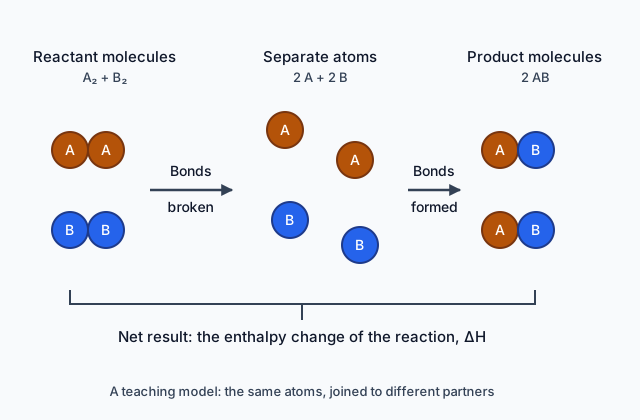
Every reaction rearranges atoms: some bonds in the reactants break, and new bonds form in the products. Both events change the potential energy of the system.
- Breaking a bond takes energy. The atoms are pulled apart against the attraction that holds them, so the potential energy of the system rises.
- Forming a bond releases energy. The atoms fall into the attraction, so the potential energy of the system drops.
The potential energy curve earlier in the course showed the same thing from one side: the depth of the well is the bond energy, the energy needed to separate the atoms. That same amount is released when the atoms come together to form the bond. A stronger bond has a larger bond energy.
In a reaction both things happen, so the net result depends on which is larger: the energy needed to break the old bonds, or the energy given back by forming the new ones.
Quick check · Sort it
Each card describes a change in bonding. Tap a card, then the bin for what happens to the energy of the system.
Takes in energy
Releases energy
2b. Estimating ΔH from average bond energies
To estimate the enthalpy change of a whole reaction, add up the energy of every bond that breaks, add up the energy of every bond that forms, and compare:
ΔH = Σ(bond energies broken) − Σ(bond energies formed)
Σ means "the sum of". Breaking bonds is energy in, so that sum counts positive. Forming bonds is energy out, so that sum is subtracted. The answer is in kJ for the reaction as the equation is written. Topic 6.6 gave ΔH per mole of a named substance, and the two agree when the equation is written with 1 mol of that substance.
The values come from a table of average bond energies. The same bond has a slightly different energy in different molecules, so a table gives a typical value, and the result is an estimate, not an exact value. The table below is a teaching table of typical values; a question gives you the ones it wants you to use.
Example: H₂ + Cl₂ → 2 HCl. Broken: one H-H (436 kJ) and one Cl-Cl (243 kJ), a total of 679 kJ. Formed: two H-Cl (2 × 431 kJ), a total of 862 kJ. ΔH = 679 − 862 = −183 kJ.
| Bond | Average bond energy (kJ/mol) |
|---|---|
| H-H | 436 |
| C-H | 413 |
| C-C | 347 |
| C=C | 614 |
| C≡C | 839 |
| C-O | 358 |
| C=O (in CO₂) | 799 |
| O-H | 467 |
| O=O | 498 |
| N-H | 391 |
| N-N | 160 |
| N≡N | 945 |
| H-Cl | 431 |
| Cl-Cl | 243 |
| C-Cl | 339 |
| H-F | 567 |
| F-F | 159 |
Quick check · Calculate
In a teaching example, the average bond energies are H-H 436 kJ/mol, F-F 159 kJ/mol and H-F 567 kJ/mol. Estimate ΔH, in kJ, for H₂ + F₂ → 2 HF. Include its sign, and give your answer to the nearest kJ.
2c. Count every bond
Most mistakes in these calculations are counting mistakes, so count before you add. Draw each molecule's Lewis structure if you are not sure what bonds it has. Count a double bond or a triple bond as one bond with its own energy.
- CH₄ has four C-H bonds.
- H₂O has two O-H bonds.
- CO₂ is O=C=O, with two C=O double bonds.
- N₂ is N≡N, with one triple bond.
Then multiply by the coefficient in the equation. Two H₂O molecules have 2 × 2 = 4 O-H bonds, and 3 H₂ is three H-H bonds.
All the bonds in the reactant molecules are counted as broken, and all the bonds in the product molecules are counted as formed. A bond that appears on both sides, such as a C-H bond that the reaction does not touch, is counted in both sums. It then cancels out of ΔH, so the answer is the same either way, but the careful method does not miss any.
Quick check · Match
Match each amount of substance to the bonds it contains.
2d. Reading the sign
Once you have both sums, compare them:
- If the energy released in forming bonds is greater than the energy required to break bonds, the reaction is exothermic and ΔH is negative.
- If the energy required is greater than the energy released, the reaction is endothermic and ΔH is positive.
Because ΔH = broken − formed, the sign comes out right automatically: a larger "formed" makes ΔH negative.
The two sums are usually big and close in size, so a miscount of one bond can flip the sign of the answer. Check the sign against the comparison: say which total is larger in words, then see that your ΔH agrees.
Quick check · Decide and justify
In a teaching example, the bonds broken in a reaction need 1812 kJ in all, and the bonds formed release 1654 kJ in all. Is the reaction exothermic or endothermic?
Which reason supports your decision?
Part 3 Watch it done Burning methane, bond by bond
Predict first, then watch each step, then finish the calculation yourself.
Estimate ΔH for the burning of methane, CH₄ + 2 O₂ → CO₂ + 2 H₂O, from these average bond energies in kJ/mol (a teaching table): C-H 413, O=O 498, C=O (in CO₂) 799, O-H 467.
Predict first
Before you open the first step, predict: will the energy released in forming the product bonds be greater than, equal to, or less than the energy needed to break the reactant bonds?
Step 1 · Add up the bonds broken
The reactant molecules are one CH₄ and two O₂. CH₄ has four C-H bonds, and each O₂ has one O=O double bond, so there are two. Broken: 4(413) + 2(498) = 1652 + 996 = 2648 kJ.
Step 2 · Count the bonds formed
The product molecules are one CO₂ and two H₂O. CO₂ is O=C=O, with two C=O bonds. Each H₂O has two O-H bonds, and there are two H₂O.
Why this step?
Why are four O-H bonds formed, not two?
The equation makes 2 H₂O. Each water molecule has two O-H bonds, so 2 × 2 = 4 O-H bonds form.
Your step · Calculate
Finish it. For CH₄ + 2 O₂ → CO₂ + 2 H₂O, the bonds broken total 2648 kJ. The average bond energies are C=O (in CO₂) 799 kJ/mol and O-H 467 kJ/mol. Estimate ΔH for the reaction, in kJ. Include its sign, and give your answer to the nearest kJ.
kJ
The product bonds give back 818 kJ more than the reactant bonds took, which is why methane is a fuel. Measured with liquid water as the product, burning methane gives about −890 kJ per mole, so the estimate is close but not exact: table values are averages, and this table's O-H bond energy is for gas-phase water. The estimate is for the reaction as written, one CH₄ with two O₂, so it is also the estimate per mole of CH₄. For a reaction written with a coefficient of 2 on the substance you want, divide by 2 to get the energy per mole of that substance.
Part 4 Try it Making ammonia, then judging an estimate
Ammonia, NH₃, is made on a huge scale from nitrogen and hydrogen, and it is mostly used for fertilizer. Estimate the energy change of making it from bond energies. The values in the questions are from a teaching table.
Try it · Calculate
In a teaching example, the average bond energies are N≡N 945 kJ/mol, H-H 436 kJ/mol and N-H 391 kJ/mol. Estimate ΔH, in kJ, for making ammonia: N₂ + 3 H₂ → 2 NH₃. Include its sign, and give your answer to the nearest kJ.
Bond energies are averages, so an estimate is not a measurement. The next question compares an estimate with a measured value for a different reaction.
Try it · Decide and justify
A student uses average bond energies (C=C 614, C-C 347, C-H 413 and H-H 436 kJ/mol) to estimate ΔH for C₂H₄ + H₂ → C₂H₆ and gets −123 kJ. A calorimeter experiment on the reaction gives a measured ΔH of about −136 kJ. Did the student make a mistake?
Which reason supports your decision?
Part 5 Explain it Burning hydrazine
On the exam this is handwritten, so answer on paper first. Nothing you type here leaves this page. Then check your answer against the model and each scoring point.
Free response is 50% of the exam score. This one is shaped like a short-answer question, which is worth 4 points.
Free-response practice · Short-answer style
Hydrazine, H₂N-NH₂, burns in oxygen: N₂H₄ + O₂ → N₂ + 2 H₂O. In a teaching example, the average bond energies in kJ/mol are N-N 160, N-H 391, O=O 498, N≡N 945 and O-H 467.
(a) Identify each kind of bond broken in the reaction and the number of each.
(b) Calculate the total energy required to break those bonds and the total energy released in forming the bonds in the products.
(c) Calculate ΔH for the reaction, and determine whether the reaction is exothermic or endothermic.
(d) Explain what happens to the potential energy of the system when bonds break and when bonds form in this reaction, and why the net result has the sign you found.
Model answer
(a) One N-N bond, four N-H bonds (two on each nitrogen of H₂N-NH₂) and one O=O bond.
(b) Required: 160 + 4(391) + 498 = 2222 kJ. Released: the product bonds are one N≡N and four O-H (two in each of 2 H₂O), so 945 + 4(467) = 2813 kJ.
(c) ΔH = 2222 − 2813 = −591 kJ. The energy released is greater than the energy required, so the reaction is exothermic.
(d) Breaking bonds takes energy, so it raises the potential energy of the system. Forming bonds releases energy, so it lowers it. More energy is released in forming the product bonds than was required to break the reactant bonds, so the potential energy ends up lower and the net energy change is negative.
Score your own answer. This is a self-check, not a grade. Tick each point your answer makes.
Part 6 Check yourself Chlorine and methane
The first three questions use the table.
A student estimates the energy change for the reaction CH₄ + 2 Cl₂ → CH₂Cl₂ + 2 HCl, in which two of the hydrogen atoms of methane are replaced by chlorine atoms. CH₂Cl₂ has two C-H bonds and two C-Cl bonds. The table lists the average bond energies the student uses. These numbers are a teaching table.
| Bond | Average bond energy (kJ/mol) |
|---|---|
| C-H | 413 |
| Cl-Cl | 243 |
| C-Cl | 339 |
| H-Cl | 431 |
| H-H | 436 |
Case question 1 · Calculate
Using the table: what total energy, in kJ, is required to break all the bonds in the reactant molecules, one CH₄ and two Cl₂? Give your answer to the nearest kJ.
Case question 2 · Calculate
Using the table: estimate ΔH, in kJ, for CH₄ + 2 Cl₂ → CH₂Cl₂ + 2 HCl. Include its sign, and give your answer to the nearest kJ.
Case question 3 · Multiple choice
Using the table: the reaction CH₄ + Cl₂ → CH₃Cl + HCl is exothermic. CH₃Cl has three C-H bonds and one C-Cl bond. Which statement about the reverse reaction, CH₃Cl + HCl → CH₄ + Cl₂, is correct?
The rest stand on their own and do not use the case.
Check yourself · Spot the error
A student estimates ΔH for 2 H₂ + O₂ → 2 H₂O from average bond energies: H-H 436, O=O 498 and O-H 467 kJ/mol. Tap the first line that goes wrong.
Check yourself · Rank it
Three reactions are estimated from bond energies. X: bonds broken total 1350 kJ and bonds formed total 1680 kJ. Y: broken 2010 kJ and formed 1880 kJ. Z: broken 980 kJ and formed 1070 kJ. Rank the reactions by ΔH.
Most negative ΔH first
Give each one a place, 1 for first. Give two the same place if they are equal.
Your ranking: none yet
Part 7 Keep it Bring back earlier ideas
This lesson leans on two earlier ideas: what the sign of ΔH tells you, and how bond energy grows with the number of shared pairs. Pulling them back up is what makes them last.
From 6.6 Introduction to Enthalpy of Reaction · Select all
A reaction at constant pressure has ΔH = +45 kJ/mol. Which two statements are true? Select two.
Select 2 answers, then check.
From 2.2 Intramolecular Force and Potential Energy · Rank it
Carbon and oxygen are joined by a single bond in methanol, CH₃OH, by a triple bond in carbon monoxide, CO, and by double bonds in carbon dioxide, CO₂. Rank these carbon-oxygen bonds by bond energy.
Largest bond energy first
Give each one a place, 1 for first. Give two the same place if they are equal.
Your ranking: none yet
In three lines
- Breaking bonds takes energy and raises the potential energy of the system; forming bonds releases energy and lowers it.
- ΔH ≈ Σ(average bond energies broken) − Σ(average bond energies formed), counting every bond in every molecule with its coefficient; the result is an estimate.
- If the energy released is greater than the energy required, the reaction is exothermic (ΔH negative); if it is less, the reaction is endothermic (ΔH positive).
Exam strategy for this topic
- Section I, Multiple Choice: 60 questions in 90 minutes.
- Section II, Free Response: 7 questions in 105 minutes.
- A scientific or graphing calculator is recommended for use on both sections of the exam.
Write the bonds in each molecule and count them with the coefficients before adding anything, label the two totals as broken and formed, and compute ΔH as broken minus formed. Then state in words which total is larger and whether that makes the reaction exothermic or endothermic.
Questions students ask
How do you calculate ΔH from bond energies?
Add the average bond energies of every bond broken in the reactants, add the average bond energies of every bond formed in the products, and subtract: ΔH = Σ(broken) − Σ(formed).
Does breaking a bond release energy?
No. Breaking a bond takes energy and raises the potential energy of the system. Forming a bond releases energy and lowers it.
How can you tell from bond energies whether a reaction is exothermic?
If the energy released in forming the product bonds is greater than the energy required to break the reactant bonds, the reaction is exothermic. If it is less, the reaction is endothermic.
Why is a bond-energy answer only an estimate?
Table values are averages, and the same kind of bond has a slightly different energy in different molecules.
How do you count the bonds in a molecule?
Use its Lewis structure. A single, double or triple bond each counts as one bond with its own energy, and the coefficient in the equation tells you how many molecules there are.
Course alignment, for teachers
AP Chemistry topic 6.7, Unit 6: Thermochemistry.
- Skill 5.F: Calculate, estimate, or predict an unknown quantity from known quantities by selecting and following a logical computational pathway and attending to precision (e.g., performing dimensional analysis and attending to significant figures).
This lesson maps all 2 essential knowledge statements of the topic to the part that teaches each one: 2 are checked by a scored question. The map is in the lesson file.