Unit 7 · Topic 7.2 · about 30 minutes · 7 parts · 11 scored checks, 1 of them multiple choice, plus 2 from earlier lessons
AP Chemistry 7.2: Direction of Reversible Reactions
Unit 7: 7 to 9% of the multiple-choice section
What you'll be able to do
- Explain how the direction in which a reversible reaction proceeds depends on the relative rates of the forward and reverse reactions.
Key vocabulary
| Term | What it means | The exam trap |
|---|---|---|
| Rate of the forward reaction | How fast the reactants are being converted to products, in units such as M/s. | The size of one rate does not say which way the flask is changing, so find the other rate at the same moment before you decide. |
| Rate of the reverse reaction | How fast the products are being converted back to reactants. | A reverse rate can be zero at one moment and large at another, so read it at the moment the question names. |
| Net conversion | The overall change that is left after both the forward and reverse reactions are counted, from reactants to products or from products to reactants. | Net means the result of both reactions, so a reaction can be going on in a direction that is not the net direction. |
| Equilibrium state | The state in which the forward and reverse rates are equal, so the concentrations or partial pressures no longer change. | Equal rates describe the reactions and constant amounts describe the substances, so keep track of which one a question asks about. |
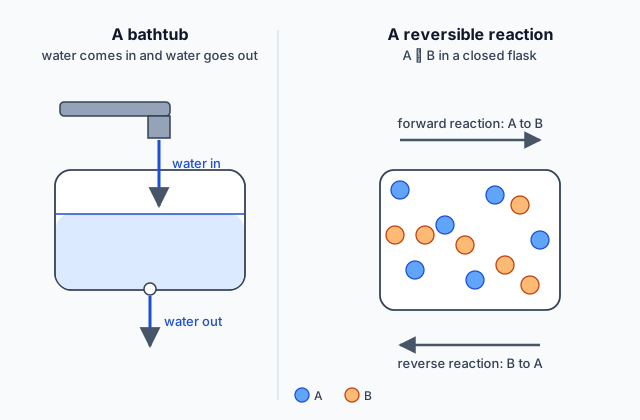 Tap to open the picture full size
Part 1 Think first A bathtub with the drain open
Commit to a guess first. Being wrong now makes the right idea stick better.
Predict first
A bathtub has its faucet running and its drain open. Sometimes the water in the tub rises, sometimes it falls, and sometimes it holds at one level while water keeps pouring in and draining out. What decides which of the three happens?
In short. A reversible reaction proceeds in the direction of the faster of its two reactions, and it reaches equilibrium when the forward and reverse rates are equal.
- If the forward rate is greater, reactants are converted to products overall. If the reverse rate is greater, products are converted to reactants overall.
- As the reaction proceeds, the larger rate falls and the smaller rate rises until the two are equal.
- At equilibrium the rates are equal and above zero, so there is no net change but both reactions continue.
Part 2 Learn it Which way does a reversible reaction go?
2a. Two rates, one net direction
A reversible reaction has two reactions going on at once. The forward reaction turns reactants into products at some rate. The reverse reaction turns products into reactants at its own rate. A rate here is how much reacts per liter each second, for example in M/s.
What the flask does overall depends on which rate is larger:
- Forward rate greater than reverse rate. More reactant is changed into product than product into reactant. There is a net conversion of reactants to products: reactant concentrations fall and product concentrations rise.
- Reverse rate greater than forward rate. There is a net conversion of products to reactants: product concentrations fall and reactant concentrations rise.
- Equal rates. There is no net change. This is the equilibrium state.
The bathtub is the same. What counts is the difference between the two flows, not how big either one is. Two fast flows that are equal change nothing, and two slow flows that are unequal change the level, slowly. The net rate of conversion is the forward rate minus the reverse rate.
Quick check · Sort it
Each card gives the rates of the forward and reverse reactions of a reversible reaction in a closed flask at one moment. Tap a card, then the bin that says what the flask is doing overall.
Net conversion of reactants to products
Net conversion of products to reactants
No net change
2b. How the two rates change as the reaction proceeds
Start a closed flask with only reactants. At the first instant the reverse rate is zero, because there are no products to react back. The forward rate is at its greatest, because the reactants are at their highest concentration. The net change is toward products.
As the reaction goes on, reactants are used up, so the forward rate falls. Products build up, so the reverse rate rises. The gap between the two rates shrinks, and the net conversion slows. When the rates become equal, the flask is at equilibrium.
Start with only products and the story runs the other way. The reverse rate is greatest at first and the forward rate is zero. The net change is toward reactants, the reverse rate falls and the forward rate rises, until they are equal.
On a graph of rate against time, the two curves start apart and move toward each other until they meet. After that they run together at one height above zero. At any time, the gap between the curves is the net conversion, and the curve that is higher is the reaction that is ahead.
Quick check · Fill the statement
A closed flask starts with only CO₂ and H₂, the products of CO(g) + H₂O(g) ⇌ CO₂(g) + H₂(g). Complete the description of what happens until equilibrium.
At first only the reaction can occur, so there is a net conversion of to . As the reaction goes on, the forward rate and the reverse rate , until the two rates are equal.
2c. Equal rates and what they show
An equilibrium state is reached when the rate of the forward reaction equals the rate of the reverse reaction. Then the net conversion is zero, so each concentration or partial pressure stops changing. Equal rates do not mean three things:
- The rates are zero. Both reactions still go on, each undoing the other's change.
- The concentrations are equal. Equal rates fit any ratio of products to reactants.
- The rates were always equal. They become equal only after they have moved toward each other.
You can also work backward from what you observe. If a product's concentration is rising, the forward rate is greater than the reverse rate. If it is falling, the reverse rate is greater. If it is constant, the two rates are equal. A concentration trend tells you which rate is larger, not how large either rate is.
Quick check · Spot the error
A student explains what equal forward and reverse rates mean for a reversible reaction in a closed flask. Tap the line with the mistake.
Part 3 Watch it done A flask that starts with reactants
Predict first, then watch each step, then finish the calculation yourself.
A closed flask at constant temperature holds only CO and H₂O when the reaction CO(g) + H₂O(g) ⇌ CO₂(g) + H₂(g) begins. At 0, 20, 40, 60 and 80 s the rate of the forward reaction is 8.0, 5.2, 3.8, 3.1 and 3.1, and the rate of the reverse reaction is 0.0, 1.9, 2.8, 3.1 and 3.1, all in units of 10⁻⁴ M/s. These numbers are a teaching example. Which way is the flask changing, and how fast, as time goes on?
Predict first
Before you open the first step, predict: at the instant the CO and H₂O are mixed, which reaction can occur?
Step 1 · Start at 0 s
The forward rate is 8.0 and the reverse rate is 0.0. There are no products yet, so only the forward reaction can occur. The net change is from reactants to products, at 8.0 − 0.0 = 8.0 × 10⁻⁴ M/s.
Step 2 · Compare the rates at 20 s
The forward rate is 5.2 and the reverse rate is 1.9. The forward rate is still greater, so the net change is still from reactants to products, but now at 5.2 − 1.9 = 3.3 × 10⁻⁴ M/s, much less than at the start.
Why this step?
Why does the gap between the two rates shrink as time goes on?
Reactants are being used up, so the forward rate falls, and products are building up, so the reverse rate rises. The two rates move toward each other, and the difference between them is the net change.
Step 3 · Find where the rates meet
At 60 s and again at 80 s the forward and reverse rates are both 3.1. They are equal, so the net change is zero and the flask is at equilibrium. Both rates are still above zero, so both reactions continue.
Your step · Calculate
Finish it. At 40 s the forward rate is 3.8 × 10⁻⁴ M/s and the reverse rate is 2.8 × 10⁻⁴ M/s. What is the net rate of conversion of reactants to products at 40 s, in units of 10⁻⁴ M/s? Give your answer to two significant figures.
× 10⁻⁴ M/s
The net rate fell from 8.0 to 3.3, to 1.0 and then to zero, because the larger rate fell and the smaller rate rose until they met. That is how a reaction moves toward equilibrium from the reactant side.
Part 4 Try it Sugar in a sealed jar
A student stirs sugar into a jar of water until a pile of sugar sits on the bottom, and then seals the jar. Over the next hour the pile slowly shrinks. For the rest of the day the pile stays the same size. Sugar dissolving off the pile is the forward process, and dissolved sugar crystallizing onto the pile is the reverse process.
Try it · Decide and justify
While the pile of sugar is shrinking, which of the two processes, dissolving or crystallizing, is faster?
Which reason supports your decision?
Back to reactions. Four flasks hold the same reversible reaction, each at its own moment.
Try it · Rank it
Four flasks hold the same reversible reaction at the same moment. The rate of the forward reaction and the rate of the reverse reaction, in 10⁻³ M/s, are: flask W, 7.5 and 2.0; flask X, 3.0 and 3.0; flask Y, 4.0 and 6.5; flask Z, 9.1 and 8.0. Rank the flasks by the net rate of conversion of reactants to products.
Greatest net conversion to products first
Give each one a place, 1 for first. Give two the same place if they are equal.
Your ranking: none yet
Part 5 Explain it Which way is the flask going?
On the exam this is handwritten, so answer on paper first. Nothing you type here leaves this page. Then check your answer against the model and each scoring point.
Free response is 50% of the exam score. This one is shaped like a short-answer question, which is worth 4 points.
Free-response practice · Short-answer style
A student mixes CO and H₂O in a closed flask at constant temperature: CO(g) + H₂O(g) ⇌ CO₂(g) + H₂(g). The rate of the forward reaction and the rate of the reverse reaction, in 10⁻⁴ M/s, are 6.4 and 0.8 at 5 s, 3.6 and 1.9 at 25 s, and 2.0 and 2.0 at 60 s. These numbers are a teaching example.
(a) Identify the direction of the net conversion at 5 s, and the comparison of rates that shows it.
(b) Calculate the net rate of conversion at 25 s, in units of 10⁻⁴ M/s.
(c) Explain why the forward rate falls and the reverse rate rises between 5 s and 60 s.
(d) Make a claim about whether the flask is at equilibrium at 60 s, and justify it with the rates.
Model answer
(a) Reactants are being converted to products, because the forward rate, 6.4, is greater than the reverse rate, 0.8.
(b) Net rate = forward rate − reverse rate = 3.6 − 1.9 = 1.7 × 10⁻⁴ M/s.
(c) The forward rate falls because CO and H₂O are being used up, so their concentrations drop. The reverse rate rises because CO₂ and H₂ are building up, so their concentrations rise.
(d) The flask is at equilibrium at 60 s. The forward and reverse rates are equal, 2.0 each, so there is no net conversion and the concentrations are constant, although both reactions continue.
Score your own answer. This is a self-check, not a grade. Tick each point your answer makes.
Part 6 Check yourself A flask that starts with products
All three case questions use the table.
A student seals only CO₂ and H₂ in a flask at constant temperature and follows CO(g) + H₂O(g) ⇌ CO₂(g) + H₂(g). The table gives the rates of the forward and reverse reactions. These numbers are a teaching example.
| Time (s) | Forward rate (× 10⁻⁴ M/s) | Reverse rate (× 10⁻⁴ M/s) |
|---|---|---|
| 0 | 0.0 | 9.0 |
| 10 | 0.9 | 6.1 |
| 20 | 1.7 | 4.4 |
| 30 | 2.4 | 3.5 |
| 40 | 2.8 | 3.1 |
| 50 | 3.0 | 3.0 |
| 60 | 3.0 | 3.0 |
Case question 1 · Multiple choice
Using the table: which statement describes the flask at 30 s?
Case question 2 · Select all
Using the table: which two statements are true? Select two.
Select 2 answers, then check.
Case question 3 · Decide and justify
Using the table: is the flask at equilibrium at 40 s?
Which evidence decides it?
The rest stand on their own and do not use the case.
Check yourself · Match
Match each observation about a closed flask to what it tells you about the rates of the forward and reverse reactions.
Check yourself · Sketch the graph
A different closed flask holds only NO₂ at the start, at constant temperature, and 2 NO₂(g) ⇌ N₂O₄(g) begins. The flask is close to equilibrium by the last time shown, but still creeping toward it. Sketch the rate of the reverse reaction against time. The first point is placed for you; drag the others so the graph shows how the reverse rate changes on the way to equilibrium.
One shape that fits
Drag a point up or down, or tap it and use the arrow keys. Only the shape is checked.
Part 7 Keep it Bring back earlier ideas
This lesson builds on the last one: both reactions keep going at equilibrium, and the rates move toward each other on the way there. Pulling them back up is what makes them last.
From 7.1 Introduction to Equilibrium · Decide and justify
The brown color of the sealed flask has not changed for an hour. Have the forward and reverse reactions stopped?
Which reason supports your decision?
A bottle of club soda holds water with CO₂ dissolved in it and a little CO₂ gas above the liquid: CO₂(g) ⇌ CO₂(aq). Gas dissolving is the forward process, and dissolved CO₂ leaving the liquid is the reverse process.
Now go back to the flask of N₂O₄ and think about how the system gets from the first moment to equilibrium.
From 7.1 Introduction to Equilibrium · Put it in order
Only N₂O₄ is placed in a sealed flask at constant temperature. Put what happens in order, from the moment the gas is sealed in.
In three lines
- A reversible reaction proceeds in the direction of the faster of its forward and reverse reactions: forward faster means net conversion of reactants to products, reverse faster means net conversion of products to reactants.
- As a reaction proceeds, the larger rate falls and the smaller rate rises until the two are equal.
- Equilibrium is reached when the rates are equal; they are above zero, so both reactions continue, and equal rates do not make the concentrations equal.
Exam strategy for this topic
- Section I, Multiple Choice: 60 questions in 90 minutes.
- Section II, Free Response: 7 questions in 105 minutes.
- A scientific or graphing calculator is recommended for use on both sections of the exam.
To say which way a reversible reaction is going, compare the forward and reverse rates at that moment and name the larger one. Then state the net conversion in words, from reactants to products or from products to reactants, and do not judge from one rate alone.
Questions students ask
How can you tell which way a reversible reaction is going?
Compare the rate of the forward reaction with the rate of the reverse reaction. If the forward rate is greater, reactants are converted to products overall. If the reverse rate is greater, products are converted to reactants overall.
When does a reversible reaction reach equilibrium?
When the rate of the forward reaction equals the rate of the reverse reaction. Then there is no net conversion in either direction.
Are the rates zero at equilibrium?
No. At equilibrium both rates are above zero and equal to each other, so both reactions continue with no net change.
What happens to the two rates as a reaction proceeds toward equilibrium?
The greater rate falls and the smaller rate rises until they are equal. A flask that starts with only reactants has its forward rate fall and its reverse rate rise.
Does a larger forward rate always mean the reaction is going forward?
Only if it is larger than the reverse rate at the same moment. A large forward rate beside a larger reverse rate gives a net conversion of products to reactants.
Course alignment, for teachers
AP Chemistry topic 7.2, Unit 7: Equilibrium.
- Skill 4.D: Explain the degree to which a model or representation describes the connection between particulate-level properties and macroscopic properties.
This lesson maps the one essential knowledge statement of the topic to the part that teaches each one: 1 is checked by a scored question. The map is in the lesson file.