Unit 7 · Topic 7.3 · about 30 minutes · 7 parts · 12 scored checks, 2 of them multiple choice, plus 2 from earlier lessons
AP Chemistry 7.3: Reaction Quotient and Equilibrium Constant
Unit 7: 7 to 9% of the multiple-choice section
What you'll be able to do
- Represent the reaction quotient Qc or Qp for a reversible reaction, and the equilibrium expressions Kc = Qc and Kp = Qp that it gives at equilibrium.
Key vocabulary
| Term | What it means | The exam trap |
|---|---|---|
| Reaction quotient (Q) | The concentrations or partial pressures of the products over those of the reactants, each raised to the power of its coefficient, which describes a mixture at any moment. | The expression comes from the balanced equation, so check that the equation is balanced before you write anything from it. |
| Equilibrium constant (K) | The value the reaction quotient has at equilibrium: Kc = Qc for concentrations and Kp = Qp for partial pressures. | K and Q are written the same way, so read whether a number describes a mixture at one moment or one at equilibrium before you name it. |
| Law of mass action | The rule that gives the form of the expression: products over reactants, each species raised to the power of its coefficient. | The rule is applied to a balanced equation, so a coefficient you change in the equation changes the expression. |
| Partial pressure (P) | The pressure one gas in a mixture would exert by itself, used in Qp and Kp in place of concentration. | Only a gas has a partial pressure, so look at the state of each species before you choose between Qc and Qp. |
| Pure solid or pure liquid | A substance that is a solid or a liquid on its own, not dissolved in anything and not mixed with other substances. | Look at the state of every species in the equation before you write the expression. |
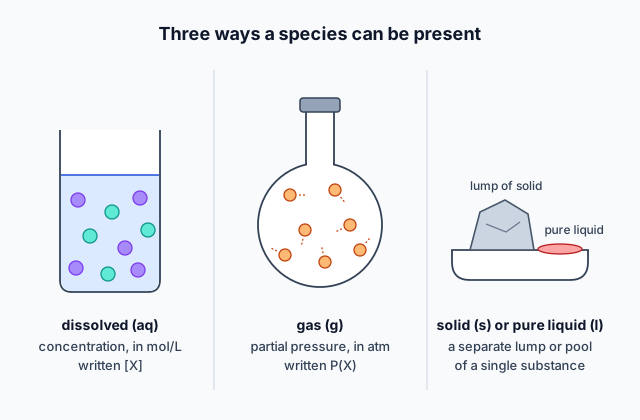 Tap to open the picture full size
Part 1 Think first Following one number
Commit to a guess first. Being wrong now makes the right idea stick better.
Predict first
A student seals pure N₂O₄ in a flask and watches N₂O₄(g) ⇌ 2 NO₂(g) at constant temperature. Every 10 seconds she measures both concentrations and divides the NO₂ concentration by the N₂O₄ concentration. She keeps going until the brown color stops changing. What does that number do over the whole time?
In short. The reaction quotient Q is the concentrations (Qc) or partial pressures (Qp) of the products over those of the reactants, each raised to the power of its coefficient, and at equilibrium Q equals the equilibrium constant K.
- Write products over reactants, and make each coefficient in the balanced equation the exponent of its species.
- Use Qc with concentrations in brackets, and Qp with partial pressures of gases. At equilibrium, Kc = Qc and Kp = Qp.
- Solids and pure liquids are left out of the expression, because their concentrations do not depend on how much of them there is.
Part 2 Learn it The reaction quotient and the equilibrium constant
2a. Writing Qc from a balanced equation
To follow a reversible reaction with one number, chemists use the reaction quotient, Q. It describes the relative concentrations of the reacting species at any moment. For the general reaction a A + b B ⇌ c C + d D, the quotient written with concentrations is
Qc = [C]ᶜ[D]ᵈ ÷ ([A]ᵃ[B]ᵇ)
Square brackets mean the concentration of a species in mol/L. The rules follow from the balanced equation:
- Products go in the numerator and reactants in the denominator.
- Each coefficient becomes an exponent on its species.
- The concentrations in each part are multiplied.
For N₂O₄(g) ⇌ 2 NO₂(g), the coefficient 2 on NO₂ makes it squared: Qc = [NO₂]² ÷ [N₂O₄]. This is the law of mass action. Q and K are written here without units.
Quick check · Multiple choice
Which expression is Qc for 2 SO₂(g) + O₂(g) ⇌ 2 SO₃(g)?
2b. Concentrations or partial pressures
For a reaction of gases, the amount of each gas can be given as a partial pressure in atm instead of a concentration. The quotient written with partial pressures is Qp, with P(X) for the partial pressure of X. For N₂O₄(g) ⇌ 2 NO₂(g):
Qp = P(NO₂)² ÷ P(N₂O₄)
The form is the same: products over reactants, each raised to its coefficient.
Qc and Qp for one reaction are different expressions, built from different quantities, and a question uses whichever one matches the numbers it gives. A dissolved species has a concentration but no partial pressure, so a reaction of dissolved species has only a Qc. Qp is for reactions that involve gases.
Quick check · Sort it
Each card describes an expression for a reaction. Tap a card, then the bin it belongs in.
Qc
Qp
Cannot be written for the reaction
2c. Q at any moment, K at equilibrium
Q changes as a reaction proceeds, because the concentrations change. The graph shows Qc = [NO₂]² ÷ [N₂O₄] for a flask that starts with pure N₂O₄. These numbers are a teaching example. Qc starts at zero, since there is no NO₂, climbs, and levels off at 0.360 once the color stops changing.
When the flask is at equilibrium, Q has reached its final value. That value is the equilibrium constant:
Kc = Qc for concentrations, and Kp = Qp for partial pressures.
K and Q have the same expression. The difference is when it is used: Q describes a mixture at any moment, and K is what Q equals at equilibrium.
Qc against time
Qc for a flask that starts with pure N₂O₄ (a teaching example)
Quick check · Select all
A flask of N₂O₄(g) ⇌ 2 NO₂(g) has reached equilibrium at constant temperature. Which two statements are true? Select two.
Select 2 answers, then check.
2d. Solids and pure liquids are left out
Some species are left out of the expression. A solid or a pure liquid has a concentration that does not depend on how much of it there is: a gram of solid calcium carbonate and a kilogram of it are equally dense. A value that does not change with the amount has no part in Q.
For CaCO₃(s) ⇌ CaO(s) + CO₂(g), both solids are left out, so Qc = [CO₂] and Qp = P(CO₂).
For Fe₂O₃(s) + 3 CO(g) ⇌ 2 Fe(s) + 3 CO₂(g), Qc = [CO₂]³ ÷ [CO]³.
Gases and dissolved species stay in. A solid or pure liquid still has to be present for the reaction to run; only its term is left out. To write any expression:
- Start from the balanced equation, with the state of each species.
- Leave out the solids and pure liquids.
- Put the products over the reactants.
- Make each coefficient the exponent of its species.
Quick check · Spot the error
A student writes Qc for Fe₂O₃(s) + 3 CO(g) ⇌ 2 Fe(s) + 3 CO₂(g). Tap the line with the mistake.
Part 3 Watch it done Working out Qc for one moment
Predict first, then watch each step, then finish the calculation yourself.
A flask holds the reaction 2 NO(g) + O₂(g) ⇌ 2 NO₂(g) at one moment, not at equilibrium. [NO] = 0.030 M, [O₂] = 0.045 M and [NO₂] = 0.060 M. These numbers are a teaching example. What is Qc?
Predict first
Before you open the first step, predict: will Qc come out much smaller than 1, near 1, or much larger than 1?
Step 1 · Write the expression from the equation
All three species are gases or dissolved, so none is left out. The product, NO₂, goes in the numerator, with its coefficient 2 as the exponent. The reactants, NO and O₂, go in the denominator: NO has the coefficient 2, and O₂ has the coefficient 1, which is not written. Qc = [NO₂]² ÷ ([NO]²[O₂]).
Why this step?
Why is each concentration raised to the power of its coefficient, and not multiplied by it?
The law of mass action builds Q so that each particle in the balanced equation counts once. A coefficient of 2 means two particles of that species take part, so its concentration enters twice in the product, which is a square.
Step 2 · Substitute the values
Put in each concentration: Qc = (0.060)² ÷ ((0.030)²(0.045)). The numerator is 0.0036 and the denominator is the product of 0.0009 and 0.045. Keep every digit until the last step, and give the answer to two significant figures, the same as the concentrations.
Your step · Calculate
Finish it. Evaluate Qc = [NO₂]² ÷ ([NO]²[O₂]) with [NO] = 0.030 M, [O₂] = 0.045 M and [NO₂] = 0.060 M. Give your answer to two significant figures.
Qc is much larger than 1 here because the product is squared on top, while the reactants are small numbers multiplied together below. Whether Q is large or small depends on the mixture, and the next topics use the value.
Part 4 Try it A flask from the last lesson
In the last lesson a rigid flask held N₂(g) + 3 H₂(g) ⇌ 2 NH₃(g) at constant temperature. It settled at equilibrium with N₂ at 0.640 atm, H₂ at 0.920 atm and NH₃ at 0.720 atm. These numbers, given here to three significant figures, are a teaching example.
Try it · Calculate
At equilibrium the flask holds N₂ at 0.640 atm, H₂ at 0.920 atm and NH₃ at 0.720 atm. What is Kp for N₂(g) + 3 H₂(g) ⇌ 2 NH₃(g)? Give your answer to three significant figures.
Twenty seconds into the same experiment, the flask was not yet at equilibrium.
Try it · Decide and justify
Earlier, at 20 s, the same flask held N₂ at 0.70 atm, H₂ at 1.10 atm and NH₃ at 0.60 atm. Kp for this reaction at this temperature is 1.04. Is Qp at 20 s equal to Kp?
Which reason supports your decision?
Part 5 Explain it Carbon and carbon dioxide
On the exam this is handwritten, so answer on paper first. Nothing you type here leaves this page. Then check your answer against the model and each scoring point.
Free response is 50% of the exam score. This one is shaped like a short-answer question, which is worth 4 points.
Free-response practice · Short-answer style
At 1000 K, solid carbon and carbon dioxide gas are in equilibrium in a closed container with carbon monoxide gas: C(s) + CO₂(g) ⇌ 2 CO(g). At equilibrium the partial pressure of CO is 0.60 atm and that of CO₂ is 0.20 atm. These numbers are a teaching example.
(a) Represent the expression for Qp for this reaction.
(b) Explain why carbon does not appear in the expression.
(c) Calculate the value of Kp, to two significant figures.
(d) Justify the statement that the value of Qp in this container equals Kp.
Model answer
(a) Qp = P(CO)² ÷ P(CO₂).
(b) Carbon is a solid. The concentration of a solid does not depend on how much of it there is, so it is left out of the expression.
(c) Kp = Qp = (0.60)² ÷ 0.20 = 0.36 ÷ 0.20 = 1.8.
(d) The container is at equilibrium, and at equilibrium the reaction quotient has reached its final value, which is the equilibrium constant, so Qp = Kp.
Score your own answer. This is a self-check, not a grade. Tick each point your answer makes.
Part 6 Check yourself Three flasks of calcium carbonate
All three case questions use the table.
A student heats CaCO₃(s) in three sealed flasks, X, Y and Z, to the same temperature. In each flask CaCO₃(s) ⇌ CaO(s) + CO₂(g) comes to equilibrium. The table gives the masses of the two solids and the partial pressure of CO₂. These numbers are a teaching example.
| Flask | Mass of CaCO₃(s) (g) | Mass of CaO(s) (g) | P(CO₂) (atm) |
|---|---|---|---|
| X | 10.0 | 2.0 | 0.236 |
| Y | 25.0 | 8.0 | 0.236 |
| Z | 4.0 | 15.0 | 0.236 |
Case question 1 · Calculate
Using the table: what is Kp for CaCO₃(s) ⇌ CaO(s) + CO₂(g) at this temperature? Give your answer to three significant figures.
Case question 2 · Decide and justify
Using the table: a student says that Kp depends on how much CaCO₃(s) is in the flask. Do the data support the claim?
Which reason supports your decision?
Case question 3 · Multiple choice
Using the table: which statement best explains why the three flasks give the same Kp although they hold different masses of solid?
The rest stand on their own and do not use the case.
Check yourself · Match
Match each reaction to its Qc expression.
Check yourself · Fill the statement
Bromine is a liquid at room temperature. Complete the description of Br₂(l) ⇌ Br₂(g) in a sealed flask.
Liquid bromine is a , so its concentration does not change with the amount of liquid, and it is the expression. For Br₂(l) ⇌ Br₂(g), Qp = .
Part 7 Keep it Bring back earlier ideas
This lesson uses two earlier ideas: concentrations in mol/L, and how the forward and reverse rates compare in a closed flask. Pulling them back up is what makes them last.
From 3.7 Solutions and Mixtures · Calculate
A student dissolves 29.2 g of sodium chloride, NaCl (molar mass 58.44 g/mol), in water and adds water to make 250.0 mL of solution. What is the molarity of the solution? Give your answer to three significant figures.
From 7.2 Direction of Reversible Reactions · Sort it
Each card gives the rates of the forward and reverse reactions of a reversible reaction in a closed flask at one moment. Tap a card, then the bin that says what the flask is doing overall.
Net conversion of reactants to products
Net conversion of products to reactants
No net change
In three lines
- The reaction quotient is products over reactants, each raised to the power of its coefficient: Qc with concentrations in brackets, Qp with partial pressures of gases.
- Solids and pure liquids are left out of the expression, because their concentrations do not depend on how much there is.
- Q can be worked out at any moment, and at equilibrium Kc = Qc and Kp = Qp.
Exam strategy for this topic
- Section I, Multiple Choice: 60 questions in 90 minutes.
- Section II, Free Response: 7 questions in 105 minutes.
- A scientific or graphing calculator is recommended for use on both sections of the exam.
Write the expression from the balanced equation: products over reactants, each raised to its coefficient, with solids and pure liquids left out. Use brackets for concentrations or P(X) for partial pressures, and read the state of each species before you write anything.
Questions students ask
What is the reaction quotient?
A ratio of the concentrations (Qc) or partial pressures (Qp) of the products to those of the reactants, each raised to the power of its coefficient. It describes a mixture at any moment of a reaction.
How do you write Qc from a balanced equation?
Put the concentrations of the products in the numerator and the reactants in the denominator, multiply those in each part, and raise each concentration to the power of its coefficient. Leave out solids and pure liquids.
What is the difference between Q and K?
Q can be worked out at any moment from the current concentrations or partial pressures. K is the value Q has at equilibrium: Kc = Qc and Kp = Qp.
Which species are left out of the expression?
Solids and pure liquids, because their concentrations do not depend on how much of them there is. Gases and dissolved species stay in.
When do you use Qp instead of Qc?
Use Qp when a question gives partial pressures of gases, and Qc when it gives concentrations. A reaction of dissolved species has only a Qc.
Beyond the AP Exam
College Board sets these limits on what the AP Exam asks about this topic. Anything past them is not on the exam.
Conversion between K_c and K_p will not be assessed on the AP Exam. Students should be aware of the conceptual differences and pay attention to whether K_c or K_p is used in an exam question.
Equilibrium calculations on systems where a dissolved species is in equilibrium with that species in the gas phase will not be assessed on the AP Exam.
Course alignment, for teachers
AP Chemistry topic 7.3, Unit 7: Equilibrium.
- Skill 3.A: Represent chemical phenomena using appropriate graphing techniques, including correct scale and units.
This lesson maps all 2 essential knowledge statements of the topic to the part that teaches each one: 2 are checked by a scored question. The map is in the lesson file.